

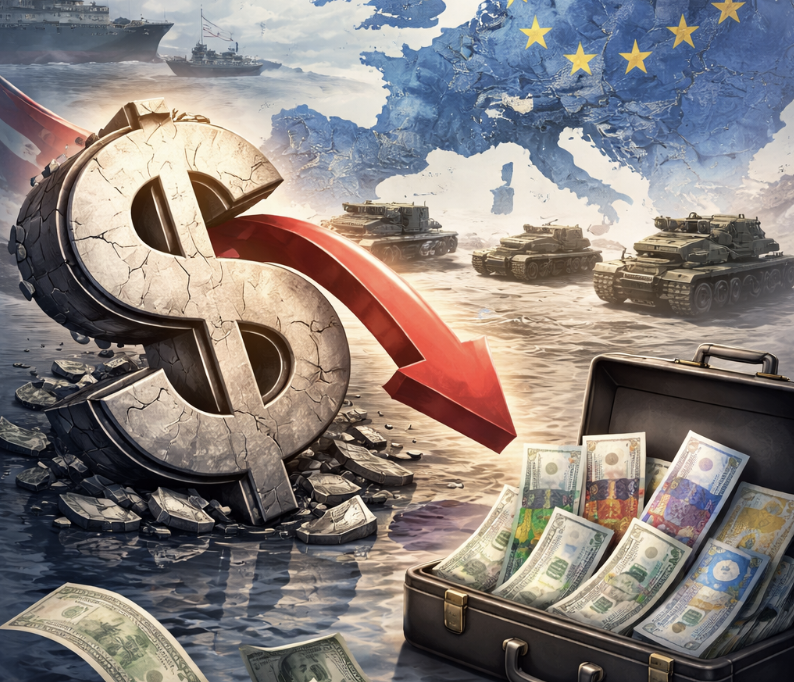
The US Dollar Just Fell And The Reason Is Clear
By ERIK BOJNANSKY, Money Digest
On January 20, 2026, after President Donald Trump announced he would hit eight European countries with new tariffs for not going along with his plans to annex Denmark’s autonomous territory of Greenland, the stock market plummeted along with the value of the U.S. dollar. Both recovered after Trump backed away from his tariff threats and finally clarified that he would not send in troops to occupy the land of another NATO country.
But the bounceback didn’t last long for the U.S. dollar. Days after Trump backed down at Davos, the dollar’s value still trended downward…
Summary
The U.S. dollar’s recent decline reflects growing global unease over U.S. policy under President Trump. While markets initially rebounded after Trump backed away from tariff threats and clarified he would not militarily seize Greenland, confidence in the dollar continued to erode. The underlying issue is uncertainty: investors no longer feel assured about U.S. trade policy, foreign relations, or the independence of the Federal Reserve.
Throughout 2025, the dollar lost roughly 9% against major global currencies. Concerns about Trump’s willingness to interfere with the Fed, combined with aggressive tariff policies, have pushed investors toward alternative currencies such as the Swiss franc, Swedish krona, and Mexican peso. Economic fundamentals have compounded the problem, including stagnant job growth and higher consumer prices driven by import tariffs.
While a weaker dollar can support U.S. manufacturing by making exports more competitive, that advantage is fragile. Retaliatory tariffs could erase those gains. European policymakers have openly discussed using the EU’s “Anti-Coercion Instrument,” a powerful trade mechanism designed to punish economic coercion, which could further undermine U.S. trade and capital flows.
More consequentially, Europe holds roughly $8 trillion in U.S. assets. Even modest rebalancing away from U.S. bonds and equities would weaken the dollar and complicate America’s ability to finance its $38 trillion debt. While investors are not rushing to abandon the U.S. outright, capital is quietly migrating toward jurisdictions seen as more predictable and rule-bound. Trust erodes this way—incrementally, through repeated shocks. Threatening economic coercion or territorial seizure of Greenland, an autonomous territory of a NATO ally, did real damage. The dollar’s decline reflects a growing skepticism about the reliability of U.S. governance itself—skepticism that recent events have only reinforced.

