

Ro Khanna Is Shaken by What He’s Learned From the Epstein Files
Ro Khanna’s congressional career has been an ongoing attempt to reconcile what others might see as irreconcilable. He represents a swath of Silicon Valley that includes the headquarters of Nvidia and Intel. He won his seat in 2016 with endorsements from tech titans like Sundar Pichai, Eric Schmidt and Marc Andreessen. He is, himself, one of the richest members of the House. But he is also a stalwart of the House Progressive Caucus, was the co-chair of the 2020 presidential campaign of Bernie Sanders and is backing a proposed wealth tax in California.
To Khanna, there was no contradiction here, just a single polity that had to be reminded of its common interests. “We have to make sure every American has a stake in the success of Silicon Valley, and that Silicon Valley doesn’t become an island unto itself,” he told me in 2019. “Or we’re going to see a rebellion against some of the forces that I think are good for society.” Now Khanna may have reached the end of what can be reconciled.
Summary
What the Epstein Files Actually Reveal
Roughly 3.5 million pages of emails, texts and court records have now been released, though the government says more than 6 million pages exist. The public has therefore seen only part of the total archive. Most notably absent are the full FBI survivor statements — the direct testimony identifying who victims say abused them. That missing material is widely viewed as the most consequential.
What the released files clarify is not so much the mechanics of specific crimes, but the structure of Jeffrey Epstein’s world: a dense, cross-industry, cross-ideological elite network held together by access, status and mutual advantage.
Epstein appears less as a financial mastermind than as a broker. He constantly offered introductions, curated dinners, proximity to power and — in some cases — access to women. He tailored his approach to each correspondent. For some, that meant meetings with heads of state or Nobel officials. For others, it meant access to billionaires, hedge fund capital or global institutions. The pattern is transactional and deliberate: Epstein studied what people valued and positioned himself as the gateway.
The files also show how his legitimacy was reinforced by association. His social circle cut across politics and business, including figures such as Noam Chomsky, Peter Thiel, Steve Bannon, Kathryn Ruemmler, Elon Musk, Larry Summers and Bill Gates. The ideological diversity is striking. This was not a partisan circle. It was a status network.
That breadth became self-reinforcing. If so many prominent figures were dining with him, traveling with him or emailing him, others inferred that whatever he had done could not be disqualifying. Even after his 2008 conviction for soliciting a minor, prominent individuals maintained contact. The files contain messages of sympathy, casual engagement and continued transactional interaction. The overall impression is not necessarily that everyone knew everything — but that many knew enough to pause and did not.
Financial institutions appear to have made similar calculations. Investigations into his banking relationships show internal concerns about suspicious transactions and trafficking risk. Yet Epstein’s ability to deliver wealthy clients and sovereign contacts helped override those red flags for years. His network value insulated him.
At the same time, the documents remain suggestive rather than conclusive. There are references to “secrets,” efforts to avoid written records and ambiguous exchanges. But the released material does not contain definitive proof tying specific individuals to criminal acts. That absence — especially without full victim testimony — is central to the continuing controversy.
What the Files Show About Donald Trump
The article includes several references to Donald Trump, though it does not present new documentary evidence of criminal involvement.
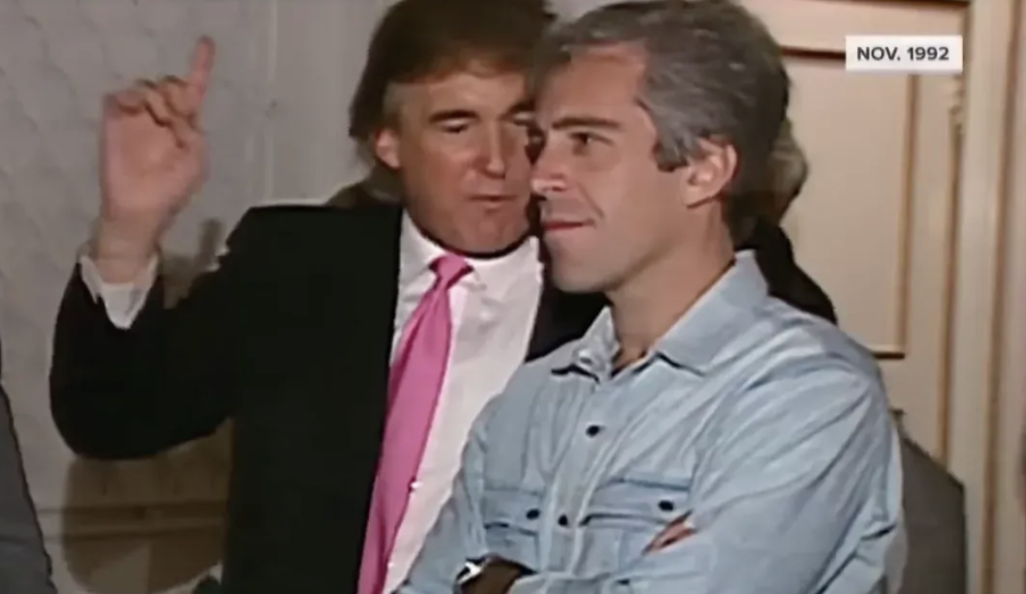
First, there is a 50th birthday note to Epstein that appears to be signed by Trump, containing the line: “May every day be another wonderful secret.” Trump denies writing the note. The files themselves do not conclusively establish its authenticity in the article’s account, but its language has drawn attention because of its reference to secrecy.
Second, the article recalls a 2002 quote Trump gave to New York magazine about Epstein: “I’ve known Jeff for fifteen years. Terrific guy… It is even said that he likes beautiful women as much as I do, and many of them are on the younger side.” This quote predates Epstein’s conviction and has long been part of the public record. It reflects awareness of Epstein’s reputation for younger women, though not necessarily knowledge of criminal conduct.
The article’s broader point is about elite tolerance rather than direct criminal linkage. It suggests that Epstein’s predilections were widely rumored and not hidden. The choice, for many in his orbit, was whether to distance themselves or to maintain association. Trump is presented as part of that broader elite environment in the early 2000s, not as uniquely singled out in the newly released material.
Importantly, based on what the article describes, the files do not contain direct evidence tying Trump to participation in Epstein’s crimes. The discussion centers on social proximity, public statements and the symbolic language of that birthday note — not on documented acts of abuse.
The Larger Pattern
The most powerful takeaway from the released documents is structural. Power in this world appears to be defined less by ideology or formal authority and more by density of connections. Access is currency. Cutting ties can be costly. Association confers legitimacy — even when warning signs are visible.
The files offer a window into a slice of the global elite that chose to associate with Epstein. They do not show everyone who refused him. But they do reveal how network culture can override character concerns, and how reputational insulation can persist long after red flags emerge.
What remains unknown — and perhaps most consequential — is what is contained in the unreleased pages and the full survivor testimony. Until that material is public, the picture remains incomplete: revealing about elite behavior, but not yet definitive about criminal accountability beyond Epstein and Ghislaine Maxwell.

