

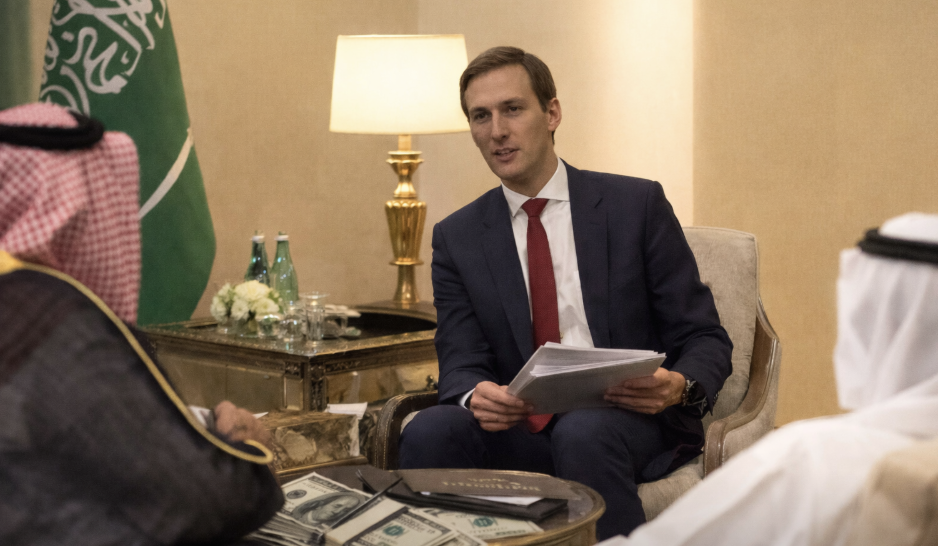
Jared Kushner, President Trump’s son-in-law, is playing a central role in major diplomatic negotiations — including talks involving Iran, Gaza, and Ukraine — while simultaneously running a private equity firm that collects billions of dollars from governments directly affected by those negotiations.
In late February (second article below), Kushner was representing the U.S. in talks with Iran while his investment firm was funded largely by sovereign wealth funds from Saudi Arabia, the United Arab Emirates, and Qatar. Because those governments have clear economic and geopolitical interests in the outcome of regional diplomacy, critics warned that Kushner’s financial ties created an obvious conflict of interest in decisions that could determine whether diplomacy succeeds or whether the United States moves closer to war.
According to the NY Times article (first article below), while acting as a key envoy for the Trump administration in the Middle East, Kushner has been seeking to raise an additional $5 billion from foreign governments with direct interests in U.S. policy decisions.
Mixing personal financial incentives with decisions involving sanctions, diplomacy, and potentially military conflict — decisions that affect millions of lives and can determine whether wars begin — is the kind of conflict the Constitution sought to prevent through safeguards such as the Emoluments Clause and federal conflict-of-interest laws. In this case, those protections have been sidestepped by classifying Kushner as a “volunteer” rather than a formal government official.
These articles show how closely Kushner’s diplomatic role and private financial interests now overlap.
Jared Kushner Solicits Funds for His Firm While Working as Mideast Envoy
President Trump’s son-in-law is trying to raise $5 billion or more from foreign governments and others for his private equity firm.
Rob Copeland and Maureen Farrell, NY Times
Jared Kushner, one of the U.S. government’s chief negotiators in the Middle East, is trying to raise more money for his private equity firm from governments in the region.
Mr. Kushner, President Trump’s son-in-law, has spoken with potential investors in recent weeks about raising $5 billion or more for Affinity Partners, his investment firm, according to five people with knowledge of the talks who were not permitted to speak publicly about the discussions.
As part of the fund-raising effort, Affinity’s representatives have already met with Saudi Arabia’s Public Investment Fund, which invests the proceeds of the kingdom’s vast oil reserves, two of the people briefed on the discussions said. PIF is led by Crown Prince Mohammed bin Salman, who has formed close ties with Mr. Kushner and the Trump administration.
Read also “Deeply conflicted, Kushner represents the U.S. in high-stakes negotiations with Iran”. Before Trump launched his war in Iran, U.S. diplomacy with the country was being led by Jared Kushner — a private investor with no diplomatic background and significant financial ties to foreign governments, including several aligned against Iran. That combination is a recipe for both diplomatic failure and self-dealing, and recent events suggest that is exactly what we are getting.
Deeply conflicted, Kushner represents the U.S. in high-stakes negotiations with Iran
By Judd Legum, Popular Information
Today in Geneva, Switzerland, Jared Kushner will represent the United States in meetings with Iranian officials — a last-ditch effort to avoid war. Kushner, however, has serious financial conflicts that could make reaching a deal more difficult.
Kushner has played a central role in all of the most important foreign policy negotiations during Trump’s second term. He has been at the table representing the United States in talks concerning the future of Gaza, the war in Ukraine, and now Iran.
Today’s meeting comes at a critical time. Trump has ordered a large military buildup and publicly said he is considering attacking Iran. It is not clear exactly what Trump wants from Iran, but his demands include new limitations on Iran’s nuclear program. (Notably, Trump claimed that his attack on Iran in June 2025 “completely obliterated Iran’s nuclear capability.”) According to reports, if Trump’s new demands are not met, a U.S. attack on Iran could come as soon as this weekend.

