

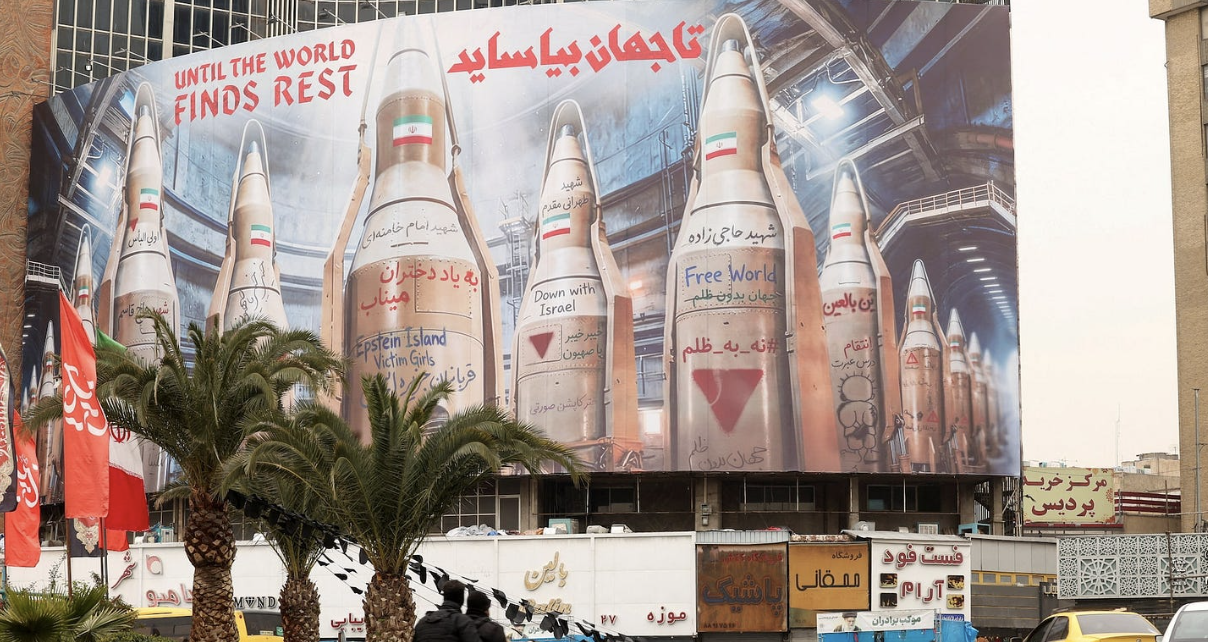
In a moment when most analysis of Iran is framed in terms of strategy, deterrence, and traditional geopolitics, Claire Berlinski takes a different approach—focusing instead on the ideas, theology, and historical narratives that shape how the Islamic Republic understands the world.
She has made this essay freely available, noting that limiting access would undercut its reach. It’s a dense piece at times, but well worth reading. The early sections outline the underlying religious and ideological framework, while the later portions connect those ideas more directly to current events and the regime’s behavior.
The Believers
The Islamic Republic, Khomeinism, and the End of History
Have a look at the photo above, a billboard recently spotted in Tehran. The red slogan in the center, :تا جهان بیاساید , is the Persian translation of the English words, “Until the world finds rest.”1 The missiles say:
- شهید امام خامنهای — “Martyr Imam Khamenei”
- به یاد دختران میناب — “In memory of the girls of Minab”
- شهید طهرانی مقدم — “Martyr Tehrani Moghaddam”
- شهید حاجیزاده — “Martyr Hajizadeh”
- شهید قاسم — “Martyr Qasem”
- جهان بدون ظلم — “A world without oppression/injustice”
- #نه_به_ظلم — “#No to oppression/injustice”
- انتقام — “Revenge”
- درس عبرت — “A lesson.” (Or “an object lesson” or “a warning”)
Note the themes of martyrdom, redemptive struggle against injustice, and the rectification at the end of history. These are a quintessentially Shiite triad. But the militarization of this triad is distinctively Khomeinist.
“UNTIL THE WORLD FINDS REST” are the most important words on the billboard, and they’re doing enormous theological work. They’re ominous enough on the face of it, but far more so in the context of revolutionary Shia eschatology. The world is restless because injustice reigns, and injustice reigns because the enemies of God and righteousness prevail. The world will only find rest when the Mahdi—the “Rightly Guided One”—returns at the end of history, vanquishing evil and ushering in Islamic rule. The billboard is, therefore, an exhortation to struggle in a conflict that is both cosmically necessary and inevitable. The current war, it suggests, belongs to a struggle that ends only with the eschatological consummation.
“A world without oppression/injustice” is another significant phrase. The Persian-Arabic word ظلم (zulm) is richer than the English word “oppression.” It denotes the state of the world under illegitimate rule, which it has been, or so Shiites believe, since the battle of Karbala in 680 CE—the pivotal confrontation in Islamic history, when the Umayyad army massacred Husayn ibn Ali and his small band of followers. The word zulm connotes tyranny, moral disorder, usurpation, things where they don’t belong.
In Shia history, the paradigmatic zulm is the usurper—the tyrant who rules against God’s moral order, who wrongs the Prophet’s family, and persecutes the just. Within this symbolic world, resistance to zulm is a sacred duty. The Islamic Republic uses this word to describe Israel, the United States, hostile Arab states, and internal dissidents. We are embodiments of zulm.

