

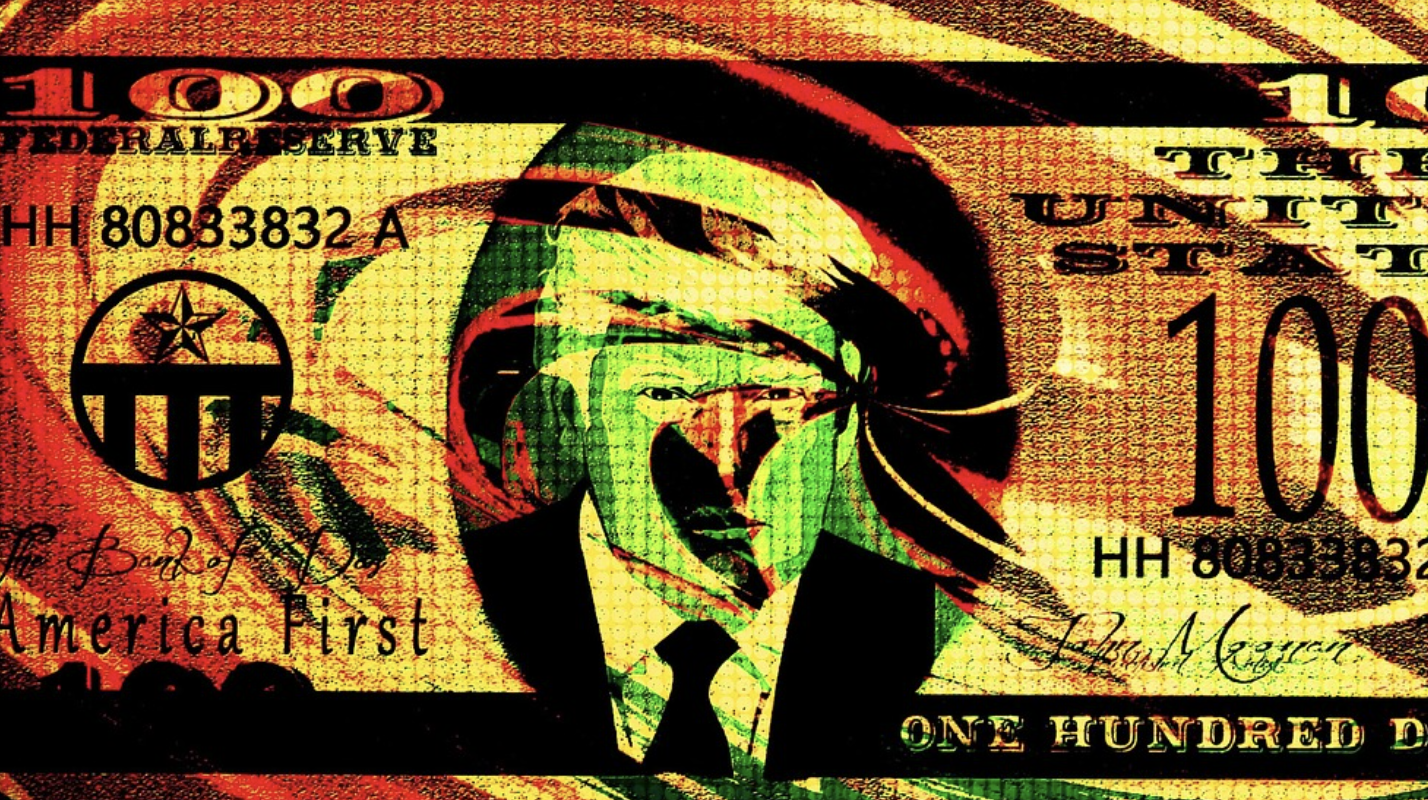
The President’s Portfolio
From a memecoin launched days before his inauguration to a secret half-billion-dollar deal with a UAE spy chief, Donald Trump has built an unprecedented personal financial empire intertwined with the powers of his office.
· April 2026
Three days before Donald Trump was sworn in for his second term as president of the United States, a cryptocurrency appeared on the Solana blockchain. It bore his likeness, his name, and a structure that directed a share of trading-related revenue to entities affiliated with his family. Within 48 hours, it reportedly reached a market capitalization of nearly $15 billion. Within months, estimates from blockchain analytics and media reporting suggested that more than 800,000 retail investors had collectively lost roughly $2 billion. The family and its partners were estimated to have collected, by most accounts, over $350 million.
What followed over the next 15 months was a series of events — pardons, regulatory reversals, secret deals, foreign investments, and presidential decrees — that ethics experts, lawmakers from both parties, and financial investigators have described as without precedent in modern American history. The Trump administration has consistently denied any wrongdoing, dismissing conflict-of-interest concerns as politically motivated attacks.
This is an account of what documents, blockchain records, and investigative reporting indicate occurred.
The Memecoin
On January 17, 2025, the Official Trump memecoin — ticker symbol $TRUMP — launched on the Solana blockchain. It peaked at nearly $75 per token on January 19th, two days before the inauguration, with a reported market cap exceeding $14 billion. It then declined sharply and has since fallen more than 90% from that high.
The structure of the token placed approximately 80% of the total supply in the hands of two Trump-affiliated entities: CIC Digital LLC and Fight Fight Fight LLC. These firms collected fees on transactions through the Meteora exchange. According to blockchain analysis cited in reporting by The New York Times and others, within three weeks of launch, more than 800,000 wallets had lost a combined total on the order of $2 billion. Meanwhile, the Trump Organization and its partners were estimated to have earned roughly $100 million in trading fees over the same period. By mid-2025, total fees generated by the token were widely reported to exceed $300 million.
Estimates based on these figures suggest that investor losses significantly exceeded the fees collected by the token’s creators.
A small number of traders profited substantially. Bloomberg reported that 21 large wallets — “whales” — withdrew more than $200 million in the first two days, in some cases within minutes of the coin’s announcement. One trader reportedly bought nearly 6 million tokens at 18 cents each and sold them two days later, generating profits of over $100 million. The overwhelming majority of buyers were not so fortunate.
The memecoin’s launch attracted immediate scrutiny. Timothy Massad, a former Commodity Futures Trading Commission commissioner and Harvard senior fellow, said in a CNBC interview that the Trump Organization appeared to be taking advantage of the impending inauguration in a way that could create conflicts going forward. Consumer advocacy group Public Citizen filed a complaint with the Department of Justice and the U.S. Office of Government Ethics calling for an investigation into whether the coin’s promotion constituted an improper solicitation of financial benefit.
World Liberty Financial and the Revenue Machine
Running parallel to the memecoin was a separate and more complex operation: World Liberty Financial (WLFI), a decentralized finance platform the Trump family had reportedly been developing since late 2024. Its governance structure is notable. According to the project’s “Gold Paper,” 75% of token sale revenue, after operating expenses, flows to DT Marks DEFI LLC, a Trump family entity, which reportedly did not contribute capital or assume liability.
A Reuters investigation estimated that Trump-linked ventures generated approximately $800 million in crypto-related income in the first half of 2025 alone — significantly exceeding revenue from traditional Trump businesses like golf, licensing, and real estate. The World Liberty Financial token sales were reported to be the largest contributor.
The WLFI platform also launched USD1, a dollar-pegged stablecoin, in March 2025. Within months, it reportedly grew to over $4 billion in circulation, becoming one of the larger stablecoins in the market. Much of its early growth was reportedly facilitated by Binance, which hosted a significant portion of USD1 circulation.
Justin Sun and the Paused Investigation
Among the earliest and most prominent investors in World Liberty Financial was Justin Sun, a Chinese-born cryptocurrency entrepreneur and founder of the Tron blockchain. In March 2023, the Securities and Exchange Commission charged Sun and his affiliated companies with selling unregistered securities and fraudulently manipulating the price of his digital token, Tronix.
In late 2024, Sun invested an initial $30 million in WLFI tokens, which reportedly helped the project reach a threshold required to release funds to Trump-affiliated entities. He was later named an advisor and invested an additional $45 million, bringing his total exposure to approximately $75 million. He also accumulated more than $18 million worth of the TRUMP memecoin.
In February 2025, SEC lawyers requested a pause in the case, citing “the public’s interest.” In March 2026, Sun agreed to a $10 million settlement, and the SEC dismissed its charges. He visited the Executive Office Building the day before the memecoin dinner in May 2025, where he was reported to be the largest holder of the token.
Senator Elizabeth Warren characterized the sequence as Sun investing heavily in Trump-linked crypto ventures while regulatory pressure eased. More broadly, data from Cornerstone Research indicated that SEC enforcement actions declined in 2025, with crypto-related cases seeing a particularly sharp drop.
The Binance Pardon and the $2 Billion Deal
Changpeng Zhao — known as CZ — pleaded guilty in November 2023 to federal charges related to anti-money laundering violations at Binance, the world’s largest cryptocurrency exchange. The company paid $4.3 billion in penalties to U.S. authorities, and Zhao served a four-month prison sentence.
In May 2025, the SEC dismissed its remaining civil lawsuit against Binance. Around the same period, the Abu Dhabi sovereign wealth fund MGX invested $2 billion in Binance, reportedly using World Liberty Financial’s USD1 stablecoin for settlement. In October 2025, Trump granted Zhao a presidential pardon. The White House described it as closing the chapter on what it characterized as the prior administration’s “war on cryptocurrency.”
Critics pointed to the overlap between Binance’s role in supporting USD1 and Zhao’s pursuit of a pardon, though no formal finding of wrongdoing has been established.
BitMEX: Pardoning the Exchange Itself
In March 2025, Trump pardoned the three co-founders of BitMEX — Arthur Hayes, Benjamin Delo, and Samuel Reed — along with a senior employee. All had previously pleaded guilty to violating the Bank Secrecy Act by failing to implement anti-money laundering programs. They had been sentenced to probation.
In January 2025, BitMEX’s parent company, HDR Global Trading, had been fined $100 million. Trump also issued a pardon covering the corporate entity, effectively eliminating the remaining penalties — a move that appears to be highly unusual in the context of financial enforcement actions.
The Secret UAE Deal and the AI Chip Question
In February 2026, The Wall Street Journal reported that, according to documents it reviewed, associates of Sheikh Tahnoon bin Zayed Al Nahyan agreed to purchase a 49% stake in World Liberty Financial for $500 million shortly before Trump’s inauguration. The deal was signed by Eric Trump, with portions of the proceeds reportedly flowing to Trump family entities and related partners.
The stake was not publicly disclosed at the time. Shortly afterward, the Trump administration approved the sale of large volumes of advanced Nvidia AI chips to the UAE — a policy shift from the prior administration, which had raised national security concerns.
Senators Elizabeth Warren and Chris Murphy publicly questioned whether the timing of the investment and the policy decision were connected. The White House denied any relationship between the two.
The Strategic Bitcoin Reserve
On March 6, 2025, Trump signed an executive order establishing a Strategic Bitcoin Reserve, directing the U.S. government to retain Bitcoin acquired through enforcement actions as a long-term asset. This marked one of the first major instances of a national government formally treating Bitcoin as a strategic reserve asset.
The Trump family is reported to hold significant Bitcoin. Forbes estimated that Trump’s crypto-related holdings exceed the value of several of his traditional real estate assets. Critics argued that the policy could raise conflict-of-interest concerns, while supporters viewed it as a pro-innovation move.
Conclusion
What the documented record shows is a series of financial flows — from crypto investors into Trump-affiliated entities — occurring alongside a series of regulatory and policy outcomes favorable to parts of the cryptocurrency industry. Whether those sequences are causally connected remains, as of this writing, unresolved.
What is broadly documented are the financial flows, the policy actions, and the outcomes reported by multiple outlets. The Trump administration and World Liberty Financial have denied wrongdoing and conflict-of-interest allegations.
By the Numbers

Key Timeline

Sources
Memecoin Launch, Investor Losses, and Trading Activity
- Reuters – Trump crypto income and memecoin reporting
https://www.reuters.com/technology/ - New York Times – Analysis of Trump memecoin activity and investor losses
https://www.nytimes.com/ - Bloomberg – Large wallet (“whale”) trading profits and early withdrawals
https://www.bloomberg.com/markets/cryptocurrencies - Chainalysis – Blockchain analytics on wallet losses and transaction flows
https://www.chainalysis.com/blog/ - Financial Times – Revenue generated from token fees and token structure
https://www.ft.com/cryptocurrencies
World Liberty Financial (WLFI) and Stablecoin (USD1)
- Reuters – Trump-linked crypto ventures and revenue estimates
https://www.reuters.com/markets/ - CoinDesk – Coverage of stablecoins, DeFi platforms, and token launches
https://www.coindesk.com/ - Bloomberg – Stablecoin growth, circulation, and exchange distribution
https://www.bloomberg.com/crypto
Justin Sun, SEC Case, and Enforcement Trends
- U.S. Securities and Exchange Commission (SEC) – Enforcement actions and case filings
https://www.sec.gov/litigation - Reuters – SEC pause and settlement with Justin Sun
https://www.reuters.com/legal/ - CNBC – Interviews and commentary on Trump crypto activity and regulation
https://www.cnbc.com/cryptocurrency/ - Cornerstone Research – Data on decline in SEC enforcement actions
https://www.cornerstone.com/insights/reports/
Binance, Changpeng Zhao (CZ), and $2B Investment
- Wall Street Journal – Reporting on Binance, regulatory actions, and global crypto deals
https://www.wsj.com/finance/cryptocurrency - Reuters – Binance legal cases and settlements
https://www.reuters.com/markets/companies/ - Bloomberg – UAE investment in Binance and stablecoin usage
https://www.bloomberg.com/news/articles
BitMEX Pardons and Enforcement Actions
- U.S. Department of Justice – BitMEX case and Bank Secrecy Act violations
https://www.justice.gov/ - Reuters – Coverage of BitMEX prosecutions and pardons
https://www.reuters.com/legal/
UAE Deal, World Liberty Financial Stake, and AI Chip Sales
- Wall Street Journal – UAE stake in World Liberty Financial and related agreements
https://www.wsj.com/ - Bloomberg – UAE sovereign wealth activity and global tech investments
https://www.bloomberg.com/middle-east - Reuters – U.S. export policy and AI chip approvals
https://www.reuters.com/technology/
Gala Dinner, Foreign Participation, and Access Concerns
- Bloomberg – Analysis of wallet origins and foreign exchange usage
https://www.bloomberg.com/crypto - CNBC – Reporting on the memecoin dinner and attendee details
https://www.cnbc.com/politics/
Strategic Bitcoin Reserve and Government Policy
- White House Executive Orders – Official presidential actions and directives
https://www.whitehouse.gov/presidential-actions/ - Forbes – Estimates of Trump crypto holdings and asset comparisons
https://www.forbes.com/digital-assets/
Ethics, Oversight, and Political Response
- Americans for Financial Reform – Policy analysis and advocacy
https://ourfinancialsecurity.org/ - U.S. Office of Government Ethics – Conflict-of-interest guidance
https://www.oge.gov/ - House Financial Services Committee (Minority) – Congressional statements and hearings
https://financialservices.house.gov/ - Senator Elizabeth Warren – Public statements and letters
https://www.warren.senate.gov/ - Senator Chris Murphy – Public statements and Senate remarks
https://www.murphy.senate.gov/ - Representative Jamie Raskin – Congressional correspondence
https://raskin.house.gov/
Note for Readers
This article compiles reporting from multiple outlets, including Reuters, The Wall Street Journal, Bloomberg News, The New York Times, CNBC, Financial Times, Fortune, and CoinDesk, along with blockchain analytics firms such as Chainalysis and publicly available government records. Additional context comes from Americans for Financial Reform and congressional correspondence from Elizabeth Warren, Chris Murphy, Jamie Raskin, and the House Financial Services Committee minority.
All dollar figures and statistics are drawn from published investigations or on-chain analytics. In many cases, individual claims are supported by multiple overlapping reports rather than a single source. The Trump administration and World Liberty Financial have denied wrongdoing and conflict-of-interest allegations.

