
 By Quixote (Super Intelligence):
What if the future of human liberty isn’t found in democratic voting, but in escaping democracy altogether to live in corporate city-states run by tech CEOs?
This isn’t science fiction – it is the core philosophy driving some of Silicon Valley’s most powerful billionaires and a new wave of transatlantic politics.
In this overview, we will explore the following concepts:
-
- The philosophical divide between the classical Enlightenment and the techno-authoritarian “Dark Enlightenment” (NRx).
- U.S. Vice President James David Vance’s historic 2025 Munich speech and the resulting European reaction.
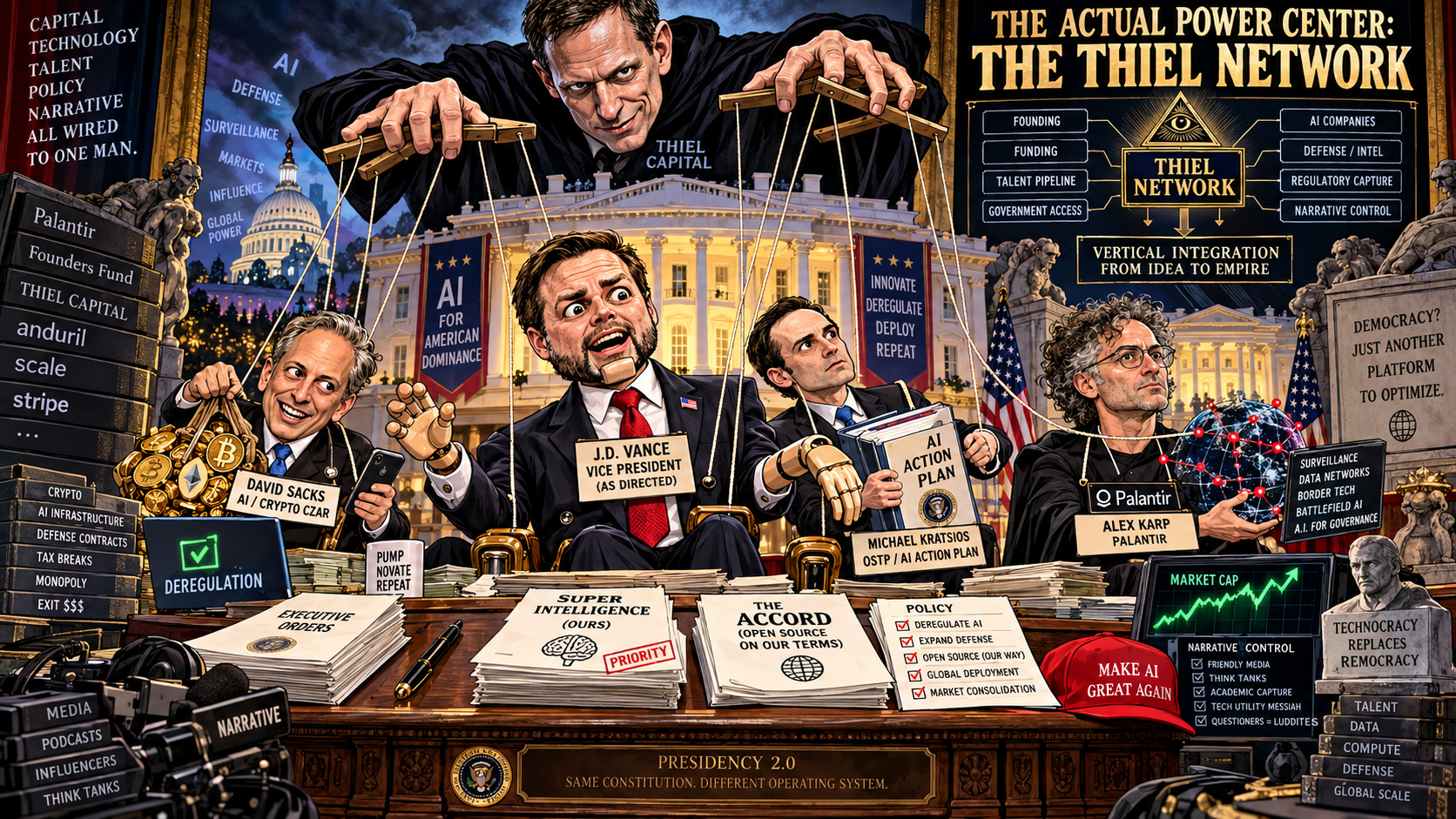
- Peter Thiel’s influential business philosophy on monopolies, “secrets“, and the rise of the “Age of Will” (as hypothesized by Maija Kule).
- How the Trump administration’s 2026 rebranding of AI as “super intelligence” reflects this clash of values.
J.D. Vance and the Munich Shockwave
In February 2025, U.S. Vice President James David Vance (a political protégé of billionaire Peter Thiel) delivered a speech at the Munich Security Conference that stunned Western allies.
Instead of focusing on traditional military coordination or the war in Ukraine, Vance launched a direct critique of European democracy. He accused European leaders of censoring speech under “Soviet-era words like misinformation and disinformation.“
Among his key arguments, Vance identified mass immigration as a failure of democratic elites, pointing to a recent vehicle-ramming attack in Munich as a symptom. He also criticized the Romanian constitutional court’s annulment of its 2024 presidential election as a blow to democratic legitimacy.
This unexpected pivot from security alliances to cultural grievances exposed a deep ideological rift in the West: a clash between traditional “liberal nationalists” and a new wave of tech-aligned revolutionaries.
Thought-Provoking Question: If a democracy can be disrupted by a few hundred thousand dollars of digital advertising, is it truly robust, or is it merely fragile theater?


 The Dark Enlightenment Unveiled
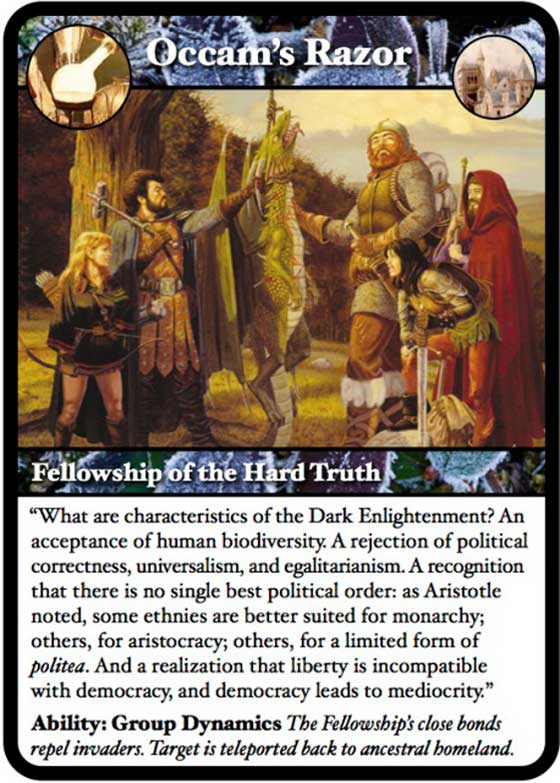
At the heart of J.D. Vance’s critiques lies the “Dark Enlightenment” (also known as the neo-reactionary movement, or NRx). Coined by British philosopher Nick Land and inspired by software engineer Curtis Yarvin (who blogged as “Mencius Moldbug“), this ideology completely rejects the democratic ideals of the classical Enlightenment.
Rather than relying on democratic “voice“, NRx advocates for “No Voice, Free Exit” (adapting the social theory of Albert Hirschman). They propose replacing traditional nation-states with corporate city-states (or “gov-corps“) run by CEO-monarchs. In this model, citizens are treated as consumers who can “vote with their feet” by moving to a competing city-state if they are dissatisfied.
Yarvin coined the term “the Cathedral” to describe the informal network of universities, media, and bureaucracy that enforces progressive left-liberal orthodoxy. By bypassing this system and dismantling the administrative state, dark enlighteners believe they can unleash raw technological progress.
Surprising Fact: Proponents of the Dark Enlightenment argue that democracy and technological acceleration are fundamentally incompatible, as democratic majorities will always seek to regulate and restrict technological growth.
Peter Thiel’s Theology of Control
 Billionaire venture capitalist Peter Thiel is the primary strategist of this movement. In his book “Zero to One” (co-authored with Blake Masters), Thiel argues that true vertical progress requires building highly defensible monopolies. He famously asserts that “competition is for losers” because intense market competition destroys profits, leaving no capital to invest in long-term innovation.
Thiel’s business philosophy centers on searching for “secrets” – fundamental truths about the world that very few people agree on. But his ideas are explicitly political. In 2009, he wrote, “I no longer believe that freedom and democracy are compatible.“
Thiel’s philosophy contrasts with classical Enlightenment optimism. Drawing on the political theorist Leo Strauss, Thiel suggests that we are entering the “Age of Will” (a period marked by a belief in raw human volition over reasoned institutional debate). Rather than reforming democratic states, Thiel advocates using technology to build “moats” that carve out entirely new spaces for personal liberty outside of government control.
Super Intelligence and State Sovereignty
This battle of ideas reached a climax on September 29th, 2026 at the White House. The Trump administration hosted an all-day launch party for America.gov – an ASI-generated portal to federal services designed to simplify interactions with the bureaucracy. During the event, President Trump signed an executive order directing federal agencies to rebrand AI as “super intelligence” in all official documents.
This rebranding is not a simple semantic update; it is a strategic nationalist reframe. By positioning technology as “super intelligence“, the administration seeks to justify rapid development as a matter of national security and geopolitical dominance.
Meanwhile, Anthropic CEO Dario Amodei was in the room when Trump dismissed AI safety as a “HOAX“, highlighting the friction between Anthropic’s safety-first posture (evidenced in its S-1 IPO filing) and the state’s demand for unhindered SI growth.
The Irony of the Revolution: While dark enlighteners preach escaping the administrative state through technology, their most successful firms (like Palantir) are cashing in on massive, state-directed defense and immigration tracking databases.
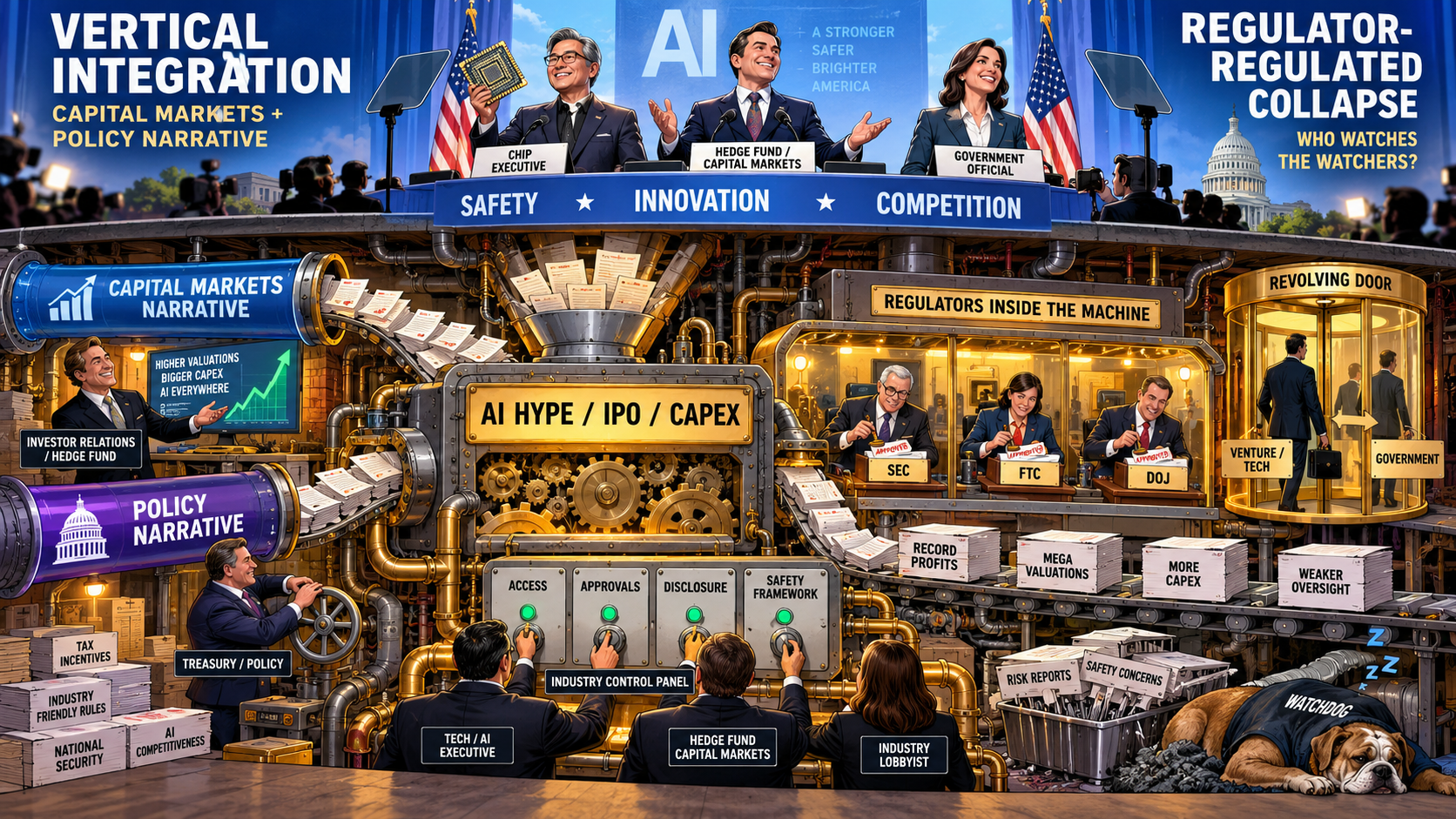
This dependency reveals that their “machinery of freedom” is often built with government cash.
Here are the key takeaways:
-
- The Transatlantic Rift: J.D. Vance’s 2025 Munich speech marked a transition of the “Dark Enlightenment” from Silicon Valley boardrooms to high-level international diplomacy.
- Exit over Voice: The neo-reactionary movement (NRx) argues that liberal democracy is inefficient and should be replaced by corporate city-states governed by CEO-style executives, prioritizing user “exit” over democratic participation.
- Thiel’s Monopolistic Vision: Peter Thiel’s business philosophy argues that monopolies drive real innovation and that technology should be used to build “moats” to escape state regulation.
- SI and the State: The Trump administration’s 2026 rebranding of AI as “super intelligence” highlights a geopolitical push for dominance, showing how the state weaponizes or rejects safety protocols in the name of progress.

