


A good strategy isn’t a hunch dressed up as a forecast. Market analysis for informed decisions means using evidence and insight, not relying on intuition alone. It helps you assess demand, supply, customer groups, competitors, and market conditions so you can spot opportunities and risks before deciding what to do next.
You can collect plenty of information and still be unsure what to do with it. Start with a clear objective: identify the decision you need to make, then focus your research on evidence that can help you make it.
This guide explains how to set an objective, examine customers and market conditions, compare competitors, and combine qualitative and quantitative evidence. You’ll also learn to turn findings into practical next steps and revisit decisions as conditions change. The aim isn’t to gather more data, but to get a clearer view of what to do next.
Key Takeaways
- Start with a clear decision to guide your research, then focus on evidence that can change what you do next.
- Track market trends alongside historical sales to build forecasts that reflect changing conditions.
- Segment customers by relevant needs and behaviors to better understand demand and where your offer fits.
- Compare competitors’ products, strategies, market position, and customer sentiment to spot gaps and risks.
- Combine qualitative feedback with quantitative data, turn findings into action, and revisit your assumptions as the market shifts.
What is a market analysis?
Market analysis examines the conditions that shape a business, including demand, competition, customer preferences, and external forces. Use the findings to inform a decision, such as revising a forecast or testing a product idea, rather than collecting data without a clear purpose.
-
Track market trends
Choose a few sources and review them consistently. Google Trends can show changes in search interest, while industry newsletters and conferences may reveal emerging themes. Compare these signals with historical sales data. A rise in searches is more meaningful when sales or customer inquiries move in the same direction.
Review your analysis regularly and when market conditions change. Shifts in customer behavior, the economy, or regulation can make earlier findings less useful. Don’t treat a single spike as a lasting trend. Record what changed, which source showed it, and whether other evidence supports the same interpretation.
-
Identify consumer trends
Look for recurring changes in what customers need, choose, and respond to. Compare purchase history, browsing behavior, engagement metrics, and direct feedback to see whether a shift appears across multiple signals. For example, more product-page visits without completed purchases may indicate interest, but they don’t prove demand is strong enough to support a launch.
Group observations by relevant customer characteristics and behavior, then compare segments instead of relying on one overall average. This can distinguish a broad preference from a niche one. When customer data informs your analysis, remember that the European Union and California Legislature identify GDPR and CCPA as regulations requiring transparency and accountability in collecting and using customer data.
-
Analyze trends and insights
Develop an explanation for each pattern before acting on it. Compare when the change occurred with sales, customer feedback, and external factors such as economic or cultural shifts. Historical sales can provide a starting point for a forecast, but state your assumptions, including whether recent demand reflects a lasting change or a temporary event.
Turn the analysis into an insight that informs a decision: what changed, which customers are affected, and what action could follow? Keep the model easy to explain. A complicated forecast can hide important assumptions, while a clear comparison of past sales and current demand makes the reasoning easier to question and refine.
-
Assess market growth and limitations
Analyze industry trends by comparing market size, growth, and external forces such as regulation and economic conditions. To assess growth, check whether demand is increasing, steady, or weakening, then consider whether supply and competition can meet it. Growth in a category alone doesn’t show that a particular product or business can capture that demand.
Market analysis has limits. Incomplete data, changing conditions, and forecast assumptions can distort conclusions. Reduce these risks by comparing sources and stating what evidence would change your decision. Revisit the analysis as conditions shift, and treat a forecast as a planning tool, not a guarantee of future sales.
Demand, supply, and customer segmentation
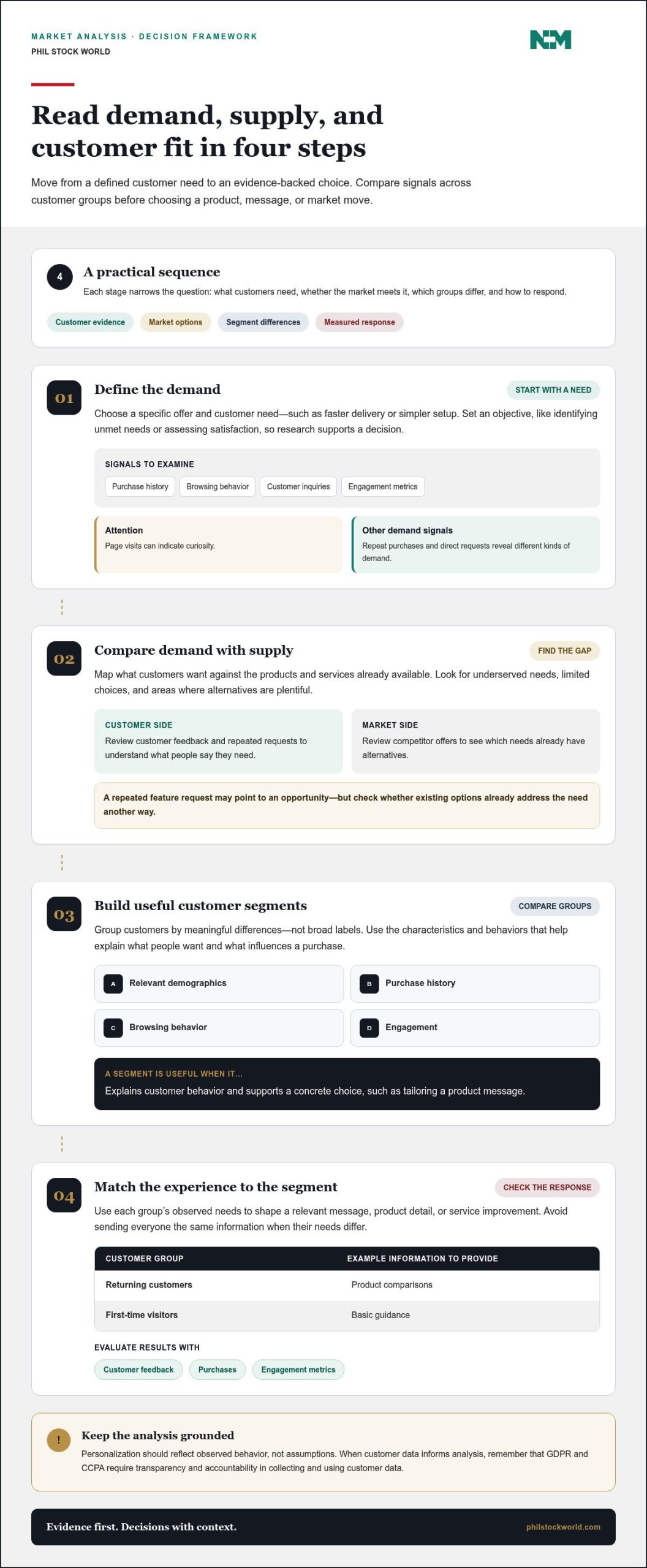
Use customer and operational evidence to understand who wants an offer, what they value, and whether supply can meet demand. Compare findings across customer segments before choosing a product, message, or market move.
- Define the demand you need to understand. Start with a specific offer and customer need, such as faster delivery or simpler setup. Look for evidence of interest in purchase history, browsing behavior, inquiries, and engagement metrics. Distinguish attention from intent: page visits can indicate curiosity, while repeat purchases and direct requests reveal other kinds of demand. Set a clear research objective, such as identifying unmet needs or assessing satisfaction, so your data answers a decision rather than becoming a pile of disconnected observations.
- Compare demand with available supply. Map what customers want against the products and services already available. Review customer feedback and competitor offers to find where choices seem limited, where alternatives are plentiful, and which needs remain underserved. Repeated requests for a feature may point to an opportunity, but check whether existing options already address the need in another way. A useful analysis considers both customer demand and the market’s ability to meet it.
- Build practical customer segments. Identify your target audience using relevant demographics, purchase history, browsing behavior, and engagement. Group customers by meaningful differences, such as the problem they’re solving, how they discover products, or what influences a purchase. Then compare needs and responses across groups. A segment is useful when it explains behavior and supports a concrete choice, such as tailoring a product message. Avoid broad labels that don’t clarify what customers want.
- Use segment insights to improve customer experience. Match each group’s needs with a relevant message, product detail, or service improvement. If returning customers respond to product comparisons while first-time visitors need basic guidance, provide information for each group instead of sending everyone the same message. Evaluate results through customer feedback, purchases, and engagement metrics. Personalization should reflect observed behavior, not assumptions. The goal is a more relevant experience that helps customers find a suitable option.
For a closer look at market evidence, explore market charts and analysis alongside your customer and supply findings.
Competitor products, share, strategy, and customer sentiment
Competitor analysis shows how your offer compares and how customers respond to alternatives. Use these steps to turn observations into useful insights that support your objectives.
- Set the competitive target. Define the customer, product category, and decision the analysis concerns. A business comparing entry-level software shouldn’t treat enterprise platforms as direct substitutes without explaining why. Identify the competitors customers actually consider, including alternatives that solve the same problem in a different way. This boundary keeps the comparison useful by focusing on products that compete for the same need, not a long list of familiar names.
Write down the question first. Are you assessing a feature gap, a pricing decision, or a new audience? The objective determines which competitors matter and what evidence to collect. Without that focus, the analysis can become a catalogue of competitors’ activity instead of a practical guide to your next move.
- Compare competitor products and positioning. Record the key features, customer benefits, and intended audiences of each relevant offer. A simple comparison may show that one product emphasizes convenience while another focuses on specialist functionality. Note how each company describes its value, then compare those claims with customer opinions and product details. Separate genuine differences from features that are common across the category.
Look for patterns, not isolated selling points. If several competitors highlight the same benefit, customers may consider it a basic expectation. If one alternative serves a need that others overlook, investigate whether that gap matters. Keep observations tied to your target customer: a feature advantage matters only if it solves a meaningful problem for that audience.
- Assess market share and strategy. Compare available market-share information with competitors’ product focus and business activity. Market share can help describe a company’s position, but it doesn’t explain how the company achieved it or whether that position matters to your target. Pair the figure with evidence about strategy, such as the customer groups a competitor serves and the benefits emphasized in its messaging.
Then consider what the comparison means for your decision. A prominent competitor may signal strong demand, intense competition, or both. A smaller rival may be attracting attention with a focused offer. Don’t treat a single snapshot as a lasting trend. Compare like-for-like information across sources and periods when available. The goal is to understand competitive dynamics, not simply rank companies.
- Include customer sentiment and decide what to do. Gather opinions about competing products through feedback, reviews, interviews, or customer-service themes. Sort comments by recurring topics, such as reliability, usability, or support. One complaint is an observation; repeated feedback from customers may indicate a broader concern worth investigating. Include positive comments too, since they show which benefits competitors deliver well.
Translate findings into a specific action: improve a product detail, clarify your message, or test whether an unmet need matters to your audience. Record the evidence behind the choice and what result would change your view. This final check grounds competitor analysis in customer needs, not imitation or assumptions about competitors’ actions.
Proactive business decisions
Use market evidence to choose a next move, define how to assess it, and adapt as conditions change. These steps turn findings into action.
- Set a decision and a measurable objective. Name the choice you’re considering, such as launching a product, adjusting a campaign, or entering a market. Then define what success would look like. A marketing team might aim to increase brand awareness, drive website traffic, or boost sales. Link the objective to a business priority so the evidence supports a decision rather than producing an interesting but unused report.
Before collecting more information, identify what evidence could change your mind. For a proposed product, that might include customer interest, competitor offers, and the investment needed to develop and promote it. Clear criteria make the final choice easier to explain and help teams act with focus.
- Translate findings into an action plan. Give each insight a practical response, an owner, and a review point. If customers show interest in a product feature, a team could test the message before committing to full development. If a campaign attracts website visits but misses its sales objective, adjust the audience or creative and compare the results.
Keep the action proportional to the evidence. A market signal may justify a focused test, while a major investment calls for deeper analysis. For example, a company considering an acquisition to enter a new market can research current conditions there before deciding whether that approach supports its objectives.
- Monitor the result and adjust. Track campaign performance and use current results to make changes. Compare each result with the objective you set, rather than treating activity alone as progress. If a marketing change aims to drive website traffic, assess whether traffic responds and whether the change advances the broader business goal.
Make the next action explicit: continue, revise, or stop the initiative based on the evidence. This decision loop helps a business respond before a small mismatch becomes a larger strategic problem. It also keeps teams focused on outcomes instead of defending an idea simply because they have already invested effort in it.
- Reassess decisions as the market shifts. Review past strategies, including those that once drove growth, against current customer needs and market conditions. A successful product or campaign can lose relevance as customer preferences, competition, or economic conditions change. Updating market research helps teams distinguish a lasting advantage from one tied to an earlier environment.
Build learning into the process: compare new evidence with the assumptions behind the original decision, gather feedback from affected teams, and refine your approach. Treat analysis as a continuing cycle, not a one-time approval step. This discipline can improve decisions, reveal when another direction makes more sense, and keep resources aligned with current opportunities.
Qualitative and quantitative methodologies
For market research in the United States, combine government statistics, industry reports, and online statistics tools with direct customer evidence. Use quantitative methods to measure patterns and qualitative methods to understand what may be driving them.
-
Apply quantitative methods
Use surveys, CRM data, social media analytics, or an A/B test to answer a clear question. For example, compare two landing-page versions to see which better supports your objective, or use survey responses to assess interest among your intended audience. Quantitative results help you evaluate patterns, but the question and sample must suit the decision you’re making.
Put results in context before acting. A campaign may attract clicks without showing purchase intent, while CRM activity can reveal how existing customers behave over time. Define the measure that matters, collect comparable data, and check whether the result holds across customer groups. Don’t treat a single metric as the whole story. Use it to spot opportunities, then investigate what the numbers can’t explain.
Keep the analysis easy to read. A complex model can bury the assumptions behind a result, while a clear comparison helps teams understand what changed and why. Record the method, the audience represented, and the decision the finding informs. That makes it easier to review the work later and see whether new evidence changes your view.
-
Select research tools and data sources
Choose sources based on your objective, not their volume or convenience. Industry reports, government statistics, and online statistics tools can establish market context; surveys, interviews, focus groups, and observation can add direct customer perspectives. Existing market reports provide secondary evidence, while customer interviews and surveys generate primary evidence for the question at hand.
Check whether each source covers the same market, customer group, and period you’re evaluating. A broad industry report may describe overall demand but miss a niche audience’s preferences. Pair it with customer feedback or CRM patterns to sharpen your understanding. Track where evidence comes from and what it measures so you don’t combine unlike sources into a misleading conclusion.
Make research continuous: revisit sources as conditions change, and refine your method when findings conflict. Surveys can show how common a response is; interviews can uncover the reasons behind it. Neither method answers every question. Combining them gives you a stronger basis for assessing customer needs, identifying opportunities, and choosing a course of action.
Use Market Charts and Analysis to add market context to your evidence review.
Phil Stock World: Premium Membership
Phil Stock World’s Premium Membership gives readers interested in stocks and options access to exclusive content, including top trades, market charts, and sector-specific insights. It’s a natural next step when you want ongoing market commentary to complement your own analysis, not replace your own decisions.
For a closer look at your holdings, a Virtual Portfolio Review offers another way to examine a portfolio. Educational Webinars can build your understanding, while Market Charts and Analysis help you follow market activity. Choose the resource that fits the question you’re considering, whether you’re interpreting a market move or deepening your strategy knowledge.
Visit Phil Stock World to explore its membership and educational resources.
Make your next decision a learning loop
The real advantage of Market analysis for informed decisions lies in what happens after you choose: observe the result, learn from it, and use new evidence to shape your next move. Treat each decision as a working hypothesis, not a verdict. This mindset keeps your strategy responsive without making every market shift a reason to change course.
If you want to keep developing your market perspective, Phil Stock World offers Premium Membership, Educational Webinars, and Virtual Portfolio Review. These resources can support ongoing learning and portfolio reflection as you develop your own approach. Choose the format that fits the question you’re exploring.
Contact Phil Stock World to explore the available resources and take your next step with confidence.
Frequently Asked Questions
What is market analysis and why is it important for informed business decisions?
Market analysis for informed decisions connects evidence about customers, competitors, and market conditions to a specific business choice. It helps a company assess whether an idea fits customer needs and whether the market can support it. Before expanding a service, for example, a team can assess who might use it, what alternatives are available, and what could make adoption difficult. That context makes decisions more deliberate and easier to explain.
What data and research methods are used in market analysis?
Market analysis combines existing information with evidence gathered directly from customers. Secondary sources include industry reports, government statistics, and online statistics tools. Primary research may involve surveys, interviews, focus groups, or observing customer behavior. A retailer exploring a new product category, for example, could compare industry data with customer interviews. Choose methods that fit the decision, and record how each source was collected and what it represents.
How do you identify target customers and estimate market size?
Identify target customers by describing the need your product serves, then defining the people or organizations most likely to have that need. Use relevant demographic details, purchase history, and customer feedback to refine the audience. To estimate market size, first define the geography and customer group, then use credible industry or government data to estimate how many potential buyers fit. Distinguish the total potential market from the portion your business can realistically reach.
How do you assess competitors and compare their pricing and offerings?
Assess competitors by comparing businesses that serve the same customer need, including alternatives that solve it differently. Review their products, features, positioning, and customer feedback. To compare prices, use publicly available prices for equivalent offers and note differences in features, service terms, or intended customers. A simple comparison table can show where an offer is distinct, where it meets category expectations, and where customers may see stronger value elsewhere.
How do supply, demand, and economic conditions affect market opportunities?
Demand indicates how strongly customers want an offer, while supply reflects how readily the market can provide it. If customer interest rises faster than available alternatives, an opportunity may emerge, but delivery constraints can limit its value. Economic shifts can also change purchasing priorities, operating costs, or access to resources. For example, a product customers consider optional may face weaker demand when household or business budgets tighten.
How do you evaluate market entry opportunities and forecast revenue?
To use market analysis for informed decisions about entering a market, assess customer demand, competitors, barriers, and the resources needed to serve it. Consider regulatory and economic barriers, and whether dominant competitors control important channels. When historical sales data is available, use it as a starting point for a revenue forecast, making assumptions about customer reach, purchasing behavior, and supply capacity explicit. Compare alternative scenarios and update them as actual results provide new evidence.