


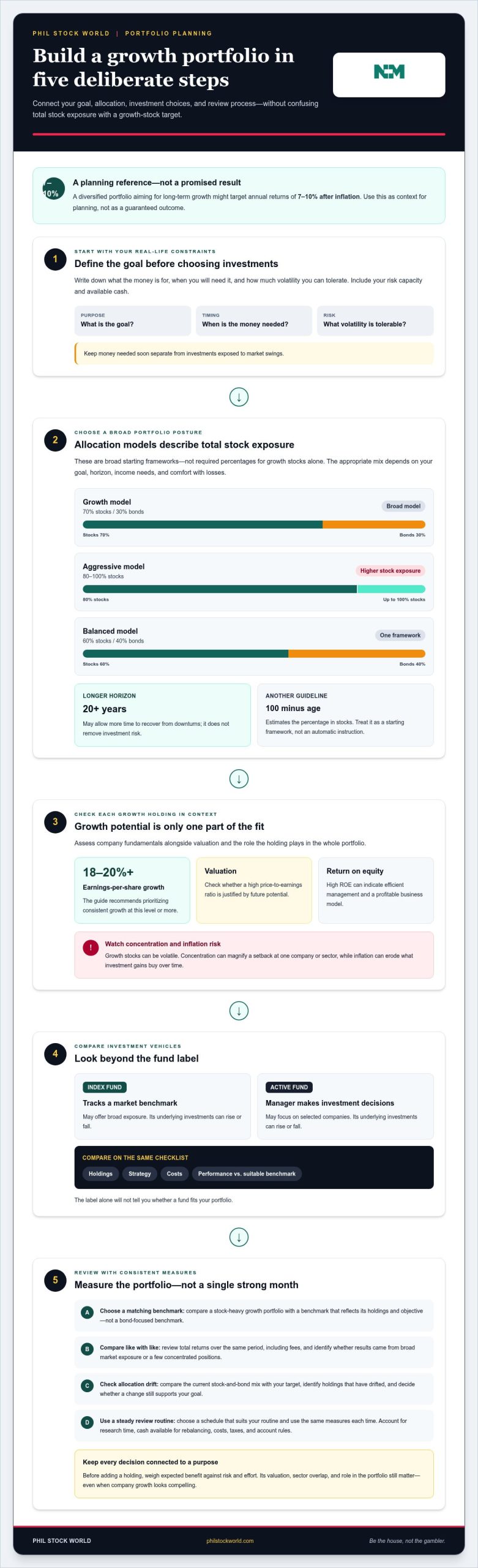
A growth portfolio model uses 70% stocks and 30% bonds, while an aggressive model holds 80-100% stocks; these are total stock allocations, not recommended percentages for growth stocks alone. Investors with a 20-year or longer time horizon may allocate more to stocks because they have more time to recover from downturns. There’s no single growth-stock slice that suits everyone. Portfolio optimization strategies for growth balance upside with diversification and the level of volatility you can live with.
It’s natural to focus on stocks with strong growth potential, but concentration can leave a portfolio exposed when a favored company or sector struggles. This guide explains how to weigh growth against diversification, set a practical risk plan, and understand the tradeoffs before putting a strategy into action. It starts with allocation choices, then covers resilience and common implementation challenges.
Key Takeaways
- Set a stock allocation that reflects your time horizon and comfort with downturns, then decide how much of that stock exposure belongs in growth companies.
- Look beyond individual holdings: diversification can help balance portfolio risk, while risk budgeting makes the sources of that risk easier to consider together.
- Review your plan as market conditions and your goals change, using clear performance measures to guide adjustments rather than reacting to every market swing.
- Before changing allocations, organize and validate your portfolio information so decisions rest on a reliable view of what you own.
- Put changes into practice gradually, learn from a pilot approach, and make roles and communication clear when several people contribute to portfolio decisions.
1. Balancing portfolio benefits, risks, and resources
Growth investing works best when expected gains fit your time horizon, risk capacity, and available cash. A diversified portfolio aiming for long-term growth might target annual returns of 7-10% after inflation. That’s a planning reference, not a promised result. Start by listing your goal, when you’ll need the money, and how much volatility you can tolerate. Then assess whether each holding helps meet that goal or simply adds another moving part.
Index funds generally track a market benchmark, while actively managed funds rely on a manager’s investment decisions and analysis. When comparing funds for growth investing, look at their holdings, strategy, costs, and performance against a suitable benchmark. The label alone won’t tell you whether a fund fits. An index fund may offer broad exposure; an active fund may focus on selected companies. Both can rise or fall with their underlying investments.
Allocation sets the portfolio’s basic risk posture. A growth model described in the guide holds 70% stocks and 30% bonds; an aggressive model holds 80-100% stocks. These are broad models, not a required growth-stock allocation. Investors with a 20-year or longer time horizon may have more time to recover from downturns, but a long horizon doesn’t remove risk. Keep money needed soon separate from investments exposed to market swings.
Growth stocks can be volatile, and concentration can magnify the effect of a setback at one company or sector. Inflation can also erode what investment gains buy over time. Compare a company’s earnings growth with its valuation: the guide recommends prioritizing consistent earnings-per-share growth of 18-20% or more and checking whether a high price-to-earnings ratio is justified by future potential. High return on equity can indicate efficient management and a profitable business model.
Fees, taxes, and account type all affect long-term growth in the United States. Fund and transaction costs reduce returns. Taxes may apply to investment income or realized gains, and account rules affect when taxes are due. Compare the costs and tax treatment of available accounts before choosing where to hold investments. Consider the account’s purpose and withdrawal timing alongside your investment choices.
Evaluate performance against a benchmark that matches your portfolio’s holdings and objective. Compare like with like: don’t judge a stock-heavy growth portfolio against a bond-focused benchmark. Review total returns over the same period, including fees, and consider whether results came from broad market exposure or a few concentrated positions. This gives you more useful information than a single strong month.
Resources include more than money. The time you can devote to research, cash available for rebalancing, and ability to follow a plan all shape how you put it into practice. Set a review schedule that suits your routine, and use the same measures each time. Compare your current stock-and-bond mix with your target, identify holdings that have drifted, and decide whether a change still supports your original goal.
Finally, weigh expected benefit against risk and effort before adding a holding. A company with 18-20%+ earnings-per-share growth may deserve analysis, but its valuation, sector overlap, and role in the portfolio still matter. A disciplined process connects each investment decision to a purpose, limits accidental concentration, and keeps the portfolio’s moving parts manageable.
2. Diversification and portfolio resilience
Diversification spreads exposure across investments that may respond differently to the same market conditions. Stocks can offer growth potential, while bonds may help balance a stock-heavy portfolio. The right mix depends on your goal, time horizon, and ability to withstand declines. No single asset class is best for every investor. The aim is to combine holdings with different risk drivers.
Mean-Variance Optimization, introduced by Harry Markowitz in 1952, formalized a key idea: consider risk and expected return across the portfolio, not one security at a time. In practice, two investments that look different may still move together. Compare their sectors, business models, and exposure to economic factors, then ask whether each holding adds a distinct role. A collection of stocks is not automatically diversified if one market theme dominates it.
A 60/40 allocation, meaning 60% stocks and 40% bonds, is one balanced portfolio model. The “100-minus-age” rule is another guideline, estimating the percentage allocated to stocks by subtracting an investor’s age from 100. Treat both as starting frameworks, not automatic instructions. Your income needs, investment horizon, and comfort with losses affect whether either mix makes sense.
Portfolio efficiency depends in part on how holdings work together. One study found that combining green and non-green stocks improved portfolio efficiency. It also found different performance patterns: green stocks had lower returns but greater efficiency in the short term, then outperformed non-green stocks in the long run with greater stability and profitability. The finding illustrates why diversification analysis should consider both returns and risk, rather than relying on a label.
Before adding another investment, map your existing exposure. Group holdings by asset class, sector, geography, and investment style, then look for overlaps. Several funds may own the same large companies, even if their names suggest different strategies. A new position adds value when it changes the portfolio’s overall exposure, not simply when it increases the number of holdings.
Rebalance on your chosen schedule or when allocations drift enough to change the portfolio’s intended risk. Calendar-based rebalancing is straightforward. Threshold-based rebalancing acts when a holding moves beyond a preset allocation range. Either method can help restore your target mix. When practical, direct new contributions toward underweight areas, which may reduce the need to sell appreciated holdings.
Track performance against a benchmark that reflects your portfolio’s mix and purpose. Review returns alongside concentration and each asset class’s contribution. If one sector drives most gains, the headline result may hide a fragile position. A written target allocation and consistent review process make diversification decisions easier to explain and repeat.
3. Reactive and proactive portfolio planning
Growth planning starts with a goal, not a market forecast. Define what the money is for, when you expect to use it, and what level of decline you can withstand without abandoning the plan. A time horizon of 20 years or longer can support a larger stock allocation, but the individual investor’s cash needs and response to volatility still matter. Write those decisions down before choosing investments.
Beginners can follow a repeatable sequence: set a goal and time horizon, choose a stock-and-bond allocation, select diversified investments, and schedule regular reviews. Record why you chose each holding, then check its role against your original plan before making changes. This routine can reduce impulse decisions prompted by market headlines and make it easier to adjust when your circumstances or goals change.
Proactive planning means deciding in advance what would trigger a review. A job change, a new savings goal, or a shift in a holding’s business outlook may warrant fresh analysis. Reactive planning responds to a sharp market move or an unexpected personal expense. Both approaches have a place, but written triggers help distinguish meaningful changes from ordinary price fluctuations.
Choose review intervals that fit your strategy. Organizational project portfolio guidance recommends updating portfolios quarterly and/or monthly, while monitoring performance against metrics established during planning. For individual investors, the useful principle is consistency: choose a review schedule, track allocation and progress toward your goal, and avoid changing course solely because markets are unsettled. Revisit the plan when a material change affects your time horizon, risk tolerance, or financial needs.
A strategic portfolio plan connects current choices with longer-term objectives. In organizational planning, it typically describes strategic intent through a vision statement, mission statement, and tactics for long-term goals. Investors can adapt the same approach: write down the portfolio’s purpose, define its role, and set practical rules for contributions and reviews. Each holding should support that purpose, not compete with it.
Budget and workforce planning belong to organizational project portfolios, not an individual’s stock allocation. In that setting, budget analysis can examine a 10-15% difference from the approved budget to assess workforce-reduction risks and potential benefits from hiring additional staff. The broader lesson for investors is to leave room for changing conditions: don’t commit every available dollar if future contributions, expenses, or goals may shift.
Planning also needs a response to change. Organizational portfolio optimization sessions are generally necessary when one or more components change, and lifecycle processes should adapt to shifting internal and external conditions. For an investor, a change in a company’s outlook or personal circumstances may prompt a review, not an automatic sale. Compare new information with the original investment case, then adjust only if the portfolio’s purpose or risk balance has materially changed.
A successful process is one you can follow in different markets. Keep a brief record of your goal, allocation, review date, and reasons for any adjustments. That record lets you compare each decision with the plan instead of starting over with a guess about what might happen next.
4. Hierarchical risk parity and risk budgeting
Hierarchical risk parity (HRP) organizes investments by how they move together, then allocates across those groups. Rather than treating every holding as an isolated decision, it uses a correlation structure to identify clusters of similar behavior. A broad-market stock fund and a technology fund, for example, may be more closely related to each other than either is to a bond fund. This map can reveal concentration hidden by a long list of holdings.
A practical HRP process has three stages. First, estimate how holdings have moved in relation to one another. Next, group investments with similar patterns and arrange the groups in a hierarchy. Finally, allocate capital across that hierarchy, considering how much risk each group contributes. The method can clarify relationships, but historical correlations may change as markets shift.
Risk budgeting adds a deliberate limit to this process. Instead of asking only how much money to allocate to each asset, decide how much portfolio risk each holding or group should contribute. A growth investor might assign a larger risk budget to diversified equities and a smaller one to a narrow sector position. The appropriate budget depends on the investor’s goals and tolerance for losses, not on a universal formula.
Consider a portfolio with a broad stock fund, a technology fund, and bonds. If the stock funds overlap heavily, their combined risk may be greater than their individual weights suggest. HRP can group the funds, while a risk budget can show whether that cluster dominates the portfolio. The investor can then reduce the overlap or redirect contributions toward another source of risk.
To use the approach thoughtfully, take these steps:
- List each holding and its role, such as broad equity exposure, sector exposure, or income.
- Review correlations and volatility over a consistent historical period.
- Group investments with similar behavior, then inspect the largest clusters.
- Set risk limits for each cluster and compare actual exposure with those limits.
- Revisit assumptions when holdings, goals, or market conditions change.
HRP is not a forecast. It organizes available data to make portfolio structure easier to see. Risk estimates still depend on the period selected, the holdings included, and how relationships behave under stress. Assets that seemed distinct in calm markets, for example, may become more closely linked during a broad selloff. Treat clustering as a decision aid, not a guarantee of protection.
Use risk budgeting in support of a growth objective, rather than letting an algorithm define growth for you. A portfolio can have balanced risk contributions yet still be too volatile for your needs. Check whether each allocation suits your time horizon and whether concentrated positions have a clear role. If a position doesn’t, reduce or replace it through a deliberate plan.
These tools add analytical structure, but complexity requires time and attention. Start with a small set of understandable holdings, document your risk limits, and compare the resulting allocation with your target. This turns HRP from a technical label into a repeatable portfolio decision process.
5. Portfolio strategy implementation challenges
Even a sound portfolio plan can falter during implementation. Common problems include stale data, unclear priorities, and changes made before their impact is understood. Keep one reliable record of holdings, target allocations, investment reasons, and review dates, and validate it before making a shift. If a growth fund already overlaps heavily with another holding, adding more may increase concentration instead of improving diversification.
Implementation works better through gradual improvement than a sweeping overhaul. Choose one practical change, such as directing new contributions toward an underweight asset, then track its effect against your written plan. Organizational portfolio guidance recommends piloting a new way of working with real projects and applying lessons as they emerge. Individual investors can use the same discipline: test a process with a limited change before applying it across the portfolio.
Useful metrics turn intentions into decisions. Track allocation, performance against a suitable benchmark, sector concentration, and whether each holding still serves its stated role. Choose these measures during planning, then review them consistently. Portfolio guidance recommends monitoring performance with metrics established during the planning phase, rather than inventing new scorecards after results arrive. This helps keep a temporary market swing from rewriting the strategy.
Before implementing a change, use this sequence:
- Gather current holdings and confirm each position’s purpose.
- Compare actual allocations with the written targets.
- Identify the specific issue, such as overlap, drift, or a changed investment case.
- Choose the smallest adjustment that addresses that issue.
- Record the decision and review its effect at the next scheduled check.
Communication matters when several people share portfolio decisions. In organizational project management, senior leaders are advised to establish formal channels between the PMO, portfolio owners, and business leaders, while clarifying roles and financial resources. For a household portfolio, agree on who gathers statements, who reviews proposed changes, and how decisions are recorded. A shared spreadsheet and scheduled review can help prevent conflicting instructions and overlooked holdings.
Keep the process adaptable. Portfolio guidance recommends updating project portfolios quarterly and/or monthly, and adjusting lifecycle processes as conditions change. For personal investing, choose a review rhythm you can sustain and revisit sooner if a goal, holding, or financial need changes materially. Frequent monitoring doesn’t have to mean frequent trading. The purpose is to notice relevant changes and respond deliberately.
If implementation feels tangled, review your portfolio strategy with a structured second look. A clear record of holdings, targets, and metrics makes that discussion more useful, and helps turn analysis into practical next steps.
Phil Stock World: Premium Membership
Phil Stock World’s Premium Membership gives growth-minded investors access to exclusive market commentary, trading ideas, charts, and analysis. Use these resources to follow market developments and consider how investment ideas relate to portfolio decisions. A Virtual Portfolio Review offers a focused way to examine your holdings and strategy. Educational Webinars can deepen your understanding of investing concepts, while Market Charts and Analysis support ongoing research.
These offerings support your learning and decision-making; they don’t replace direct asset management, brokerage services, or personalized financial planning. To explore Phil Stock World’s educational resources and market insights, visit the site.
Make your next portfolio decision a deliberate one
A portfolio doesn’t need constant reinvention. It needs a clear purpose, a process you can follow, and the discipline to revisit decisions when your circumstances or investment case changes. Strong portfolio optimization strategies for growth turn analysis into choices you can explain, then give those choices room to work instead of chasing every market move.
When you’re ready to take a fresh look at your approach, Phil Stock World’s Virtual Portfolio Review can help you examine your holdings. Educational Webinars and Premium Membership offer further learning and market insights. Use these resources to sharpen your questions and decide what deserves attention next. Your plan remains yours to shape.
Contact Phil Stock World to discuss your portfolio and explore a practical next step. Keep learning, stay intentional, and build with confidence.
Frequently Asked Questions
How much of my portfolio should be in growth stocks?
There’s no single growth-stock percentage that fits every investor. Portfolio optimization strategies for growth start with deciding how much of your overall portfolio to allocate to stocks, based on your time horizon and ability to handle losses. Then decide how much of that stock exposure to devote to growth companies. Someone saving for a distant goal may accept more stock risk than someone who expects to use the money soon. Make sure growth holdings don’t crowd out other needs.
What is Growth Investing?
Growth investing focuses on companies expected to expand earnings or revenue over time. Investors often assess business prospects, earnings trends, and whether a share price already reflects ambitious expectations. A company can grow quickly and still disappoint investors if results fall short of expectations or its valuation contracts. For example, compare a company’s earnings trajectory with the assumptions behind its market price instead of treating a popular growth story as proof of future performance.
What is a growth-focused investment portfolio?
A growth-focused portfolio seeks long-term capital appreciation, typically through meaningful exposure to stocks. Portfolio optimization strategies for growth help connect each holding to that objective while accounting for its role alongside other investments. An investor might, for instance, pair established businesses with newer growth companies rather than rely on a single theme. The portfolio’s purpose, not a particular fund name, defines its focus. Each holding should fit the investor’s time horizon.
How should a growth portfolio be diversified across stocks, bonds, and other assets?
Build diversification around distinct sources of risk, not a long list of holdings. Stocks can provide growth exposure, while bonds may serve a different role in the overall mix. Check whether funds share major holdings or depend on the same sector, since apparent variety can hide overlap. Add an asset only when it contributes a useful exposure or function, and consider how it may behave alongside existing investments as market conditions change.
What are sample growth portfolio allocations by age and risk tolerance?
Common reference models include a 70% stock, 30% bond growth allocation, an 80-100% stock aggressive model, and a 40/60 conservative model. A balanced model uses 60/40, while the “100-minus-age” rule estimates the stock share by subtracting age from 100. These are frameworks, not age-based prescriptions. Compare them with your time horizon, income needs, and comfort with declines before choosing an allocation.