


A portfolio review shouldn’t be a daily scorecard. Getting expert feedback on your stock portfolio can help you assess whether its performance, allocation, and risks still align with your goals. A full review once a year is a useful baseline, with another after a major life change. Between reviews, check-ins can range from monthly to quarterly, depending on your investing style and contribution habits.
It’s easy to focus on returns and miss what’s happening underneath: overlapping holdings, growing concentration in one sector, or a stock-heavy mix that no longer suits your timeline. A review doesn’t automatically mean making trades. Sometimes the most useful outcome is a clearer understanding of what you own and why.
This guide explains how to prepare for an expert review, compare performance with meaningful benchmarks, examine allocation and concentration, and identify risks that may be hiding in plain sight. You’ll also learn what information to organize so the feedback leads to practical next steps, not more market noise.
Key Takeaways
- Set a practical review rhythm: assess the full portfolio annually and revisit it after major life changes, without turning every market move into a reason to trade.
- Judge performance against your goals and comparable investments over a reasonable period, while accounting for fees, transaction costs, and inflation.
- Compare your actual asset mix with your target allocation and consider rebalancing when market moves shift the balance or your time horizon changes.
- Look beyond the number of holdings: examine overlap among funds and exposure to individual stocks, sectors, and regions to spot hidden concentration.
- Prepare a clear inventory of holdings, values, and intended roles so expert feedback can focus on the portfolio’s biggest risks and blind spots.
Assessing performance against goals and comparable investments
Review returns in light of your financial goals and comparable investments over a reasonable period. Investing involves risks, including the possible loss of principal, so strong performance alone doesn’t show that a portfolio is suitable.
- Bring every account into one view. List each investment, its current value, fees, and intended purpose. If your stocks are spread across accounts, create a master spreadsheet showing each holding and its value at the time of review. Include retirement accounts, taxable brokerage accounts, and employer plans. A consolidated view makes your overall allocation clearer and helps an expert spot duplicated exposure or an account that no longer serves its original purpose.
- Measure progress toward a specific goal. Compare your portfolio’s return with the amount and timeline your goal requires, then use comparable investments as context. A 30-year-old saving for retirement may reasonably carry a different risk profile than someone five years from drawing down a nest egg. Past performance doesn’t indicate future results, so use comparisons to assess progress, not to predict what comes next.
- Calculate returns consistently. Include dividends and purchase transaction fees; subtract sale fees when calculating actual gains or losses after selling. For example, a $2,000 stock investment that gains $500 in price and pays $120 in dividends earns a 31 percent total return over three years, with a 9.42 percent annualized return. Annualized returns help compare investments held for different periods. Consider inflation for long-held investments, since it reduces money’s purchasing power.
- Review costs alongside performance. Check fund expense ratios, account fees, and trading costs, because each can reduce returns over time. Monitor your 401(k), too: review its asset mix and whether investment options have changed.
- Clarify the review’s fee model and tax consequences. Fee-only advisors are compensated through client fees, while commission-based advisors receive compensation tied to transactions. Ask how the arrangement affects recommendations. Review fees depend on scope and charging method, such as time, assets reviewed, or depth of analysis. Selling holdings can realize capital gains or losses, with tax effects depending on the investment and your circumstances. A tax professional can help assess those implications.
- Ask about relevant credentials and experience. Look for a CFP® professional or CFA charterholder, then ask about their experience evaluating portfolios like yours. Request a clear explanation of how the reviewer assesses performance, fees, allocation, and risk. A structured review should answer specific questions and leave you with a practical record of each holding’s role, not just a verdict on recent returns.
Asset allocation, time horizon, and risk tolerance
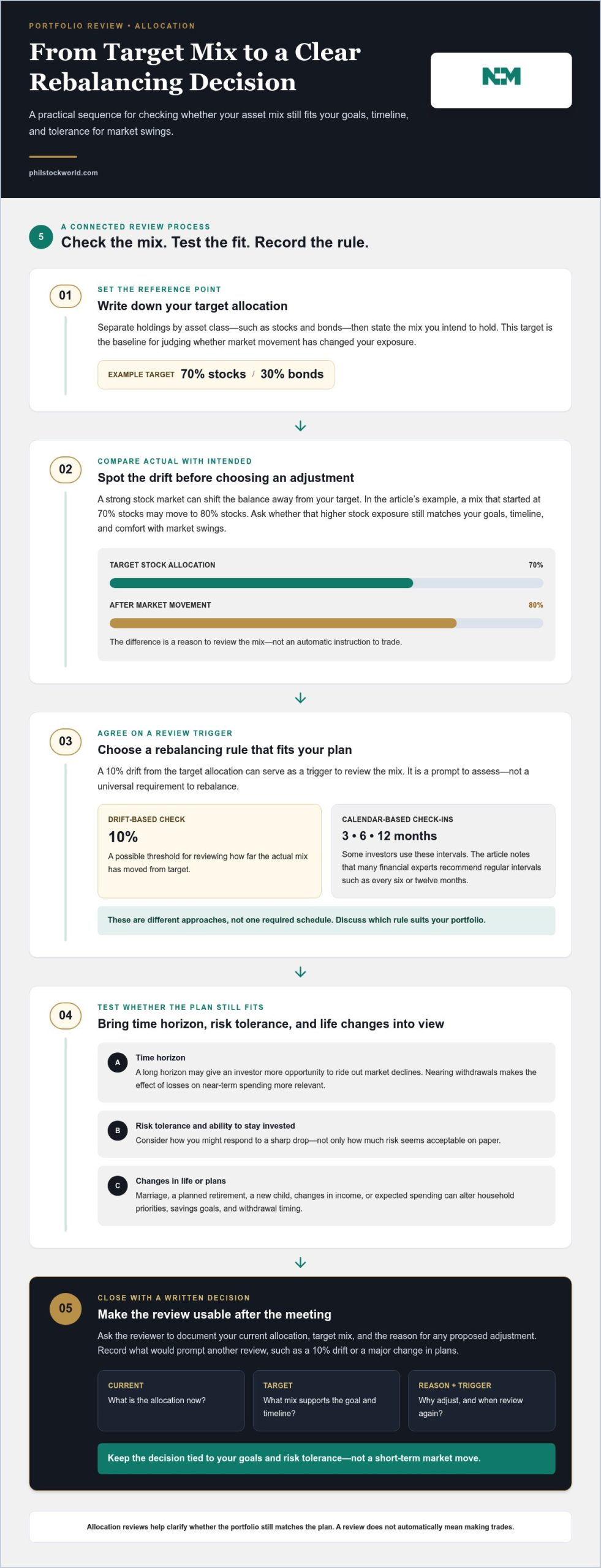
- Write down your target allocation. Separate your holdings by asset class, such as stocks and bonds, then compare the current mix with your intended mix. For example, a portfolio targeting 70% stocks and 30% bonds may shift after a strong stock market. If stocks rise to 80%, the portfolio carries more stock exposure than planned. Ask an expert whether that change still suits your goals, timeline, and tolerance for market swings before deciding what to adjust.
- Set a clear rebalancing rule. A 10% drift from a target allocation can serve as a trigger to review the mix. Some investors rebalance every 3, 6, or 12 months; according to Investor.gov, many financial experts recommend regular intervals such as every six or twelve months. These are different approaches, not a single required schedule. Discuss which rule fits your portfolio, and whether contributions or withdrawals can help restore the target without selling holdings.
- Match risk to the time you have. A long time horizon can give investors more opportunity to ride out market declines. Someone approaching withdrawals may need to consider how losses could affect near-term spending. Risk tolerance matters too: think about how you might respond to a sharp drop, not just how much risk seems acceptable on paper. Ask an expert to relate your allocation to both your goal date and your ability to stay invested through volatility.
- Revisit the plan after life changes. Marriage may prompt a couple to assess their allocation together rather than as separate investors. A planned retirement can make income needs and withdrawal timing more central. A new child may change household priorities and savings goals. Include these changes in the review, along with any change in income or expected spending, so your targets reflect the life you’re planning for, not an outdated snapshot.
- Turn the review into a written decision. Ask the reviewer to show your current allocation, target mix, and the reason for any proposed adjustment. Record what would trigger another review, such as a 10% drift or a major change in plans. If you want an outside perspective on your holdings and allocation, explore portfolio allocation feedback as part of your review process. Keep the final decision tied to your goals and risk tolerance, not a short-term market move.
Concentration in individual stocks and sectors
Review holdings by company and industry, not just by account. Investor.gov says a stock portfolio with only four or five individual stocks isn’t diversified.
-
Review Individual Stock Concentration
List each individual stock and its share of your total portfolio. Then check whether one company, including your employer, has become a dominant exposure. Investor.gov’s four-or-five-stock example is a reminder not to assume that a short list of companies provides diversification. Ask an expert to explain how each position affects the overall balance and whether its size fits its intended role.
Check exposure across every account, including employer stock awards. A new job may add more shares of your employer, increasing your dependence on one company while your income also relies on that business. Note any vesting awards alongside shares you bought yourself. For each holding, record why you own it, what could change your view, and what would make you reduce it. This turns a vague concern into a question you can review.
-
Review Sector Concentration
Group holdings by sector and look for industries that recur across individual stocks and funds. Different company names can still leave a portfolio exposed to the same business cycle. For example, owning a technology stock directly and through a fund may increase your technology exposure beyond what the account list suggests. Ask the reviewer to assess combined exposure, not just count securities.
Compare each sector’s role with your investment purpose and risk tolerance. Note whether a large position reflects a deliberate view or simply strong past performance. A market rise can quietly change the balance; Investor.gov’s example shows a portfolio’s stock allocation moving from 60% to 80% after a stock market rise. That example concerns asset allocation, but the same review habit helps uncover unintended concentration in a sector or company.
- Look through funds for overlap. List the largest underlying holdings in each fund, then mark companies that appear more than once. A fund’s label alone doesn’t show how much exposure it shares with your individual stocks or other funds. Ask for an explanation of the overlap and its effect on your portfolio’s intended balance. This is a practical learning exercise, not a guarantee against losses.
- Separate intended exposure from drift. For each company and sector, note whether its current weight reflects a deliberate choice, employer awards, fund overlap, or price changes. Compare the result with your original reason for holding it. If the position has grown beyond its intended role, discuss possible responses, including holding, trimming, or redirecting future contributions.
- Turn findings into review questions. Ask which single holding could have the biggest effect on the portfolio, which sector accounts for the largest combined exposure, and what evidence would change the analysis. Record the answers alongside each position. Diversification can reduce dependence on one company or industry, but it doesn’t guarantee gains or prevent losses.
Diversification across assets, industries, and regions
An expert assesses diversification by mapping what a portfolio owns across asset classes, industries, and regions. They also examine overlapping holdings, since different funds can share exposure to the same companies.
- Map holdings by asset class. Separate stocks, bonds, and cash equivalents across all accounts, then compare their roles. A stock fund and individual shares both belong in the stock portion, even when held in different accounts. Ask what each asset is intended to do, such as pursue growth, provide income, or support near-term spending. This overview helps an expert assess whether the mix suits your purposes and financial situation.
- Look through funds to their underlying investments. Record major holdings within each fund and flag companies that appear more than once. For example, a broad-market fund may hold a company you also own directly. The fund names may sound different, but the overlapping exposure still affects the portfolio. Ask the reviewer to explain how much your portfolio depends on the same companies and whether that concentration is intentional.
- Compare industry exposure across the full portfolio. Group each stock and fund holding by industry, then note where exposure accumulates. A technology stock held directly and through multiple funds can create a larger technology position than a quick account-by-account scan suggests. Ask the expert to distinguish deliberate exposure from unintended overlap. The goal is to understand how industry-specific news could affect several holdings at once.
- Check regional exposure. Identify whether investments focus on the United States, international markets, or both. Review underlying holdings rather than relying only on a fund’s name or label. A fund with “international” in its title may still hold a concentrated set of markets or companies. Ask how currency movements, local economic conditions, and regional market patterns may affect the role of these holdings alongside domestic investments.
- Test diversification against your purposes. Ask the reviewer to explain which risks each asset, industry, or region may help balance, and where exposures may still move together. Diversification can spread exposure, but it doesn’t guarantee gains or prevent losses. For a long-term goal, discuss how inflation may reduce purchasing power and how the portfolio mix relates to that goal. Finish by documenting gaps, overlaps, and questions for your next review.
Identifying portfolio risks
Map the risks that could disrupt your goals, then decide which need closer attention. Investing involves risks, including the possible loss of principal.
- Check whether market moves changed your exposure. Compare your current stock allocation with your intended target, rather than relying on the mix you originally chose. Investor.gov illustrates a portfolio intended to hold 60% stocks drifting to 80% after a stock market rise. That shift means more of the portfolio depends on stocks. Identify what changed, then discuss whether the new balance still fits your time horizon and risk tolerance.
- Stress-test your largest positions. Consider how a sharp decline in one company or industry could affect your total holdings. An oversized employer-stock position can create linked risks: the same business may affect both your investment value and employment income. Note which positions would have the greatest impact in a difficult scenario. Use that list to discuss whether concentration is intentional or has accumulated over time.
- Match withdrawal needs to investment risk. List planned expenses and the timing of withdrawals, especially near retirement. If you expect to draw from your portfolio soon, a market decline could force you to sell when prices are lower. Ask how cash needs, income sources, and withdrawal timing affect your exposure. The aim is to identify where your plan has little room to absorb losses, not to predict the next market move.
- Include life and estate considerations. Review whether marriage, a new child, a retirement date, or a change in household income alters the consequences of a loss. Estate documents and intended beneficiaries also shape what your assets are meant to support. Bring these details into the risk discussion, then identify which holdings or account decisions relate directly to those purposes. Keep investment decisions aligned with your actual plans, not outdated assumptions.
- Turn risk findings into review triggers. Write down the risk, the evidence you’ll monitor, and the event that would prompt another assessment. For example, note when your stock allocation moves materially from its target or a major life change alters your timeline. Ask an expert to explain the trade-offs before you adjust holdings. A structured review can help organize those questions; request a portfolio risk review to examine your exposures and possible blind spots.
Phil Stock World: Premium Membership
Phil Stock World offers a Virtual Portfolio Review for investors seeking an outside perspective on their holdings, allocation, and potential risks. It can help turn questions from a self-directed review into a clearer discussion of portfolio structure and market exposure.
For ongoing market context, Premium Membership provides exclusive content, while Market Charts and Analysis can help you examine market conditions. Educational Webinars offer another way to build investing knowledge and think through portfolio decisions. These resources support research and learning; they don’t replace your judgment or make investment decisions for you.
To examine your portfolio with a fresh perspective, visit Phil Stock World and explore its Virtual Portfolio Review and educational resources.
Make your next portfolio decision with clarity
A review’s value isn’t just the feedback you receive. It’s also the sharper questions you bring to your next decision. Before making a change, write down your reason, the risk you’re addressing, and what would make you revisit the choice. This simple decision record can help distinguish a considered move from a reaction to a noisy market day.
Getting expert feedback on your stock portfolio can offer another perspective on the assumptions behind your strategy. Use the conversation to clarify what you understand, what remains uncertain, and which trade-offs matter most to your goals. Then give yourself time to think before acting. A useful review should support your judgment, not replace it.
If you’re ready to discuss your portfolio and its risks, contact Phil Stock World for portfolio feedback. A more deliberate next step can make the decisions ahead feel more manageable, and help you move forward with greater confidence.
Frequently Asked Questions
Portfolio Review Frequency: How Often Is Really Necessary?
Schedule a full portfolio review at least annually, and add one after a major life change, such as marriage, a new child, or a retirement shift. Between full reviews, monthly-to-quarterly check-ins may suit different investing styles and contribution patterns. Monitor on a schedule rather than reacting to every price move. Frequent checking can fuel anxiety and impulsive trades. A review is an assessment, not an automatic instruction to buy or sell.
Should I sell something just because it dropped?
No. A price decline alone doesn’t tell you whether an investment still belongs in your portfolio. Revisit why you bought it, whether the underlying business or fund has changed, and whether the position still fits your goals. For example, a broad market downturn may affect a sound holding differently from a lasting change in a company’s prospects. Consider taxes and transaction costs before acting, and avoid selling solely to escape short-term discomfort.
Where can I get expert feedback on my stock portfolio?
Getting expert feedback on your stock portfolio can start with Phil Stock World’s Virtual Portfolio Review. It provides a way to examine your holdings and discuss portfolio questions from an outside perspective. For ongoing market education, Phil Stock World also offers Premium Membership and Educational Webinars. These resources can support your research and understanding as you assess your investments. Use feedback to inform your decisions, not as a guarantee of any market outcome.
What should I prepare before asking an expert to review my portfolio?
Gather recent account statements, a list of holdings, transaction history, and each investment’s purchase price or cost basis. Write down your goals, expected cash needs, and questions about specific positions. Note recent changes, such as a job transition or planned retirement, that could affect your decisions. Keep account access secure: share relevant documents through an appropriate channel, but never disclose passwords or account login codes.
What risks should I consider before following an advisor’s investment recommendations?
Consider the possibility of losing principal, along with how a recommendation could affect concentration, liquidity, taxes, and risk tolerance. Ask what assumptions support the idea, what could cause it to underperform, and how it fits your time horizon. Understand any fees or transaction costs associated with acting. If you can’t explain the recommendation in your own words, pause and clarify the trade-offs before changing your portfolio.