


Premium income is not a free cushion. Optimizing your options portfolio means balancing active equity option management and call premium against the upside you may give up and the index basis risk you take on. In a partial call-writing strategy, at-the-money calls are sold at half the notional size of the underlying equity portfolio.
It’s easy to focus on the cash premium and miss the trade-off: a call can generate income, but it can also limit gains if the shares rise. When an option references an index rather than the portfolio’s actual holdings, the hedge may not move in sync with them.
This guide explains how active management, at-the-money call writing, premium income, and index basis risk shape portfolio decisions. You’ll see what each approach can contribute, where its limitations appear, and why balance matters when markets turn choppy. The goal isn’t to crown a winning strategy, but to make the moving parts easier to assess together.
Key Takeaways
- Balance option income against the equity exposure and upside your strategy is meant to preserve.
- Assess at-the-money call writing by considering both the premium collected and the shares’ potential gains you may cap.
- Factor index basis risk into hedge decisions because an index option may not move in line with the portfolio it’s meant to offset.
- Use market analysis and portfolio review to examine how active management, call writing, and premium income fit together.
Active management of equity options
Active management means adjusting option positions as portfolio exposure, market direction, and volatility change. The right mix depends on which risks you want to retain and which you’re willing to trade.
Comparing Equity Option Strategies
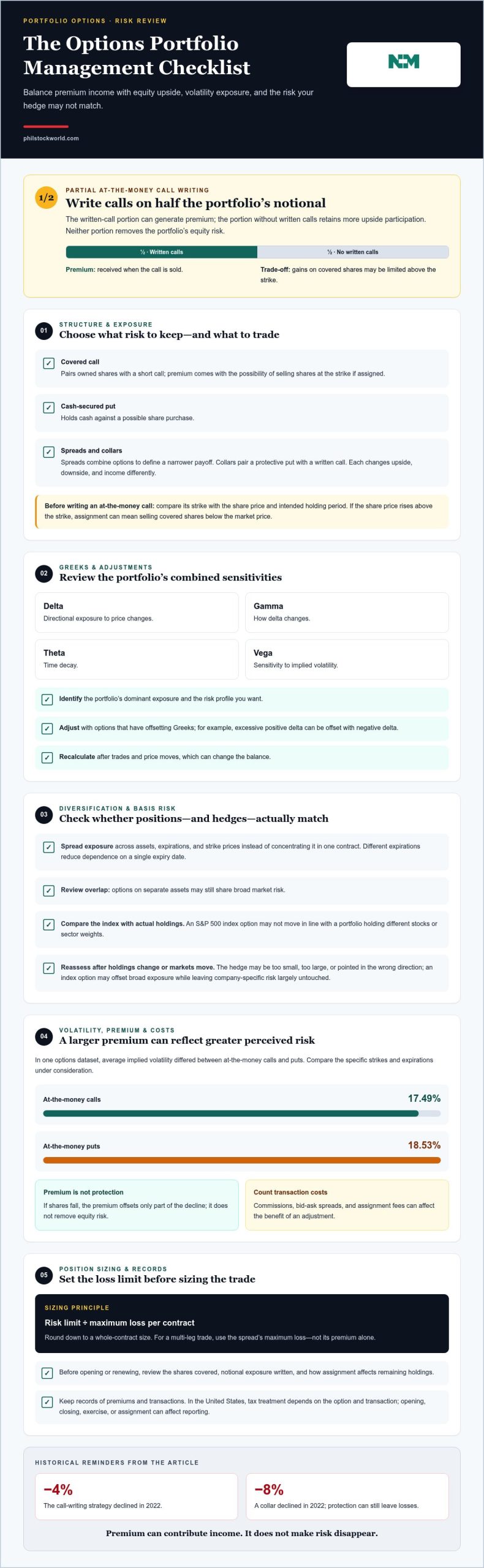
A covered call pairs owned shares with a short call; a cash-secured put holds cash against a possible share purchase. Spreads combine options to define a narrower payoff, while collars pair a protective put with a written call. Each structure changes upside, downside, and income differently. For example, a collar declined by 8% in 2022, showing how protection can still leave losses. In the United States, tax treatment depends on the option and transaction: opening, closing, exercise, or assignment can affect reporting. Keep records of premiums and transactions, then apply the relevant tax rules to the position.
Adjusting Portfolio Greeks
Portfolio Greeks estimate how options respond to changes in share prices, time, and implied volatility. Delta reflects directional exposure; gamma tracks changes in delta, while theta and vega relate to time decay and volatility. To align a portfolio with a target risk profile, identify the dominant exposure, then adjust positions with options that have offsetting Greeks. For example, a portfolio with excessive positive delta can add a position with negative delta. Recalculate after trades, since price moves can change the balance.
Diversifying Options Positions
Diversification spreads option exposure across assets, expirations, and strike prices instead of concentrating it in one contract. Different companies may react to different business events, while varied expirations reduce dependence on a single expiry date. Strike diversification also changes how strongly positions respond to price moves. For example, holding calls and puts at several strikes creates a different exposure profile from concentrating every contract at one strike. Review overlap, too: options on separate assets may still share broad market risk.
Volatility, Skew, and Hedging
Implied volatility influences option premiums, while skew describes how volatility differs across strikes. In one options dataset, average implied volatility was 17.49% for at-the-money calls and 18.53% for at-the-money puts. Compare volatility across the specific strikes and expirations you’re considering; a premium can look attractive while reflecting greater perceived risk. Hedging can combine options with opposing price or volatility exposure, but the hedge itself has costs. Trading expenses can include commissions, bid-ask spreads, and assignment fees; compare the full transaction cost with the position’s expected benefit before adjusting.
At-the-money call writing
An at-the-money call has a strike near the underlying share price when the option is opened. Writing one means selling the call and receiving its premium, while accepting an obligation to sell shares at the strike if assigned. In a partial call-writing strategy, calls are sold at half the notional size of the underlying equity portfolio, leaving part of the portfolio without written calls.
The half-notional structure creates a deliberate trade-off. Written calls can generate premium income, but their share exposure can limit gains if the stock rises above the strike. The uncovered portion retains more upside participation. If shares fall, the premium offsets only part of the decline; it doesn’t remove the portfolio’s equity risk. This is a choice about exposure, not a free add-on.
Consider a portfolio holding shares in a company whose price is near a call’s strike. If the share price rises above the strike, assignment can mean selling the covered shares at the agreed price, even if the market price is higher. If the price stays below the strike, the call may expire without assignment, and the writer keeps the premium. The outcome depends on the share-price path and the option’s terms.
Timing matters. An investor can compare the call’s strike with the intended share-holding period, then assess whether selling at that strike fits the portfolio’s objective. A call written close to the current share price has a different payoff profile from one written farther away. In 2022, the call-writing strategy declined by 4%, a reminder that premium collection doesn’t make an equity-linked strategy immune to losses.
Before opening or renewing a position, review the shares covered, the notional exposure written, and the effect of assignment on the remaining holdings. Options market charts and analysis can help frame those comparisons alongside the broader market backdrop.
Basis risk in index options
Basis risk arises when an index option and the portfolio it hedges move differently. For example, an S&P 500 index option tracks the index, while a portfolio may hold different stocks or sector weights. A broad market decline can therefore leave the hedge too small, too large, or pointed in the wrong direction. The option’s index exposure is not identical to the portfolio’s holdings.
Compare the portfolio’s actual holdings with the index underlying the option. Differences in sector exposure, individual stock performance, and timing can widen the gap between portfolio returns and hedge returns. Reassess the relationship after significant holding changes or market moves. A hedge sized for yesterday’s portfolio may leave today’s exposure mismatched.
Delta estimates price sensitivity, gamma measures how delta changes, theta tracks time decay, and vega estimates sensitivity to implied volatility. Consider all four Greeks across the entire portfolio, not contract by contract. An index option’s delta may offset broad market exposure while leaving company-specific risk largely untouched.
Position size starts with the risk limit you’re willing to allocate and the position’s maximum loss. Divide that limit by the maximum loss per contract, then round down to a whole-contract size. For a multi-leg trade, use the spread’s maximum loss, not its premium alone. This aligns the planned loss with the portfolio’s risk budget.
Payoff calculators, option-chain analysis, and portfolio risk tools can model profit and loss across underlying-price and volatility scenarios. Use a scenario grid to compare the index option’s payoff with the portfolio’s projected move. Common rebalancing mistakes include ignoring basis drift, focusing on one Greek, or changing size without recalculating maximum loss. Review the exposure and hedge together before adjusting. A Virtual Portfolio Review can help organize that assessment.
Historical measures can add context, though they do not remove portfolio-specific basis risk. The study’s sample of monthly S&P 500 index and VIX observations covers January 1996 to September 2008, and its numerical example assumes a constant relative risk aversion coefficient of 10.
For scale, average daily trading volume for S&P 500 index options (SPX) in 2008 was 707,688 contracts. The study reports that S&P 500 index options had open interest of around 13 million in August 2009.
Call writing and option premium income
Call writing brings in a premium by selling another investor the right to buy shares at a set strike. The cash arrives when the option is opened, but it isn’t a guaranteed return on the portfolio. The writer takes on an obligation, and the final result depends on the share price, strike, and option terms. Treat the premium as one part of the position’s payoff, not the whole story.
For an equity holder, the central trade-off is income now versus some future upside. If the share price stays below the strike through expiration, the call may expire without exercise, leaving the writer with the premium. If the stock rallies above the strike, the shares may be called away at the agreed price. The premium cushions the outcome, but covered shares don’t capture gains above the strike.
Market conditions shape the premium available. Implied volatility affects option prices, while strike and expiration determine the contract’s exposure. A richer premium can reflect greater expected movement, not a bargain. In 2022, the call-writing strategy declined by 4%. That result underscores a key point: collecting option premium doesn’t prevent losses when the underlying equity exposure falls.
Evaluate the position by comparing the premium received with the shares’ potential return up to the strike, the downside exposure, and the cost of closing or adjusting the call. Then consider the portfolio’s objective. A shareholder seeking income may accept capped upside; someone prioritizing participation in a rally may prefer less call coverage. The same premium can suit one objective and undermine another.
Before writing calls, map the covered shares and strike against the outcome you’d accept at expiration. Track the premium alongside changes in the underlying, rather than judging the trade by cash received alone. For ongoing market context and trading ideas, explore Premium Membership.
Phil Stock World: Premium Membership
Phil Stock World’s Premium Membership offers market commentary and trading ideas for readers seeking ongoing context for options decisions. Market Charts and Analysis can help you track changing exposures, while Educational Webinars explore strategies and market themes. If you’re assessing how a particular position fits with your broader holdings, a Virtual Portfolio Review offers another way to examine the portfolio’s moving parts.
Use these resources to connect ideas such as call writing, premium income, and index basis risk with your portfolio analysis. They offer education and review, while trading decisions remain yours.
Visit philstockworld.com to explore the available resources.
Make Your Next Portfolio Decision Deliberate
Start your next options decision with a clear purpose, not a premium that simply looks appealing. Before changing a position, identify the exposure you want to retain, the loss you can accept, and the market conditions that would prompt a review. This discipline makes optimizing your options portfolio an ongoing process: match trades to your goals, then revisit the fit as conditions shift.
Use education and portfolio analysis to sharpen your process. Phil Stock World offers Premium Membership, Virtual Portfolio Review, and Educational Webinars for readers seeking market commentary, portfolio perspective, or deeper strategy learning. Choose the resource that best helps you think through your decisions with greater clarity.
Contact Phil Stock World to explore the available resources, and keep building your options knowledge one considered decision at a time.
Frequently Asked Questions
What does it mean to optimize an options portfolio?
Optimizing an options portfolio means aligning positions with your goals, risk limits, and market outlook, then reviewing that fit as conditions change. It isn’t simply about chasing the highest premium or potential return. Before adding an option tied to a company already prominent in your holdings, consider whether it adds useful exposure or concentrates the portfolio further.
What are the costs of options trading, including commissions, bid-ask spreads, and assignment fees?
Options trading costs can include commissions, bid-ask spreads, and assignment fees. Compare the full transaction cost with the position’s expected benefit before adjusting.