


A stock is a share of ownership in a company, so buying one gives you a stake in its fortunes and risks. Stock market education for active investors connects that basic idea to the decisions that shape a portfolio: what to own, how different holdings fit together, and how to assess changing market signals. The aim isn’t to predict every move. It’s to understand what you’re holding and why.
It’s easy to focus on a stock’s ticker or latest price. But a portfolio is more than a list of exciting names: diversification, investment approach, and consistent tracking all shape how you interpret its performance. This guide explains how those elements work together, without treating any one strategy as a shortcut.
You’ll explore common stock types and index funds, compare active and passive investing, consider what market efficiency means for stock selection, and see how research and portfolio tracking can support clearer decisions. Together, these ideas offer a framework for evaluating opportunities and managing your portfolio with intention.
Key Takeaways
- Look beyond the number of holdings: consider whether they expose your portfolio to different risks and market drivers.
- Weigh active and passive approaches by the role you want each to play, rather than assuming one strategy fits every goal.
- Use market efficiency as a lens for thinking about how quickly information may be reflected in stock prices and what that means for stock selection.
- Track performance alongside your reasons for owning each investment, so you can spot when a holding or your overall approach deserves another look.
Index funds and diversification
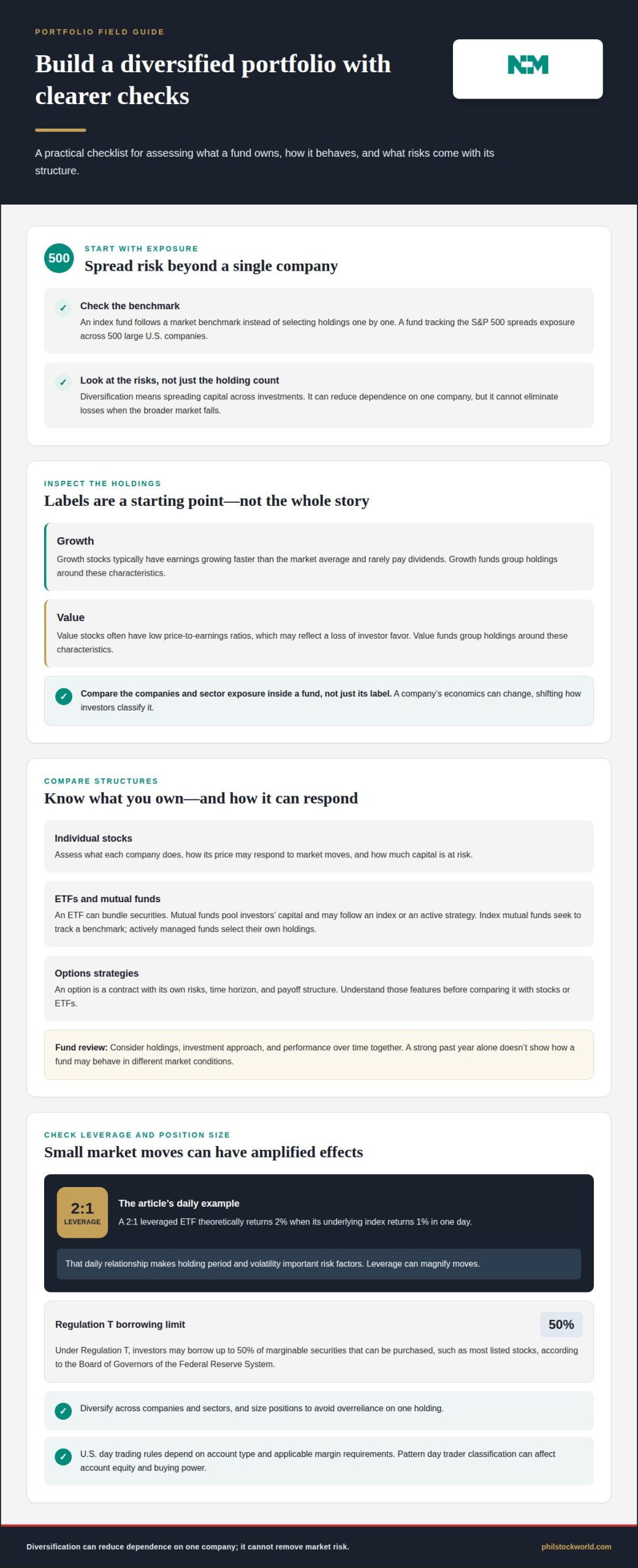
An index fund follows a market benchmark instead of selecting holdings one by one. A fund tracking the S&P 500 spreads exposure across 500 large U.S. companies. This diversification, or spreading capital across investments, can reduce dependence on one company. It can’t eliminate losses when the broader market falls. Index funds are available as mutual funds and ETFs, with different trading mechanics.
Growth stocks typically have earnings that are growing faster than the market average and rarely pay dividends. Value stocks often have low price-to-earnings ratios, which may reflect a loss of investor favor. Growth and value funds group holdings around these characteristics. Compare the companies and sector exposure inside a fund, not just its label. A company’s economics can change, shifting how investors classify it.
When comparing individual stocks, ETFs, and options strategies, assess what each holds, how its price may respond to market moves, and how much capital is at risk. An ETF can bundle securities, while an option is a contract with its own risks, time horizon, and payoff structure.
U.S. day trading rules depend on account type and applicable margin requirements; pattern day trader classification can affect account equity and buying power. Under Regulation T, investors may borrow up to 50% of marginable securities that can be purchased, such as most listed stocks, according to the Board of Governors of the Federal Reserve System.
To limit losses, diversify across companies and sectors, size positions to avoid overreliance on one holding, and understand how leverage magnifies moves. A 2:1 leveraged ETF theoretically returns 2% when its underlying index returns 1% in one day. That daily relationship makes holding period and volatility important risk factors.
Mutual funds pool investors’ capital and may follow an index or an active strategy. An index mutual fund seeks to track its benchmark, while an actively managed fund selects its own holdings. Review holdings, investment approach, and performance over time together. A strong past year alone doesn’t show how a fund may behave in different market conditions.
Active and passive investing approaches
Active investors select securities or adjust positions to pursue returns beyond a benchmark. Passive investors usually track an index rather than predict which companies will outperform. The choice changes how investors research, trade, and judge results. An estimate says passive investment strategies save U.S. investors around $100 billion annually. Yet lower effort doesn’t mean zero risk: an index fund still reflects its market’s declines.
Active management lets a portfolio manager or investor respond to company earnings, industry shifts, and changing valuations. That flexibility also demands a clear thesis, disciplined execution, and regular review. Results can lag a benchmark, even when the analysis appears sound. For context, 79% of actively managed U.S. large-cap funds underperformed the S&P 500 over the 12 months ending Dec. 31, 2025. One period doesn’t settle which approach suits every investor.
Passive stock-fund management follows a defined benchmark. An index mutual fund adjusts its holdings as the index changes, while an ETF trades on an exchange during market hours. Compare each fund’s objective, holdings, and tracking approach. Dividends and earnings still matter: companies can change even when a fund follows an established index.
For frequent trading in the United States, keep records of each sale, its proceeds, and the investment’s cost basis. Realized gains and losses may affect taxes, while investments held long term may qualify for lower capital-gains tax rates. Holding periods and transaction details matter, so include tax treatment in your strategy discussion rather than leaving it as an afterthought.
A useful course pairs clear instruction with practice reading real charts. Start with price direction, trading volume, and how a stock responds around prior support or resistance; then compare that observation with company earnings. Educational Webinars and Market Charts and Analysis can support that learning. To avoid trading scams, be wary of guaranteed-return claims, pressure to act immediately, and strategies whose risks or costs are obscured. Reliable education explains uncertainty and shows how its ideas can be examined.
Efficient market hypothesis
The efficient market hypothesis (EMH) argues that stock prices reflect available information. When investors act quickly on earnings reports, economic data, and company announcements, prices may adjust before a latecomer responds. EMH doesn’t say every share is perfectly valued at every moment. Instead, it asks whether investors can consistently identify mispriced stocks and earn returns above the market after accounting for risk and costs.
Three common versions describe the information that prices may reflect. The weak form focuses on past prices and trading data, challenging strategies based only on chart patterns. The semi-strong form includes public information, such as a company’s financial statements. The strong form proposes that prices reflect both public and private information. These are theoretical models, not guarantees that every stock moves instantly or rationally.
Consider a company reporting stronger earnings than expected. Investors may revise their estimates, changing what they’re willing to pay for its shares. But the price response depends on expectations already reflected in the stock, the report’s details, and broader industry conditions. A headline alone may not show whether income prospects have improved or future payments to shareholders remain sustainable.
For active investors, EMH offers a useful test for an investment thesis. Ask what information the market may already have priced in, what evidence could change that view, and what risk could overturn it. A chart can show how prices reacted to news, but it can’t prove a pattern will repeat. Comparing a company’s results with competitors can reveal a stronger or weaker outlook, though interpretation still matters. Market Charts and Analysis can help you examine price behavior alongside the events and company developments behind it. The practical takeaway: treat market prices as informed signals, not unquestionable verdicts, and have a clear reason before betting against them.
Investment decisions and portfolio tracking
A portfolio tracker brings separate holdings together, giving you a clearer view of assets, performance, and exposure. Record each position’s ticker, share count, purchase price, and current value. Note the reason for owning it, such as a product launch or leadership change. Stock market education for active investors becomes practical when your records link each holding to a testable idea. If the original reason no longer fits the facts, look beyond routine price fluctuations.
Measure performance against a relevant benchmark over consistent time periods. A broad U.S. index may suit a portfolio focused on large U.S. companies, while an industry benchmark may better reflect a specialized strategy. Include dividends and realized capital gains when assessing results; price appreciation alone may miss a holding’s full contribution. Comparing mismatched periods can distort performance, especially when one includes a sharp market swing and another does not.
Tracking can reveal concentration that a list of ticker symbols hides. Group assets by company, industry, and type, then consider which may respond to the same economic forces. Separate businesses, for example, can still depend on similar customer spending or borrowing conditions. Stock market education for active investors includes spotting these connections, so you judge portfolio risk by underlying exposures rather than the apparent number of holdings.
Choose a review rhythm that suits your approach, and revisit positions after company updates or a meaningful change in your thesis. Compare new results and business conditions with the original rationale. A decision log can capture what you expected, what happened, and what you learned, helping separate sound analysis from hindsight. For a structured look at how holdings fit together, use a Virtual Portfolio Review to examine your portfolio and clarify your next investment decisions.
Phil Stock World: Educational Webinars
Phil Stock World’s Educational Webinars help investors deepen their understanding of market strategies and apply concepts to real decisions. Explore topics such as interpreting market conditions, evaluating trade ideas, and thinking through portfolio risks. Market Charts and Analysis can add context to price movements, and a Virtual Portfolio Review can help you examine how your holdings fit together. Premium Membership provides access to exclusive content for investors seeking ongoing market commentary and analysis. These resources support learning and research; they don’t manage investments or execute trades for you. To build on the ideas in this guide, explore Phil Stock World’s educational resources and choose the next step that fits your interests.
Make your next portfolio decision deliberate
Strong investing habits aren’t built by reacting to every headline. They come from making decisions you can explain, reviewing what changed, and staying curious when evidence challenges your view. Stock market education for active investors is most useful when it becomes part of that routine, not a one-time research project.
Choose one question about your portfolio that deserves a closer look. You might be reconsidering an investment thesis, assessing how a position fits your broader approach, or deciding what you want to learn next. A focused question makes your research more useful and keeps your attention on the decisions that matter to you.
If you’re ready to discuss your investing interests and possible next steps, contact Phil Stock World for investing insights. Keep learning, stay deliberate, and let your process guide the next move.
Frequently Asked Questions
What Are Stocks?
Stocks are securities that represent ownership shares in a company. Owning shares can give an investor a claim on the company’s performance, but it doesn’t guarantee profits or dividend payments. Common stock may include voting rights at shareholder meetings, while preferred stock generally gives dividends priority over common shares. An investor who buys common shares becomes a partial owner, not a lender to the business.
What topics should active investors learn about the stock market?
Active investors benefit from learning to assess business quality, valuation, risk, and trading behavior. Study how revenue, debt, cash flow, and competition can influence a company’s outlook, then connect those fundamentals to price and volume patterns. Portfolio construction, position sizing, order types, and decision journaling also matter. This broader stock market education helps investors distinguish a reasoned strategy from a reaction to market noise.
How much do stock market investing courses cost in the United States?
Course costs vary with the format, depth of instruction, instructor access, and whether materials or ongoing education are included. A self-paced introductory course and a program with live teaching may use different pricing structures. Compare what the course teaches, how learners practice, and whether the material suits your experience level. Focus on the curriculum and learning format before weighing the cost.
How should active investors evaluate company financial statements and fundamentals?
Start with the income statement, balance sheet, and cash flow statement, then look for a consistent business story across all three. Rising sales alongside weak operating cash flow, for example, may warrant closer scrutiny. Review debt obligations, profit margins, and changes in share count, then compare those trends with companies facing similar business conditions. A single quarter rarely tells the whole story.
What are the best stock market education courses and platforms for active investors?
A useful course combines clear instruction with practice reading real charts, including price direction, trading volume, support or resistance, and company earnings. Phil Stock World’s Educational Webinars and Market Charts and Analysis can support that learning.
What are the U.S. rules for day trading, margin accounts, and pattern day traders?
U.S. day-trading rules depend on account type and applicable margin requirements, and pattern day trader classification can affect account equity and buying power. Under Regulation T, investors may borrow up to 50% of marginable securities that can be purchased.