

Top Trade Alert: Bloom Energy—Putting Profits Behind the Power Story
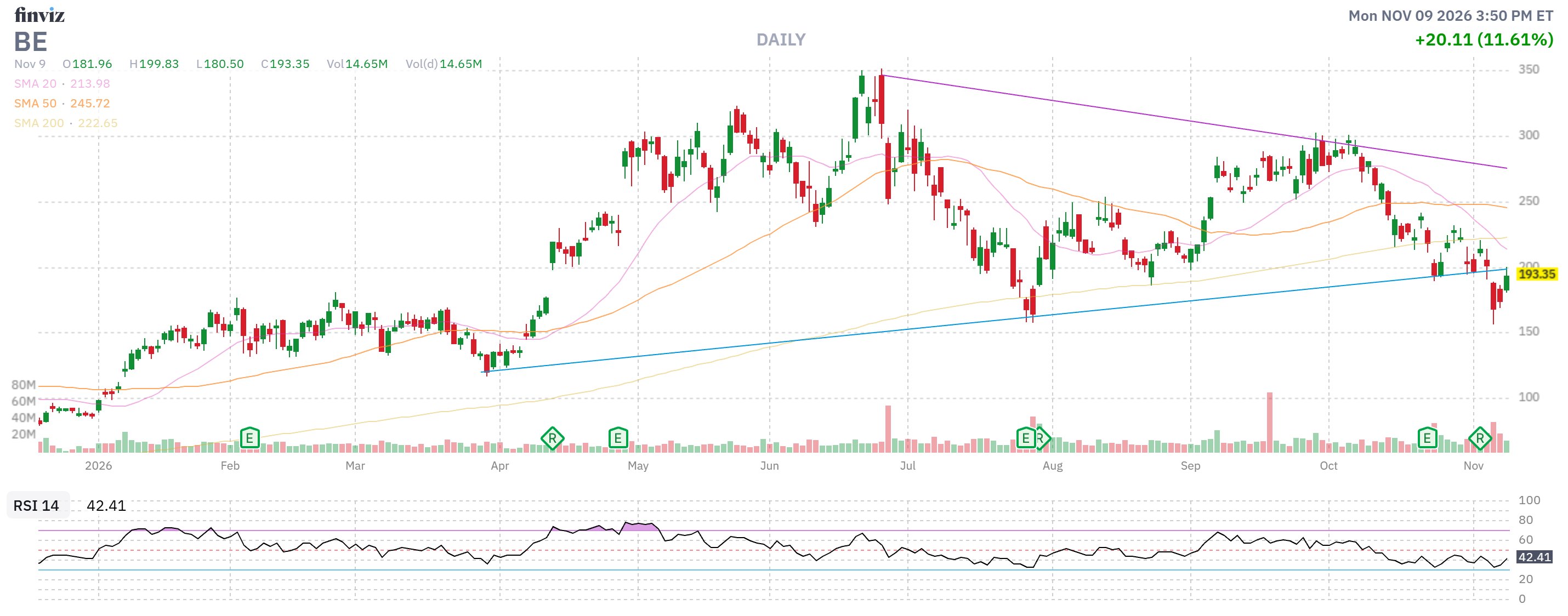
We are adding Bloom Energy (BE) to the Long-Term Portfolio because the business is beginning to deliver what investors have spent years anticipating: substantial revenue, expanding margins, and meaningful operating profits. The post-earnings pullback gives us an opportunity to establish long-term exposure after an exceptional quarter rather than chase the initial excitement.
The key word is execution. Bloom is no longer asking us to value the company entirely on what its technology might accomplish. It is showing us what customers are buying and what those sales can earn.
The earnings were exceptional
Bloom reported Q3 revenue of $1.236Bn, up 138% from a year earlier and 16% sequentially. GAAP gross margin reached 33.8%, GAAP operating income was $225M, and GAAP EPS was $0.78. Adjusted EPS came in at $0.94. Those are substantial operating results—not merely another announcement about a potential future market.
Management also raised its full-year outlook to $4.4Bn–$4.6Bn of revenue and $3.10–$3.40 of adjusted EPS. The investment case is increasingly supported by deliveries and earnings rather than promises alone.
That distinction matters in an infrastructure market full of enormous spending commitments. We want exposure to companies turning the spending into profitable business.
Bloom addresses the timing problem
The opportunity is not simply that AI needs electricity. It is that customers need usable electricity on a timetable that conventional infrastructure cannot always accommodate.
Bloom’s on-site fuel-cell systems offer another way to supply power, allowing customers to pursue projects without relying exclusively on the timing of new grid connections and centralized generation. The applications extend beyond data centers to commercial, industrial, and utility customers.
We do not need every announced data center to be built for that proposition to have value. We need a sufficient number of customers for whom reliable, timely power is worth purchasing—and Bloom’s revenue growth demonstrates that this is already a business, not just a theoretical need.