


A trading course can give you a framework, but it can’t make market decisions for you. Online trading courses for investors are most useful when they match your experience and learning goals, whether you want to understand fundamentals, read charts, or build a strategy.
It’s reasonable to want more than a stack of videos and unfamiliar terminology. A useful learning path connects concepts to practice: what to study first, how investing differs from active trading, and how analysis and risk management inform decisions. Simulated practice can help you rehearse, but paper performance doesn’t guarantee success in live trading. The aim isn’t to predict every market turn; it’s to build a repeatable process for making and reviewing decisions.
This guide compares beginner, intermediate, and advanced course topics, along with long-term investing and shorter-term trading strategies. You’ll see what courses may cover, how to choose a path that fits your goals, and how to put what you learn into practice with discipline.
Key Takeaways
- Match course depth to your experience: start with market basics, then build toward more specialized analysis and execution.
- For a long-term approach, prioritize learning how fundamental analysis, portfolio management, and value investing principles fit together.
- Turn a strategy into clear rules for entries, exits, and risk, then practice applying those rules before committing real money.
- Choose a learning path that connects market analysis, strategies, risk management, and trading tools instead of treating each topic as a separate lesson.
Beginner, intermediate, and advanced course levels
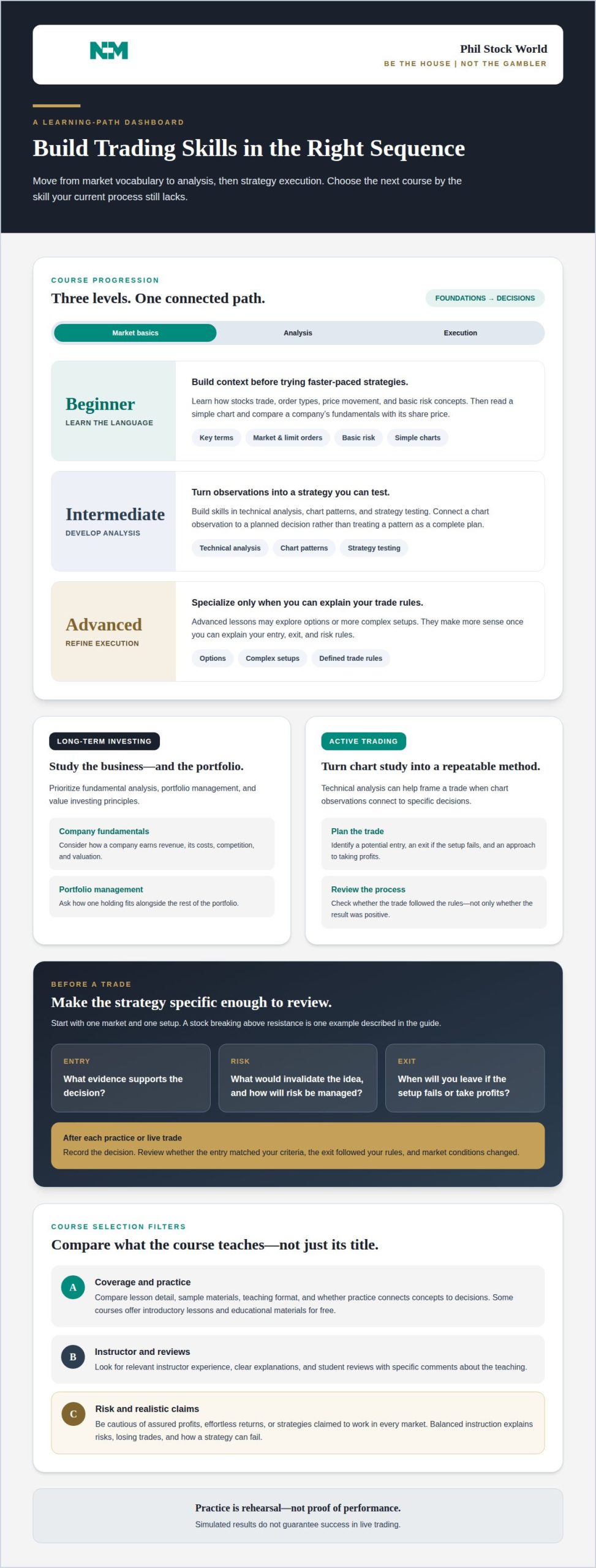
Choose a course based on the decisions you can already explain, not its title. A useful progression moves from market vocabulary to analysis, then strategy execution.
Course Levels and Beginner Paths
A beginner path starts with how stocks trade, order types, price movement, and basic risk concepts. Next, learn to read a simple chart and compare a company’s fundamentals with its share price. This sequence builds context before lessons introduce faster-paced strategies.
Intermediate courses can develop technical analysis, chart patterns, and strategy testing. Advanced lessons may explore options or more complex setups, but these make more sense once you can explain your entry, exit, and risk rules. Choose your next level by identifying the skill your current process lacks.
Course prices depend on factors such as lesson depth, teaching format, and included practice. Free options may include introductory lessons and educational materials. Compare what each course covers instead of treating its title as a measure of value.
Beginner Stock Market Foundations
Beginner stock market courses should explain that stock trading involves buying and selling shares of publicly traded companies on stock exchanges. A beginner trading course can then introduce market and limit orders with practical examples, such as accepting the current price or setting a preferred one.
For beginner trading education, look for a clear sequence: learn key terms, examine a sample trade, then review why the decision worked or failed. Avoid jumping straight into advanced jargon. Each new concept should connect to a practical choice, such as how a chart’s trend affects a planned entry.
Some online courses cover paper trading, risk management, and portfolio diversification, but their content varies. Look for explicit practice with simulated trades, lessons on limiting exposure, and examples of spreading investments across holdings. Simulation results don’t guarantee success in live trading, so treat practice as rehearsal, not proof of performance.
Long-term investing and fundamental analysis
Long-term investing and active trading involve different questions. A course should make that distinction clear before introducing strategies or analysis tools.
For a long-term approach, prioritize lessons in fundamental analysis, portfolio management, and value investing principles. Fundamental analysis examines a company’s business and financial position to assess its prospects. A learning path might begin with how a company earns revenue, then consider its costs, competition, and valuation. Portfolio management adds a broader question: how does one holding fit alongside the rest?
Trading strategies and market analysis follow a different rhythm. Technical analysis courses often teach traders to interpret price charts, identify patterns, and plan trades around defined conditions. For day trading, look for courses covering technical analysis, chart patterns, and real-time trading strategies. A chart pattern is a possible signal to examine, not a complete plan by itself.
Technical analysis is more useful when connected to specific decisions. For example, a trade plan can identify a potential entry, a point to exit if the setup fails, and an approach to taking profits. Then review whether the trade followed those rules, rather than judging the process only by its result. This turns chart study into a repeatable method.
Course topics may include stocks, options, forex, and technical analysis, depending on the curriculum. Compare courses by examining lesson detail, sample materials, and whether practice connects concepts to decisions. Assess instructors through relevant experience and clear explanations. Look for student reviews with specific comments about the teaching, not just general praise.
Watch for claims of assured profits, effortless returns, or strategies that supposedly work in every market. A course built around selective winning examples may leave out losing trades and changing conditions. Look for balanced instruction that explains risks and how a strategy can fail.
For a practical reference point, Market Charts and Analysis can help connect chart observations with market context.
Creating and executing a trading strategy
A workable strategy connects a market idea to specific actions. Build it around a particular setup, risk limits, and planned exits.
Building a Trading Strategy
Start with one market and one setup, such as a stock breaking above resistance. Define the evidence that supports an entry, what would invalidate the idea, and how you’ll manage risk. Then record each decision and review whether you followed the plan, not just whether the trade made money.
Day trading education should cover technical analysis, chart patterns, and real-time trading strategies. Practice a setup in a demo trading account before investing real money. This lets you rehearse entries and exits while observing how quickly prices can change.
Options strategies require a different layer of learning. A course should explain calls, puts, strike prices, and expiration dates, then show how each affects a position’s potential outcome. Options tools can help map possible outcomes, but they don’t replace understanding the strategy’s risks. Choose lessons that connect each tool to a specific decision.
Planning Trade Exits
Set exit rules before entering a trade. For a stock purchase based on a breakout, decide what price action would show that the setup has failed. Also define when you’d consider taking profits. These rules make risk management practical instead of leaving decisions to the pressure of the moment.
Review your plan after each practice or live trade. Note whether the entry matched your criteria, whether the exit followed your rules, and what market conditions changed. A Virtual Portfolio Review can help you examine those choices and identify where your process needs refinement.
Keep your strategy simple enough to explain clearly. Educational Webinars can support your learning when you want to work through market examples and sharpen your execution process.
Trading courses and curated learning paths
A well-structured learning path connects course topics in a useful order. Look for lessons that move from market analysis to trading strategies, risk management, and trading platforms, then tie each topic to a practical decision.
Check that the course clearly defines its focus. A program on stocks may explain securities, order types, and chart tools, while another may concentrate on options or active trading. A clear syllabus shows what each lesson covers and how the material builds. For example, a trading platform lesson should explain how its charts or order tools relate to a strategy, not just list features.
Free trading education is available through U.S. brokerage learning resources and regulator investor-education materials. Use them to study a specific topic, then assess whether the lessons explain the risks and decisions involved. No course can guarantee results.
Scheduling can shape a learning path, too. The November 2026 beginner trading class meets Wednesdays from 2:30 to 3:30 p.m. ET. The December 2026 beginner trading class meets Thursdays from 10:30 to 11:30 a.m. ET. The January 2027 beginner trading class meets Wednesdays from 2:30 to 3:30 p.m. ET. These sessions offer set times for building beginner knowledge.
Before choosing a course, compare its syllabus with your goal. If you want to understand market analysis, look for lessons on interpreting information and applying it to a decision. If your focus is execution, seek practical exercises using platform tools and risk-management concepts. A useful path makes the connection between the topic, the tool, and the trade clear.
Continue building your trading knowledge with focused market education.
Phil Stock World
Phil Stock World can help you keep learning as you turn course concepts into a more considered market process. Its educational resources connect market commentary and trading ideas with ways to review strategies and follow market activity.
Use Educational Webinars to explore a topic or a Virtual Portfolio Review to examine how your portfolio decisions align with your approach. Market Charts and Analysis can add context as you study market moves, while Premium Membership provides access to exclusive content. These resources support learning and analysis; they don’t replace your own decisions or guarantee trading outcomes.
To continue building your investing knowledge with Phil Stock World’s educational resources, contact the team.
Make Your Next Learning Move Count
Make your next step small and deliberate: choose one skill to strengthen, then decide how you’ll apply it. The right online trading courses for investors should support the decisions you want to make, not pull you into every market topic at once. Keep a record of the questions that arise as you learn. They can help you shape a more focused path.
As your knowledge develops, revisit your approach and notice where your reasoning feels clear and where it needs more work. Reflection turns learning into an active process rather than a collection of disconnected lessons. You don’t need to master every technique before moving forward. Consistency matters more than chasing the next shiny strategy.
If you’d like to talk through what you want to learn next, contact Phil Stock World to discuss your learning path. Keep asking sharper questions, stay curious, and build your market knowledge one thoughtful decision at a time.
Frequently Asked Questions
What are the best online trading courses for investors in the United States?
The best fit depends on whether you want to invest for the long term, trade actively, or understand options. Compare the syllabus with your goal, then look for lessons that explain decisions through examples, not just terminology. For instance, a stock research course should show how an investor evaluates a company. A trading course should teach how to plan and review a trade.
Which online trading courses are best for beginners versus experienced investors?
Beginners benefit from courses that explain market structure, order types, and investing vocabulary before introducing complex strategies. Experienced investors may prefer focused instruction on a specific gap, such as evaluating options positions or refining chart-based decisions. To choose your level, list the decisions you can make confidently, then identify what you still need to learn. This helps you avoid spending time on material you already understand.
Which online trading courses offer certificates, instructor access, or live trading sessions?
Course features vary, so look for specific details in the syllabus and description. Check whether a certificate marks completion or demonstrates an assessed skill, and whether instructor access means feedback, Q&A, or something else. A live trading session differs from a recorded market walkthrough. Compare the format with how you learn best, and don’t treat a certificate as proof of trading results.
How can I choose an online trading course based on my goals, experience, and budget?
Start by naming one goal, such as understanding company research or practicing trade planning. Match the course level to your current knowledge, then compare its format, topics, and learning materials with your budget. A free introductory resource may help you explore a subject before committing to a longer course. Prioritize clear instruction and relevant practice over a long list of features you may not use.