

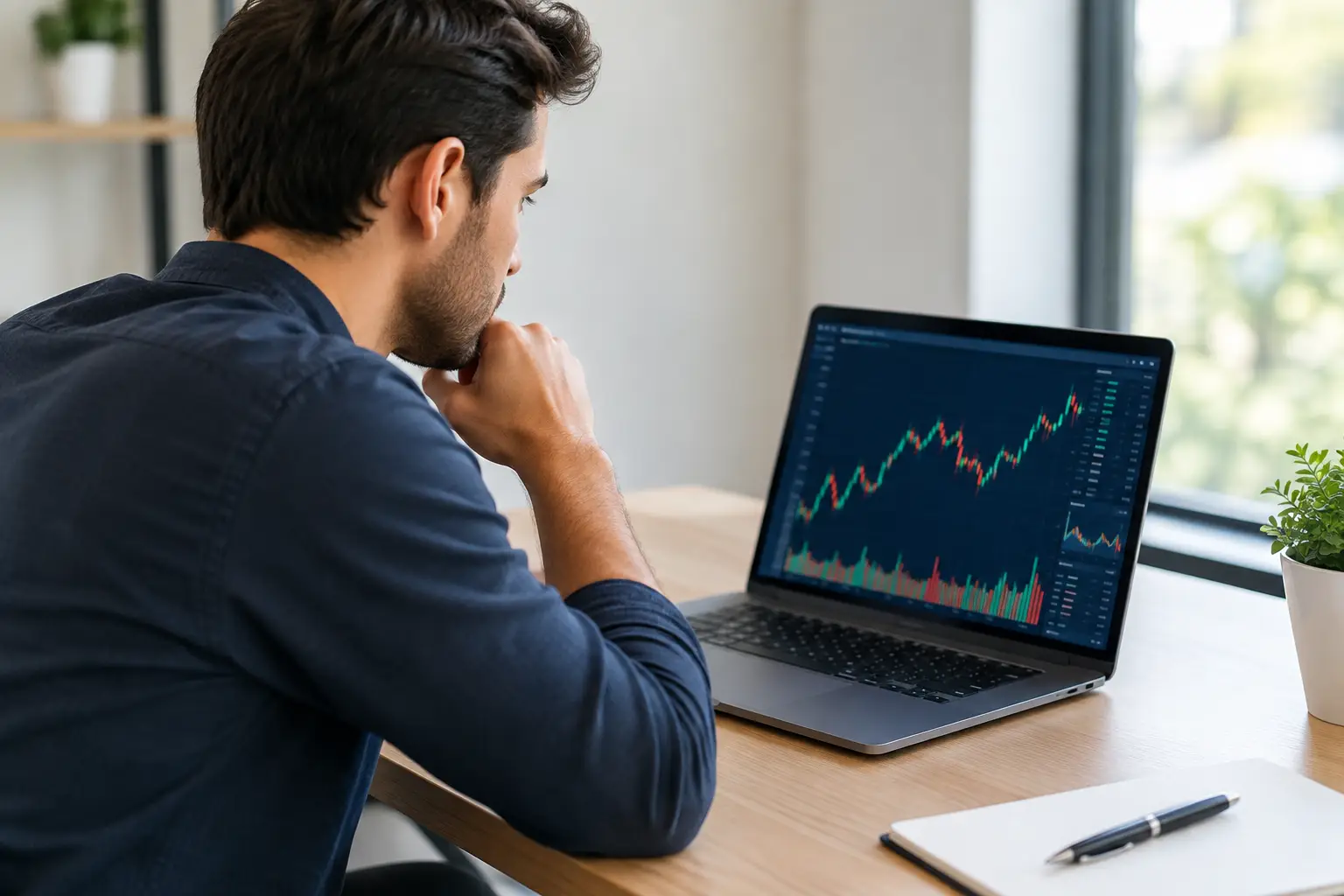
A simulated $100,000 account can make anyone look like a hero. Load up on weekly calls, catch one explosive move in a mega-cap, and suddenly the virtual portfolio is up 18%. Then real money enters the picture, a position moves against you by 2%, and the confident trader becomes a nervous button-clicker.
That is the real value of paper trading platforms: not pretending to make money, but exposing the gap between having an idea and executing a repeatable plan. Used well, they are a laboratory for stock selection, options mechanics, position sizing, and market timing. Used badly, they are a video game with candlestick charts.
For self-directed investors, the question is not whether paper trading is useful. It is whether the platform and the process are realistic enough to teach habits that will survive contact with an actual brokerage account.
What Paper Trading Platforms Can Actually Teach
Paper trading removes the financial consequences of being wrong, which is both its greatest feature and its biggest flaw. A new options trader can learn how a vertical spread responds to time decay without paying tuition to the market. An investor can test whether buying quality stocks after earnings gaps works better than chasing them before the report. An active trader can practice entering orders around CPI, Fed decisions, or a sharp geopolitical headline without risking a bad fill during a volatile morning.
The platform matters because it provides the market data, order types, watchlists, charts, and portfolio view that shape those decisions. But the learning comes from the rules attached to the account.
A useful simulation answers practical questions. How much does a 10% move in the underlying really matter to a call spread with 30 days left? What happens to a short put when implied volatility jumps? Does a stop order make sense in a thinly traded small-cap, or does it create a worse exit? Those are far better lessons than simply seeing whether a hypothetical trade ended green.
Paper trading is especially valuable when you are moving into a strategy you understand conceptually but have not managed in real time. Selling premium, calendar spreads, covered calls, protective puts, index hedges, and earnings trades all behave differently once the clock starts running. Watching an options position change through several market sessions builds familiarity that a textbook cannot provide.
The Problem With Perfect Fills
Every paper account has an embedded fantasy: liquidity is often better than it will be when you are trading for real. Many platforms fill simulated orders at the quoted price, or close enough to it, even when a live order would sit unfilled, receive a partial fill, or require you to give up another nickel or dime per contract.
That distinction is minor when buying 100 shares of a heavily traded index ETF. It can be enormous when trading a wide options spread, a low-volume stock, or a contract with a large bid-ask spread. If your entire paper-trading edge disappears after realistic slippage and commissions, you do not have an edge. You have a spreadsheet artifact.
This is why traders should treat the mid-price as suspicious, not sacred. For long option positions, assume you pay closer to the ask. For short positions, assume you sell closer to the bid. On multi-leg trades, model each leg conservatively. A strategy that still looks sensible after those adjustments is worth studying further.
There is also no simulation for the emotional cost of a losing position. A paper trader may calmly roll a threatened short put lower and later in time. With real capital at risk, the same trader may freeze, close at the worst moment, or double down because the loss suddenly feels personal. That does not make paper trading useless. It means it should be treated as the first stage of training, not certification for larger bets.
How to Use Paper Trading Platforms Like a Real Account
The simplest way to ruin a paper account is to give yourself unlimited buying power and no consequences. Set the virtual account near the size of the capital you expect to trade live. If you have a $25,000 account, do not practice with $500,000. A position that is appropriately sized in a large simulation can be reckless in your real portfolio.
Use the same risk limits you intend to follow with actual money. Define a maximum allocation per position, a cap on total exposure to one sector, and a limit on how much premium you will sell against a single market event. If you would not put 35% of your real account into one semiconductor name ahead of earnings, do not do it on paper just because the result will not hurt.
Before entering every trade, write down four things: the thesis, the catalyst or time frame, the maximum acceptable loss, and the condition that would prove you wrong. That last point matters. Traders are often excellent at finding reasons to enter and remarkably creative at avoiding reasons to exit.
Then review the trade after it closes. Was the thesis right but the structure wrong? Did you buy too much time, not enough time, or use a strike that required an unrealistic move? Did the broad market, interest rates, or sector rotation overwhelm an otherwise solid company-specific idea? This is where a trade journal turns random activity into useful data.
At PhilStockWorld, the central lesson behind structured trade ideas is not to predict every tick. It is to know why you own something, what you are being paid to wait for, and what adjustment is available if the market does not cooperate. A paper account is an excellent place to practice that discipline before the pressure gets real.
Choosing Among Paper Trading Platforms
There is no single best choice because the right platform depends on what you plan to trade. A long-term investor practicing stock entries and portfolio allocation needs reliable quotes, basic charting, and easy performance tracking. An active options trader needs an options chain with Greeks, multi-leg order entry, strategy analysis, and a clear view of buying-power effects.
Look first at the quality and timing of market data. Delayed quotes can be perfectly fine for practicing position construction, portfolio allocation, and end-of-day decisions. They are much less useful if you are trying to learn intraday execution around fast-moving news. If your intended approach relies on short-term momentum, opening-range moves, or rapid options adjustments, real-time data is worth prioritizing.
Next, inspect how the simulator handles options. Can it model assignment, expiration, dividends, early exercise risk, and spreads? Does it show delta, theta, gamma, vega, and implied volatility? You do not need every sophisticated feature on day one, but you should not learn an options strategy on a platform that hides the forces driving its value.
Finally, consider workflow. A platform should make it easy to build a watchlist, place a limit order, review open risk, and revisit closed trades. Flashy charts are fine. The useful question is whether the platform helps you make a decision before the trade and evaluate that decision afterward.
A Better 30-Day Paper Trading Test
Instead of firing off dozens of simulated trades, run a focused 30-day experiment. Pick one market style: buying pullbacks in strong sectors, selling defined-risk put spreads on quality companies, or building hedges when the market becomes extended. Keep the strategy narrow enough that your results mean something.
During the test, take only trades that meet written criteria. Record the market backdrop, the technical or fundamental setup, the entry price you realistically could have received, and the planned exit. Include trades you passed on as well. Sometimes the most valuable finding is that your best returns came from doing less.
At the end of 30 days, do not judge the experiment solely by profit and loss. Examine average winner, average loser, maximum drawdown, time in trade, and the quality of execution. A strategy with a modest paper profit but controlled losses and clear rules may be more promising than one spectacular winner surrounded by inconsistent decisions.
If the process holds up, move to real money carefully. Start smaller than your paper position size, especially with options. The first live trade is not the moment to prove courage. It is the moment to learn whether your decision-making remains intact when every price move has a dollar sign attached.
When Paper Trading Stops Helping
Paper trading becomes less useful once you are repeatedly avoiding its limitations. If you only take huge bets, ignore fills, hold losers indefinitely, or keep changing strategies after every result, the account is teaching the wrong lesson. Resetting the balance will not fix that. Better rules will.
It also has a shelf life. After you understand a strategy’s mechanics and can execute it consistently in simulation, eventually you need a small live position to learn the behavioral side. The goal is not to graduate from preparation into reckless action. It is to move from simulated repetition to controlled exposure.
The market will always find a way to humble a trader, whether through a Fed surprise, a bad earnings reaction, a volatility spike, or a headline nobody had on the calendar. Paper trading platforms cannot eliminate that uncertainty. They can help you build the habits that keep one surprising day from becoming an expensive education.