




Protection with no upfront net premium still has a price: you give up some upside. A zero cost collar strategy for downside equity protection pairs a protective put with a sold call on shares you own, using the same expiration date. When the call premium offsets the put premium, there’s no net option premium outlay, but losses are limited below the put strike and gains are capped above the call strike.
That trade-off can make sense when a floor matters more than capturing every possible rally. The details matter: the strikes set how much downside remains and where the upside cap begins, while option premiums determine whether the collar is truly zero-cost before other expenses. This guide explains how the structure works, how premium balancing shapes its terms, and what happens at expiration. You’ll see what the protection covers, what it doesn’t, and what you trade away to get it.
Key Takeaways
- See how owning shares alongside a protective put and a short call creates a downside floor while setting an upside ceiling.
- Learn how option premiums shape the collar’s terms, and why offsetting premiums doesn’t necessarily eliminate other trading costs.
- Understand how dividends, interest rates, borrow conditions, and liquidity can influence collar pricing and execution.
- Use Phil Stock World’s market analysis, webinars, and portfolio review resources to deepen your understanding of options strategies.
What Is a Zero Cost Collar?
A zero-cost collar pairs stock with a protective put and a short call sharing the same expiration. For every 100 shares, one contract of each option creates a defined downside floor and an upside cap.
Shares, Protective Puts, and Short Calls
A collar combines 100 owned shares, one put, and one call sold short, with both options covering the same shares and expiration. The put gives you the right to sell at its strike, setting a floor if the stock falls. The short call may require you to sell at its strike if exercised. This structure matters because your share exposure changes across three price zones: below the put strike, between strikes, and above the call strike.
Funding Put Protection with Call Premiums
Selling an out-of-the-money call brings in a premium that can offset the cost of buying an out-of-the-money put. For example, a collar on 100 shares bought at $100 could pair a $95 put with a $105 call. The put protects against deeper losses below $95, while the call limits gains above $105. The options strategy targets zero net premium when the call credit equals the put cost, though the trade still exchanges upside for protection.
Strike Selection and Collar Alternatives
Put and call walls can offer market-positioning references when comparing potential strikes. A put wall may help frame a downside area, while a call wall may show where call positioning is concentrated; neither creates a guaranteed floor or ceiling. A protective put alone preserves upside but requires paying its premium. A put spread buys one put and sells another at a lower strike, reducing the premium outlay while limiting protection below the lower strike. A collar also sells a call, offsetting the put cost but capping gains above that call’s strike. Choose by weighing the floor you want against the upside you’re willing to surrender.
Balancing option premiums to target zero net cost
A collar targets zero net cost when the call premium offsets the put premium before commissions, taxes, and other costs. Market pricing determines whether that balance is possible at the strikes you want.
Transaction Costs and Unequal Premiums
With two option legs, the premium balance isn’t the position’s only expense. Trading costs can leave a net debit even when the call credit matches the put premium. If the put costs more, changing either strike can shift the balance: a lower put strike can reduce its price, while a closer call strike may bring in more premium. Each adjustment changes the protection or upside you’re buying or selling.
American-style equity options can be exercised on any business day through expiration. A short call can therefore be assigned early, and your shares may be called away before the planned end date. Assignment risk matters particularly around ex-dividend dates when the call trades near parity. The option terms, share ownership, and timing all affect what happens next.
Volatility Skew and Option Pricing
Volatility skew means options at different strikes can have different implied volatility and prices. Downside puts on single stocks often have higher implied volatility than upside calls, making put protection relatively expensive. That pressure can place the call cap closer to the current share price than the put floor. Compare strikes and premiums together: the zero-premium target alone doesn’t show how much upside the position gives away.
Consider the simplified IBM example: an investor owns 100 shares at $140 per share and buys a 130-strike put for $5 per share. The cap means gains above $150 per share may be surrendered.
For ongoing options analysis, Premium Membership offers market commentary and trading ideas that can help frame how volatility affects a position.
What Is an Options Collar Strategy?
An options collar changes the risk profile of an existing stock position through paired trades. Its put acts like insurance below the put strike price, while the short call limits upside above its strike. That insurance analogy is for comparison purposes only: the collar doesn’t remove market risk or guarantee a profit. Dividends, interest rates, share borrow, and liquidity can all influence the terms available.
Dividends shape both sides of the options market. Meaningful dividends tend to make calls cheaper and puts dearer, which can make funding downside protection more demanding. An investor holding shares in a collar continues to receive dividends, but a short call may be assigned early, especially near an ex-dividend date when it trades near parity. The shares could be called away before expiration, changing both the stock position and dividend outcome.
U.S. tax treatment depends on the collar’s structure, holding period, and applicable rules. According to the Internal Revenue Service, when a put is exercised, its cost reduces the amount realized on the underlying stock sale when calculating gain or loss. A collar that removes substantially all risk and reward may also be treated as a constructive sale, potentially triggering tax. Straddle rules can affect holding periods and carrying-cost deductions.
Execution matters, too. Thinly traded or hard-to-borrow shares can lead to less favorable collar pricing, as can a position large relative to daily trading volume. Higher interest rates tend to help the call side, while borrow conditions and liquidity influence dealer quotes. Because a collar involves two option trades, transaction costs can also reduce the value of premiums that otherwise offset. Compare the economics of the whole position, not just the apparent premium balance.
Zero-cost collar structure and mechanics
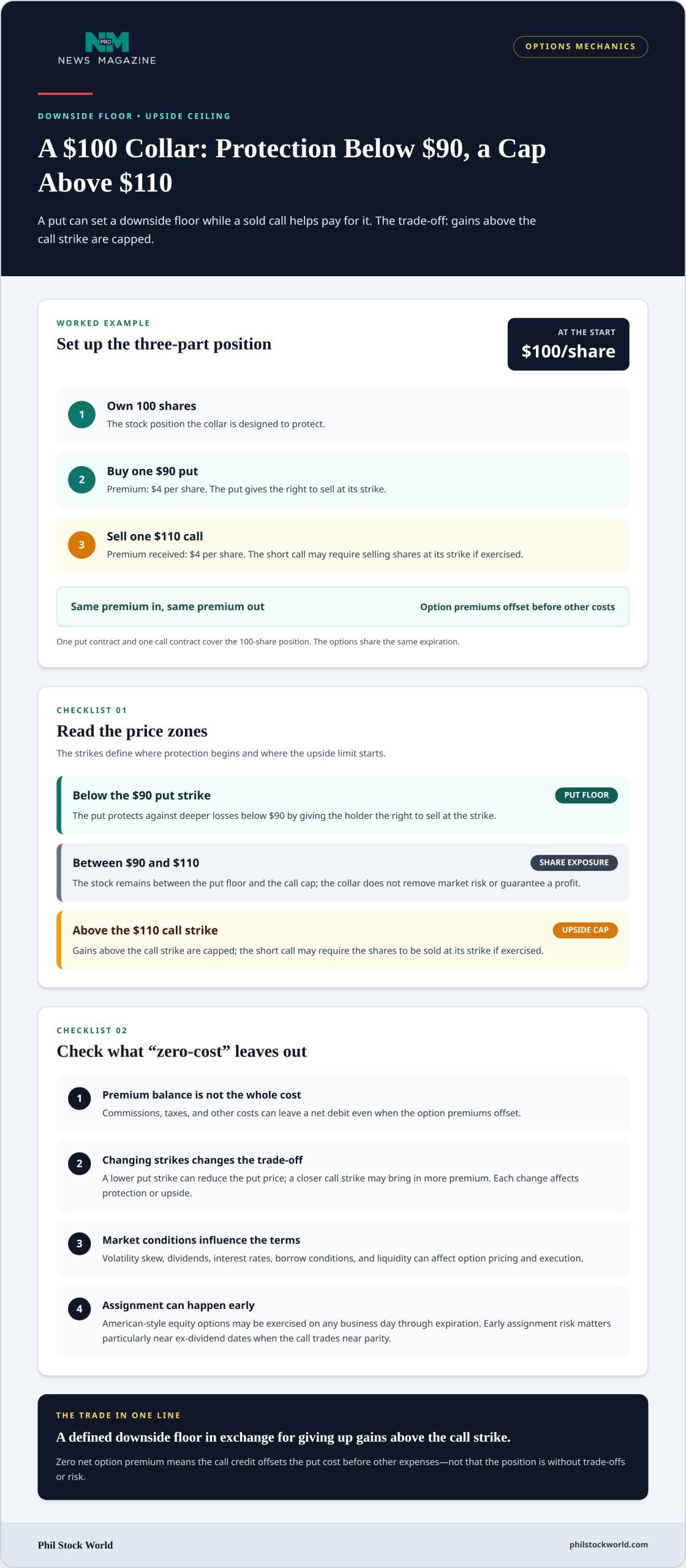
Consider 100 shares valued at $100 each when the collar begins. The investor buys a $90 put for a $4-per-share premium and sells a $110 call for the same premium. Before other costs, the option premiums offset. Each standard option contract represents 100 shares, so the example uses one put contract and one call contract against the stock position. A zero cost collar strategy for downside equity protection uses this balance to define a floor and a cap, not to remove every risk.
At expiration, the stock price determines which part of the collar matters. Below $90, the put can support selling shares at that strike, limiting the stock loss to about $10 per share before other costs. Between $90 and $110, both options can expire without value, leaving the shares with ordinary stock-like gains or losses. Above $110, the short call can cap the sale value at $110, limiting the gain to about $10 per share. For a zero cost collar strategy for downside equity protection, these boundaries show exactly what the investor trades away.
Trading before expiration is more complicated. Implied volatility, time remaining, and the share price affect option values, so closing early can produce a different result from holding to expiration. A collar can be ended early, but the dealer’s market price may be unfavorable. Protection also ends at expiration; extending it means arranging a new hedge at the prices, volatility, and terms available then.
For a large or restricted stock position, an over-the-counter dealer can tailor size, dates, and settlement terms. Listed options may suit smaller positions. A registered investment adviser can help assess whether the cap, floor, and expiration fit an investor’s objectives, while tax counsel can review potential tax effects. Explore options analysis and trading ideas to deepen your understanding of collar mechanics.
Phil Stock World
Phil Stock World offers a useful next step for exploring how collar mechanics interact with real market conditions. Market Charts and Analysis and Educational Webinars can help you examine options concepts, while Premium Membership provides access to exclusive market commentary and trading ideas. A Virtual Portfolio Review offers a way to discuss how a strategy’s trade-offs relate to a portfolio you’re evaluating. These resources support learning and analysis; you still need to weigh the put floor, call cap, expiration, and costs for yourself. Explore Phil Stock World’s market analysis and options education to continue learning.
Make the Trade-Off Fit Your Next Move
Judge a zero cost collar strategy for downside equity protection by what you need from the shares next, not by the “zero cost” label alone. Before acting, define the loss you’re trying to contain, the upside you’re willing to give up, and how long that balance should last. Those priorities can clarify whether a collar fits your broader investment analysis.
Options add moving parts, and a structure that looks straightforward at entry can behave differently as market conditions shift. Keep the decision anchored to your objectives, understand the position’s limits, and treat each new expiration as a fresh choice rather than an automatic roll. A thoughtful process is more useful than chasing a perfect hedge.
To keep building your perspective on options and market strategy, contact Phil Stock World. Take the next step with curiosity and a clear view of the trade-offs.
Frequently Asked Questions
Can I end a collar early?
Yes, a collar can often be closed before expiration, but its current market value determines the cost or proceeds. Closing generally means unwinding the option legs and deciding what to do with the shares. If the stock price or implied volatility has moved, the exit value may differ substantially from the opening premium balance. An early close also ends the collar’s protection and cap.
Do I need listed options or a bank dealer?
No. The route depends largely on position size and customization needs. Listed options may suit smaller positions, while large or restricted holdings may use an over-the-counter dealer for custom size, dates, and settlement terms. Those routes can produce different pricing and exit mechanics. The key question is whether listed contracts fit the share quantity and timeline or the position calls for tailored terms.
How Do You Choose the Put Floor and Call Ceiling?
Start with the share price you could accept if the stock falls, then weigh how much upside you’re prepared to surrender for that floor. With a concentrated holding, you might protect only part of the position, leaving other shares uncapped. Expiration matters, too: protection ends then, so choose a term that matches the period you want to hedge rather than assuming the collar lasts indefinitely.
How Much Can You Gain or Lose With a Collar?
At expiration, the put strike limits losses from further stock declines, but it doesn’t erase any gap between your purchase price and that floor. Above the call strike, the call limits the stock’s sale value. Between the strikes, the shares retain ordinary stock exposure. Your overall result also reflects premiums paid or received and any trading costs, so evaluate the whole position against your share basis.
How do you choose collar strikes?
Choose the put strike around the downside level you want to defend, then weigh the call strike against the upside you’re willing to give up. Premiums, term, and implied volatility all affect the available balance. In a dealer-arranged collar, you can set the floor and term, and the dealer determines a call strike that offsets the put premium. Treat that quote as a snapshot of market conditions.
Is a Costless Collar Really Costless?
Not necessarily. “Zero cost” describes option premiums offsetting each other at entry, not a guarantee that the entire trade has no expense. Commissions, taxes, and other transaction costs can still affect results. There’s also an opportunity cost: if the stock rallies beyond the call strike, you give up gains above that level. Early adjustments or closing the collar can carry additional costs, too.