


Consumer credit trend remains the same; guess who is doing all the borrowing?
Courtesy of SoberLook.com
Econoday: Consumers are active borrowers with credit outstanding, up $14.2 billion, up sharply for a third month in row. Much of the gain is once again tied to loans for students who, limited by the soft jobs market, continue to stay in school. Strong sales of autos are also driving up borrowing. Student and auto loans are part of the nonrevolving component which is up $10.8 billion in the month. The revolving side, where credit cards are tracked, popped up $3.4 billion following the prior month's $2.2 billion decline. Willingness to borrow money and willingness to make big ticket commitments like auto purchases are good signs for the holiday shopping season.
Student loans owned by the federal government now constitute nearly a fifth ($0.52 trillion) of US consumer credit (excluding mortgages). Based on the pace of the past 12 months' growth, government-owned student debt will be at $1.7 trillion in 10 years. That's roughly 39% of total consumer debt, assuming other consumer credit also grows at the current pace. And this number doesn't include student loans guaranteed by the government but owned by banks (included in blue below), which represent another half a trillion. As discussed earlier (see post), this allows universities to rapidly increase tuition costs, often with little incentive to do otherwise. And that ends up creating even more demand for student loans.
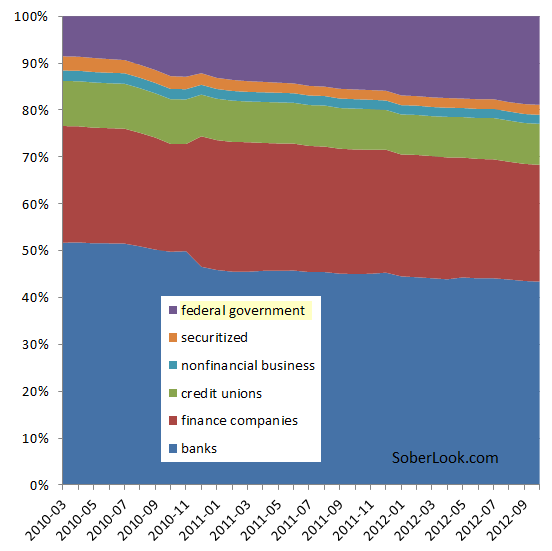 |
| Owners (lenders) of consumer credit (source: FRB) |

