


Courtesy of Mish.
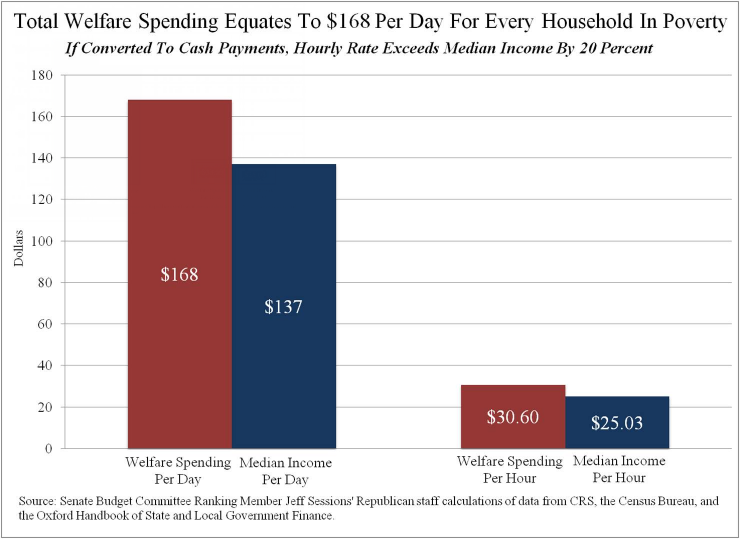
It’s better to receive median welfare than median income according to a US Senate budget committee report Total Welfare Spending Equates To $168 Per Day For Every Household In Poverty.
Based on data from the Congressional Research Service, cumulative spending on means-tested federal welfare programs, if converted into cash, would equal $167.65 per day per household living below the poverty level. By comparison, the median household income in 2011 of $50,054 equals $137.13 per day. Additionally, spending on federal welfare benefits, if converted into cash payments, equals enough to provide $30.60 per hour, 40 hours per week, to each household living below poverty. The median household hourly wage is $25.03. After accounting for federal taxes, the median hourly wage drops to between $21.50 and $23.45, depending on a household’s deductions and filing status. State and local taxes further reduce the median household’s hourly earnings. By contrast, welfare benefits are not taxed.
The diffuse and overlapping nature of federal welfare spending has led to some confusion regarding the scope and nature of benefits. For instance, Newark Mayor Cory Booker has recently received a great deal of attention for adopting the “food stamp challenge” in which he spends only $30 a week on food (the average individual benefit). The situation Booker presents, however, is not accurate: a low-income individual on food stamps may qualify for $25,000 in various forms of welfare support from the federal government on top of his or her existing income and resources—including access to 15 different food assistance programs. Further, even if one unrealistically assumes that no other welfare benefits are available, the size of the food stamp benefit increases as one’s income decreases, as the benefit is designed as a supplement to existing resources; it is explicitly not intended to be the sole source of funds for purchasing food.
Crazy Incentives in Welfare System
Please consider Julia’s mother: Why a single mom is better off with a $29,000 job and welfare than taking a $69,000 job.
The U.S. welfare system sure creates some crazy disincentives to working your way up the ladder. Benefits stacked upon benefits can mean it is financially better, at least in the short term, to stay at a lower-paying jobs rather than taking a higher paying job and losing those benefits. This is called the “welfare cliff.”
Let’s take the example of a single mom with two kids, 1 and 4. She has a $29,000 a year job, putting the kids in daycare during the day while she works.
As the above chart – via Gary Alexander, Pennsylvania’s secretary of Public Welfare — shows, the single mom is better off earning gross income of $29,000 with $57,327 in net income and benefits than to earn gross income of $69,000 with net income & benefits of $57,045.
It would sure be tempting for that mom to keep the status quo rather than take the new job, even though the new position might lead to further career advancement and a higher standard of living. I guess this is something the Obama White House forgot to mention in its “Life of Julia” cartoons extolling government assistance.

Comments
Several comments to the article were interesting. Here are a couple of them.
Stinch writes …
Here is the truth about welfare from one who works in a PA welfare office. While welfare is designed to provide assistance to those who are at the lower end of the economic spectrum. The program was designed to supplement people’s efforts in supporting themselves not being their sole support. Reality is that there are some that by no fault of their own will never be able to fully support themselves, but the number of people who could have supported themselves but due to poor decision making (and suffering the negative consequences of those decisions) only continues to grow. The truth is that welfare, though an assist for some is a trap for too many. There are some who escape the trap, and more power to them, but for most it is a trap. It is far too easy to become complacent and begin to rely on the system. There is little to no incentive to leave the system. I have seen too many people come through our doors ashamed to be asking for help, and years later are fighting to remain on the welfare rolls and seeking more. Without serious reform the future will only consist of more and more people receiving benefit and fewer and fewer paying more and more taxes to support them.
Nesg83 writes ……

