


Courtesy of Lee Adler of the Wall Street Examiner
The seasonally adjusted (SA) headline claims number got back in line with the actual trend this week, a rare occurrence that happens randomly. Looking at the actual data, the trend is still improving, but very slowly. That trend does not support the recent run in stock prices.
There’s no way to know whether the SA number is misleading or a reasonably accurate representation of the trend unless we are also looking at charts of the actual data. And if we are looking at the actual data and using the tools of technical analysis to view the trend, then there’s no reason to be looking at a bunch of made up crap, which is what the seasonally adjusted data is. Seasonal adjustment just confuses the issue.
The Labor Department reported today that the seasonally adjusted (SA) representation of first time claims for unemployment rose by 4,000 to 352,000 from a revised 348,000 (was 346,000) in the advance report for the week ended April 13, 2013. The consensus median economists’ estimate of 355,000 for the SA headline number was pretty close to the mark this week. Even a blind squirrel can find his nuts sometimes. Normally the consensus of economic forecasters is wrong, not just because forecasters are practicing quackery but also because the seasonally adjusted number, being made-up, is impossible to consistently guess.
Note: Seasonally adjusted numbers are fictional and are not finalized until 5 years after the fact. There are annual revisions that attempt to accurately reflect what actually happened this week. The weekly numbers are essentially worthless for comparative analytical purposes because they are so noisy. Seasonally adjusted noise is still noise. It’s just smoother. So economists are fishing in the dark for a fictitious number that is all but impossible to guess. But when they are persistently wrong in one direction, it shows that their models have a bias. Since the third quarter of 2012, with a few exceptions it has appeared that a pessimism bias was built in to their estimates.
To avoid the confusion inherent in the fictitious SA data, I work with only the actual, not seasonally adjusted (NSA) data. It is a simple matter to extract the trend from the actual data and compare the latest week’s actual performance to the trend, to last year, and to the average performance for the week over the prior 10 years. It’s easy to see graphically whether the trend is accelerating, decelerating, or about the same.
The advance number for the most recent week is normally a little short of the final number the week after the advance report, because the advance number does not include all interstate claims. The revisions are minor and consistent however, so it is easy to adjust for them. Unlike the SA data, after the second week, they are never subsequently revised.
The headline seasonally adjusted data is the only data the media reports but the Department of Labor (DOL) also reports the actual data, not seasonally adjusted (NSA). The DOL said in today’s press release, “The advance number of actual initial claims under state programs, unadjusted, totaled 354,973 in the week ending April 13, a decrease of 1,269 from the previous week. There were 370,482 initial claims in the comparable week in 2012.” [Added emphasis mine]
For purposes of this analysis, I adjusted this week’s reported number up by 2,500. The advance report is usually revised up by from 1,000 to 4,000 in the following week, when all interstate claims have been counted. Last week’s number was approximately 2,500 shy of the final number for that week released today. The adjusted number that I used in the data calculations and charts for this week is 357,000, rounded, which implies a week to week real increase of 1,000. The final number for the week, to be released next week, should be near that. Whether a positive or negative number, it will be an insignificant change.
The actual filings represent a decrease of 3.5% versus the corresponding week last year. That’s still within the usual range of -3% to -20% of the past two years. It is not as good as the average year to year change of -8.6% over the past two years. The year to year comparisons are now much tougher as the number of job losses declined sharply between 2009 and 2011.
The current week to week change of an increase of 1,000 in the NSA number compares with an average change of a decrease of 1,500 for the same week over the prior 10 years. The comparable week has had extreme variations with both increases and decreases. In 2012 there was a decrease of 20,000 for this week while in 2011 there was a decrease of 66,000. By those standards, this year was weak, but in 2010 claims jumped by 94,000 in the comparable week. Consequently I don’t think that we can glean much from this week’s number on this basis.
The Labor Department, using the usual statistical hocus pocus, applied seasonal adjustment factors ranging from about .93 to about 1.12 to the week corresponding to this one over those 10 years. This week they applied a factor of .991.
Any move toward a year to year increase in claims would suggest a slowing in the economy. We haven’t seen any clear sign of that yet either in this series or in the real time withholding tax data. I will continue to watch both of them closely for any sign of deterioration. While there was a sharp downtick in bi weekly withholding last week, it may be due to external or calendar factors. It is not yet clear that there will be any significant cumulative knock-on effects of the Federal spending sequester that took effect in March.
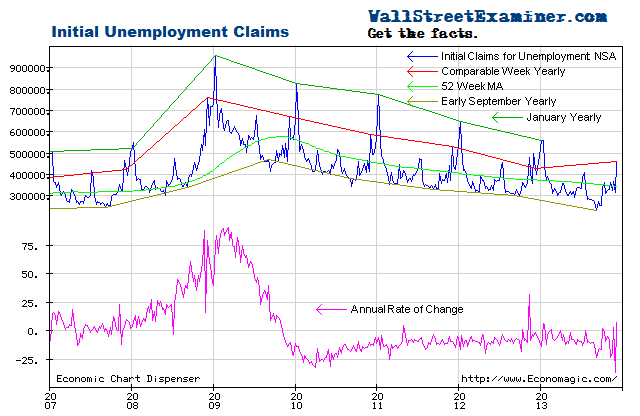
Initial Unemployment Claims – Click to enlarge
The correlation of the broad trends of claims with the trend of stock prices over the longer term is strong. This is clearly visible when the claims trend is plotted on an inverse scale with stock prices on a normal scale.
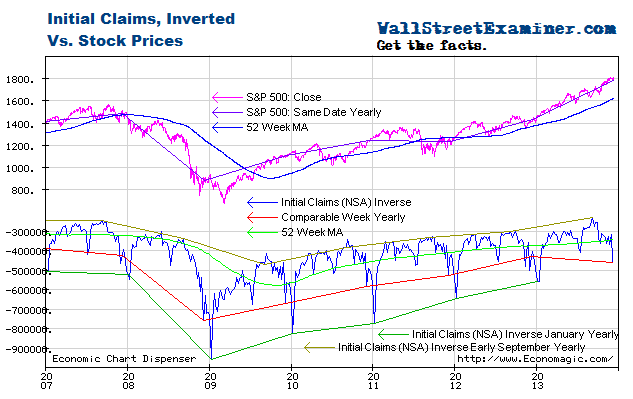
Initial Unemployment Claims and Stock Prices- Click to enlarge
Stock prices broke out of the top of their range channel earlier this year, while the trend rate of improvement of initial claims has slowed. As a monetary/technical analyst, the conclusion I draw is that the Fed’s QE3-4 money printing campaign is having far more success in creating a stock market bubble, which was one of Bernanke’s stated goals (in more slightly different words), than in driving economic growth.
The initial claims claims trend has been improving at a very modest rate lately. The slowing improvement in the claims trend does not support the acceleration of stock prices this year. However, as long as the trend of new claims does not deteriorate further and the Fed (now joined by the BoJ) keeps cashing out the Primary Dealers every month via its asset purchase programs (QE3-4), I would not expect the uptrend channel in stocks to break down. That trend could remain intact and still have an intermediate correction to the mid 1400s. If the claims trend does turn negative toward more rather then fewer claims year to year, then expect a bear market in stocks.
[I cover the technical side of the market in the Professional Edition Daily Market Updates.]
Read Retail Sales Rebound in March after Weak January-February
Get regular updates the machinations of the Fed, Treasury, Primary Dealers and foreign central banks in the US market, in the Fed Report in the Professional Edition, Money Liquidity, and Real Estate Package. Click this link to try WSE's Professional Edition risk free for 30 days!
Copyright © 2012 The Wall Street Examiner. All Rights Reserved. The above may be reposted with attribution and a prominent link to the Wall Street Examiner.

