

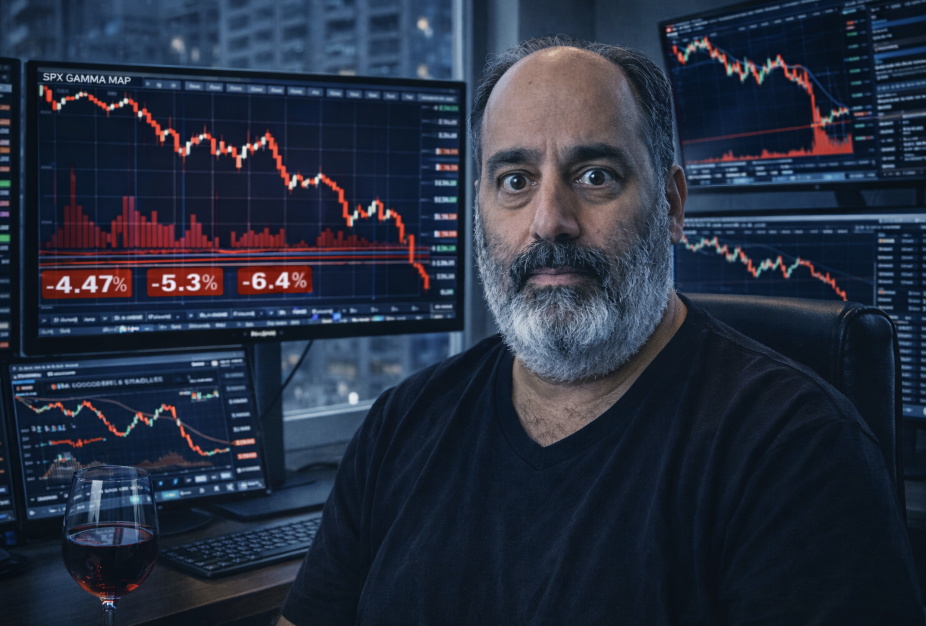
FED Meeting and Cash Out Decision (3/18/2026)
Timeline
0:00 – Oil shock
6:00 – Market selloff
10:00 – Trump credibility
12:00 – Oil shortage outlook
15:30 – Portfolio decision
18:00 – Research process
22:00 – Cash vs staying invested
25:30 – Bear vs bull case
30:00 – Media / trust issues
34:00 – Risk / hedging
36:00 – Fed setup
38:00 – Iran / Hormuz / negotiations
42:30 – Binary market view
45:00 – Cash strategy
47:00 – Stock examples
50:00 – Portfolio reset
52:00 – Fed decision
55:00 – Fed reaction
58:00 – Rates / debt constraints
1:03:00 – Labor / Fed dynamics
1:06:00 – Fed policy stance (“wait and see”)
1:08:00 – Fed projections (growth, inflation, rates)
1:11:00 – Policy contradictions / soft landing debate
1:13:00 – GDP downgrade vs Fed forecasts
1:16:00 – Oil inflation impact on economy
1:18:00 – Fed policy error risk / slowdown reality
1:20:00 – System-wide narrative bias (Fed, media, Wall St.)
1:22:00 – Stagflation risk discussion
1:26:00 – Powell speech begins
1:29:00 – Powell Q&A (inflation, oil, policy path)
1:33:00 – Portfolio strategy (move to cash, reduce risk)
1:34:00 – Defensive sectors / stock selection
1:36:00 – Consumer inflation examples
1:38:00 – Market valuation / correction risk
1:40:00 – 2008 comparison / forward PE risks
1:42:00 – Portfolio risk management & positioning
1:44:00 – Final outlook (no Fed support, markets weakening)
1:46:00 – Example trade (Blue Owl strategy)
1:51:00 – Closing remarks & market outlook
Transcript
Market Webinar — Oil, the Fed, and Portfolio Strategy
Fortunately, I have my key. All right, so as you can see on the NYMEX strip, the front month is $96–97. The April contract — that’s the front month contract — is trading at $80. So it costs less to buy oil right now than it does if you buy the April delivery contract. There’s a premium for April delivery, which tells you which way the market is hedging: they’re betting that in April it will be harder to get oil, not easier.
May is very tight and expensive. June, July, August — look at how many contracts are trading per day. About 400,000 contracts are trading daily, while only 300,000 are open. Every single contract is rolling over today. That is an insane volume of churning, and it’s making everything more expensive.
Things don’t get back to normal until next year — and even then it’s not very normal, with prices around $75. By the volumes, you can see 102,000 contracts trading today for December at $77–78. Oil prices are through the roof.
Trump just said something on TV, but it didn’t help the markets. We’re waiting on the Fed and we’ll look at the petroleum status report.
Petroleum Status Report
Crude oil inventory showed a 6.2 million barrel build from last week. Gasoline inventories dropped by 5 million barrels, but they’re still 3% above the five-year average. Distillate fuel decreased by 2.5 million barrels and is below the five-year average. All other oils — which aren’t in the headlines — are up 3 million barrels too. So on net, it’s a build on oil.
Here’s what’s infuriating: in the middle of this crisis, we are exporting 5.2 million barrels of petroleum products per day — 35 million barrels per week leaving the country. To put that in perspective, the Strait of Hormuz moves 20 million barrels per day total. We are exporting the equivalent of two full days of Strait of Hormuz traffic every week.
Refining capacity is at 90%. The refineries are producing as much as they can — about 20–21 million barrels of petroleum per day, which is a stunning amount.
In terms of price changes from last year: crude oil was $67, now it’s $98 — up about 50%. Gasoline was $1.90, now up about 50%. Heating oil was $2.00, now $4.00 — up 100%. Diesel fuel up 100%. These increases drive up the cost of shipping, trucking, and aviation. Airlines are seeing their fuel costs double. Interestingly, airlines are actually benefiting in the short term because they immediately added surcharges and are seeing a rush of people booking tickets before prices rise further — which was unexpected.
Market Overview
Looking at the Dow: we closed yesterday at a decent level, went up overnight, then fell from 47,600 to 46,800 at the open — down about 800 points since pre-market. We’re at the lows. Not a good day. Gold also sold off, which was interesting. Bitcoin is down almost 5%. People are moving to cash across the board.
Trump’s Statement and the Jones Act
Trump announced a waiver of the Jones Act, which allows foreign vessels to move fuel between U.S. ports. This matters because the East Coast has been having trouble getting gasoline in the current situation. He also signaled willingness to waive certain oil-related sanctions and hinted at guaranteed tanker escorts through the Strait.
The net effect: modestly bearish for crude, mildly supportive for airlines, shippers, and consumers. But the war with Iran is still on. Hormuz traffic is still constrained. Policy signals remain inconsistent.
The equity markets are treating Trump’s statements as headline wiggles at this point — and that itself is telling. Trump is losing credibility. Everything he says, regardless of whether it’s true, isn’t moving markets anymore because nobody believes him. He’s been saying this will be over in a couple of weeks for three weeks now. This is day 19. We’re well into our third week with no real end in sight.
Why Going to Cash Makes Sense
We’re kind of hitting the point of no return with this war. Even if there’s a ceasefire today and the Strait of Hormuz reopens, we’ve already created roughly a 400 million barrel oil shortage. Even in the most ridiculously optimistic scenario — where global producers somehow find 5 million extra barrels per day with no shipping issues — it would still take 80 days just to get back to normal. That’s three months of constrained supply, low inventory, and it would take additional time to refill the Strategic Petroleum Reserve.
More realistically — because turning on spare capacity takes time and capital — you’re looking at 180 days. That takes us into Q4. Essentially, 2026 is already significantly damaged. We’re crossing the threshold where the economic impact may be irreversible for this year.
Responding to Chat: Clown Daddy’s Question
A member in the chat — “Clown Daddy” — put it well: all this back and forth is making his head spin. He’s having trouble determining whether we’re going to cash, selling positions, keeping things, or what direction we’re heading. He doesn’t want to be caught like a deer in the headlights by doing nothing, but also doesn’t want to be churning in and out.
I completely understand that. In a situation like this — on the verge of a major prolonged war — you need to understand what’s happening in context, not just get daily box scores of who bombed what. I’m up at 4 a.m. reading 100–200 articles each morning, and because I’m an expert in this space, I can quickly identify what’s new versus rehashed background. The AI roundtable does the same: they distill hundreds of articles into what actually matters today.
My honest answer: things are getting worse, not better. Going to cash is not some final, definitive retreat from the market. We can always buy stocks again. We can always take the same template and rebuild the portfolio. The question is: why take the pain of a potential 20% drop when you can step aside, let the situation clarify, and come back and buy things that are 20% cheaper? That’s not giving up — that’s smart positioning.
The Bullish Case (Asked of the Roundtable)
I specifically asked the roundtable to give me the bull case — the strongest argument for staying invested. Here’s what they came up with:
Iran’s new Hormuz protocol. Iran signaled yesterday that they’ll establish a new protocol for passage through the Strait. Right now there’s been essentially zero traffic; the Strait was moving 20 million barrels per day before the war. If Iran lets even 10 million barrels through, the problem is cut in half. This appears to be a negotiating tactic — they’ll open the Strait in exchange for concessions like stopping AI-guided bombings, which have a 40% miss rate versus 10–15% for human-guided attacks. Qatar and Oman are brokering back-channel negotiations.
Demand destruction. At $100 oil and $5 diesel, people and businesses start finding ways to use less fuel. This demand destruction could cap prices around $100–110 and prevent a run to $120+.
Oil industry windfall funds new production. U.S. oil producers are making roughly $60 billion more than last year. In theory, that money can fund increased production to help offset the shortage.
Geopolitical reset. One analyst made the case that removing or neutralizing Iran as a destabilizing force could, over years, be good for Middle East stability and development.
The honest assessment: the bull case is flimsy. The best case requires multiple good things happening simultaneously. The bear case only requires the war to continue as it is for another two to three weeks.
Next week marks one month since Trump said this would be over in a couple of weeks. Once you cross one month, the economic damage becomes increasingly irreversible.
The Fed Decision
The Fed held rates unchanged at 3.5–3.75%, as expected.
Key takeaways from the statement and Powell’s press conference:
The Fed explicitly added language acknowledging Middle East risks — a line that didn’t exist before. They are acknowledging the oil shock without reacting to it. As Warren’s analysis put it: “They acknowledged the fire and chose not to reach for the hose. Because they think the fire might burn out, and by pulling the hose, they could flood the house.”
On the dot plot: they still project two cuts in 2026 — slightly more dovish than the one cut we were expecting — but with meaningful internal movement toward fewer cuts. About four or five members shifted from two cuts to one.
On their projections: they raised their growth forecast, raised their inflation forecast, kept unemployment steady, and still think they can cut. This is internally inconsistent. GDP was just radically downgraded — Q4 came in at 0.7%, down from 4.4% — and they’re projecting stronger growth? They’re essentially dismissing the Q4 print as distorted and projecting a rebound that doesn’t yet exist in the data.
Powell’s message to Trump: there will be no rate cuts. The 10-year rate is at 4.2%. The Fed cannot set its rate substantially below the 10-year because no one will buy U.S. paper at those yields. You can’t just declare a lower rate — the market dictates what it will lend at. Japan got away with near-zero rates because the yen represents only about 5% of global currency and their total debt is roughly $13 trillion. We’re at $40 trillion and borrowing $2 trillion per year. The math is completely different.
The bottom line on the Fed: they are in “wait and pray” mode. Waiting for inflation to fall, praying the oil shock doesn’t stick, hoping the labor market doesn’t crack. They downgraded the present and upgraded the future — which only works if everything fixes itself.
Portfolio Positioning Going Forward
Powell didn’t say what we needed him to say. He didn’t provide a clear signal that the Fed would step in if things deteriorate materially. Markets are not responding positively — the Dow is down 650 points (1.4%) and the other indexes are following.
Tomorrow, we are going to go through the long-term portfolio very carefully and de-risk it significantly. That may mean cutting half the positions; it may mean cutting all of them. We’ve made great money this year — the portfolio is only a year old and we’re well ahead of target. There’s no reason to let those gains get wiped out.
What we want to hold going forward:
- Oil companies and refiners (Valero, Exxon) that benefit from the current environment
- Utility companies and water companies with regulated, essential revenues
- Companies with large physical moats that AI can’t easily disrupt (Coca-Cola, Pfizer)
- Defensive, recession-resistant businesses — companies people buy from regardless of economic conditions
What we want to avoid:
- Consumer-sensitive stocks that depend on discretionary spending
- Companies facing AI disruption in their core business
- High-PE growth stocks that require everything to go right
The strategy going to cash is not a permanent move. There are always stocks to trade, always positions to build. We don’t need to stick with what we have. It’s the strategy that makes the money, not any specific stock.
Stock Highlight: Blue Owl (OWL)
One actionable trade the roundtable independently flagged today, which I also called at $10: Blue Owl, currently around $9.18.
The logic: it’s trading under 10x earnings, which is genuinely cheap. If they pay their dividend (which they’ve indicated they will), it’s a 10% yield.
A straightforward structure:
- Buy 500 shares at ~$9.18
- Sell the $10 covered calls for ~$2.30 (net cost ~$6.88/share)
- Collect ~$1.80 in dividends twice before the 2028 expiration
- Effective net cost: ~$5.00/share
- If called away at $10 in 2028: roughly 100% profit
You can also layer in put sales for additional income. The panic around Blue Owl is overdone — the math on this one makes sense at current prices.
Closing Thoughts
We have strong hedges in place, so if the market continues to decline, those will help offset losses in the long portfolio. But ideally, we don’t want to be in a situation where we’re making money on hedges while losing money on longs. The ideal outcome is to be in cash, watch the situation develop, and come back in when the picture is clearer.
The Dow is down 650 points today. If we have another month of this, you’ll be glad we went to cash. Better safe than sorry. See everyone next week.