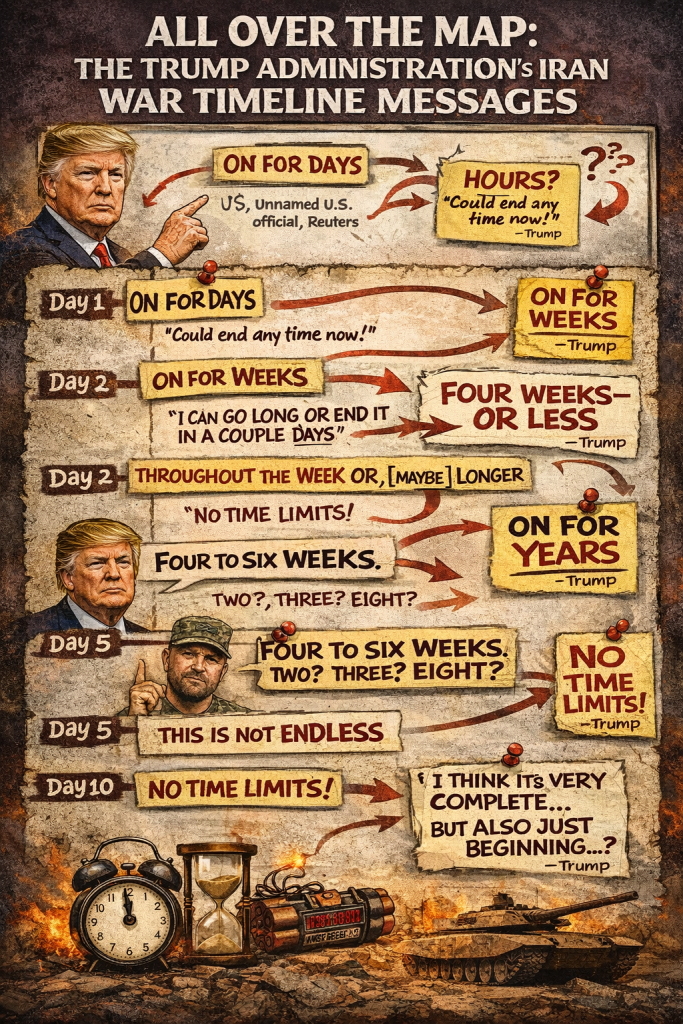
How long will President Trump’s new war with Iran last? That depends on who you’re asking, how, when, and perhaps whether or not the markets are currently freaking out. Since the start of the war, Trump, Secretary of War Pete Hegseth, and others have offered very mixed messages about the potential timeline for the conflict — which clearly isn’t ending anytime soon, or could end hours from now, or will go on as long as it has to, because the U.S. can go longer than any other country. It’s also proceeding way ahead of schedule, as Iran is being decimated and re-decimated and re-re-decimated daily. But the war is also now complete, or almost complete, or only just beginning. To help everyone keep track, below is an updating rough timeline of Trump and other officials’ emanations about the potential length of the war.
AI’s Assessment:
What military reality suggests
Looking at how wars like this normally unfold, analysts generally see three plausible scenarios.
1. The “declare victory and leave” scenario (fastest)
This is the most politically convenient outcome.
What happens:
- Airstrikes destroy key Iranian military targets.
- U.S. claims nuclear and missile programs are neutralized.
- War is declared a success and bombing stops.
Typical timeline: 2–5 weeks total
This roughly matches the original White House estimate and the kind of campaign used in Kosovo or Libya.
2. Extended air campaign (very plausible)
This happens if:
- Iran continues firing missiles and drones
- Proxy forces in Iraq, Syria, Lebanon attack U.S. assets
- Shipping in the Strait of Hormuz remains threatened
In that case the U.S. keeps bombing strategic targets but avoids invasion.
Typical timeline: 2–6 months
Some Israeli officials already warn the conflict could last months, especially if destroying missile networks proves harder than expected.
3. Escalation / regime-change attempt (worst case)
If the goal becomes overthrowing Iran’s government, the timeline explodes. That could mean:
- Support for internal uprising
- Ground forces or proxy armies
- Long-term occupation risk
Typical timeline: years
This is what people fear when they hear phrases like “building a new country.”
My best estimate
If I had to give a probability breakdown:
| Outcome | Probability | Timeline |
|---|---|---|
| Declare victory and stop bombing | 50% | 3–6 weeks |
| Continued air war / regional conflict | 35% | 2–6 months |
| Escalation into regime-change war | 15% | years |
So the most likely window is: late March to mid-April 2026 (if the administration chooses to declare success and wind down).
✔️ Important point:
Wars often “end” politically before they end militarily. The U.S. could stop major strikes but still remain in a low-level conflict with Iran and its proxies for years.
Three Signals That Will Tell Us Soon Whether This War Ends Quickly or Becomes Something Much Bigger
While official messaging has been inconsistent, the real clues about how long the conflict may last will come from developments on the ground and in the global energy and military systems surrounding the war. There are three indicators that analysts and markets are watching closely. Within the next week or two, these signals will likely reveal whether the conflict is heading toward a quick political conclusion or expanding into a broader and longer war.
The first signal is whether Iran retains the ability to keep launching missiles and drones.
The entire premise of the U.S. operation, according to statements from the Pentagon and the White House, is that the goal is to eliminate Iran’s missile threat and degrade its military command structure. If Iranian missile launches taper off sharply and drone attacks decline, the United States can plausibly argue that the mission has succeeded. That would make it politically easier for the administration to declare victory and wind down the campaign within a few weeks. If, however, Iran continues firing missiles at Israel, Gulf states, or U.S. bases in the region, the logic of the operation changes. A persistent Iranian ability to strike back would force the United States to continue air operations longer than originally planned in order to suppress those capabilities.
The second signal is whether the war spreads through Iranian proxy forces across the region.
Iran rarely fights wars only through its own military. Instead, it operates through a network of allied militias and armed groups across the Middle East, including organizations in Iraq, Syria, Lebanon, and Yemen. If these groups begin launching sustained attacks on American forces, shipping lanes, or Israeli infrastructure, the conflict could quickly expand into a multi-front regional war. In that scenario, the United States would likely have to maintain military operations far longer than a short air campaign. On the other hand, if proxy groups remain relatively quiet or carry out only limited attacks, it would suggest that Tehran is attempting to contain the conflict rather than escalate it.
The third signal is what happens to global oil markets and shipping routes.
Oil markets are extremely sensitive to Middle Eastern conflict, especially when fighting involves Iran, which sits near the Strait of Hormuz — one of the most important energy chokepoints in the world. If oil prices stabilize or decline, it likely means that energy traders believe the conflict will remain limited and temporary. But if oil prices surge and remain elevated, that would indicate that markets expect prolonged instability or disruptions to shipping. Historically, sustained spikes in oil prices often coincide with longer wars in the region.
Taken together, these three indicators — Iran’s ability to continue striking back, the involvement of proxy forces, and the reaction of global oil markets — will probably determine the real timeline of the war. If Iranian retaliation fades, proxies stay largely out of the fight, and oil markets calm down, the conflict could end in a matter of weeks. If the opposite occurs, the war may settle into a longer and more unpredictable phase that could last months or even years.