


What if the most confident market take is the one that deserves the closest inspection? Headlines can turn routine moves into apparent turning points, while commentary may blend evidence, forecasts, and personal opinion into one persuasive story. Unbiased stock market insights aren’t about finding a voice with a “neutral” label. They’re about seeing how a claim is built and what might be missing.
If you’ve ever wondered whether an analyst’s argument is balanced or simply compelling, that skepticism is useful. This article offers a practical way to assess market insights: check the evidence and context, separate what’s known from what’s predicted, and look for incentives or overlooked perspectives. You’ll also learn how to read daily commentary and market analysis as material for clearer thinking, not as a guaranteed trade signal. The goal isn’t to eliminate uncertainty. It’s to recognize it before a confident narrative starts making decisions for you.
Key Takeaways
- Use a four-step test to clarify what a market claim says, where its evidence comes from, and whether the surrounding context supports it.
- Match the source to the question: news can report what happened, company materials show management’s position, and investor discussions reveal what people are debating.
- Keep a brief research note that separates observed facts from interpretation and any action you’re considering.
- Unbiased stock market insights depend on transparent reasoning, not a label. Look for assumptions and uncertainty alongside the evidence.
- Use Phil Stock World’s daily commentary and analysis as one input in your research, then assess its reasoning for yourself.
What Are Unbiased Stock Market Insights, and What Can They Actually Tell You?
There’s no shortage of market commentary. The harder part is deciding whether a confident-sounding claim rests on solid evidence or simply tells a compelling story. A useful insight makes its reasoning visible: it points to relevant information, identifies assumptions, and acknowledges what remains uncertain. That’s a more practical standard than expecting any commentator to be entirely free of perspective.
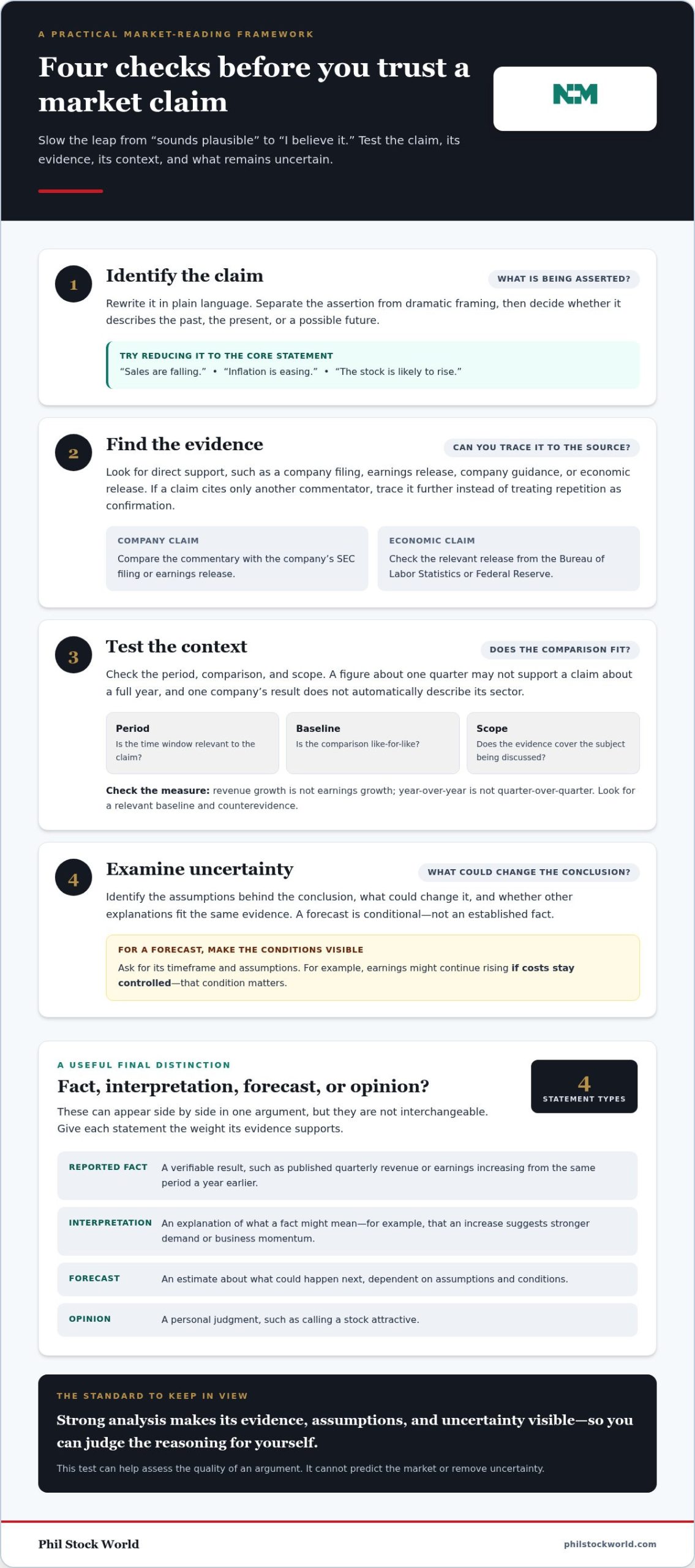
Start by separating four kinds of statements. A reported fact describes something verifiable, such as a company’s published quarterly revenue. An interpretation explains what that fact might mean, perhaps that sales growth suggests stronger demand. A forecast estimates what could happen next, such as revenue rising next quarter if demand holds. An opinion expresses a personal judgment, like calling the stock attractive. These statements can sit side by side, but they aren’t interchangeable.
Balance doesn’t mean treating every argument as equally credible. A claim supported by company filings or economic releases deserves a different weight from an unsupported prediction. Assess each statement according to its evidence, relevance, and limits. A broad Stock market overview and analysis can help frame how different forces and approaches shape market activity, but it can’t settle a specific investment claim on its own.
How market facts, analysis, and forecasts differ
Imagine a company reports that quarterly earnings increased from the same period a year earlier. That’s a reported result, assuming the figures match its published report. Saying the increase shows the business is gaining momentum is an interpretation. It may be reasonable, but you still need context, such as whether revenue also grew or whether a one-time event affected earnings.
A forecast goes a step further: an analyst might estimate that earnings will continue rising if costs stay controlled. That’s conditional, not established fact. Time horizon matters, too. A product delay may weigh on a stock in the near term while having little bearing on the long-term business outlook. Ask which period the claim addresses.
Why no market source is perfectly neutral
Every source makes choices about what to cover, which comparisons matter, and who it’s speaking to. Expertise can sharpen analysis; an audience or commercial incentive can influence emphasis. Those influences don’t automatically invalidate a view. The key distinction is between an acknowledged perspective and an undisclosed conflict, or a claim presented as fact without adequate support.
Neutrality is the absence of perspective; transparent analysis shows its evidence, assumptions, and uncertainty so readers can judge the perspective for themselves. With Unbiased stock market insights, look for that transparency rather than a promise of perfect objectivity. Sound analysis can clarify what the available evidence suggests and where it stops. It can’t remove uncertainty, guarantee a forecast, or decide what matters most to every investor.
How to Test a Stock Market Insight: Four Checks Before You Trust the Claim
A sharp headline can make a claim feel settled before you’ve checked what it rests on. Use this four-part test to slow the leap from “sounds plausible” to “I believe it.” It won’t predict the market, but it will help you judge the quality of the reasoning.
- Identify the claim. Rewrite it in plain language. Is it saying a company’s sales are falling, inflation is easing, or a stock is likely to rise? Separate what’s asserted from dramatic framing, and ask whether the statement describes the past, the present, or a possible future.
- Find the evidence. Look for a direct reference to a company filing, earnings release, company guidance, economic release, or another primary source. If the claim cites only another commentator, you may be following an echo instead of checking the original evidence.
- Test the context. Check the period, comparison, and scope. A statistic about one quarter may not support a claim about a full year; a figure for one company doesn’t automatically describe its sector. Look for a relevant baseline and counterevidence.
- Examine uncertainty. Identify the assumptions behind the conclusion, what could change it, and whether other explanations fit the same evidence. The more specific the forecast, the more useful it is to know its timeframe and conditions.
Trace the claim back to evidence
For a company claim, compare the commentary with its SEC filings or earnings release. Original documents let you inspect the figures and definitions instead of relying solely on a summary that may omit a caveat. Check that the evidence measures the same thing the claim discusses: revenue growth is not earnings growth, and a year-over-year comparison is not the same as a quarter-over-quarter one. The SEC Office of Investor Education and Advocacy also provides investor education resources.
Watch for citation chains. If one article repeats an analyst’s claim and a social post repeats the article, repetition hasn’t created independent confirmation. Trace the statistic to its original source where possible.
Test context, assumptions, and uncertainty
For an economic claim, compare the cited number with the relevant release from the Bureau of Labor Statistics or Federal Reserve. Check the release date, measure, and comparison period. A shift in one indicator may not establish a broad economic trend. Benchmarks such as the S&P 500 can help show how a stock or portfolio compares with a broad index over a chosen period, but they don’t capture every sector, risk, or investor’s circumstances.
Ask what else could explain the move and what would weaken the argument. A forecast without assumptions and a timeframe is difficult to evaluate. To practice this framework with ongoing market commentary, Phil Stock World’s stock and options analysis can be one input in your research, not a substitute for your judgment.
News, Research, and Community Commentary: Which Sources Fit Which Question?
Think of market research as a set of different lenses, not a contest to find one perfectly neutral voice. Each source can help answer a particular question, but none should be treated as a bias-free authority. Start by asking what you need to know: what happened, what management says happened, how an analyst interprets it, or what investors are debating.
| Source | Best question to ask | What it can offer | What to keep in mind |
|---|---|---|---|
| Financial news reporting | What happened? | Timely coverage of events, results, and market developments. | A summary may leave out detail or context. Follow material claims back to the original source. |
| Company materials | What does management report or expect? | Published results, company explanations, and forward-looking guidance. | These materials present the company’s account, not an independent verdict on its prospects. |
| Analyst commentary | How might the information affect the outlook? | Interpretation, comparisons, and forecasts that can help frame questions. | Check the reasoning, evidence, assumptions, and timeframe behind the view. |
| Investor discussions | What are investors debating? | Questions, concerns, and alternative explanations that may point to issues worth researching. | Agreement, popularity, or confidence in a discussion doesn’t establish that a claim is true. |
What financial news can and cannot establish
A broad financial-news homepage can help you spot stories worth examining. MarketWatch, for example, offers a mix of financial news and investing coverage; that breadth alone doesn’t establish whether a particular article is neutral or complete. News reporting can tell you that a company released results or that a market event occurred. It doesn’t automatically tell you what the event means for a stock or what you should do.
If an article says a company raised its outlook, open the company’s announcement and read what management actually said. Pay attention to qualifications and the period covered. You can also use FINRA investor resources and education to build your understanding of investing concepts and make better sense of the claims you encounter.
How to read commentary and investor discussions
Commentary is interpretation, even when it draws on experience or detailed analysis. Note the evidence it cites and whether it’s discussing a short-term move or a longer-term business outlook. Then compare its explanation with other plausible readings of the same facts. Disagreement can reveal which assumptions deserve a closer look; it doesn’t mean every explanation has equal support.
Investor forums, including Reddit-style discussions, can surface useful questions: Is a cost temporary? Does a product delay affect future sales? Treat those questions as prompts, not conclusions. Upvotes show engagement, not verification. For Unbiased stock market insights, use each source for the question it can help answer, then check important factual claims against primary evidence.
Build a Repeatable Routine for Reading Stock Market Insights
A consistent routine can keep a market headline from hijacking your attention. The goal isn’t to check every move or turn each new opinion into a decision. It’s to pause, capture what’s being claimed, and decide whether the evidence changes your understanding. A short written note helps separate new information from the urgency of the moment.
A practical checklist for a headline or trade idea
Before reacting, make a quick record. Include enough detail to revisit the claim later, then check what supports it and what might challenge it. Keep the routine simple enough to use regularly, but specific enough to expose gaps in the argument.
- Record the claim, source, date, and timeframe. Note whether it’s a report about what happened, an interpretation, or a forecast for a stated period.
- Find a primary source. Look for the filing, company release, or economic data behind the claim rather than relying only on a summary.
- Write down an alternative explanation. Ask what else could account for the event or market reaction, and what credible evidence supports that view.
- Name what could change your mind. Identify the new information that would weaken your interpretation, strengthen it, or leave the question unresolved.
Then separate the note into three lines: Observation: what the source reports. Interpretation: what you think it may mean, including assumptions. Possible action: what you might consider next, if anything. Keeping these distinct makes it harder for a guess to quietly become a “fact” just because you’ve written it down.
Track what changed without chasing every market move
Revisit your note when meaningful new evidence arrives, not simply because the price moves. A price change is an observation; deciding it proves your thesis right or wrong is an interpretation. Check whether the underlying facts changed, whether your assumptions shifted, or whether the market is reacting to something outside your original reasoning. If nothing material changed, you may not need to rewrite the thesis.
Indicators can add context, not certainty. The Cboe Volatility Index, or VIX, reflects expected near-term volatility implied by S&P 500 options. It can help describe the market’s volatility outlook, but it doesn’t tell you whether prices will rise or fall, and it can’t predict an individual stock’s path. Treat it as one dashboard reading, not the steering wheel.
Finally, keep any possible action grounded in your own goals, time horizon, and tolerance for risk. General commentary can help frame questions, but it can’t determine what’s appropriate for your circumstances. To add a regular source of analysis to this note-taking routine, explore Phil Stock World market commentary and assess the reasoning for yourself.
How Phil Stock World Commentary Can Fit into Your Research
Phil Stock World publishes daily stock and options commentary, market analysis, and trading ideas. Treat that material as a starting point for questions, not a verdict or instruction to trade. Apply the same evidence-and-uncertainty framework: identify the claim, trace its support, consider what’s missing, and decide whether the reasoning holds up against other relevant information.
Use commentary as a prompt for deeper research
Suppose a commentary piece suggests that a company’s new guidance could influence its share price. First, pin down the claim: is it about an immediate market reaction or the company’s longer-term outlook? Then examine the reasoning, assumptions, and timeframe. Compare the discussion with the company’s own release and, if the argument relies on economic conditions, the relevant data. Note what could weaken the thesis, too.
This approach keeps Unbiased stock market insights focused on transparent reasoning rather than a supposedly perfect source. Phil Stock World membership offers different levels of access to commentary and related resources. For background on that structure, the article Phil Stock World Membership: Your 2026 Guide to Trading Like “The House” provides a useful overview. Whatever the format, an idea is something to investigate, not a guaranteed outcome or replacement for your own judgment.
Choose an educational next step that fits your goals
To build your understanding, explore Phil Stock World’s educational resources, including webinars, market charts and analysis, and virtual portfolio reviews. These can help you examine market reasoning, explore strategies, or reflect on how you assess your own portfolio. A virtual review can be a learning opportunity, not a promise of returns or personalized financial planning.
Membership tiers provide different levels of access to commentary, alerts, and interactive sessions. The material to explore depends on what you’re trying to understand: a chart may help you inspect price action, while a webinar or discussion can offer context for how market participants interpret events. For a closer look at the review format, the article Virtual Portfolio Review: Auditing Your Strategy for the 2026 Market offers related context.
Keep your process in the driver’s seat. Read the analysis, check its evidence, and decide what further research would help you, without treating any commentary or alert as a trade signal that must be followed. If you’d like another perspective to examine, explore Phil Stock World’s market insights and use what’s useful in your own research.
Make Your Next Market Read More Deliberate
Your next step doesn’t need to be a bold prediction. Pick one market claim that catches your attention and track how your view changes as new evidence appears. Over time, that habit can make Unbiased stock market insights less about finding a supposedly perfect source and more about asking sharper questions, staying open to alternatives, and keeping uncertainty in view.
Phil Stock World can be one resource in that process. Its daily stock and options commentary and trading ideas give you material to examine, while webinars, virtual portfolio reviews, market charts, and strategy guides offer educational ways to explore market reasoning. Use what you find to deepen your own research, not to outsource your judgment or assume any idea guarantees an outcome.
Explore Phil Stock World’s market insights and use them to prompt questions for your research. A thoughtful routine starts small, and every claim you test is a chance to become a more confident, independent reader of the markets.
Frequently Asked Questions
Is it possible to get completely unbiased stock market insights?
No source can remove every perspective or incentive from market analysis. Treat “unbiased” as a standard to test, not a guarantee attached to a publication. For example, if two articles interpret the same earnings release differently, compare each explanation with the release and notice which relevant details or counterarguments each leaves out. That helps you judge the reasoning without assuming either source is perfectly neutral.
Can financial news be trusted when outlets have sponsors or advertisers?
Sponsorship alone doesn’t prove that a report is inaccurate. Check whether the content is labeled as advertising, sponsored material, analysis, or opinion, and note who produced it. If a story says a company is changing its outlook, compare that statement with the company’s announcement before drawing a conclusion. Assess the specific claim and its supporting evidence rather than treating an outlet’s advertising model as proof for or against it.
How can I tell if a stock analyst has a conflict of interest?
Look for disclosures about the analyst’s positions, compensation, affiliations, or other relationships that could bear on the analysis. Then examine the argument: does it explain its assumptions and address risks, or only emphasize a favorable scenario? A disclosed relationship is context, not proof that the conclusion is wrong. If you can’t find a disclosure, don’t assume either independence or misconduct; weigh the claim against other available evidence.
What should I do when market experts disagree?
First check whether they’re discussing the same company measure, event, and timeframe. One analyst may be weighing next quarter’s results while another is considering long-term demand. Compare their underlying assumptions and the evidence each uses, then identify what future information could distinguish between their scenarios. If they’re repeating the same forecast, repetition doesn’t make it a confirmed fact. You can wait for clearer evidence rather than force a choice.
Are online investor discussions reliable sources for stock market information?
They can be useful for discovering questions, but shouldn’t be your final source for a factual claim. A forum thread about a company’s product delay, for instance, might prompt you to look for a company announcement or filing. Posts can reflect personal positions, omit context, or repeat unverified claims. Treat votes and agreement as signs of discussion, not confirmation that the information is accurate.
How often should I review stock market insights?
Review them according to the question’s timeframe and your own research needs, not every time a headline appears. If you’re following a company event, revisit your notes when the company releases relevant information or a stated assumption changes. A simple dated record can show whether new evidence actually changed the case or only the commentary’s tone. More frequent checking doesn’t guarantee better decisions.
Does a paid stock market newsletter guarantee better investment results?
No. Paying for commentary or research can’t guarantee investment results or remove risk. Before subscribing, understand what the membership includes and how access varies by tier. Phil Stock World offers different levels of access to commentary, alerts, and interactive sessions. Treat any alert as information to assess, not an instruction. Consider whether the material helps you research questions you care about, and judge ideas against your own circumstances.