


What if the best reason to join a trading room isn’t getting the next trade alert, but understanding the thinking behind it? Market commentary, trade ideas, and live discussion can blur together, especially when markets are moving fast. An interactive trading room membership is most useful as a place to examine ideas and context, not as a shortcut around your own decisions.
It’s reasonable to consider how much time a live room demands and whether a stream of real-time ideas could pull you away from your plan. At Phil Stock World, interactive sessions are part of a broader mix of market commentary, analysis, webinars, and community discussion. The value is in learning and evaluating ideas, not treating commentary as a promise of results.
This guide explains what an interactive trading room membership can include, how live discussion differs from static research, alerts, and brokerage tools, and what to consider before joining. Use the practical comparisons and questions below to assess the format, time commitment, and fit with your decision-making routine, without letting the room trade for you.
Key Takeaways
- An interactive trading room membership adds live discussion and questions to market analysis, but it doesn’t execute trades or make decisions for you.
- Use a simple process to move from market context to evaluating an idea, asking questions, and making an independent decision.
- Compare live room discussion with newsletters, alerts, and brokerage platforms by looking at timing, interaction, and your role in each.
- Assess whether the format fits your experience, available attention, learning goals, and preferred way to discuss markets.
- Phil Stock World membership combines commentary and trade ideas with interactive sessions in some tiers, plus educational resources.
What an Interactive Trading Room Membership Gives You Beyond Alerts
An alert gives you an idea. A live room gives you a place to examine an idea in context. An interactive trading room membership typically centers on real-time market discussion, analysis, and member questions, so participants can follow how commentary connects to changing conditions. The format builds on the broader idea of a trading room, but discussion does not mean handing over your trading decisions.
A trading room informs decisions; it doesn’t make them for members. Discussion and trade ideas are not brokerage execution, asset management, or individualized financial planning. Members decide whether an idea suits their objectives, risk limits, and trading plan, then handle any resulting transaction through their own brokerage account.
What happens in a live trading room?
A discussion may draw on market commentary, charts, economic or company developments, and questions from members. Instead of receiving a standalone alert with little explanation, participants can follow analysis as it unfolds and ask how a market move might affect the idea under discussion. This exchange can make the reasoning easier to examine while leaving room for different interpretations.
Hypothetical example: Suppose a company’s shares move sharply after an earnings announcement. A room discussion might examine the price action on a chart, consider the announcement alongside broader market conditions, and address member questions about what could change the outlook. This is an illustration, not a report of a specific event or trade.
Separate understanding an idea from acting on it. Ask what assumptions the analysis depends on, what could invalidate those assumptions, and whether the idea fits your plan. A lively discussion can sharpen your questions, but it can’t replace independent judgment or personal risk controls.
How membership differs from a newsletter or brokerage account
A newsletter delivers written commentary for you to read on your own time. It can provide market context and ideas, but the format is generally one-way: you interpret the material without a live back-and-forth. A live room adds dialogue and shared context, which can help clarify how an idea is being considered as markets develop. The trade-off is attention: following a live conversation takes time, while written research can fit around your routine.
A brokerage account serves a different purpose. It provides the means to place and manage transactions; a trading room provides discussion and analysis. Commentary may inform your thinking, but it doesn’t place orders or manage your assets. Keeping those roles distinct helps prevent a market idea from feeling like an instruction to trade.
At Phil Stock World, interactive sessions are part of a broader membership that includes daily stock and options commentary, trade ideas, and community discussion. For more context on how these elements fit within the wider offering, explore the Phil Stock World membership guide.
How Interactive Trading Room Membership Turns Market Information into Discussion
Market information becomes more useful when you know what to ask about it. A chart can show a price move; commentary can add context. In a live discussion, members can consider what the information might mean, test assumptions, and identify what remains uncertain. That’s a thinking process, not a forecast or a prompt to trade.
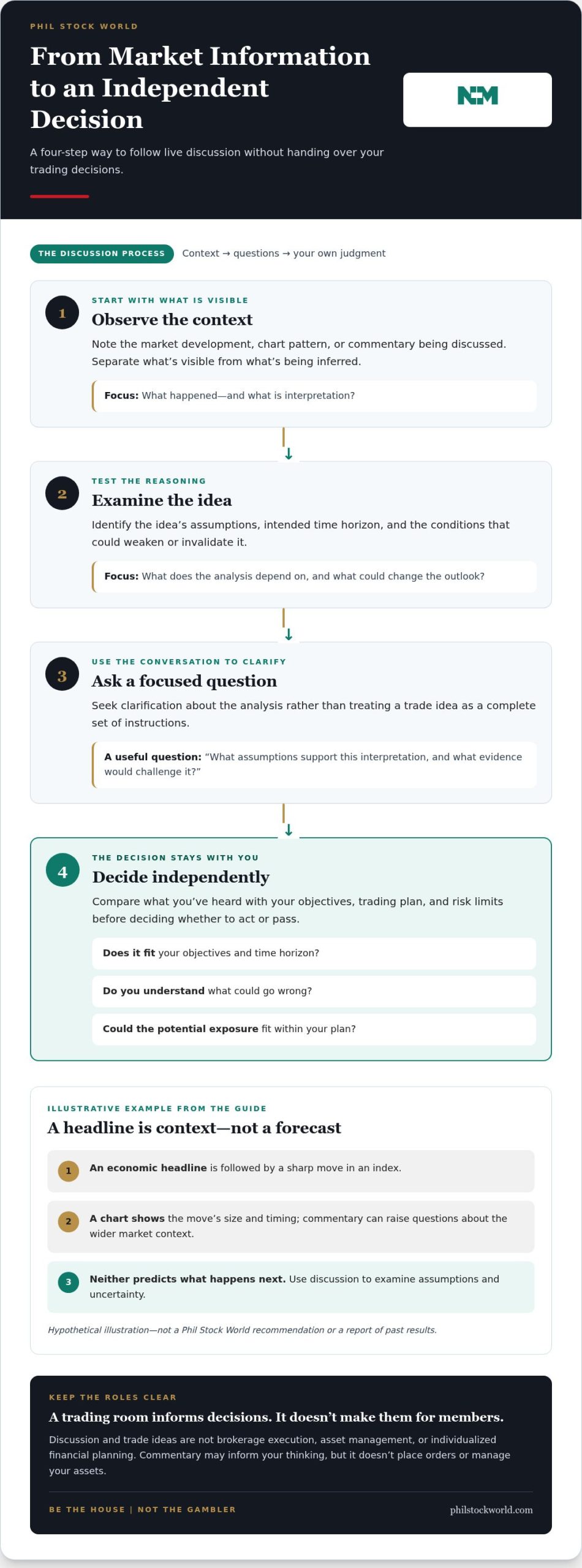
A practical way to follow the exchange is to move through four steps:
- Observe the context. Note the market development, chart pattern, or commentary being discussed. Separate what’s visible from what’s being inferred.
- Examine the idea. Identify its assumptions, intended time horizon, and the conditions that could weaken or invalidate it.
- Ask a focused question. Seek clarification about the analysis, rather than treating a trade idea as a complete set of instructions.
- Decide independently. Compare what you’ve heard with your objectives, trading plan, and risk limits before deciding whether to act or pass.
Market analysis can frame your decision; the final trading decision remains yours. An interactive trading room membership can offer a setting for learning how ideas are discussed, but the conversation can’t account for every member’s circumstances or replace a personal plan and risk controls.
From market context to a question worth asking
Consider a hypothetical example: an economic headline is followed by a sharp move in an index. A chart may show the size and timing of that move, while commentary can raise questions about the wider market context. Neither predicts what happens next. A useful follow-up might be: “What assumptions support this interpretation, and what evidence would challenge it?” This is an illustration, not a Phil Stock World recommendation or a report of past results.
From discussion to an independent decision
Before acting, compare the discussion with your objectives and risk limits. Does the idea suit your time horizon? Do you understand what could go wrong? Could the potential exposure fit within your plan? If key questions remain open, write them down and pause. There’s no requirement to turn every conversation into a position. For related educational context on options, explore advanced options trading strategies.
This approach keeps discussion useful without letting the pace of a live room rush your judgment. Phil Stock World brings together commentary, trade ideas, and educational resources. Browse its market analysis and educational resources to see how broader market context can support your own research.
Interactive Trading Room vs. Alerts, Newsletters, and Brokerage Tools
These formats can all bring market information to your screen, but they serve different purposes. A live conversation makes questions and dialogue possible; a newsletter gives you written analysis to review at your own pace; an alert delivers a brief prompt; and a brokerage platform supports account and transaction activity. The useful comparison is not which one is “best,” but what job you need it to do.
| Format | Interaction | Timing | Purpose and member responsibility |
|---|---|---|---|
| Live trading room | Discussion and questions may be part of the format. | Takes place in a live session; timing and access depend on the service. | Explore market context and ideas through discussion. You decide what, if anything, fits your plan. |
| Written newsletter | Usually read individually, without live dialogue in the document itself. | Available for reading when delivered or accessed. | Review commentary and analysis at your own pace, then interpret it for yourself. |
| Standalone alert | Typically presents a message or idea rather than an ongoing conversation. | May arrive as an update; delivery timing varies by service. | Take the alert as information to assess, not an instruction or assurance that an idea suits you. |
| Brokerage platform | Primarily provides tools for managing an account and transactions. | Used when you access the platform. | Review account information and enter transactions yourself; platform functionality is distinct from market discussion. |
Formats and timing differ, so focus on what each one provides. Consider what information you’ll receive, whether you can engage in discussion, and which decisions remain yours. A room, newsletter, alert, and brokerage platform address different information and execution needs.
Live discussion versus trade alerts and newsletters
A live room can let you ask how an idea relates to the market context being discussed. A newsletter provides analysis to consider independently, while a standalone alert may call attention to a particular development or idea with less surrounding explanation. Each has a different rhythm and level of dialogue. Faster delivery alone doesn’t establish an idea’s quality, explain its assumptions, or show whether it suits your circumstances.
Discussion doesn’t eliminate uncertainty. Treat a chart, alert, or comment as a starting point for questions: what’s the time horizon, what assumptions are being made, and what could change the interpretation? That habit helps keep speed from masquerading as certainty.
Trading room membership versus brokerage tools
Brokerage platforms and rooms occupy different parts of a trader’s workflow. Interactive Brokers is an example of a brokerage platform, not a direct equivalent to a membership-based discussion room. Brokerage access relates to accounts and transactions; a room centers on market analysis and conversation. One doesn’t replace the other, and room membership doesn’t mean trades are executed or assets managed for you.
An interactive trading room membership may suit someone seeking dialogue around market information, while brokerage tools serve account and transaction needs. Keeping those roles clear makes it easier to judge what each format contributes and what it leaves to your own research and decisions.
How to Decide Whether an Interactive Trading Room Fits Your Routine
A live room can be engaging, but engagement alone doesn’t make it a good fit. Before choosing an interactive trading room membership, consider how you learn, how much attention you can give a discussion, and what you want from it. The aim isn’t to keep up with every market move. It’s to find a format that supports thoughtful decisions without crowding out your own process.
Questions to ask about your own trading habits
Start with the routine you actually have, not an idealized one. If you can’t focus on live conversation during the periods that matter to you, written commentary may fit better. If you learn by hearing ideas discussed and asking questions, interaction may be more useful. Be clear about whether you want market context, education, idea discussion, or tools for executing transactions. Those are different needs.
- Experience: Can you explain your own approach and the risks you’re willing to take, or are you still building those foundations?
- Attention: Can you follow a live discussion without multitasking or feeling pressured to respond immediately?
- Learning goal: Are you there to understand market analysis, explore trade ideas, or build knowledge through discussion?
- Format: Do you learn better through live questions, written research, or a combination?
- Personal boundaries: What assets, strategies, or situations have you already decided you won’t trade?
That last question matters. Decide your boundaries before outside commentary enters the picture, so a persuasive idea doesn’t quietly rewrite your rules in the moment.
Set realistic expectations and risk boundaries
Analysis and discussion can’t guarantee a profitable outcome, and an idea raised in a room won’t suit every member. Treat a membership as a source of context and education, not a substitute for your judgment. Compare any idea with your objectives, risk tolerance, and documented trading plan. If you can’t explain why it fits, pausing or passing is a sound option.
Set practical guardrails before joining a discussion: decide how much time you’ll spend following it, define position-sizing limits in your plan, and keep independent research in your routine. Note questions you can’t yet answer rather than treating urgency as a reason to act. These boundaries help keep participation deliberate, whether the conversation is fast-moving or quiet.
If you’re evaluating how current holdings and strategy fit together, a virtual portfolio review offers related context for examining portfolio decisions. For a broader look at membership formats and resources, use the Phil Stock World membership guide as part of your comparison.
Explore the research and education available alongside interactive discussion through Phil Stock World membership resources, and consider how they align with your routine and learning goals.
What Phil Stock World Membership Adds to an Interactive Trading Room
A trading room can be more useful when it sits within a wider research and education environment. Phil Stock World brings together daily stock and options commentary, trade ideas, community discussion, and real-time interactive trading sessions in some membership tiers. Members can engage with market analysis in different ways, from reviewing written context to taking part in live discussion.
A membership that combines commentary, sessions, and education
Daily commentary and trade ideas offer material to examine alongside market developments. Interactive sessions in some tiers add a live discussion format, while community discussion creates space to engage with ideas. These elements are part of a broader mix, and not every member receives the same features or finds every idea suitable for their trading plan.
Educational and analytical resources extend beyond the room. Phil Stock World offers webinars, virtual portfolio reviews, market charts, sector insights, and strategy guides. Each can contribute to your own research: charts can help you study price action, sector insights can add context, and educational material can help you explore a strategy. These are resources for learning and analysis, not a substitute for independent judgment.
That distinction matters. Phil Stock World is not a brokerage, asset manager, or provider of personalized financial planning. Membership provides commentary, ideas, and educational resources; members remain responsible for their own research and trading decisions. No discussion, chart, or analysis can guarantee a profitable outcome.
How to take the next step with Phil Stock World
Before joining, review the membership details on the Phil Stock World site and compare the format with your goals, schedule, and risk boundaries. Consider whether you want ongoing commentary, interactive discussion, educational resources, or a blend of those formats. The right fit is one you can use thoughtfully, without treating participation as a reason to move beyond your plan.
To assess an interactive trading room membership, ask whether its mix of discussion and research supports how you want to learn and make decisions. If it does, explore the details at your own pace and decide whether the format fits. Explore Phil Stock World membership.
Make Your Next Market Conversation More Intentional
The value of an interactive trading room membership depends on how you use the discussion: as a prompt to think more clearly, not as a substitute for your judgment. Before taking the next step, decide what you want to learn, how much time you can give it, and which personal rules you’ll keep in place regardless of what’s being discussed.
Phil Davis founded and leads Phil Stock World, bringing a veteran trader and market analyst’s perspective to its research and education. That history offers context, but no membership or commentary can promise a particular trading outcome. Your plan, questions, and decisions remain central.
If the format aligns with your goals, review the current membership information and consider how it fits your routine. Explore Phil Stock World membership and choose your next step with care.
Frequently Asked Questions
What is an interactive trading room membership?
An interactive trading room membership provides access to a setting where market ideas can be discussed and questions raised. Depending on the membership tier, the experience can include live sessions alongside research or educational material. For example, a member might listen to commentary on a market move and note questions to explore later. It’s a source of discussion and learning, not a promise that any idea will be suitable or successful.
How does a live trading room differ from a trading newsletter?
A live room offers the possibility of dialogue, while a newsletter is generally read on your own, without a real-time exchange. That difference can affect how you learn: a live discussion may let you seek clarification, while a written piece gives you time to reread or compare points with other research. Neither format removes uncertainty. Consider whether you prefer asking questions as ideas develop or reviewing analysis at your own pace.
Can a trading room help beginners understand options trading?
A trading room can expose beginners to how market ideas and options concepts are discussed, but it shouldn’t replace learning the fundamentals. Before assessing an options idea, understand the contract’s expiration, strike price, and potential risks. Educational resources such as webinars and strategy guides can support that learning. Take time to understand the mechanics before considering any options position, and avoid acting on terminology you don’t yet understand.
Do interactive trading rooms provide real-time trade alerts?
Trade alerts and trade ideas are distinct from live room discussion, though both can be part of a trading membership. Phil Stock World provides trade ideas and real-time alerts. Treat an alert as a prompt for review, not an automatic order: consider when the idea was shared, what assumptions accompany it, and whether it fits your research and trading rules.
Is a trading room membership the same as brokerage service?
No. A trading room membership provides market discussion or research, while a brokerage service provides an account and tools for transactions. You may review commentary in one place and use your own brokerage account separately if you decide to place a trade. Phil Stock World does not execute trades for members or manage their assets. Keep research, account access, and your decision to trade distinct.
How much time do I need to participate in a live trading room?
There isn’t one time commitment that applies to every room. Compare session schedules and participation formats with the times when you can focus. If you can only check in briefly, decide in advance what you want to learn and take notes for later review rather than trying to follow every comment. The goal is useful attention, not being present for every market update.
Can joining a trading room guarantee profitable trades?
No. A trading room can’t guarantee profitable trades, and a discussion or alert can’t remove market risk. Before considering an idea, write down why it might fit your approach, what could go against it, and how much risk your plan allows. If you can’t explain those points, pause and do more research. Treating “no trade” as a valid decision can help you avoid acting simply because a room is active.