


A cash-secured put is a short put backed by enough cash to buy the underlying shares at the strike price if you’re assigned. Assignment can happen at any time, including before expiration, so the strategy means being prepared to own the shares, not just collect a premium. Learning options trading online starts with understanding that trade-off.
It’s easy to focus on what an option might earn and overlook the obligation that comes with selling one. The mechanics matter: a call gives its buyer the right to buy the underlying asset, while a put gives its buyer the right to sell it. This guide explains how cash-secured puts work, how buying calls differs from buying puts, and how common strategies fit bullish, bearish, or neutral outlooks. You’ll also learn how delta describes an option’s sensitivity to changes in the underlying asset’s price, and why it is only one part of the risk picture. Start with the concepts, then consider the decisions they inform.
Key Takeaways
- See how cash-secured puts and covered calls differ, and what each strategy asks you to be prepared to own or sell.
- Match bullish, bearish, or neutral options strategies to your market outlook before weighing their trade-offs.
- Use delta to understand how an option may respond to price movement, alongside other measures of options risk.
- Explore how educational webinars, market charts and analysis, and a virtual portfolio review can support your next learning step.
What is a cash-secured put?
A cash-secured put is a short put backed by cash reserved to buy the underlying shares at the strike price. The seller collects a premium but accepts assignment, meaning an obligation to buy the shares if the option is exercised. Sellers should consider whether they would be comfortable owning the underlying asset.
Imagine an investor interested in buying a stock at a lower effective price. Selling a put may fit that view, but the premium doesn’t remove the risk that the stock could fall further. A covered call begins with the opposite position: the investor owns shares and sells a call, accepting the possibility of selling those shares at the strike price. Both strategies exchange an option premium for an obligation.
A call gives its buyer the right to buy the underlying asset; a put gives its buyer the right to sell it. Exercise is the buyer’s decision to use that right. Assignment is the resulting obligation for the option seller. For example, if a call buyer exercises, the seller may have to deliver shares; if a put buyer exercises, the seller may have to buy them.
The best online course for learning options trading in the United States is one that clearly explains contract mechanics, exercise, assignment, and risk, with examples. Compare courses by what they teach and how well that matches your learning needs, rather than expecting one course to suit everyone.
Paper trading uses simulated orders and funds, while real-money trading exposes an account to actual gains and losses. A paper-trading exercise can show how an order behaves, but it cannot reproduce the financial consequences of a live position.
In the United States, FINRA and SEC requirements are part of the regulatory framework for options markets and brokerage firms. To seek options approval, applicants provide account information, including investing experience and objectives. The brokerage reviews that information to determine permitted access.
Options tax treatment depends on the contract and transaction, including whether the option was bought or sold, exercised, or expired. Keep records of each position and its outcome to support accurate reporting.
In TWS Mosaic, use a simulated option chain to examine calls and puts, strike prices, and expiration dates. Learning options trading online becomes more practical when you connect each contract’s terms with its possible exercise or assignment outcome.
Bullish, bearish, and neutral strategies
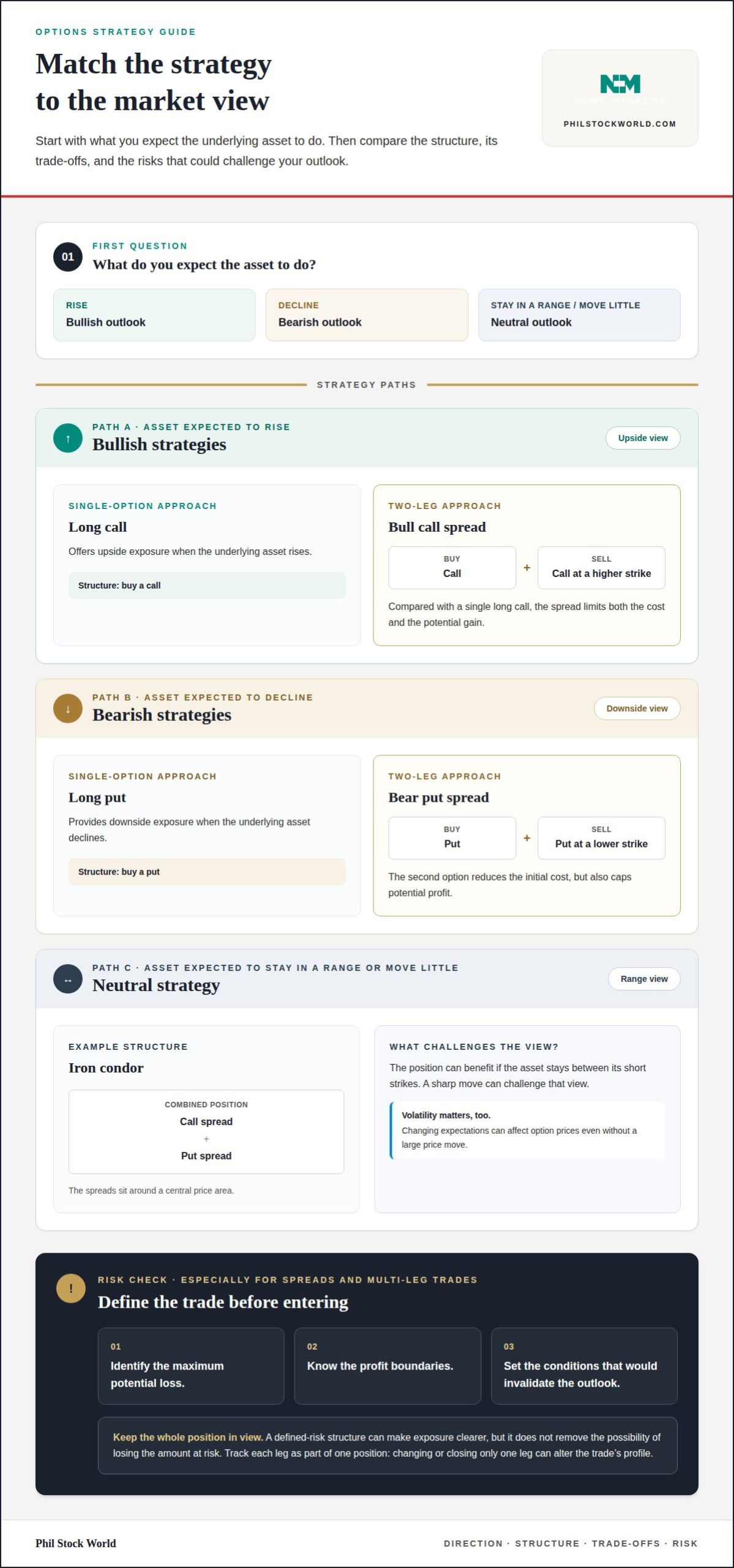
Options strategies can express a view on direction, volatility, or both. The appropriate structure depends on what you expect the underlying asset to do.
Bullish Options Strategies
A bullish options strategy is designed to benefit if an underlying asset rises. A long call offers upside exposure, while a bull call spread pairs a bought call with a sold call at a higher strike. Compared with a single long call, the spread limits both the cost and the potential gain. This distinction matters when you want to define a trade’s boundaries before entering.
Bearish Options Strategies
A bearish options strategy seeks to benefit if the underlying asset declines. Buying a put provides downside exposure, while a bear put spread combines a bought put with a sold put at a lower strike. The second option reduces the initial cost but also caps potential profit. Consider the expected size and timing of a decline, not just its direction.
Neutral Options Strategies
A neutral options strategy is designed for an underlying asset expected to stay within a range or move little. An iron condor, for example, combines a call spread and a put spread around a central price area. The position can benefit if the asset stays between its short strikes, but a sharp move can challenge that view. Volatility matters too: changing expectations can affect option prices even without a large price move.
Advanced Strategies and Risk Management
Advanced strategies combine option positions to shape exposure to price movement, time, and volatility. Before entering a spread or multi-leg trade, identify its maximum potential loss, profit boundaries, and the conditions that would invalidate the outlook. A defined-risk structure can make the exposure clearer, but it doesn’t remove the possibility of losing the amount at risk. Track each leg as part of one position, since changing or closing only one leg can alter the trade’s profile. For a broader backdrop, explore market context for options decisions alongside your strategy analysis.
Options Greeks and delta
Options Greeks measure different risks that affect an option’s price, including changes in the underlying asset, time, and volatility. They don’t predict where a stock will go. Instead, traders use them to assess how an option may respond as market conditions change. Delta is often the first Greek to study because it connects an option’s value with movement in the underlying asset.
Delta estimates how much an option’s price may change when the underlying asset moves by one unit, with other factors held constant. A call generally has positive delta, while a put generally has negative delta. For example, a call with a strike price above the current share price may respond differently from one that is already in the money. Delta changes as the share price, time, and volatility change, so it’s a snapshot, not a fixed promise.
Other Greeks add useful perspectives. Gamma describes how quickly delta may change as the underlying price moves. Theta reflects the effect of time passing on an option’s value, while vega reflects sensitivity to changes in implied volatility. Rho describes sensitivity to interest-rate changes. Together, these measures help traders distinguish price exposure from time or volatility exposure. A position can face several risks at once.
Use the Greeks to understand a position, not as a standalone signal. For a call spread, for instance, compare the Greeks of both legs to see how the combined position may respond. A long option may gain from a favorable price move yet lose value as time passes or volatility falls. A short option can have opposite sensitivities, along with exposure to assignment. Reviewing delta, gamma, theta, and vega together gives traders a clearer view of potential pressure points before changing a position. Learning options trading online is more useful when each Greek is connected to a real position and its risks.
Buying call and put options
Buying an option means paying a premium for a defined right, rather than taking on the seller’s obligation. A call gives its buyer the right to buy the underlying asset, while a put gives its buyer the right to sell it. The choice depends on the price move you expect, the contract’s strike price, and its expiration.
A call buyer may benefit if the underlying asset rises enough to make the contract more valuable. For example, an investor who expects a company’s shares to climb might buy a call instead of purchasing shares outright. The option can still lose value if the move comes too late, the price stays below the strike, or market expectations change. Direction matters, but timing does too.
A put buyer may benefit if the underlying asset declines. An investor concerned about a shareholding’s downside could buy a put as a hedge or use one to express a bearish view without shorting shares. The put’s value depends on the asset’s price relative to its strike, the time remaining, and changing expectations. A broadly correct outlook can still lose if the contract’s terms don’t fit the move.
For a purchased call or put, the premium paid is the buyer’s initial cost and is generally the most that can be lost on that option. The contract may expire without value if it finishes out of the money. Buyers can also sell an option before expiration instead of exercising it, if it retains market value. Exercise uses the option’s contractual right, but it isn’t the only way to close a position.
Buying options doesn’t automatically create income. Buyers pay a premium and need a favorable change in price, timing, or volatility for the position to gain value. Before choosing a contract, compare its strike and expiration with the market view, then consider whether the potential outcome justifies the premium. For continued study, explore options education and market analysis to connect contract mechanics with trading ideas.
Phil Stock World
Phil Stock World offers educational resources for readers who want to keep building their options knowledge after learning the core mechanics. Educational Webinars can help connect concepts such as strategy selection and options risk, while Market Charts and Analysis add market context to those lessons. A Virtual Portfolio Review can help readers examine how ideas relate to a portfolio, and Premium Membership provides access to exclusive content.
Explore these resources when you’re ready to move from understanding calls, puts, and delta to following market commentary and reviewing strategy ideas. They support ongoing learning, but don’t replace understanding the risks of an options position.
Contact Phil Stock World to explore educational resources for your next step.
Turn what you’ve learned into a decision process
Learning options trading online is most valuable when concepts become a consistent way to evaluate choices. Before considering a position, clarify your market view, the outcome you’re aiming for, and what could change your thesis. This habit helps keep a tempting trade from taking the place of a considered plan.
Keep developing your judgment by reviewing decisions, not just outcomes. Ask whether your reasoning fit the information available at the time, and note which assumptions mattered most. Over time, reflection can help you spot gaps in your understanding and decide what to study next. Options involve meaningful risks, so keep learning at a pace that gives you time to understand the trade-offs before acting.
If you’d like to continue exploring market education and strategy ideas, connect with Phil Stock World. Build your knowledge one thoughtful decision at a time.
Frequently Asked Questions
What is a long put?
A long put is a position created by buying a put option, often to express a bearish view or hedge shares already owned. For example, an investor holding a company’s stock might buy a put to gain downside exposure if the share price falls. The contract’s strike and expiration shape the position, while the premium paid affects whether the trade makes sense.
Why trade options?
Options let traders build positions around a specific view on price, timing, or volatility without simply buying or selling shares. A call or put can create exposure to a market move, while a spread can define a narrower range of outcomes. Investors may also use options to hedge an existing holding. Choose a strategy that matches your objective and the risks you understand.
What are options and how do calls, puts, strike prices, and expiration dates work?
An option is a contract that specifies an underlying asset, strike price, and expiration date. A call gives its buyer the right to buy, while a put gives its buyer the right to sell. The strike is the contract’s reference price for that transaction. Expiration marks the contract’s end, so the time remaining matters when assessing a possible trade.
How much do online options trading courses and platforms cost?
Course costs vary according to what the material covers, how it is delivered, and whether access is purchased once or through a recurring plan. Trading platforms may have separate charges tied to account features or transactions. Compare course content and access terms separately from platform costs, so an education subscription isn’t mistaken for the cost of placing trades.
How do you place an options trade step by step using an online broker?
Start by choosing an underlying asset and deciding what market view the trade expresses. Then open its options chain and select a call or put, strike, and expiration. Review the order type, quantity, and estimated total before submitting. Once the order is placed, monitor its status and position details. The broker’s interface and approval settings determine which order choices are available.
What are the risks of buying and selling options, including assignment and expiration?
Buying options risks losing value if the underlying asset, timing, or volatility doesn’t support the position. Selling options creates contractual obligations, and a short position can be assigned before expiration. At expiration, the outcome depends on the contract’s terms and the underlying asset’s price. Before entering a trade, consider whether you can meet the position’s obligations and handle its possible outcome.