


A slick options screen can show the numbers, but it can’t explain what they mean for a trade. An options trading education platform is most useful when lessons, market insights, and analysis work together, helping you connect a strategy to its risks before you act.
Options trading involves more than guessing whether a stock will rise or fall. Timing, the size of a move, and an option’s expiration all affect how a position behaves. It’s reasonable to want clear explanations and practical ways to study these factors, not just a stream of trade ideas.
Here, you’ll learn what to look for in educational resources, how charts and analysis can support your decisions, and why reviewing a strategy matters. The goal is a clearer framework for learning options, with tools that make market activity easier to interpret and insights that put potential trades in context.
Key Takeaways
- Build a learning routine that gives you time to understand options concepts, explore strategies, and practice before making decisions.
- Assess weekly trade ideas by connecting market context with a strategy’s risks and possible outcomes.
- Use P&L graphs and backtesting to examine how a position may behave across different scenarios, not as a promise of future results.
- Explore platform demonstrations to see how charts, options data, and analytical tools can support a more informed review.
Online course duration and weekly time commitment
Options education takes months, not a weekend. A practical sequence places foundation learning in months 1-2, strategy study in months 2-4, and paper-trading practice in months 3-6. Analysis can begin in month 4 and continue afterward. These stages overlap, so treat them as a learning path rather than a fixed graduation date. Set a repeatable weekly study routine around lessons, reviewing examples, and recording questions. The time needed depends on how quickly you absorb concepts and how much practice you give them.
Course format shapes your study routine. Self-paced lessons let you revisit concepts before moving on, while scheduled classes and webinars provide set learning sessions. Some courses combine recorded material, live instruction, exercises, and written guides. Before enrolling, read the prerequisites and course outline. Check whether lessons assume familiarity with stock markets, options terminology, or portfolio concepts. If selling options appears early in the syllabus, look for explanations of how the obligations differ from buying options.
Good fundamentals lessons connect terms to contract mechanics. A call gives its buyer the right to buy an underlying asset, while a put gives its buyer the right to sell. Lessons should explain how an option’s strike price and expiration affect the buyer’s rights. Strong lessons also explain how the Greeks measure the effects of different factors on an option’s value. Work through an example that changes one factor at a time.
Knowledge checks can reveal misunderstandings before they become habits. After a lesson on expiration, for example, a quiz might ask what happens to a contract as its final day approaches. Review each incorrect answer, revisit the relevant lesson, and explain the concept in your own words. The score matters less than understanding why an answer is correct.
Course pricing and refund policies vary. Before enrolling, compare the total fee, which learning materials it covers, and the refund deadline. Read the policy for conditions, timing, and whether access to lessons affects eligibility. This helps you weigh the commitment against the course format and your planned study schedule.
Weekly options trade ideas and market insights
Treat a weekly trade idea as a case study, not an instruction to copy a position. Identify the underlying, the market view, the contract’s expiration, and why calls, puts, or spreads might fit that view. Then examine what could invalidate the thesis. Buying a call exposes the buyer to the risk that the underlying may not move favorably before expiration. Useful analysis makes those assumptions clear.
Market articles add context when they connect price action to a catalyst, such as earnings or an economic release. Read the date, the instrument discussed, and the argument behind the idea. Separate observed facts from the author’s interpretation. Options trading activity volume rose 89% year over year in the most recent year reported. That figure signals greater activity, not a direction for any particular contract. Weekly market context can help readers connect trade ideas with broader market commentary.
For practice, record a hypothetical entry, the option’s premium, its expiration, and the condition that would prompt an exit. Track how the position changes as the underlying price and time to expiration shift. Compare buying calls and puts with a spread, where multiple option contracts create a different payoff profile. Leverage can magnify exposure, so examine possible losses as carefully as potential gains. A short options position can be assigned before expiration, making assignment risk part of position management.
Market mechanics matter. Exercising an option uses its right to buy or sell the underlying at the strike price; expiration is the final day that right exists. A 0DTE option has zero days remaining until expiration, so little time remains for the underlying to move. Treat that timeline as a key part of the analysis, not a footnote.
Use each weekly idea to build a review habit: identify the thesis, note the risks, follow the position on paper, then compare the outcome with your original reasoning. Options carry significant risk and aren’t appropriate for every investor.
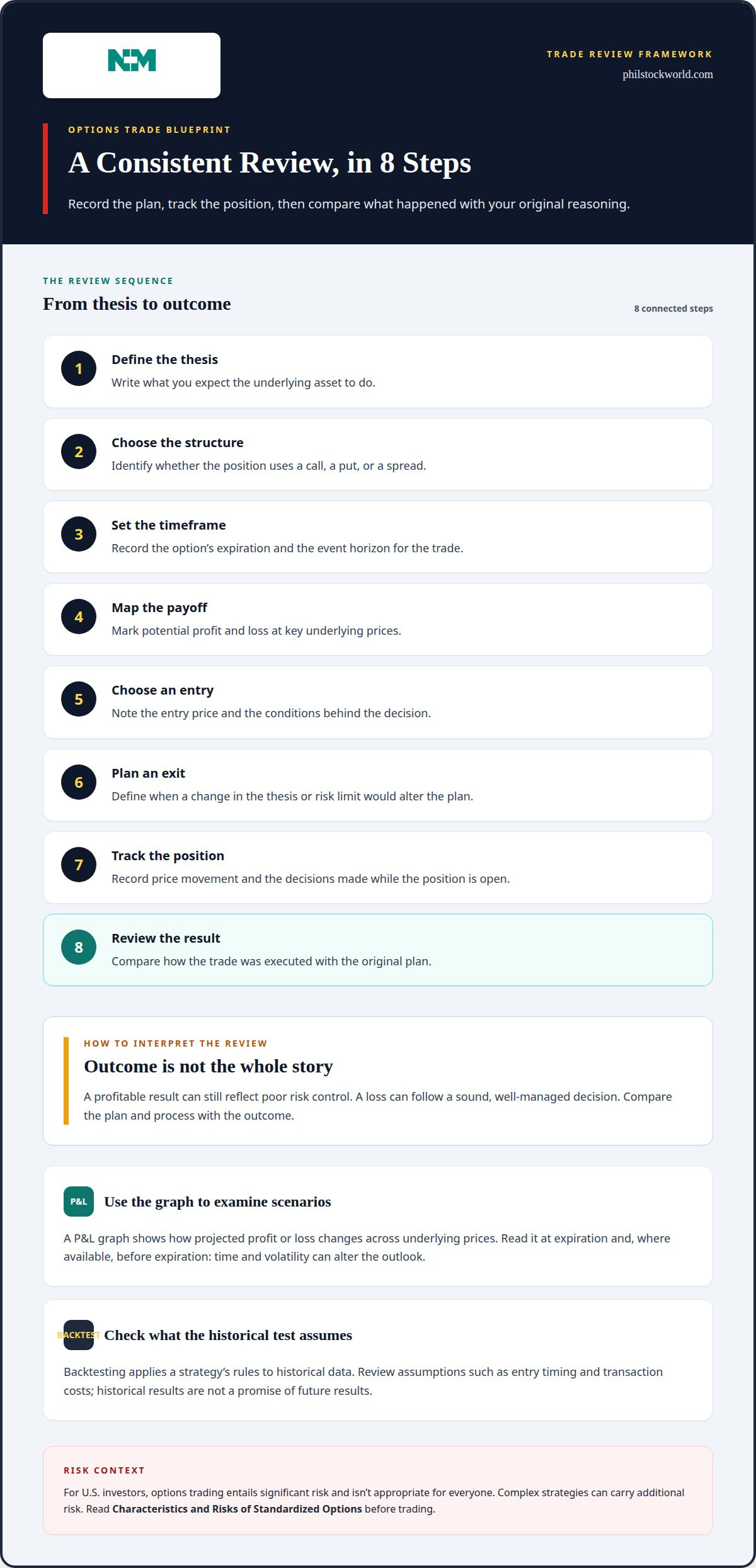
Trade review, P&L graphs, and back testing
A trade review turns an outcome into evidence about your process. For each options trade, record the thesis, contract, entry, exit, and reason for acting. Then compare your plan with what happened. A profitable result can still reflect poor risk control, while a loss can follow a sound, well-managed decision.
For U.S. investors, options trading entails significant risk and isn’t appropriate for everyone. Complex strategies can carry additional risk, so read Characteristics and Risks of Standardized Options before trading. These are essential risk disclosures to understand while learning, not a promise that any strategy will profit.
An eight-step Options Trade Blueprint can make reviews consistent:
- Define the thesis: Write what you expect the underlying to do.
- Choose the structure: Identify the call, put, or spread.
- Set the timeframe: Record expiration and the event horizon.
- Map the payoff: Mark potential profit and loss at key prices.
- Choose an entry: Note the price and conditions behind it.
- Plan an exit: Define when the thesis or risk limit changes.
- Track the position: Record price movement and decisions.
- Review the result: Compare execution with the original plan.
A P&L graph shows how a position’s projected profit or loss changes across underlying prices. Read it at expiration and, where available, before expiration, since time and volatility can alter the outlook. Backtesting applies a strategy’s rules to historical data. Check its assumptions, including entry timing and transaction costs, because historical results don’t predict future performance.
Timing deserves its own review. Some traders may exit a losing call when its open loss reaches half the call’s initial cost. That’s one possible rule, not a universal instruction. Investors may need brokerage approval to trade options, depending on the brokerage’s process and the requested strategy. Build your learning progressively: understand fundamentals, practice on paper, then review decisions before considering more complex strategies.
Options trading tools and platform demonstrations
A useful demonstration follows an options order from analysis to review. Watch how the screen displays the underlying stock, contract type, strike, expiration, bid, ask, and implied volatility. Then see how changing the strike or expiration alters the displayed payoff. A practical walkthrough should also show where assignment information appears, especially for short positions. Don’t judge a tool by a polished dashboard alone; judge whether it makes contract mechanics easier to understand.
The most useful options trading education platforms in the United States explain risk clearly and let learners test concepts. Look for structured lessons, current examples, charts, payoff visualizations, and practice activities. A good educational platform makes it easy to follow how a position changes as stock prices, volatility, and time change.
Educational resources and trading platforms may offer free courses and paper-trading tools. Treat these as separate features: a course teaches concepts, while a simulator lets you rehearse decisions without placing a live order. One useful exercise is to compare a call and a put on the same stock, then observe how their projected outcomes change.
Assess course quality by examining lesson clarity, progression from fundamentals to advanced strategies, and whether examples explain both gains and losses. Instructor credentials matter, but they don’t replace transparent reasoning. A strong demonstration explains each decision, including why a particular strike or expiration was selected.
To assess an educator’s credibility, review a sample lesson and see whether its claims are supported by clear explanations of options mechanics. Notice whether the instructor discusses volatility, assignment, and potential losses alongside possible profits. Be cautious of presentations that show winning trades without explaining the assumptions behind them.
Online learning has limitations: lessons may oversimplify changing market conditions, and simulated trades can’t fully reproduce live execution or assignment. Options themselves carry significant risk. Use demonstrations to understand platform features, not as proof that a strategy will work. Educational webinars can offer a guided way to explore tools and market concepts in context.
Phil Stock World: Educational Webinars
Phil Stock World offers Educational Webinars for readers who want to deepen their options knowledge through guided learning. They’re useful when you understand basic contract mechanics and want to connect market ideas, charts, and strategy concepts more clearly.
For a broader view, Market Charts and Analysis can put market activity in context, while Premium Membership gives access to exclusive content. A Virtual Portfolio Review offers another way to examine portfolio decisions and consider how a strategy fits your existing positions. These educational resources support learning; they don’t manage assets or execute trades for you.
Bring specific questions about a strategy or market concept to a webinar, then revisit the charts and analysis as you build your understanding. Explore Phil Stock World’s educational resources to find a useful next step.
Make your next learning step deliberate
Make your next move a question to investigate, not a trade you feel pressured to place. An options trading education platform is most valuable when it helps you keep learning, test your reasoning, and understand what you still need to explore before taking on risk.
Phil Stock World offers Educational Webinars, Premium Membership, and Virtual Portfolio Review for readers seeking educational content and portfolio discussion. Choose the resource that fits the question you’re working through, whether you want a guided lesson, ongoing market insights, or a review of portfolio decisions.
Options knowledge grows through deliberate study and honest review. Keep asking why a strategy fits, what could change its outlook, and how you’ll assess your decisions. Contact Phil Stock World to learn more about its educational resources and take your next step with a clearer focus.
Frequently Asked Questions
How much do options trading education platforms cost?
Options education platforms don’t have a standard price. Cost can depend on whether materials are self-paced or instructor-led, what content access includes, and whether membership renews. Before paying, compare the course scope, access terms, and refund policy. Price alone won’t tell you whether the instruction fits your experience or learning goals, so weigh the curriculum and format too.
What topics should a beginner learn before trading options?
Start with stock-market basics, order types, and how to read an options chain. Learn to assess liquidity by examining trading activity and the gap between bid and ask prices. Then practice comparing contracts on the same underlying, noting how their prices respond to market changes. Before placing a trade, be able to explain its potential downside and why the position fits your risk limits.
What are the best options trading education platforms in the United States?
Useful platforms offer structured lessons, current examples, charts, payoff visualizations, and practice activities. Look for clear explanations of risk and demonstrations showing how positions change with price, volatility, and time.