


Retail investors don’t need a Wall Street desk to participate in the markets. They invest their own money, often in smaller trades than institutional investors. Financial market education for retail investors can help clarify investment choices and risks. Investments can rise or fall in value, so losses are possible.
Stocks, bonds, funds, and trading tools can be confusing at first because they work in different ways. Learning the basics won’t remove market risk, but it can help you make more informed decisions about what you’re buying and why.
This guide explains who retail investors are, how common investment products and trading tools work, and which education gaps or other barriers can make investing harder to access. It offers a clearer picture of the landscape without treating any investment as a sure thing.
Key Takeaways
- See how asset allocation and diversification can shape a portfolio, while recognizing they can’t eliminate market risk.
- Understand the key differences between stocks, bonds, mutual funds, and exchange-traded products before weighing their role in an investment approach.
- Learn how market information and trading tools can support investment decisions, and why understanding fees and tracking holdings matters.
- Identify common education and access barriers, then explore how clearer explanations and market analysis can help you approach investing with greater confidence.
What Is a Retail Investor?
A retail investor is an individual who invests personal money, often through brokerage or retirement accounts. Institutional investors generally invest on behalf of others, while retail investors typically make smaller trades. Stocks can give individuals an ownership stake in a company, but their value fluctuates and investors can lose principal. Financial market education for retail investors starts with understanding what an asset does and the risks it carries.
Your time horizon helps shape investment choices. Money you may need soon for a home purchase could call for a different mix of assets than savings intended for retirement decades from now. If an unexpected expense forces you to sell during a market decline, you may lock in losses. Before choosing investments, consider when you might need the money, how much fluctuation you can manage, and whether your goal is growth, income, or preserving capital.
Asset allocation divides a portfolio among categories such as stocks and bonds. Diversification spreads holdings within or across those categories. For example, owning shares in several companies reduces your exposure to any one company compared with holding only one stock. Exchange-traded funds, or ETFs, can provide diversification through a small number of funds, each of which may hold many securities. Neither diversification nor asset allocation eliminates market risk or protects against loss of principal.
In the United States, investment income and capital gains are subject to tax rules that depend on the income, account, and transaction involved. Tax laws are complex and can change, affecting investment results. Account and transaction details therefore matter when assessing tax treatment.
To spot potential scams or misleading advice, look for pressure to act quickly, unclear explanations of risks, or claims that an investment cannot lose. Compare those claims with the investment’s documented terms and fees. The U.S. Securities and Exchange Commission says Form CRS summarizes a securities firm’s services and fees to help retail customers evaluate a financial professional and services.
Stocks, bonds, mutual funds, and exchange-traded products
A share of stock represents an ownership stake, or equity, in the company that issued it. Shareholders may benefit if the company grows, but the share price can also fall. A stock exchange is a marketplace for buying and selling shares. A “ticker” identifies a security, while a “portfolio” is the collection of investments an investor holds.
Bonds work differently. An issuer borrows money from investors, pays interest, and returns the initial investment according to the bond’s terms. A bond is a loan, not company ownership. Fixed-income investments still carry credit and interest-rate risks: bond values typically decline when interest rates rise. The issuer’s ability to repay also matters.
A mutual fund pools investors’ money to hold a portfolio of securities. Exchange-traded products, including ETFs, can also hold dozens or even thousands of stocks, bonds, and other securities. This structure can spread exposure across holdings, though a fund’s focus still shapes its risks. An actively managed fund selects investments rather than seeking to replicate a specified index, and may have higher portfolio turnover.
Compounding means investment earnings can generate further earnings over time. An Investor.gov illustration assumes monthly investments of $100 and a 7% average annual return over 40 years. It’s an example, not a set return: actual performance changes with markets and investment choices. Long-term investing centers on time in the market, not a promise of wealth.
A stock market simulator lets a learner explore hypothetical trades and observe how price changes affect a practice portfolio, without treating a trial result as evidence of future performance. To connect terminology with live market movements, Market Charts and Analysis can help readers examine how securities behave across market conditions.
Some experts use an annual return estimate of 7 – 10% for long-term diversified investments in U.S. stocks, based on historical averages, not a set rate of return.
Access to financial information and trading tools
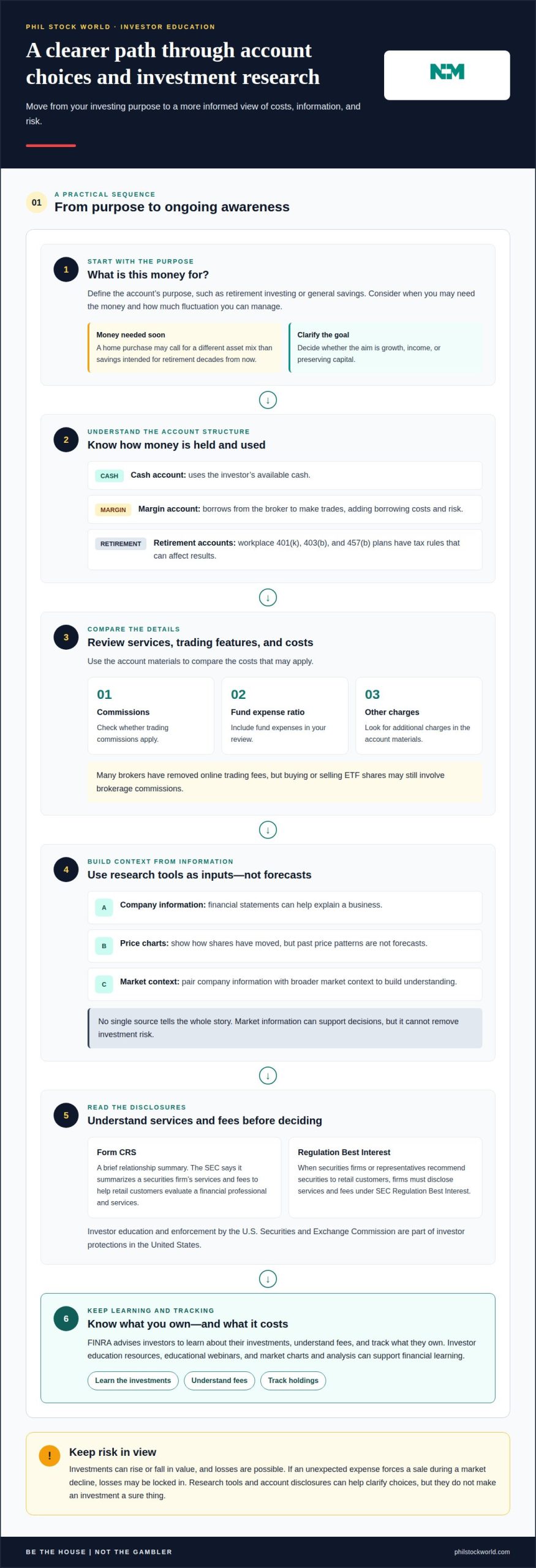
Investment research tools turn information about securities, companies, and the economic backdrop into inputs for decision-making. A company’s financial statements can help explain its business, while price charts show how its shares have moved. Neither tells the whole story. Pair company information with market context to build your understanding, without treating past price patterns as forecasts.
U.S. brokerage accounts differ by how money is held and used. A cash account uses the investor’s available cash; a margin account borrows from the broker to make trades, adding borrowing costs and risk. Retirement accounts, including workplace 401(k), 403(b), and 457(b) plans, are designed for retirement savings and have tax rules that can affect results.
In the United States, investor protections include education and enforcement by the Securities and Exchange Commission. Under SEC Regulation Best Interest, securities firms must disclose services and fees when they or their representatives recommend securities to retail customers. Firms offering retail services must also provide Form CRS, a brief relationship summary.
Before opening an account, define its purpose, such as retirement investing or general savings. Then review its services, trading features, and costs. Compare commissions, any fund expense ratio, and other charges shown in the account materials. Many brokers have removed online trading fees, but buying or selling ETF shares may still involve brokerage commissions.
U.S. retail investors can build financial knowledge through investor education resources, educational webinars, and market charts and analysis. FINRA advises investors to learn about their investments, understand fees, and track what they own. Before choosing an account, read its relationship summary, understand the securities and trading tools involved, and consider whether the account type suits its intended use.
Retail investors should research investments and consider diversification and market conditions when making investment decisions. Their share of daily equity trading volume was approximately 10% a decade before the article’s 2025 publication, compared with just over 20% at the time described. Futures and futures options trading involves substantial risk and is not suitable for all investors.
Financial education gaps and barriers to investing
Access to investing involves more than opening an account. Investors also need to understand products, risks, and how a strategy fits a financial purpose. In a global survey, 40% of people who did not invest said they avoided it because they didn’t know how or found it too confusing. That points to a practical barrier: unfamiliar terms can make even basic portfolio choices feel out of reach.
Education can help close that gap, but it can’t remove investment risk. Roughly 70% of surveyed people said expanded financial education would make them more likely to invest or invest more. Useful learning explains how a decision works, what could go wrong, and how interest, fees, and time can affect results. The goal isn’t to chase every market move. It’s to connect a choice to a purpose.
Education gaps can start before someone becomes an investor. Among high school juniors and seniors in the cited figures, 32% felt prepared to compare financial institutions and choose one that suited their needs. Only 47% felt prepared to select, open, and manage a savings or checking account. Those foundations matter: account basics and financial terminology influence how confidently people assess investing information later.
U.S. regulators and nonprofits can help make financial education more accessible. The Securities and Exchange Commission provides investor education, and FINRA advises people to learn about investments, understand fees, and track their holdings. Nonprofit financial-literacy programs can also provide learning opportunities. Focus on material that explains risks and trade-offs rather than promising a particular return.
A useful learning strategy is to start with one decision, such as understanding a fund’s holdings, then connect it to the wider portfolio. If a concept remains unclear, pause before acting and seek an explanation that addresses both potential gains and losses. Explore educational investing resources to keep building your market knowledge with a clear purpose.
Phil Stock World: Educational Webinars
Phil Stock World’s Educational Webinars help investors explore markets, investment strategies, and trading concepts. They can be a useful next step when financial terms or market movements raise questions that a general introduction hasn’t answered.
For a closer look at market activity, Phil Stock World’s Market Charts and Analysis can put price movements and sector trends in context. A Virtual Portfolio Review offers a way to examine portfolio choices, while Premium Membership provides access to exclusive market content. These resources support learning and analysis; they don’t manage assets or replace a brokerage account.
If you’d like to explore these learning options, contact Phil Stock World.
Make Your Next Investing Decision More Deliberate
Your next move doesn’t have to be a trade. It can be a clearer question. Before acting on an idea, write down what you think could drive its value, what might challenge that view, and what new information would make you reconsider. This simple decision record can help you distinguish a reasoned choice from a reaction to a headline or sudden market swing.
This habit gives financial market education for retail investors a practical purpose beyond learning terminology. It turns new knowledge into a repeatable way to examine decisions. Over time, your notes can reveal which assumptions you revisit, which risks you tend to overlook, and where further learning could help. Keep the process flexible as your goals and circumstances change.
If you’d like to discuss your investing questions, contact Phil Stock World. Each thoughtful question is a stronger starting point for your next decision.
Frequently Asked Questions
How do stocks, bonds, ETFs, mutual funds, and options work?
Stocks represent ownership in companies, bonds are loans to issuers, and funds bundle securities into one investment. ETFs trade on an exchange, while mutual funds are bought or sold through fund transactions. Options are contracts tied to an underlying asset, with terms such as an expiration date and strike price. For example, a call option gives its holder the right to buy under specified terms.
What are the risks and potential returns of common investments?
Potential returns depend on market movements, an investment’s terms, and how long you hold it. Stocks may gain value or pay dividends, but dividends aren’t guaranteed. Bonds can provide interest, yet issuers may fail to repay, and rising rates can reduce bond values. Long options can lose all invested funds, while covered calls limit gains above the strike price and provide downside protection only up to the premiums received.
How can investors research companies, funds, and financial market data?
Start with an investment’s primary materials: company filings for business and financial details, and a fund prospectus for its strategy, holdings, and risks. Then compare those details with price and volume trends, relevant sector activity, and broader market conditions. For example, a rising share price alone doesn’t show whether a company’s business outlook has improved. Track the reason behind each decision alongside the data that could challenge it.