


A short-term stock trade can last from minutes to several days, while a swing trade may run for a few days to a few weeks. But a shorter holding period doesn’t make a winning trade easier to spot. This guide to short term trading explains how the main styles differ and why consistent results are harder to achieve than a chart might suggest.
A sharp price move can look like a clear signal, but market conditions change, and a pattern viewed in isolation may not tell the whole story. Start by identifying whether you’re considering scalping, day trading, or swing trading, then understand how that approach works with stocks. We’ll cover the differences, the risks of short holding periods, and tools for evaluating potential setups, without treating any indicator as a reliable prediction of every move.
Key Takeaways
- Match a trading style to the time and attention you can realistically commit.
- Use a repeatable process to assess potential trades instead of treating a chart signal as a sure thing.
- Separate stock-trading tools from trading decisions, and consider signals alongside the broader market picture.
- Understand how holding periods can affect the tax treatment of investment gains.
1. What Is Considered Short-Term Trading?
A guide to short-term trading starts with the holding period: often 3 days to 3 weeks, though stock positions can last minutes or several days. Traders seek profit from shorter price moves across shares, forex, indices, cryptocurrencies, or commodities. Forex markets operate 24 hours a day, five days a week, while cryptocurrency markets run 24 hours a day, seven days a week.
Assess trends before entering. Compare price action across chart time frames, then consider volume, news, and the broader market. Seasonal patterns offer context, not a forecast: from 1950 to 2021, most S&P 500 gains occurred from November through April, while averages were relatively static from May through October. Fear of missing out can prompt a late entry, so define the setup before acting.
Typical costs include commissions, spreads, and, where applicable, financing charges. Each can reduce a trade’s profit.
Before placing a trade, set an entry trigger, exit target, and stop-loss level. Choose a position size that keeps a stop-out within your risk limit. Account for fast reversals, price gaps, slippage, and emotional decisions.
Market orders prioritize execution, while limit orders set a price boundary. Stop orders trigger when the specified price is reached. Slippage occurs when the execution price differs from the expected price, which can happen in fast markets.
This guide to short-term trading also suggests a lower-pressure way to test a strategy: paper trade using live prices and record hypothetical entries, exits, and stop levels. Review the results across different market conditions before risking real money.
Tax treatment matters too. According to the Internal Revenue Service, U.S. federal long-term capital gains tax rates may be 0%, 15%, or 20%, depending on adjusted gross income; assets held for more than one year qualify for that treatment. The Internal Revenue Service also says the 3.8% net investment income tax may apply to investment gains in the United States.
Difficulty consistently picking winning trades
Consistently choosing profitable trades is difficult because even a sound setup can fail. A stock may reverse after favorable news, stall near resistance, or move with its sector instead of following its own story. One winning trade doesn’t prove a method works, just as one loss doesn’t disprove it. The challenge in short-term trading is applying the same selection rules as market conditions change, rather than chasing whichever chart looks exciting.
Build a focused watchlist instead of scanning every ticker. Look for clear price movement, steady trading activity, and a catalyst you can explain, such as earnings or industry news. Then check whether the price action supports your trade idea. If the thesis relies on a headline but the price moves against it, skip the setup. Missing a trade costs nothing; an impulsive entry can erode capital.
Moving averages can help filter candidates, but they don’t predict the next move. Common reference periods include 15, 20, 30, 50, 100, and 200 days. A short-period average reacts faster to recent prices, while a longer-period average shows a broader trend. For example, compare a stock’s price with its 20-day and 50-day averages, then check whether both are rising or pointing in different directions. Treat disagreement as useful information, not a signal to force a trade.
Keep long-term investment horizons separate from short-term trade setups. A company’s strong prospects over time don’t automatically make its shares a good trade this week. Record why you entered, what price behavior would weaken your thesis, and how you exited. After a series of trades, review which setups worked better and in what conditions. Your records may show whether your approach relies on trend continuation, breakouts, or another repeatable pattern.
Selecting trades well is a process, not a search for certainty. Apply the same screening criteria each session, reject candidates that don’t meet them, and don’t change your rules after one surprising move. Consistent analysis won’t eliminate losses, but it makes your decisions easier to assess and improve.
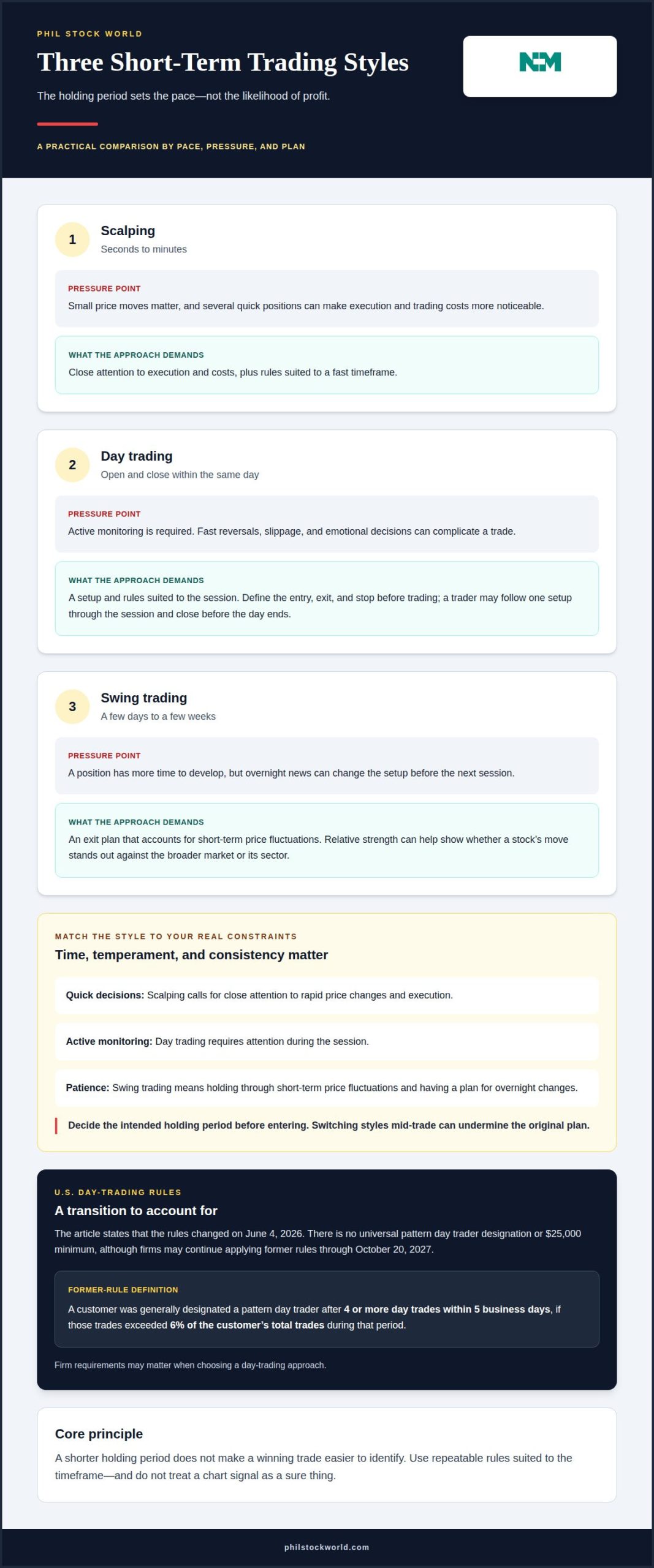
3. Short-term trading styles: scalping, day trading, and swing trading
Choose a style based on how long you can focus and how quickly you want a position to change. Scalping trades last seconds or minutes, making each small price move matter. Day trades open and close within the same day, while swing trades typically last a few days to a few weeks. The holding period sets the pace, not the likelihood of profit.
A scalper may take several quick positions as a stock fluctuates, aiming to capture small moves. This pace calls for close attention to execution and costs, which can become more noticeable with frequent trading. Day trading also requires active monitoring, though a trader may follow one setup through the session and close before the day ends. Neither style is simply faster investing; each needs rules suited to its timeframe.
Swing trading gives a position more time to develop. A trader might enter after a stock breaks above resistance, then hold while the price follows the expected trend. Overnight news can change the setup before the next session, so an exit plan matters even if you aren’t watching the position constantly. Relative strength, or how a stock performs compared with the broader market or its sector, can help show whether its move stands out.
For U.S. day trading, the rules changed on June 4, 2026: there is no universal pattern day trader designation or $25,000 minimum, although firms may continue applying former rules through October 20, 2027. Under those former rules, a customer was generally designated a pattern day trader after four or more day trades within five business days, if those trades exceeded 6% of the customer’s total trades during that period. This transition makes the applicable firm requirements important to understand before choosing a day-trading approach.
Match the style to your schedule, temperament, and ability to follow its rules. Scalping requires quick decisions; swing trading requires patience through short-term price fluctuations. Switching styles mid-trade can undermine your original plan, so decide on the intended holding period before entering.
4. Short-term stock trading
Stock prices respond to company news, sector momentum, earnings expectations, and broader market shifts. A short-term stock trade may last from minutes to several days, so define a clear reason for entry and an exit plan. For example, a breakout above resistance may attract buyers, but a failed breakout can reverse quickly. Treat the pattern as a setup to evaluate, not a promise of direction.
Technical indicators can add context. A Relative Strength Index (RSI) reading of 70 may signal a potential topping pattern, while a reading below 30 suggests the stock is oversold. A stochastic oscillator reading of 80 signals overbought conditions, while 20 signals oversold conditions. Use both alongside other tools, such as price action and volume. A stock can remain overbought or oversold for a considerable period, so an extreme reading alone isn’t an exit command.
Plan the trade before placing it: identify the trigger, decide where the idea is invalidated, and set an exit rule. A general short-term guideline is to place a sell stop or buy stop within 10% to 15% of the stock’s purchase price or the price where a short position began. That range is a reference, not a substitute for assessing volatility and the trade’s specific risk.
Taxes can also affect the net result. According to the Internal Revenue Service, gains on assets held for one year or less are taxed at federal ordinary income tax rates, which can reach 37%. Compare the potential trade outcome with its risk and tax treatment, rather than judging a setup by its chart alone.
For a practical way to examine stock setups, use Market Charts and Analysis alongside your own entry and exit rules. The takeaway: combine a defined setup, corroborating signals, and a risk limit; no single indicator can select winning trades consistently.
Phil Stock World
Phil Stock World helps traders put short-term stock decisions in context with daily market commentary, trading ideas, charts, and educational resources, presented in a fun and relaxing atmosphere. A Virtual Portfolio Review can help you examine your approach as you refine a setup or consider how a position fits your portfolio. Educational Webinars and Premium Membership provide more ways to engage with market analysis and trading ideas. These resources support your decisions but don’t remove market risk or ensure a winning trade. Explore market conditions, assess potential trades, and build a more consistent process. To learn more about Phil Stock World’s trading education resources, contact Phil Stock World.
Make your next trade a more deliberate one
A guide to short-term trading is most useful when it changes how you prepare for your next decision. Before entering a position, write down why the setup may be worth taking and what evidence would make you walk away. That pause can turn interest in the market into a process you can review and refine, rather than a series of reactions to every price swing.
To continue developing your approach, explore Phil Stock World’s Premium Membership, Virtual Portfolio Review, and Educational Webinars. These resources can help you explore market ideas, build your understanding, and bring more structure to how you assess potential trades. The goal isn’t to chase every move, but to make decisions with greater clarity.
Contact Phil Stock World to explore the next step in your trading education. Keep learning, stay deliberate, and let your process lead.
Frequently Asked Questions
What Is Considered Short-Term Trading?
A guide to short-term trading begins with defining the intended holding period and the price movement a position aims to capture. The term can describe trades lasting minutes, days, or several weeks, depending on the strategy. For example, someone might buy shares ahead of a scheduled company announcement and plan to sell after the market responds, rather than hold them as a long-term investment.
What are the types of short-term traders?
Short-term traders are often described as scalpers, day traders, or swing traders, based on how long they hold positions. Some focus on stocks, while others trade currencies or different markets. A trader might also focus on event-driven setups, such as trading around earnings news. These labels describe approaches rather than strict rules. The planned exit and amount of monitoring required help distinguish one style from another.
What is short-term trading, and how does it differ from investing and day trading?
Short-term trading aims to capture price changes over a brief period, while investing typically focuses on longer-term ownership and goals. Day trading is one type of short-term trading, with positions closed within the same trading day. Holding shares for several sessions can still count as short-term trading without being day trading. The main distinction is the intended time horizon, not whether the asset is a stock.
What are common short-term trading strategies for stocks, ETFs, options, and forex?
Traders may use breakout, pullback, or range-bound setups with stocks and ETFs. A breakout approach looks for a price to move beyond a level traders are watching; a pullback setup seeks an entry after a temporary retreat within a trend. Options involve contract-specific considerations, while forex pairs respond to currency-market conditions. Choose a strategy suited to the instrument, and set exit criteria before entering.
What technical indicators and chart time frames are commonly used for short-term trading?
In a guide to short-term trading, indicators are most useful when they answer a specific question, such as whether momentum supports a price move. Traders may compare moving averages with RSI, stochastic readings, volume, and price action. A shorter chart interval can help assess an entry, while a broader interval adds trend context. Don’t treat any single indicator as a stand-alone buy or sell instruction.
How do U.S. taxes work for short-term trading gains, including wash-sale rules?
According to the Internal Revenue Service, gains on assets held for one year or less are taxed at federal ordinary income tax rates, which can reach 37%. Wash-sale rules relate to claiming losses when certain replacement purchases occur around a sale at a loss. Keep trade confirmations and dates organized, since the transactions involved affect how losses are treated for tax purposes.