




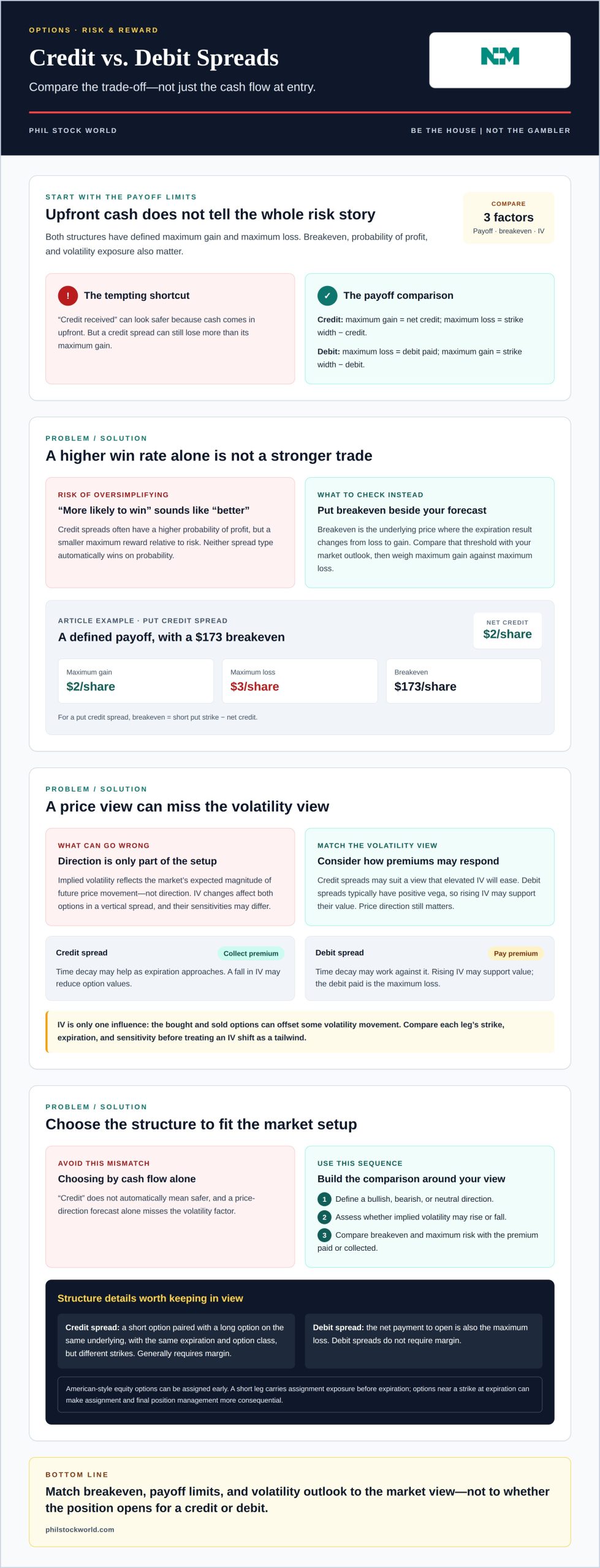
The spread that collects cash upfront isn’t automatically the safer choice. In a credit spread, the maximum gain is the net credit, and the maximum loss is the strike width minus that credit. In a debit spread, the maximum loss is the debit paid, and the maximum gain is the strike width minus the debit. A credit spread vs. debit spread risk-reward comparison also depends on probability of profit and implied volatility, not just the payoff at expiration.
Credit spreads can appeal because time decay may help, and the trade can profit if the spread narrows. Debit spreads, meanwhile, have a defined entry cost and may benefit when implied volatility rises. Neither structure is best for every market setup.
This comparison explains how credit and debit spreads differ in risk, reward, probability of profit, and sensitivity to implied volatility. It also covers how IV percentiles can help frame the choice, so you can match a spread to your market view instead of choosing by the upfront cash flow alone.
Key Takeaways
- Compare maximum gain, maximum loss, and breakeven together to see what each spread asks the underlying asset to do.
- Assess probability of profit alongside the size of the potential payout; a higher win rate alone doesn’t establish a stronger trade.
- Use implied-volatility direction and percentile as context when weighing a premium-selling credit spread against a premium-paying debit spread.
- Build a spread choice around your market outlook and volatility view, then use market analysis and educational resources to sharpen your reasoning.
Which has a higher probability of profit?
Neither spread type automatically has a higher probability of profit. The breakeven, strike prices, and market outlook matter. Credit spreads often have a higher probability of profit but a smaller maximum reward relative to risk, while debit spreads offer a different payout balance.
Breakeven Points and Probability of Profit
Breakeven is the underlying price at which a spread’s expiration result changes from a loss to a gain. Probability of profit depends partly on how likely the underlying is to finish beyond that threshold, not simply on whether the position opens for a credit or debit. Compare the breakeven with your forecast, then weigh maximum gain against maximum loss.
Credit Spread Risk, Reward, and Breakeven
A credit spread collects premium by selling one option and buying another at a different strike. In a hypothetical put credit spread, the net credit is $2 per share, maximum loss is $3 per share, and breakeven is $173 per share. The maximum profit is limited to the credit; the maximum loss is the strike width minus that credit.
Debit Spread Risk, Reward, and Breakeven
A debit spread requires a net payment to open, which is also its maximum loss. The short option caps the gain. American-style equity options can be assigned early, so a short leg carries assignment exposure before expiration.
Breakeven Calculations and Prices
For a put credit spread, subtract the net credit from the short put strike to find breakeven; for a call debit spread, add the net debit to the long call strike. These calculations produce $173 and $344, respectively, in the examples above. At expiration, options near a strike can make assignment and final position management more consequential.
| Spread | Maximum loss | Maximum gain | Breakeven |
|---|---|---|---|
| Put credit | $3 per share | $2 per share | $173 |
| Call debit | $4 per share | $344 |
Choose a spread by matching its breakeven and risk-reward trade-off to your market view, rather than relying on probability alone.
What is a Credit Spread?
A vertical credit spread pairs a short option with a long option on the same underlying, with the same expiration and option class but different strike prices. It brings in net premium upfront. Your outlook and view of implied volatility help determine whether this structure fits.
Bull Call and Bull Put Spreads
A bull call spread is a debit strategy: buy a call at a lower strike and sell one at a higher strike. A bull put spread is a credit strategy: sell a put at a higher strike and buy one below it. Both express a bullish outlook, but the call spread pays premium while the put spread collects it.
With matching strikes and expiration, the two strategies have equivalent bullish expiration profit profiles after financing. The practical differences are the entry cash flow and how volatility changes affect the position. Compare breakeven, maximum risk, and your volatility outlook instead of assuming that “credit” means safer.
Bear Put and Bear Call Spreads
A bear put spread is a debit strategy: buy a higher-strike put and sell a lower-strike put. A bear call spread is a credit strategy: sell a lower-strike call and buy a higher-strike call. Both express a bearish outlook, but they collect or pay premium differently.
For either structure, the strike gap caps the spread’s possible expiration value. The put spread’s maximum loss is its debit; the call spread’s maximum loss is its strike width minus the credit. Compare these limits with the underlying’s breakeven level and the move your thesis requires.
Volatility can influence the choice. Credit spreads generally suit a view that implied volatility is elevated or may fall: selling options brings in premium, and a volatility drop may reduce their value. Debit spreads typically have positive vega, so rising implied volatility may support their value. A price-direction forecast alone misses this second factor.
Use a simple selection sequence: define bullish, bearish, or neutral direction; assess whether implied volatility may rise or fall; then compare breakeven and maximum risk against the premium paid or collected. Credit spreads generally require margin, while debit spreads do not. Market charts and analysis can help frame the volatility backdrop alongside your market view.
How changes in implied volatility affect spread value
Implied volatility (IV) reflects the market’s expected magnitude of future price movement, not its direction. In a vertical spread, IV changes can affect both options, so the position’s net value depends on their relative sensitivity.
Implied Volatility and Spread Selection
Option premiums generally rise when implied volatility rises and fall when it declines, all else equal. A vertical spread combines a bought option and a sold option, which can offset some of that movement. Compare each leg’s strike, expiration, and sensitivity before treating an IV shift as a tailwind for the whole position.
To make a practical decision, first identify the volatility view behind the trade. Selling a credit spread may suit a view that elevated IV will ease; buying a debit spread may suit a view that IV will increase. Price direction still matters, because volatility alone doesn’t determine whether a spread finishes profitably.
Implied Volatility, Time Decay, and Spread Types
Credit spreads may benefit from time decay as expiration approaches, while time decay may work against debit spreads. This effect interacts with IV: volatility changes can alter option premiums as time passes, shifting the position’s value before expiration.
Debit spreads typically have positive vega, meaning they may benefit from rising IV during the trade. Credit spreads generally have the opposite exposure. Consider both forces together: a favorable IV change can be outweighed by an adverse move in the underlying or by time decay.
IV percentile provides context, not a standalone signal. Some traders consider credit spreads when IV is above the 50th percentile of its 52-week range, and debit spreads when it’s between the 0th and 50th percentile. Treat those thresholds as a screening framework, then compare the position’s strikes and market outlook.
In the United States, spread trading must be conducted in a margin account. Credit spreads generally require margin, while debit spreads generally don’t. Trading costs can also reduce net results. American-style equity options can be assigned early, while SPX and XSP index options are European-style and cash-settled.
Using IV percentiles to compare credit and debit spreads
An implied-volatility percentile adds historical context to a spread decision. It places current IV within the underlying’s 52-week range, helping traders distinguish relatively elevated readings from lower ones. The percentile isn’t a forecast of price direction or a guarantee about what happens before expiration. Use it alongside the spread’s strikes, breakeven, and market thesis.
Some traders consider selling a credit spread when IV is above the 50th percentile of its 52-week range. The reasoning: richer option premiums may increase the credit received, while a later decline in IV may reduce the spread’s value. But a higher credit doesn’t erase the position’s maximum loss, and the underlying can still move against the trade.
For debit spreads, some traders look at IV between the 0th and 50th percentile of its 52-week range. Lower relative IV may mean less volatility premium is included in the options being bought. Debit spreads typically have positive vega, so rising IV may support their value. The underlying’s direction and time remaining still influence the result.
- Above the 50th percentile: Consider whether collecting premium with a credit spread fits the price outlook and risk limit.
- Between the 0th and 50th percentile: Weigh a debit spread if buying options aligns with the directional thesis.
- Near expiration: Reassess how time decay and the underlying’s movement affect each contract.
A credit spread vs. debit spread risk-reward comparison should treat IV percentile as context, not a signal by itself. The difference between the strategies isn’t simply “high IV means credit, low IV means debit.” An IV percentile provides context for an underlying’s own volatility history, so it should not be treated as a direct comparison of volatility across different underlyings. Check the range, spread structure, and expected move together before trading.
Use Phil Stock World’s market analysis to examine volatility context and connect it with your trade thesis. That adds useful perspective to a credit spread vs. debit spread risk-reward comparison.
Phil Stock World
Phil Stock World helps readers evaluate spread ideas through market commentary, trading insights, and educational resources. After comparing credit and debit spreads, use market charts and analysis to examine how the underlying’s price action and implied volatility relate to your thesis. Educational webinars can build your understanding of options strategies, while a Virtual Portfolio Review offers another way to examine positions in context. Premium Membership provides access to exclusive market content for readers seeking ongoing analysis. These resources support learning and trade evaluation, but they don’t remove the need to understand a spread’s defined risk, breakeven, and expiration outcomes. Explore Phil Stock World’s resources to support your options research.
Make your next spread decision deliberate
Turn your comparison into a repeatable decision process. Before placing a trade, write down your market view, volatility expectation, acceptable risk, and the condition that would change your thesis. This brief record can help distinguish a reasoned setup from a position chosen simply because its opening cash flow looks attractive.
Use your credit spread vs. debit spread risk-reward comparison as a framework, not a verdict. Market conditions evolve, so a sound process leaves room to reassess the trade as the underlying and volatility change. The goal isn’t to force every outlook into a spread, but to understand why a particular structure fits the idea.
For further discussion of options strategies and market analysis, contact Phil Stock World. Keep asking clear questions, test your reasoning, and let each decision sharpen the next.
Frequently Asked Questions
What is a Debit Spread?
A debit spread is an options position opened by buying one option and selling another, with the purchase costing more than the premium received. For example, a trader who expects a stock to rise might buy a call and sell a higher-strike call with the same expiration. The short option helps offset the entry cost while limiting the spread’s potential value.
Are spreads better than buying calls and puts outright?
Not universally. A spread trades some potential upside for defined risk and an offsetting short option. Buying a call or put outright puts the premium paid at risk, while its potential payoff depends on the underlying asset’s movement. Consider a spread when you want a narrower payoff range. An outright option may suit a thesis requiring greater directional exposure.
Can I convert one into the other mid-trade?
You can change a position by closing the existing spread and opening a different one, but that’s a new trade, not a simple switch. For example, replacing a credit spread with a debit spread means reassessing the strikes, expiration, premium, and current underlying price. Execution prices can differ from those of the original trade, so calculate the revised risk and breakeven before acting.
How much capital does each tie up?
A debit spread generally requires paying its net debit upfront, which also defines its maximum loss. A credit spread collects premium but generally requires margin and ties up buying power against its potential loss. The amount depends on the spread’s strike width and credit received. Spread trading must be conducted in a margin account, so available buying power matters.
What is a credit spread in options trading?
A credit spread is an options position opened for a net premium received. Traders can use a put credit spread for a bullish outlook or a call credit spread for a bearish or neutral outlook. The short option brings in premium, while the long option at another strike limits exposure. The spread’s result depends on the underlying’s price at expiration.
What is a debit spread in options trading?
A debit spread is opened by paying more for the purchased option than the premium collected from the option sold. A call debit spread can express a bullish view, while a put debit spread can express a bearish view. The short option offsets part of the purchase cost but caps potential profit. The net debit is the amount at risk.