


Courtesy of Lee Adler of the Wall Street Examiner
The latest weekly jobless claims data was back on trend this week after last week’s brush with weakness. Initial claims for unemployment compensation declined at an annual rate of nearly 10%, which is better than the average drop over the past two years.
Stock prices remain extended relative to the claims trend but are in the process of breaking through resistance today, making the extension even more extreme. Behold the power of Fed money printing! The Fed’s doves have prevailed and the FOMC said nary a word about The Taper in Wednesday’s statement, even going so far as to say that inflation is too low. The extension of QE, subject to the economic data, continues the bullish status quo.
The Labor Department reported that the seasonally adjusted (SA) representation of first time claims for unemployment was 326,000, a decrease of 19,000 from the previous week’s revised figure of 345,000 (was 343,000) in the advance report for the week ended July 27, 2013. The consensus estimate of economists of 345,000 for the SA headline number was too pessimistic (see footnote 1), a reversal of the prior week’s overly optimistic estimate. They like to alternate their misses, on the low side one week, the high side the next, etc.
The headline seasonally adjusted data is the only data the media reports but the Department of Labor (DOL) also reports the actual data, not seasonally adjusted (NSA). The DOL said in the current press release, “The advance number of actual initial claims under state programs, unadjusted, totaled 279,869 in the week ending July 27, a decrease of 60,084 from the previous week. There were 312,931 initial claims in the comparable week in 2012.” [Added emphasis mine] See footnote 2.
Initial claims as a percent of total employed are now back down to levels last seen during the housing bubble.
The advance report is usually revised up by from 1,000 to 4,000 in the following week, when all interstate claims have been counted. Last week’s number was approximately 1,800 shy of the final number for that week released Wednesday. For purposes of this analysis, I adjusted this week’s reported number up by 2,000 to 282,000, as rounded. It won’t matter that it’s a thousand or two either way in the final count next week. The differences are essentially rounding errors, invisible on the chart.
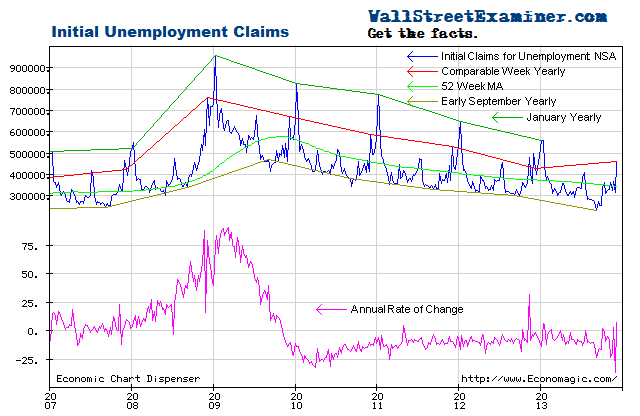
Initial Unemployment Claims – Click to enlarge
The actual filings last week represented a decrease of 9.9% versus the corresponding week last year. The prior week was down just 0.3%. The average weekly year to year improvement of the past 2 years is -8%, with a range from near zero to -20%. The year to year comparisons are now much tougher than the 2010-2012 period as the number of job losses declined sharply between 2009 and 2012, so some slowing in the rate of improvement is to be expected. If the comparisons go negative, that is if current weekly claims are greater than the comparable week’s last year it would be a sign of a weakening economy. The fact that the latest week was down nearly 10% from last year is impressive given that these comparisons are now much tougher than in the early years of the 2009-13 rebound. This data suggests that the economy is still on the same track it has been on since 2010.
Real time federal withholding tax data (which I update weekly in the Treasury Report) suggests that there’s been some weakening in July with a break of the trend of improvement that had been under way all year. This data lends support for the lowering of economic expectations for the start of the third quarter, but not for the second quarter. The fact that Q2 GDP beat expectations wasn’t surprising. But what about July jobs?
The withholding data for July suggests a miss in nonfarm payrolls. However, I’d now call it a tossup. Last week’s claims data would have reflected the reference period, and the data was weak. That and the withholding data still suggest a miss. But the ADP number of 200,000 suggests that the BLS data will be in line with the consensus guess of +175,000. It’s possible that the drop in withholding tax collections is due to the government furloughs taking effect in recent weeks that sent people home without pay for a day or so each week. Or it could have been a cut in hours worked for some workers. Because of these uncertainties I can’t handicap the non farm payrolls number for July.
I don’t think it matters much however. The stock market die was cast when the Fed said in the FOMC statement that inflation was too low and it made no mention of The Taper, instead saying that increases or decreases in QE would be data dependent. To that extent, economic bad news would still be good news for the market. And the “good” news just isn’t good enough for the Fed to back off yet, especially since they think inflation is too low.
The current weekly change in the NSA initial claims number is a decrease of 58,000 from the previous week. That compares with an average change of a drop of 38,000 for the comparable week over the prior 10 years, and a decrease 28,000 for the comparable week last year. The current weekly performance reverses the weaker than normal performances the past two weeks. Last week’s data was at the limit of the trend of the past 2 1/2 years, leaving the year to year change on the brink of going negative, that is, the current number of claims larger than last year. The current data completely mitigated that situation. It just appears to have been one of those occasional, and entirely normal trips, to the edge of the trend.
Cliff-Note: Neither stopping nor starting rounds of QE seems to have had an impact on claims. Nor did the fecal cliff secastration. The US economy is so big that it develops a momentum of its own that policy tweaks do not impact. Policy makers and traders like to think that policy matters to the economy. The evidence suggests otherwise.
Monetary policy measures may have little impact on the economy, but they do matter to financial market performance. In some respects they’re all that matters. We must separate economic performance from market performance. The economy does not drive markets. Liquidity drives markets, and central banks control the flow of liquidity most of the time. The issue is what drives central bankers.
Central bankers pay attention to economic data. Any weakness would suggest that the US economy has run out of momentum. Central bankers have learned the Pavlovian response. Bell rings —> PRINT. We’ve seen this over and over. Weak economic data panics the Fed into extending or even enlarging QE. In recent weeks I have been warning that this could send stock prices into an extended parabolic blowoff. That may be what just occurred with yesterday’s FOMC statement. The economic data and bogus inflation data is just weak enough for the Fed to keep flogging the markets with cash.
Some economic series correlate with stock prices well. Others don’t. I give little weight to economic indicators when analyzing the trend of stock prices, but economic indicators can tell us something about market context, in particular, likely central banker behavior. The economic data helps us to guess whether the Fed will continue printing or not. The printing drives this madness. The economic data helps to predict the central banker Pavlovian Response.
The claims trend is plotted on an inverse scale on the chart below with stock prices on a normal scale. This comparison suggests that bubble dynamics are at work in the equities market, thanks to the Fed’s money printing. Those dynamics could have ended here, or they could become even more extreme depending on whether stock prices pulled back, or broke out. It appears that the market has chosen Column B for breakout today (I address the specific potential outcomes in my proprietary technical work).
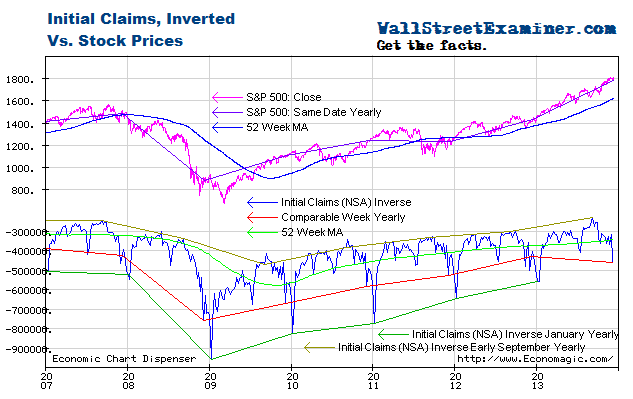
Initial Unemployment Claims and Stock Prices- Click to enlarge
Three weeks ago I wrote, “With Bernanke seemingly reaffirming that QE will be around for a while longer, there’s an increased likelihood that stock prices will decouple completely from economic indicators in the weeks ahead and continue in parabolic blowoff mode until the Fed takes concrete steps to reduce QE.” That probably still applies, especially if economic data weakens in the weeks ahead.
Get regular updates the machinations of the Fed, Treasury, Primary Dealers and foreign central banks in the US market, in the Fed Report in the Professional Edition, Money Liquidity, and Real Estate Package. Click this link to try WSE's Professional Edition risk free for 30 days!
Copyright © 2012 The Wall Street Examiner. All Rights Reserved. The above may be reposted with attribution and a prominent link to the Wall Street Examiner.

