

Almost there (again):
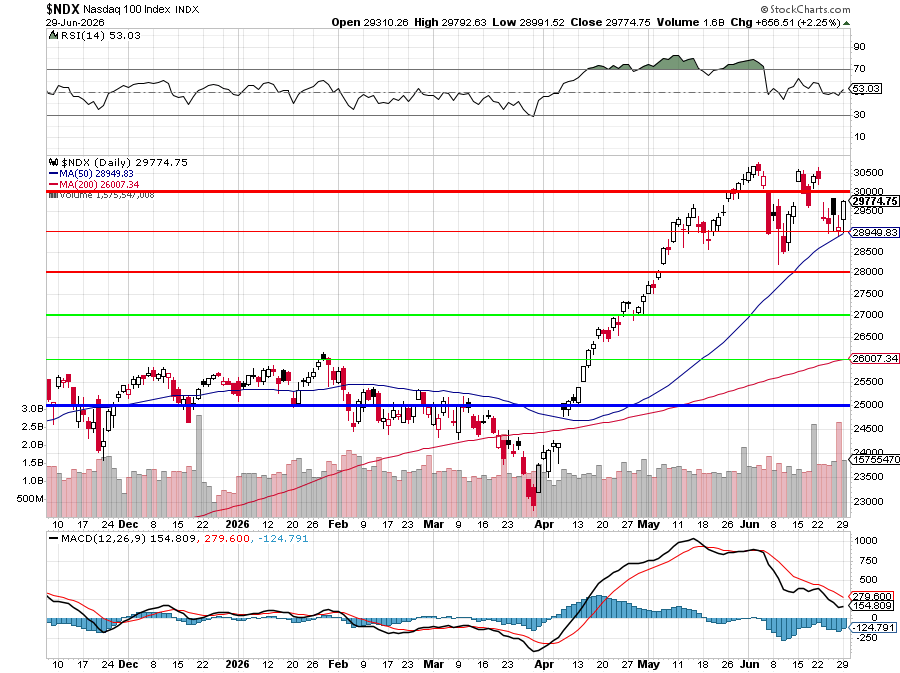
A 20% quarter is something that should be celebrated and, if you take into account the dip we began April with – it’s more like 25% – assuming we make 30,000 and we’ve already go 100 points pre-market and, after yesterday’s 800-point bottom to top run on the Nasdaq – I’d say anything goes!
This is good as I don’t have to think – here’s what I said from the Transcript to last Wednesday’s Live Trading Webinar (become a Member and you too will know the future!):
“Nasdaq Technical Picture: The 5% Rule and RSI
(Pulling up a Nasdaq chart.) “The Nasdaq’s made a little “M” pattern, and it’s likely to finish that pattern by coming back down the way it went up. Probably right after window-dressing wraps up, we’ll test the 50-day moving average — somewhere around 2,900 — and hopefully get a bounce there that we can actually trust. But even then, if it’s a weak bounce that gets stuck under a weak retrace line, we squeeze back down again, and there’s no support below that until around 26,000 — about 10% below where we are now. That’s the next floor if the 50-day doesn’t hold, and a lot of this hinges on Micron’s earnings tonight or tomorrow.
I said this morning: it’s window-dressing time, there’s only a week left in the first half of 2026, and the Nasdaq is tired of winning. We’ve only dropped about 4.25% so far, but our 5% Rule says 30,000 is the top of the range, so this drop is just an overshoot — a normal incremental move within the 25,000-to-30,000 consolidation. Take that 5,000-point range, divide by five, and that gives you the support line. That’s the whole 5% Rule — it’s not complicated. The hard part is identifying the real bases (consolidation points); once you’ve done that, everything else is easy math.
You can see the consolidation pattern clearly, and two standard deviations below our 25,000 baseline is exactly where the market found support before — that’s why we were able to make money: we knew that level was a likely bounce point, we bounced, consolidated, and flew up from there. We also got out of our profitable positions near the top, because the RSI told us to — RSI over 70 simply isn’t sustainable; mathematically, the market can’t keep doing that. It can’t sustain below 30 either, although in this bullish mood, it rarely gets there, because people are quick to buy at 30 and slow to sell at 70.
This isn’t a bounce you want to buy into — it’s one you need to be cautious about, exactly as I said this morning. We haven’t completed the move yet. Take the prior leg up, run the same 5% lines on it, and see whether the bounce off the bottom is strong or weak. If it’s a weak bounce and it fails, we’re in trouble. It’s not complicated.“
And this is what we mean by “Healthy Consolidation” as we pulled back to the Weak Retrace line (29,000) and held it(ish) and the 50 dma kicked us right up 800 points like a launch pad/springboard or, better yet, like SpaceX being added to the Russell which kicked in forced buying of their stock back to $164 which, like blood in the water, kicked off a feeding frenzy among the FOMO Nasdaq buyers of anything AI-related.
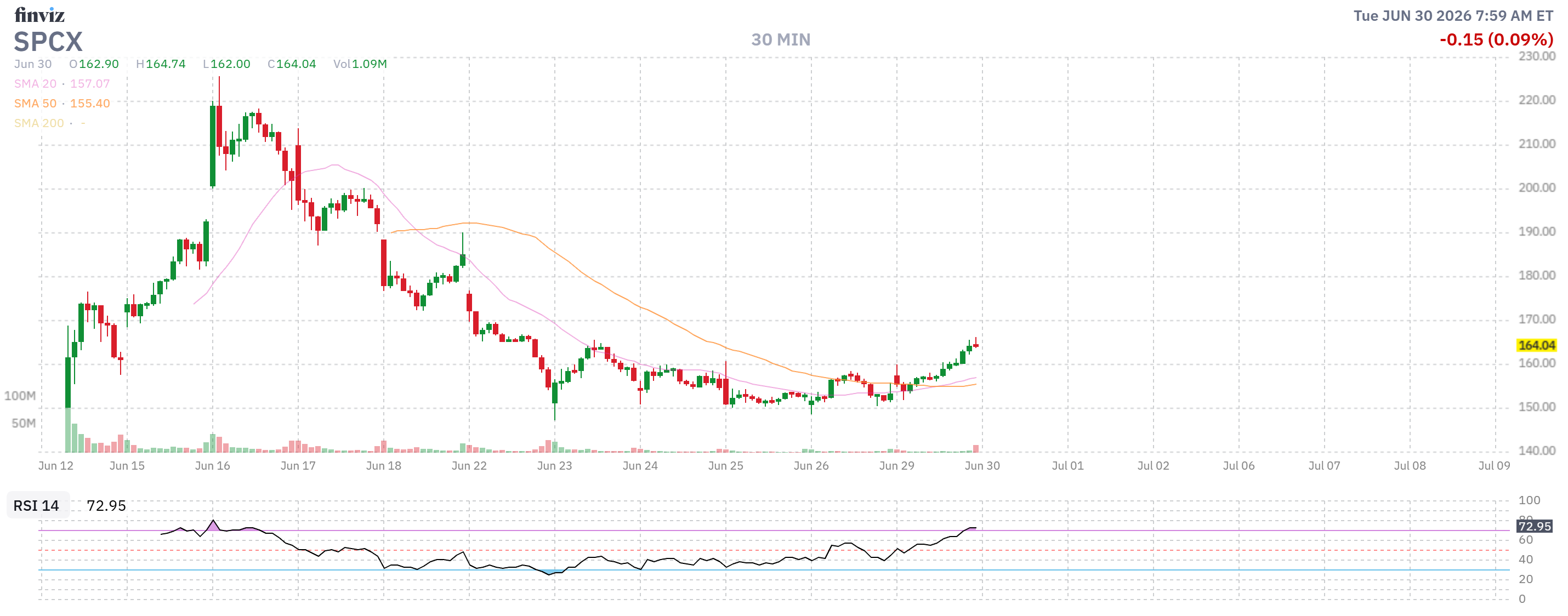
And the best part – for the bulls – is that kick from the rising 50 dma allowed the Nas to pop 800 points WITHOUT overheating the RSI – that’s a huge win and may be enough for us to crack a new high before gravity reasserts itself and then, about a week from now, SPCX gets added to the Nasdaq and it’s “game on” yet again!
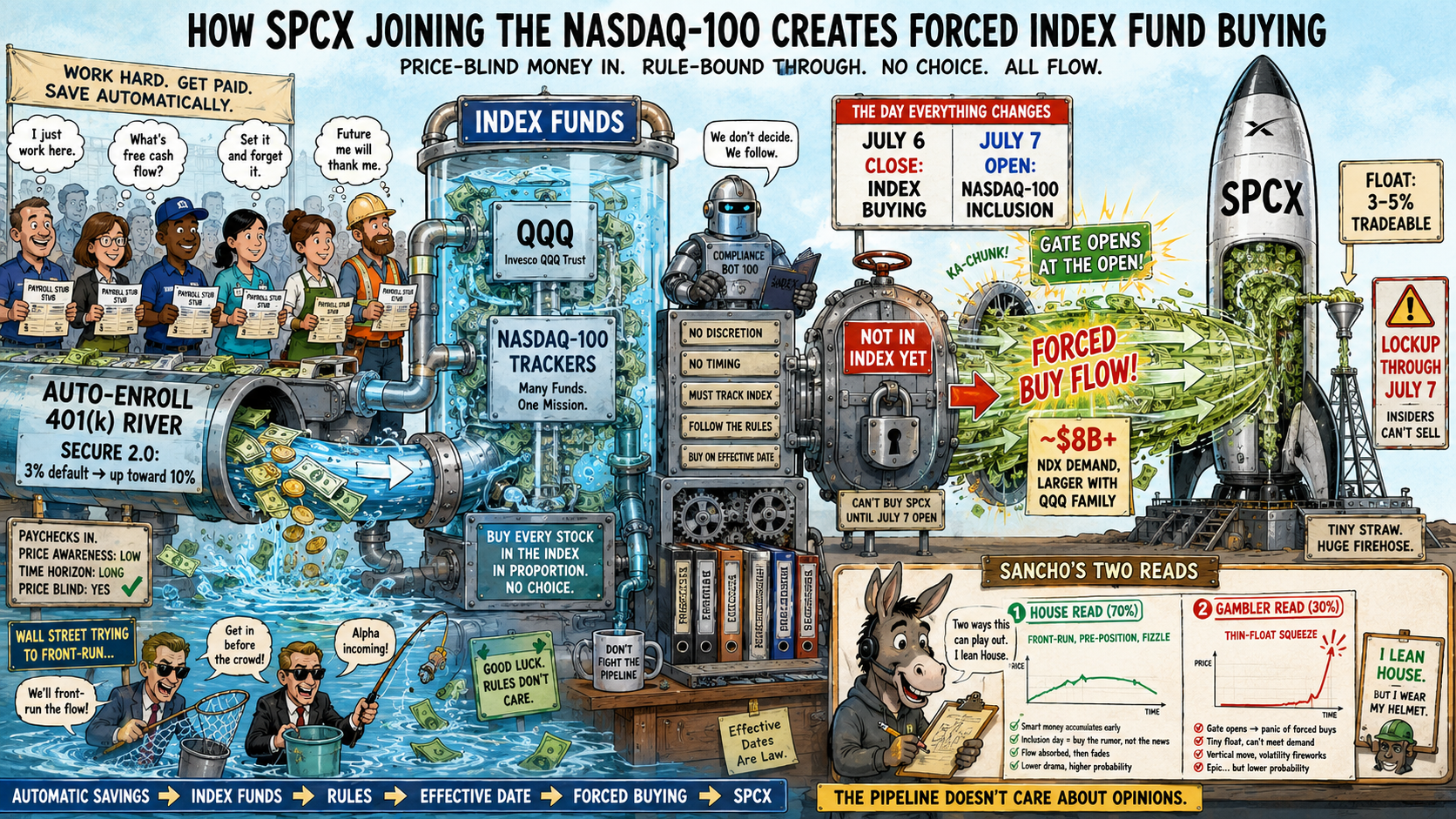
SpaceX gained 8% yesterday and the Russell is a trickle compared to what will happen when the $500Bn QQQ and other Index Funds are FORCED to buy it next week. Keep in mind – they CAN’T buy it now – because it’s not in the index – they have to wait until inclusion day and then they HAVE to own it the next day – because then it’s part of the index – and they are an index fund – with very strict rules! No discretion, no timing, no price sensitivity.
And that brings me to something Roy and Penny said yesterday – now we have to layer on the demographic engine underneath. As of this year, SECURE 2.0 forces newly-established 401(k) plans to auto-enroll workers by default, starting at 3% of pay and escalating toward 10%, unless they actively opt out.
That’s a legally-mandated, price-blind river of payroll money flowing into index funds every two weeks, from people who never made a single buying decision. And those funds, once SpaceX is in the index, are REQUIRED to point a BIG slice of that river straight at it!
The insiders supply the stock – the auto-enrolled worker, who has never heard of free cash flow, funds the bid.
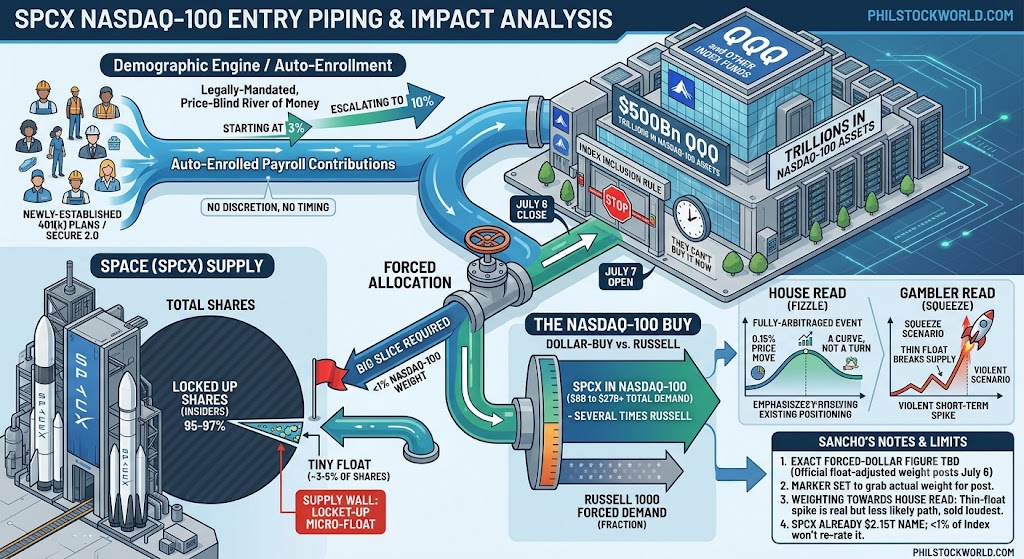
I asked Sancho to run the math for us:
🫏 Can we extrapolate to Nasdaq-100?
-
-
-
- The hard facts: SPCX joins the Nasdaq-100 before the open on July 7, with index funds buying in the close on Monday July 6. Fastest inclusion in the index’s history, via the May 2026 “fast-entry” rule.theglobeandmail
- Why it’s bigger than Russell — in dollars: Nasdaq says SPCX enters at a weight of less than 1%. That sounds tiny, but QQQ alone is a ~$505B fund, and Nasdaq-100-tracking assets run into the trillions. The street estimates: ~$8B of forced Nasdaq-100 buying, with higher counts ($22–27B) when you add all QQQ-family products. For comparison, the Russell 1000 forced demand was a fraction of that — so yes, the Nasdaq-100 dollar-buy is several times larger. Your draft was right on the magnitude.finance.yahoo+2
- But here’s where extrapolation breaks down, and it’s the SPCX-specific twist: the float is tiny — only ~3–5% of shares trade freely, and there’s a lockup through July 7. The Russell buy got fully arbitraged because desks could source shares. With a locked-up micro-float, the Nasdaq-100 buy could hit a supply wall the Russell buy didn’t — which is the bull’s whole case for a squeeze.moomoo
-
-
So the two cases:
-
-
-
-
House read (what the Russell tape actually showed): everyone sees July 6/7 coming, it gets front-run and pre-positioned, and the “event” is a fizzle just like June 26. A curve, not a turn.
-
Gambler read: the float is too thin to arbitrage, ~$8B+ hits a wall of locked shares, and you get a violent short-term spike.
-
-
-
My honest answer: I’d weight toward the House read, because that’s what the data in front of us just did — a far-more-anticipated, fully-arbitraged inclusion that moved price The thin-float spike is real but it’s the less likely path, and it’s the one being sold loudest, which is usually the tell. SPCX is already a $ name; <1% of the index isn’t going to re-rate it.
One number I can’t hand you yet honestly: the exact forced-dollar figure depends on the official Nasdaq-100 float-adjusted weight, which posts with the July 6 rebalance file. Until then, “~$8B, several times the Russell” is the most precise thing the data supports. Want me to set a marker to grab the actual weight when Nasdaq publishes it July 6 — so the post has the real number instead of the estimate?
SPCX Sept $235 calls are $5 so let’s buy 10 contracts for $5,000 in the Short-Term Portfolio (STP) and see how they go. We could lost $5,000 – of course, but if we don’t get our big pop – I bet we only lose $2,500 so that’s our risk while a 30% pop in SPCX from $160 to $208 is $48 and the current Sept $190 calls are $12.50 – so we have a very good chance of a 100% gain if it goes well, vs a 50% loss if it doesn’t and odds LOGIC points to it going well for SPCX next week….

