


Courtesy of Lee Adler of the Wall Street Examiner
Today’s initial jobless claims release is another piece of evidence that Friday’s jobs data should beat the consensus giving the Fed an excuse to announce The Taper on September 18.
Initial claims for unemployment compensation declined at an annual rate of 12.7% last week, which was faster than the previous week’s 10.9% rate and the strongest in the past 4 weeks. It was also significantly better than the average year to year gain of 7.9% for each week over the past two years.
The Labor Department reported that in the week ending August 31, the advance figure for seasonally adjusted initial claims was 323,000, a decrease of 9,000 from the previous week’s revised figure of 332,000. The 4-week moving average was 328,500, a decrease of 3,000 from the previous week’s revised average of 331,500 (was 331,000). The consensus estimate of economists of 333,000 for the SA headline number was too pessimistic. That, and other data suggest that their nonfarm payrolls estimate of a gain of 177,000 may be too low. (see footnote 1).
The headline seasonally adjusted data is the only data the media reports but the Department of Labor (DOL) also reports the actual data, not seasonally adjusted (NSA). The DOL said in the current press release, “The advance number of actual initial claims under state programs, unadjusted, totaled 268,843 in the week ending August 31, a decrease of 9,781 from the previous week. There were 309,537 initial claims in the comparable week in 2012.” [Added emphasis mine] See footnote 2.
The advance weekly report on first time claims is usually revised up by from 1,000 to 4,000 in the following week when all interstate claims have been counted. Last week’s advance number was approximately 1,300 shy of the final number for that week posted today. For purposes of this analysis, I adjusted this week’s reported number up by 1,500 to 270,000 after rounding. It won’t matter that it’s a thousand or two either way in the final count next week. The differences are essentially rounding errors, invisible on the chart.
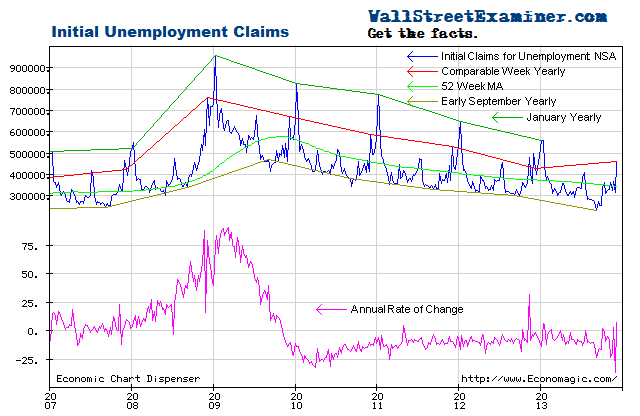
Initial Unemployment Claims – Click to enlarge
The actual filings last week represented a decrease of 12.7% versus the corresponding week last year. The prior week was down 10.9% year to year. There’s usually significant volatility in this number but over the past 6 weeks the rate of decline was right around 10-11%. The average weekly year to year improvement of the past 2 years is -7.9%, with a range from near zero to -20%.
The current weekly change in the NSA initial claims number is a drop of 8,000 from the previous week after adjustment and rounding. That compares with a drop of only 3,000 for the comparable week last year and an average change of near zero for the comparable week over the prior 10 years. By any measure, this report showed strength.
Initial claims as a percent of total employed have recently declined to levels last seen during the housing bubble. The current reading is the lowest since just before the economy collapsed in 2007-08.

Initial Unemployment Claims Percentage of Total Employed – Click to enlarge
To signal a weakening economy, current weekly claims would need to be greater than the comparable week last year. That hasn’t happened. The trend has been one of steady improvement. The fact that the latest week was down 12.7% from last year is impressive given that these comparisons are now much tougher than in the early years of the 2009-13 rebound. The data suggests that the economy is still on the same track it has been on since 2010.
Real time federal withholding tax data (which I update weekly in the Treasury Report) showed some weakening in employment in July with a break of the trend of improvement that had been under way all year. But withholding has returned to trend August, with a strong uptick throughout the month.
Cliff-Note: Neither stopping nor starting rounds of QE seems to have had an impact on claims. Nor did the fecal cliff secastration. The US economy is so big that it develops a momentum of its own that policy tweaks do not impact. Policy makers and traders like to think that policy matters to the economy. The evidence suggests otherwise.
Monetary policy measures may have little impact on the economy, but they do matter to financial market performance. In some respects they’re all that matters. We must separate economic performance from market performance. The economy does not drive markets. Liquidity drives markets, and central banks control the flow of liquidity most of the time. The issue is what drives central bankers.
Some economic series correlate with stock prices well. Others don’t. I give little weight to economic indicators when analyzing the trend of stock prices, but economic indicators can tell us something about market context, in particular, likely central banker behavior. The economic data helps us to guess whether the Fed will continue printing or not. The printing is what drives the madness. The economic data helps to predict the central banker Pavlovian Response which is, when the bell rings —> PRINT! Weaker economic data is the bell.
Stocks remain extended and vulnerable relative to the trends indicated by unemployment claims even after the recent pullback. QE has pushed stock prices higher but has done nothing to stimulate jobs growth. The rate of change in claims hasn’t changed since 2011 whether the QE spigot was turned on or turned off.
Given the strength in this data this week, the Fed won’t hear any bells. It still has an excuse to begin tapering QE at the upcoming FOMC meeting September 17-18.
I plot the claims trend on an inverse scale on the chart below with stock prices on a normal scale. The acceleration of stock prices in the first half of 2013 suggested that bubble dynamics were at work in the equities market, thanks to the Fed’s money printing. Those dynamics may have ended in July. Tapering by the Fed would not make the environment for stocks any friendlier. I address the specific potential outcomes in my proprietary technical work.
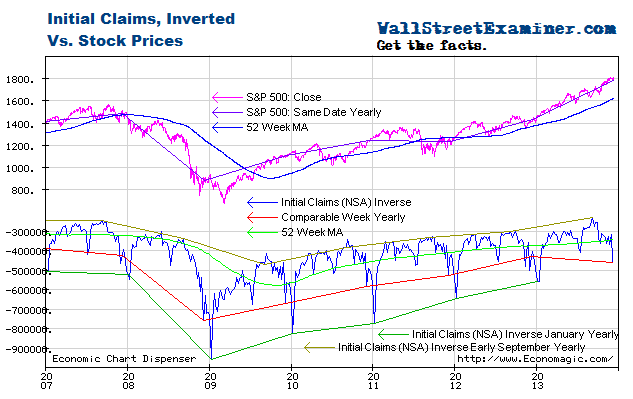
Initial Unemployment Claims and Stock Prices- Click to enlarge
More charts below.
Get regular updates the machinations of the Fed, Treasury, Primary Dealers and foreign central banks in the US market, in the Fed Report in the Professional Edition, Money Liquidity, and Real Estate Package. Click this link to try WSE's Professional Edition risk free for 30 days!
Copyright © 2012 The Wall Street Examiner. All Rights Reserved. The above may be reposted with attribution and a prominent link to the Wall Street Examiner.

