


Courtesy of Lee Adler of the Wall Street Examiner
First time unemployment claims rose sharply as of October 5, as the chaos in Washington began to ripple through the economy. However, as I pointed out last week, the recent strength reflected in the claims data “should change radically in the weeks ahead. In the short run the data will weaken, but more important will be what happens after the government reaches a deal on the budget and the debt ceiling.”
Meanwhile, the media had some lame excuse about California’s reporting software being effed up as part of the reason for the big jump. That doesn’t wash. Two weeks ago the reports were that the glitches in the new software had been ironed out. If earlier claims hadn’t been reported, why were there no significant upward revisions applied to past weeks. No, this jump in claims is real, and it is fallout from the gummit shutdown. I expect most of this weakness to be reversed once this mess is settled. The big question is how much.
The Labor Department reported that in the week ending October 5, the advance figure for seasonally adjusted initial claims was 374,000, an increase of 66,000 from the previous week’s unrevised figure of 308,000. The 4-week moving average was 325,000, an increase of 20,000 from the previous week’s unrevised average of 305,000.
The consensus estimate of economists of 318,000 for the SA headline number was too low for a change (see footnote 1) as economists had no clue what the impact of the government shutdown was and apparently are not aware of the real-time hard data on Federal Withholding taxes, which I track weekly in the Treasury Update. They showed a sharp drop in withholding tax collections over the past week. The jump in claims is not about a computer glitch in California. The tax data confirms that it’s real.
The headline seasonally adjusted data is the only data the media reports but the Department of Labor (DOL) also reports the actual data, not seasonally adjusted (NSA). The DOL said in the current press release, “The advance number of actual initial claims under state programs, unadjusted, totaled 336,849 in the week ending October 5, an increase of 84,616 from the previous week. There were 329,919 initial claims in the comparable week in 2012.” [Added emphasis mine] See footnote 2.
This was the first year to year increase since early January. Actual filings last week represented an increase of 2.1% versus the corresponding week last year. This breaks a string of the strongest year to year declines in a year.
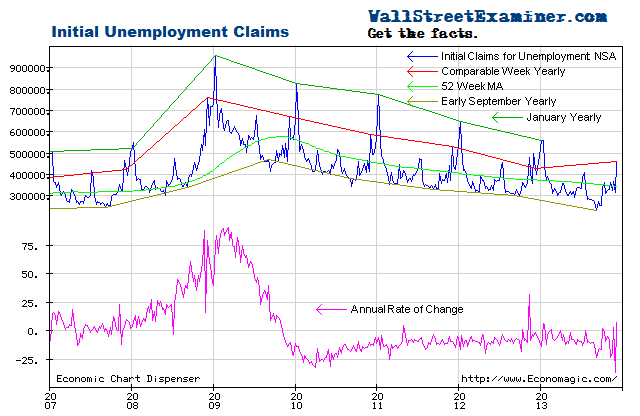
Initial Unemployment Claims – Click to enlarge
There’s usually significant volatility in this number with a usual range of zero to -20%. Prior to this week it had been consistently strong. Last week it was -16.3%. Excluding the mid September reported “glitch” weeks, over the previous 2 months the rate of decline was -10% to -13%. The average weekly year to year improvement of the past 2 years is -8.1%. Claims as a percentage of the total employed were lately at levels last seen at the end of the housing bubble, just before the market and economy collapsed.

Initial Unemployment Claims Percentage of Total Employed – Click to enlarge
That all changed this week. The question is, once a political deal is struck on the budget and debt ceiling and federal workers go back to work, whether claims will return to their recent past pattern, or this shock to the system has a lasting impact. We probably won’t know the complete answer for several months after the deal is done.
The current weekly change in the NSA initial claims number is an increase of 85,000 (rounded) from the previous week. That compares with an increase of 29,000 for the comparable week last year. The first week of October is virtually always an up week. The average change for the comparable week over the prior 10 years was an increase of 34,000. The numbers for this week were worse than any week of the past 10 years. This is clearly an outlier. And we know why.
Federal withholding tax data has slumped sharply since the end of September. It was still on trend until late September when there was a sharp downtick. I speculated last week that the government shutdown should begin to show up in this week’s data, both in withholding taxes and initial claims, and here we are.
To signal a weakening economy, current weekly claims would need to be greater than the comparable week last year. That happened this week, but I’ll give it a mulligan. The trend had been one of accelerating improvement in spite of the fact that the comparisons are now much tougher than in the early years of the 2009-13 rebound. I want to see what happens after the government shutdown ends. Will this data return to trend or not? The answer to that question will tell us whether the shutdown, and possible debt ceiling debacle, which looks like it will be avoided, have any long term effects on the economy.
The government shutdown will pollute this data for its duration. Let’s take it with a grain of salt while everyone else is crying, rending their clothes, and gnashing their teeth, or blaming a glitch. It wasn’t a glitch.
Relative to the trends indicated by unemployment claims, stocks have been extended and vulnerable since May. QE has pushed stock prices higher but has done nothing to stimulate jobs growth.
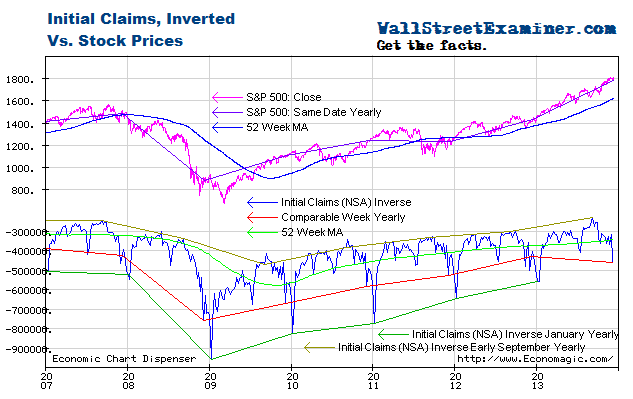
Initial Unemployment Claims and Stock Prices- Click to enlarge
I plot the claims trend on an inverse scale on this chart with stock prices on a normal scale. The acceleration of stock prices in the first half of 2013 suggested that bubble dynamics were at work in the equities market, thanks to the Fed’s money printing. Those dynamics appeared to have ended in July but the zombie has kept coming back to life. Has the government shutdown and the potential for default finally put a stake in its heart? I address the specific potential outcomes in my proprietary technical work.
Get regular updates the machinations of the Fed, Treasury, Primary Dealers and foreign central banks in the US market, in the Fed Report in the Professional Edition, Money Liquidity, and Real Estate Package. Click this link to try WSE's Professional Edition risk free for 30 days!
Copyright © 2012 The Wall Street Examiner. All Rights Reserved. The above may be reposted with attribution and a prominent link to the Wall Street Examiner.

