

28.3 C
New York
Saturday, June 20, 2026

The Myth of SpaceX

The company has mutated into something that defies both comparison and logic.

By Charlie Warzel, The Atlantic 

SpaceX had its initial public offering last week. Now Elon Musk is a trillionaire on paper. But what is SpaceX? On one level, of course, SpaceX is a company that builds rockets and spacecraft and launches them into space. (Occasionally the rockets explode.) It is also the company that birthed Starlink, a satellite-internet business that generated more than $11 billion in revenue last year.

But the company can be defined in many ways. SpaceX is a financial instrument for Musk. Before the IPO, SpaceX acquired xAI, Musk’s artificial-intelligence company, which itself acquired X, the social-media site, back in 2025. The maneuver allowed SpaceX to claim that it believed it had “the largest actionable total addressable market in human history”: $28.5 trillion, to be precise. $26.5 trillion of that, according to the filing, would come from AI infrastructure and applications, meaning not from SpaceX’s core business of aerospace engineering and satellites.

More here >

Summary

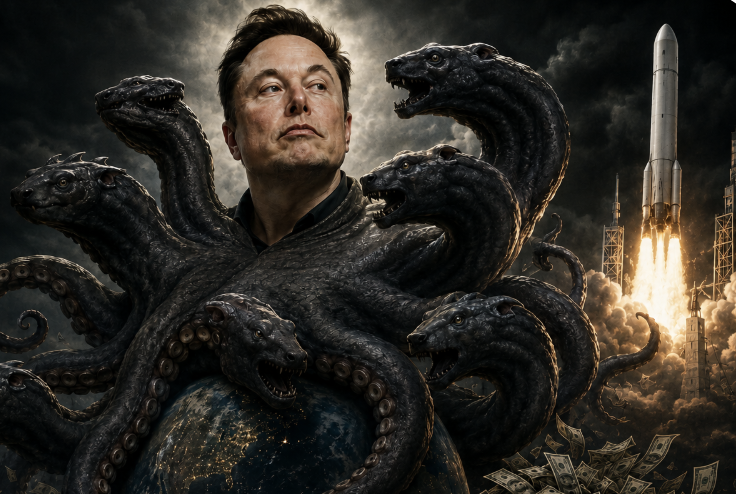
Charlie Warzel’s article argues that SpaceX has evolved into something far larger and stranger than a normal aerospace company. While SpaceX does build rockets and operate the highly successful Starlink satellite network, the author says the company now functions simultaneously as a technology company, a financial vehicle, a speculative AI story, and a cultural myth built around Elon Musk himself.

A major theme of the piece is that SpaceX’s valuation appears disconnected from traditional financial logic. The company lost billions of dollars last year while still reaching a valuation of roughly $1.7 trillion after its IPO. Warzel argues that investors are valuing SpaceX less on current profits and more on belief in Musk’s future ambitions: AI infrastructure, asteroid mining, Mars colonization, space tourism, and an “everything company” spanning multiple industries.

The article also emphasizes Musk’s ability to shape markets through narrative and attention. Warzel suggests Musk understands modern financial markets as much as technology itself, where hype, momentum, and public perception can sometimes matter more than fundamentals. In this view, SpaceX operates partly like a meme stock or speculative asset, except attached to real businesses like rockets, satellites, and AI acquisitions.

Another major argument is that Musk’s growing wealth and influence may have become systemically powerful. SpaceX’s importance in communications, government contracts, AI, and geopolitics gives Musk influence that extends beyond business into politics and infrastructure. The article compares this concentration of power to past financial excesses such as the 2008 era of Goldman Sachs, but argues Musk’s influence may be even more unusual because it is centered around one individual rather than a traditional institution.

Ultimately, the article portrays SpaceX as both impressive and dangerous: a real engineering success story wrapped inside a speculative financial and cultural phenomenon. SpaceX has become less like a normal corporation and more like a self-reinforcing myth powered by investor belief, media attention, government dependence, and Musk’s personal brand.

Subscribe
Notify of
0 Comments
Inline Feedbacks
View all comments

Stay Connected

148,800FansLike
396,312FollowersFollow
2,690SubscribersSubscribe

Latest Articles

0
Would love your thoughts, please comment.x
()
x
