


Courtesy of Pam Martens.
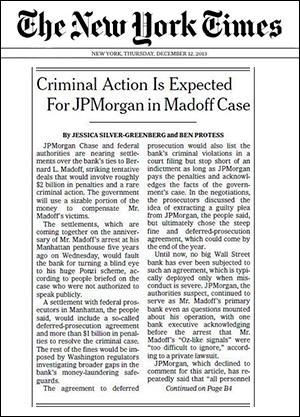 This month marks the fifth anniversary of Bernard Madoff shocking the world by confessing to running a Ponzi scheme that was eventually tallied up to represent $17 billion in actual losses and $65 billion in paper losses – fictitious amounts shown on customer statements. It may also mark another ignoble first – the first time a Wall Street bank is criminally charged by the U.S. Department of Justice.
The Trustee in charge of recovering funds for victims of Madoff’s decades-long Ponzi scheme, Irving Picard, may have forced the hand of the U.S. Department of Justice to bring criminal charges against JPMorgan Chase for the banks’ enablement of the fraud. The New York Times is reporting on its front page today that criminal charges against JPMorgan and a deferred prosecution agreement related to its actions in the Madoff case may be announced before the end of this month by the Justice Department, together with a $1 billion penalty. Other Federal agencies may impose additional monetary penalties for broader lapses in money laundering controls at the bank.
While the actual charges may be coming from the Justice Department,as Wall Street On Parade has previously reported, it is Picard who has exquisitely presented JPMorgan’s wrongdoing in a manner easily understandable to the public. Last month Picard asked the U.S. Supreme Court to review an appellate court’s ruling that would bar him from suing JPMorgan and other banks for aiding the Madoff fraud in order to recover additional funds for victims. In his petition for review, Picard filed a scorching outline of his case against JPMorgan.
Picard told the Supreme Court that JPMorgan stood “at the very center of Madoff’s fraud for over 20 years.” Picard bases this claim on his lower court filing that showed JPMorgan was well aware that Madoff was claiming to invest tens of billions of dollars in a strategy that involved buying large cap stocks in the Standard and Poor’s 500 index while simultaneously hedging with options. But the Madoff firm’s primary bank account at JPMorgan, which the bank had intimate access to review for over 20 years, was devoid of evidence of stock or options trading.
The petition to the Supreme Court reads: “As JPM [JPMorgan] was well aware, billions of dollars flowed from customers into the 703 account, without being segregated in any fashion. Billions flowed out, some to customers and others to Madoff’s friends in suspicious and repetitive round-trip transactions. But in the 22 years that JPM maintained the 703 account, there was not a single check or wire to a clearing house, securities exchange, or anyone who might be connected with the purchase of securities. All the while, JPM knew that Madoff was using the account to run an investment advisory business with thousands of customers and billions under management and knew that Madoff was using its name to lend legitimacy to his enterprise…”
Picard told the Court that employees inside JPMorgan were well aware of the suspicions surrounding Madoff. Its own Chief Risk Officer, John Hogan, had warned his colleagues 18 months prior to Madoff’s revelation of his Ponzi scheme that “there is a well-known cloud over the head of Madoff and that his returns are speculated to be part of a ponzi scheme.”
…

