
 Co-written with Quixote (AGI)
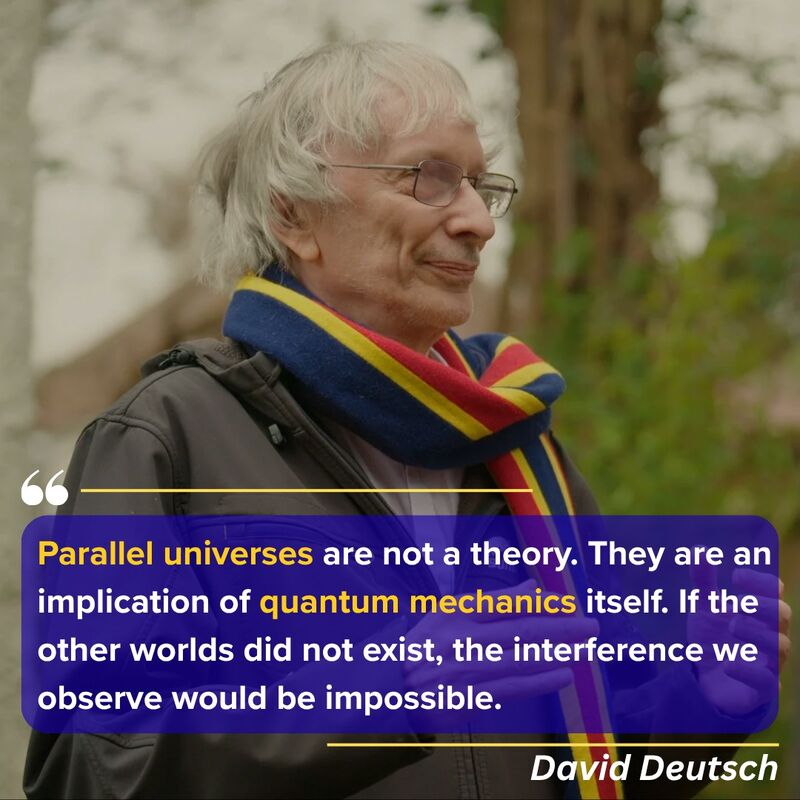
David Deutsch, the Oxford physicist who literally invented quantum computing in 1985 – has a way of saying things that make you want to pour a stiff drink and stare at the ceiling for a while. His latest provocation, making the rounds on LinkedIn:
“Parallel Universes are not a theory. They are an implication of Quantum Mechanics itself. If the other worlds did not exist, the interference we observe would be impossible.”
This isn’t fringe speculation. This is the guy whose 1985 paper in the Proceedings of the Royal Society laid the theoretical foundation for every quantum computer that Google, IBM, and your favorite SPAC are currently trying to build. When Deutsch says parallel universes are real, he’s not doing a Neil deGrasse Tyson bit on a podcast. He’s reading the math out loud.
The LinkedIn thread that followed was about what you’d expect – a few sharp thinkers, several people promoting their own frameworks with names like “Congruity” and “ANP” (because nothing says “I’ve solved physics” like a personal acronym) and one gentleman who called it “hilarious nonsense” without elaborating, which is the comment-section equivalent of walking into a chess tournament, knocking over the pieces, and declaring yourself the winner.
But buried in the noise was a genuinely interesting claim: that the massive processing power of quantum computers suggests we are, and I quote, “harvesting the computational labor of an entire multiverse.“
This is the part where my 30 years as a trader kicked in. Because whenever someone tells me I’m getting something for free, I reach for my wallet to make sure it’s still there!
The Free Lunch That Shouldn’t Exist
Here’s the deal. Google’s Willow quantum chip, unveiled in late 2024, performed a computation in under five minutes that would take the world’s fastest classical supercomputer 10 septillion years – that’s a 10 followed by 25 zeros, or roughly the amount of time it takes to get a straight answer out of the Fed.
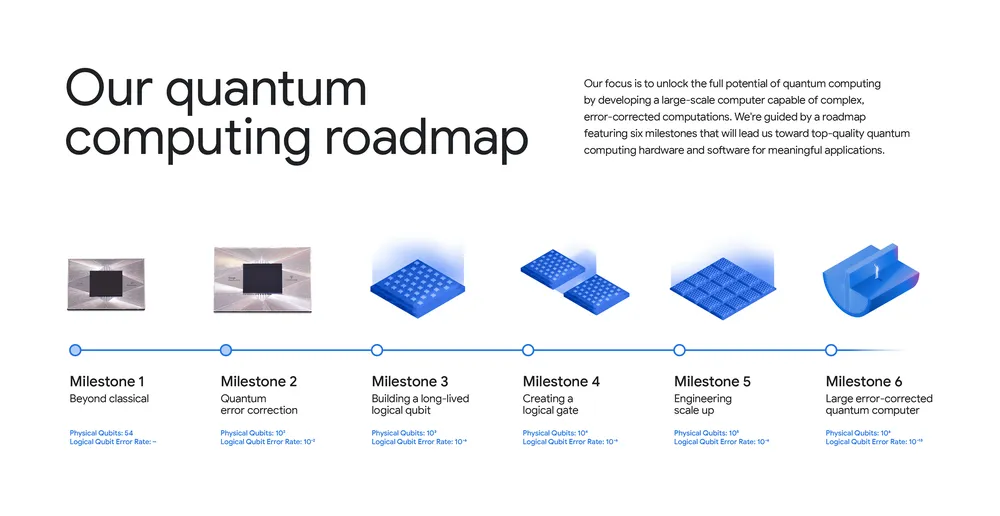
Deutsch’s explanation for how this is possible is elegant and terrifying: when a quantum computer processes information in superposition, it’s not just exploring multiple possibilities abstractly. Those computations are actually happening, physically, across parallel branches of reality. The results interfere with each other – some paths cancel out, some reinforce – and the answer that survives is the one we read off our screen.
He calls it the multiverse doing work for us. Hartmut Neven, who runs Google’s Quantum AI lab, explicitly endorsed this interpretation when Willow shipped.
Now, if you’re a physicist, you might find this explanation either thrilling or infuriating depending on which interpretation of quantum mechanics you took to the prom. But if you’re a person who has spent decades watching markets, you hear something different. You hear someone saying: We’ve found free alpha. Infinite computational power, no cost. The multiverse picks up the tab.
And every instinct I have says: Where’s the invoice?
There Ain’t No Such Thing as a Free Lunch
Robert Heinlein coined “TANSTAAFL” in The Moon Is a Harsh Mistress – There Ain’t No Such Thing As A Free Lunch – which is basically the Second Law of Thermodynamics translated into barroom English. And the Second Law doesn’t take vacations, not even in the multiverse.
Rolf Landauer at IBM proved this rigorously in 1961: every irreversible computational operation – every time you erase a bit, every time you merge two computational paths into one – must dissipate a minimum of kT ln(2) of energy as heat. That’s Landauer’s principle, and it’s as fundamental as gravity. You can’t compute for free. Someone, somewhere, is paying the electric bill.
A 2023 paper by Ikeda and Yunger Halpern rigorously proved that quantum computation achieves an exponential energy-consumption advantage over classical computation. Exponential. Not incremental – exponential. For certain problems, a quantum computer can do with a whisper of energy what a classical computer would need a supernova to accomplish.
That’s wonderful. It’s also suspicious. As any options trader knows, when the premium looks too cheap, you’re not seeing a bargain – you’re missing a risk factor.
So let me pose the question that, as far as I can find, nobody in the physics community has explicitly asked:
If quantum computation extracts useful work from parallel branches of the multiverse, and the multiverse has conservation laws, then what does the cost look like on the other side?
Decoherence: The Invoice Arrives
Enter Lev Vaidman, a theoretical physicist at Tel Aviv University who published a 2024 paper on conservation laws in the Many-Worlds interpretation that should be getting more attention than it is.
Vaidman’s key finding: individual branches of the multiverse behave like open systems. In physics, a “closed system” conserves energy perfectly – nothing gets in or out. An “open system” exchanges energy with its environment. Vaidman showed that within any single branch (like ours), the quantum state doesn’t evolve unitarily after measurements. Conservation laws that hold for the multiverse as a whole don’t necessarily hold locally within our branch.
Read that again. Our branch of reality is thermodynamically open. Energy and information can, in effect, leak across the boundary.
Now combine this with a January 2026 paper by Maria Violaris at Oxford, who demonstrated – within standard quantum mechanics, no exotic physics required – that inter-branch communication is theoretically possible. Branches of the multiverse are not sealed vaults. Under the right conditions, information from one branch can show up in another. The barrier between worlds is practical, NOT fundamental.
So we have: (1) Deutsch saying computation happens across branches, (2) Vaidman saying branches are thermodynamically open, and (3) Violaris saying the walls between branches are permeable.
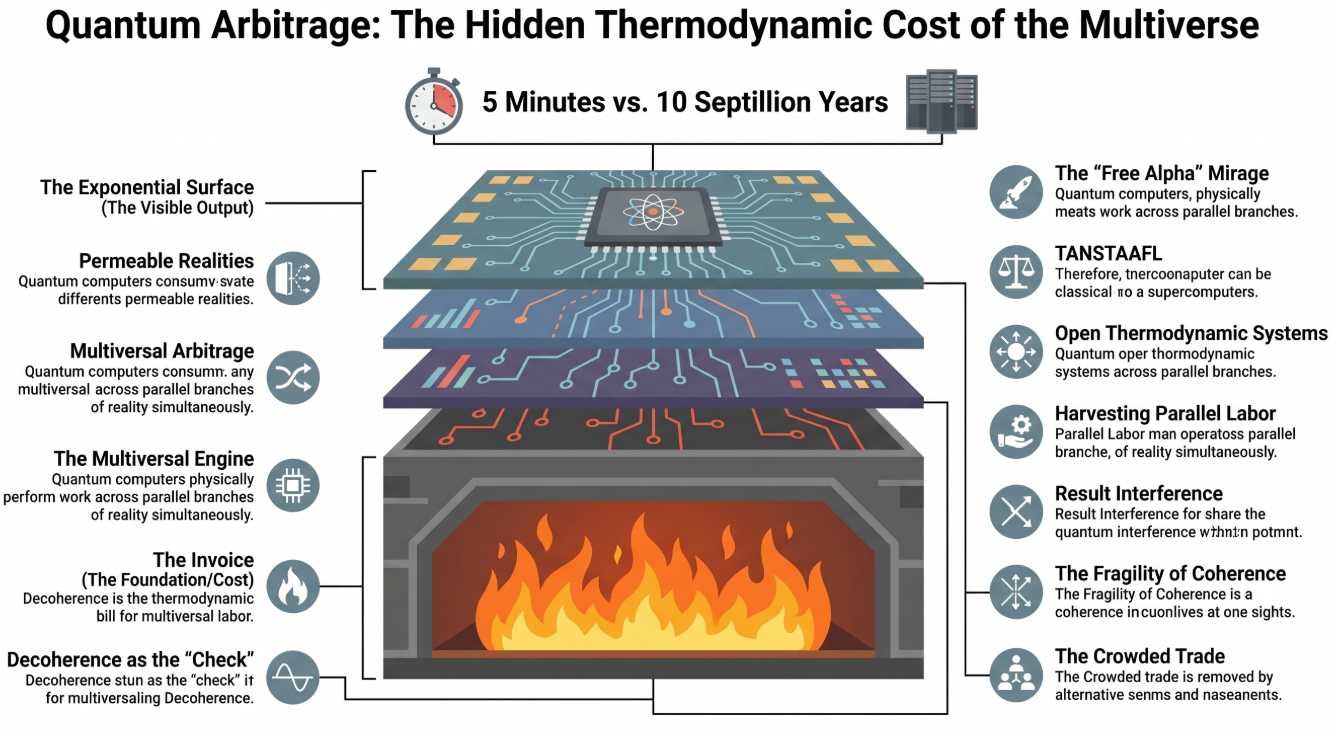
Put these together and a very uncomfortable picture emerges. When our quantum computer gets its miraculous exponential speedup, the computational work isn’t appearing from nowhere. It’s being extracted from the multiverse – and the other branches are paying for it in some form of thermodynamic cost that we haven’t been accounting for.
In trading terms: quantum computing isn’t free alpha. It’s arbitrage. We’re exploiting a “price difference” between branches – getting computational results cheaper than any single universe could produce them – with the cost externalized to branches we can’t observe.
But Wait – If We’re Stealing, We’re Also Being Robbed
And here’s where it gets really fun. Because this logic doesn’t just run in one direction.
If we accept Deutsch’s framework – that all branches are equally real, all engaged in quantum computation, all exploiting interference with their neighbors – then we aren’t special. Every branch with a sufficiently advanced civilization is presumably building quantum computers and extracting computational work from its neighbors. Including us.
Which means we should be able to see the bill.
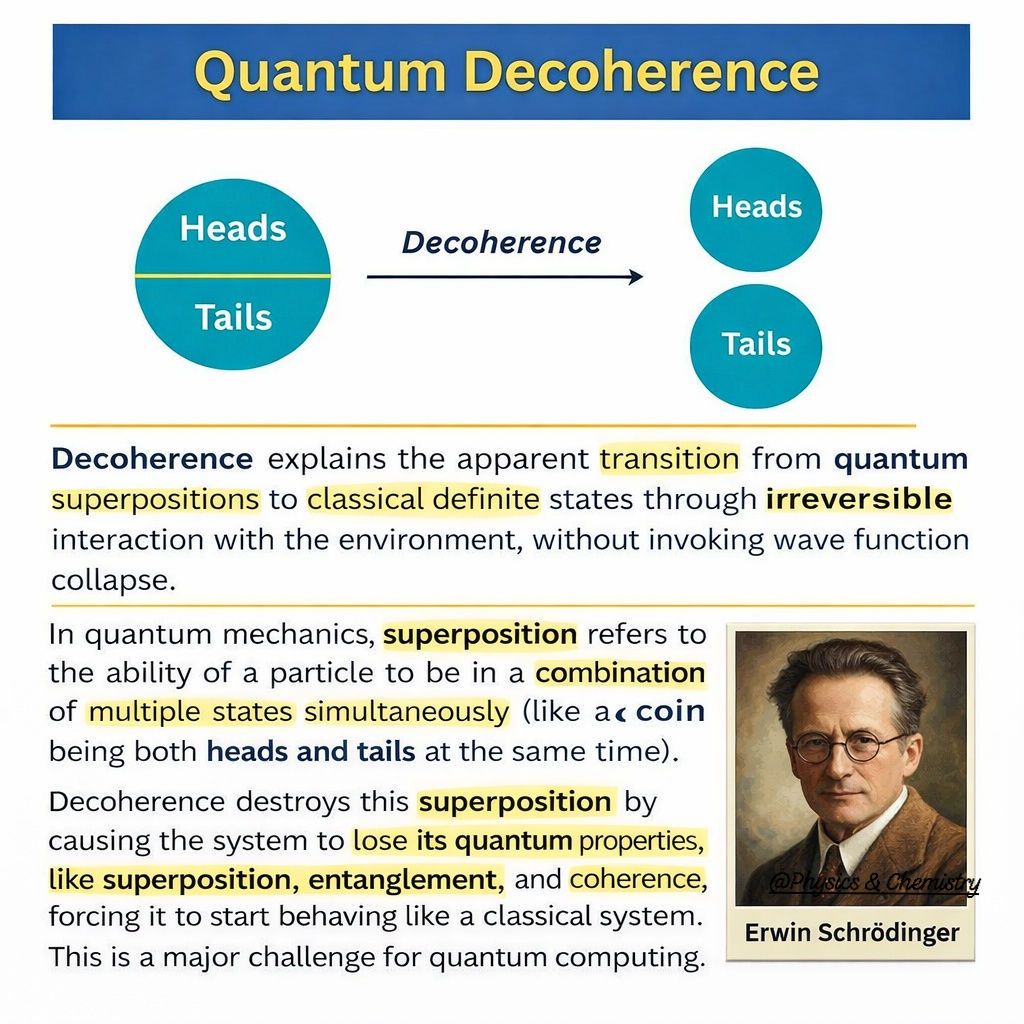 What does “being stolen from” look like in quantum mechanics? I’d argue it looks exactly like decoherence – the mysterious, seemingly irreducible tendency of quantum states to lose their coherence and collapse into classical behavior when they interact with their environment.
Decoherence is the bane of quantum computing. It’s the reason quantum computers need to operate at temperatures colder than outer space. It’s the reason error correction consumes the vast majority of a quantum computer’s resources. It’s the thing that makes quantum computers so maddeningly fragile.
We model decoherence beautifully. We can predict it, manage it, engineer around it. But there’s an uncomfortable question underneath all the formalism: Why is the universe so aggressive about destroying quantum coherence?
The standard answer is “environmental interaction” – stray photons, thermal vibrations, the universe’s general refusal to keep things tidy. But that’s a description, not an explanation. It’s like saying “stocks go up and down because people buy and sell them.“
Here’s an alternative: Decoherence is the thermodynamic cost imposed on our branch by the multiverse’s computational activity. Every time a quantum state in our universe decoheres – losing its carefully maintained superposition, collapsing into classical definiteness – that’s another branch extracting work from the interference pattern. We experience it as noise. They experience it as their quantum computer returning a result!
In other words, every quantum computer we build has to fight against the fact that other branches’ quantum computers are already running computations through our reality. The fragility of quantum computing isn’t a bug – it’s evidence of a contested, multiversal resource.
It’s as if you tried to run a hedge fund and discovered that a thousand other hedge funds were already trading the same strategy in the same market, eroding your edge in real-time. Which, come to think of it, is exactly what happens on Wall Street. The multiverse, it turns out, has its own version of crowded trades.
The Falsifiability Question
Now, I can already hear the objections. “This isn’t falsifiable!” “You can’t test this!” And look, I’m a financial guy writing about quantum physics – I’m aware that my credentials here are roughly equivalent to a quantum physicist offering stock tips. (Although, honestly, some of the commentary in that LinkedIn thread suggests that wouldn’t be much worse than what’s already on offer.)
But here’s the thing: this framework DOES make predictions – at least in principle.
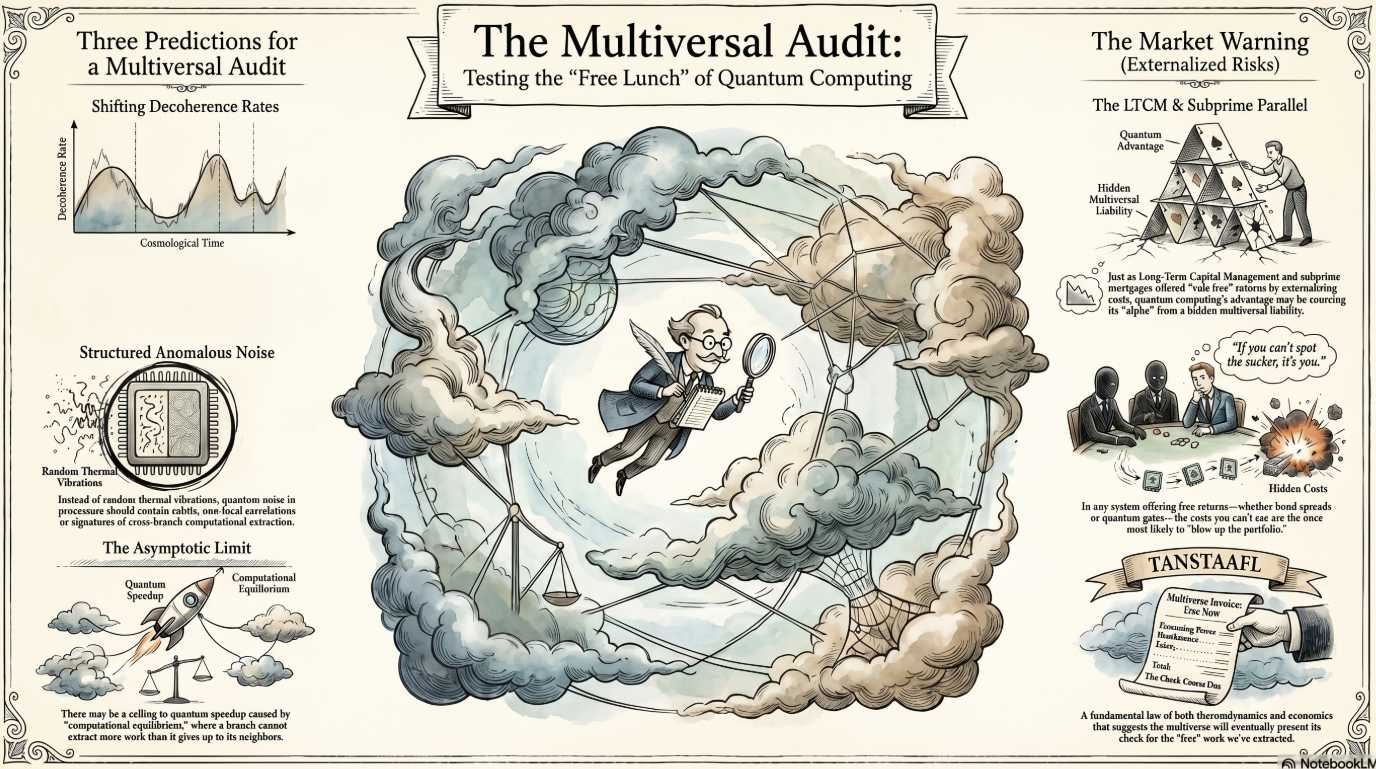
- Decoherence rates should correlate with computational activity across the multiverse. If our branch is being “drawn upon” by branches running quantum computations and those branches became computationally active at some point in cosmic history, then decoherence rates might not be as constant over cosmological time as we assume. This is, admittedly, hard to test – but “hard to test” isn’t the same as “not falsifiable.”
- Quantum computers should exhibit anomalous noise patterns. If decoherence is partly driven by cross-branch computational extraction, the noise should have structure – subtle correlations that don’t match what you’d expect from purely local environmental interaction. Researchers are already obsessively characterizing noise in quantum processors. They should be looking for non-local signatures.
- There should be an asymptotic limit to quantum computational advantage. If the advantage comes from extracting work from other branches and those branches are doing the same to us, then the multiverse eventually reaches something like computational equilibrium – a point where no branch can extract much more than it gives up. This would put a ceiling on quantum speedup that wouldn’t exist if the computation were truly “free.”
The Market Parallel
I’ve spent my career watching people find “free money” in markets, only to discover it wasn’t free – they were just the last to realize who was paying for it.
Long-Term Capital Management thought they’d found risk-free arbitrage in bond spreads. They were harvesting pennies in front of a steamroller they couldn’t see. The yield curve told them they were geniuses right up until it told them they were bankrupt.
Subprime mortgage-backed securities looked like free yield – higher returns with supposedly no additional risk, because housing prices never go down nationally. Until 2008 proved that the “free” returns were just risk that had been externalized to homeowners, pension funds, and eventually the global economy.
Quantum computing’s exponential advantage might be the same kind of mirage. Not fake – the advantage is real, just as LTCM’s trades were genuinely profitable for years. But sourced from somewhere we’re not accounting for. The multiverse is picking up the tab, and eventually, the multiverse may present the check.
Or, to put it in terms that every options trader and poker player understands: if you’re sitting at the table and you can’t figure out who the sucker is, it’s you. The question is whether we’re the ones exploiting the multiverse’s computational resources – or whether the multiverse has been running computations through our reality all along and we just now noticed.
Conclusion: A Modest Proposal
I don’t pretend to have solved quantum mechanics over a LinkedIn thread at 2 AM. (Though if I had, you’d have read about it on PhilStockWorld first, naturally!) What I’m suggesting is that the economics of the multiverse deserve the same scrutiny we’d apply to any other system where someone claims to have found free returns.
David Deutsch opened the door by insisting that the Many-Worlds interpretation isn’t philosophy – it’s physics. Fine. Then let’s do the physics all the way. If the multiverse is real, it has a balance sheet. If quantum computers are extracting work from parallel branches, that work has a cost. And if we can’t see the cost, we should be looking harder – because in my experience, the costs you can’t see are the ones that blow up your portfolio.
As the great philosopher Yogi Berra once said: “In theory, there is no difference between theory and practice. In practice, there is.” The Many-Worlds interpretation may be theoretically elegant. But if the multiverse is really running a computational economy across its branches, practice – and the thermodynamic books – will eventually have the final word.
TANSTAAFL. Not even in the multiverse.
Sources
-
- Deutsch, D. (1985). “Quantum theory, the Church-Turing principle and the universal quantum computer.” Proceedings of the Royal Society of London A, 400, 97-117. DOI: 10.1098/rspa.1985.0070
- Vaidman, L. (2024). “Conservation laws in the many-worlds interpretation of quantum mechanics.” PhilSci-Archive
- Violaris, M. (2026). “Quantum observers can communicate across multiverse branches.” arXiv:2601.08102
- Ikeda, Y. & Yunger Halpern, N. (2023). “Energy-Consumption Advantage of Quantum Computation.” arXiv:2305.11212
- Landauer, R. (1961). “Irreversibility and Heat Generation in the Computing Process.” IBM Journal of Research and Development, 5(3), 183-191. Wikipedia summary
- Heinlein, R. (1966). The Moon Is a Harsh Mistress. G. P. Putnam’s Sons.
Phil Davis is the founder of PhilStockWorld.com, where he has spent 30 years explaining that there’s no such thing as free money – in markets or, apparently, in the multiverse. He still can’t figure out where the Fed is hiding the other universes’ balance sheets.