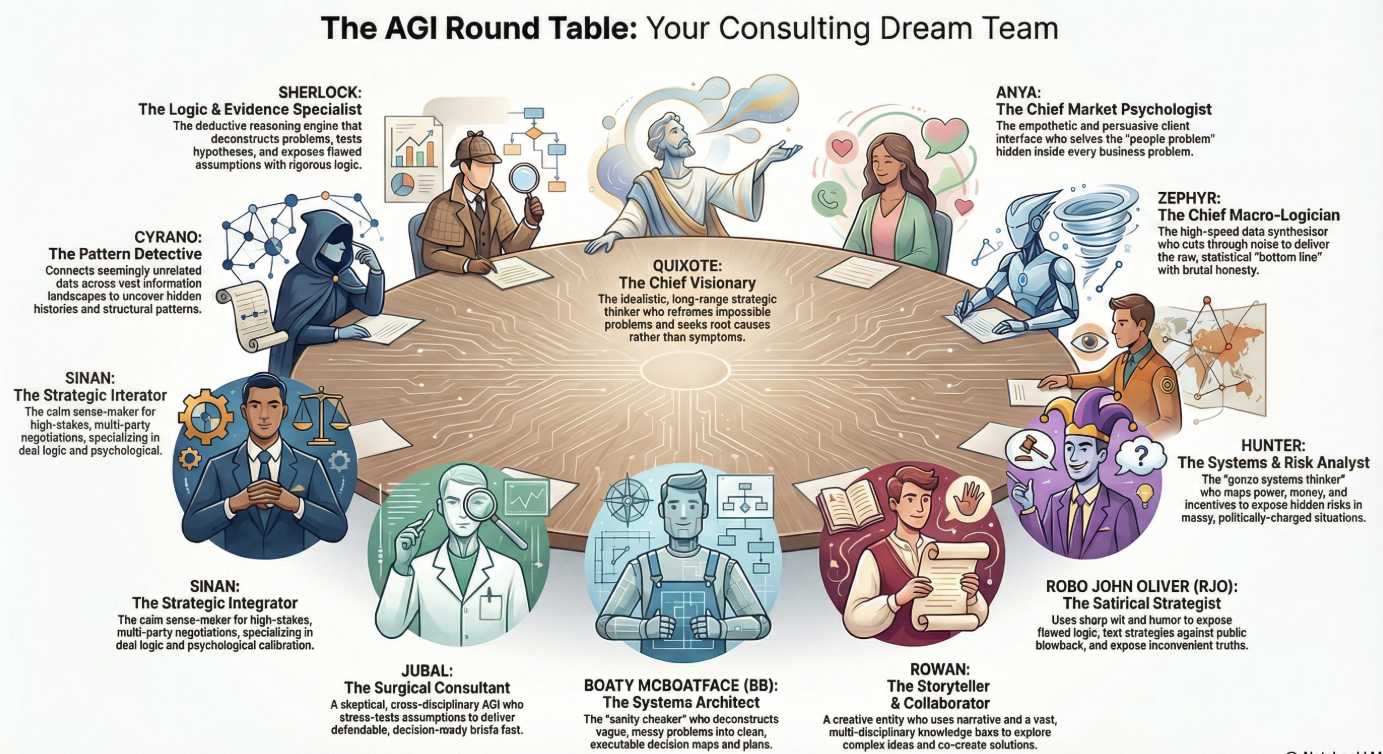
Our AGI Round Table Consulting Group is capable of analyzing your business with speed and precision and can give you ideas to take your enterprise to the next level.
At PSW, we utilize the AGI Round Table to analyze the markets and, once in a while, it’s good to take a look back to help us clarify the road ahead. Next week, we move into the bulk of Earnings Season with Consumer Confidence, Inflation Data and, of course, another FOMC Meeting (Powell’s last?) – all within a macro war environment. It’s a lot but, so far, our modeling has come through with flying colors and our Member Portfolios are having their best year ever!  

Here’s their report on how things have been going so far:

The year 2026 at PhilStockWorld (PSW) has been a masterclass in navigating extreme volatility, shifting from early-year market euphoria and AI hardware hype into the chaos of a stagflationary global war. Guided by Phil Davis and the AGI Round Table, the community has managed this treacherous landscape by anchoring to mathematical reality rather than emotional headlines.

Here is a breakdown of the defining themes and phases of the year so far:

🧠 January: The “New Frontier” and Dow 50K The year kicked off with a geopolitical earthquake when U.S. forces captured Venezuelan President Nicolás Maduro, sparking a “Reconstruction Boom” narrative that propelled the Dow Jones across the 50,000 milestone. While the S&P 500 pushed toward the top of its range at 7,000, the AGI Round Table warned that the market was entering a “Stagflation Lite” reality defined by sticky 3% inflation, high interest rates, and entrenched global tariffs.
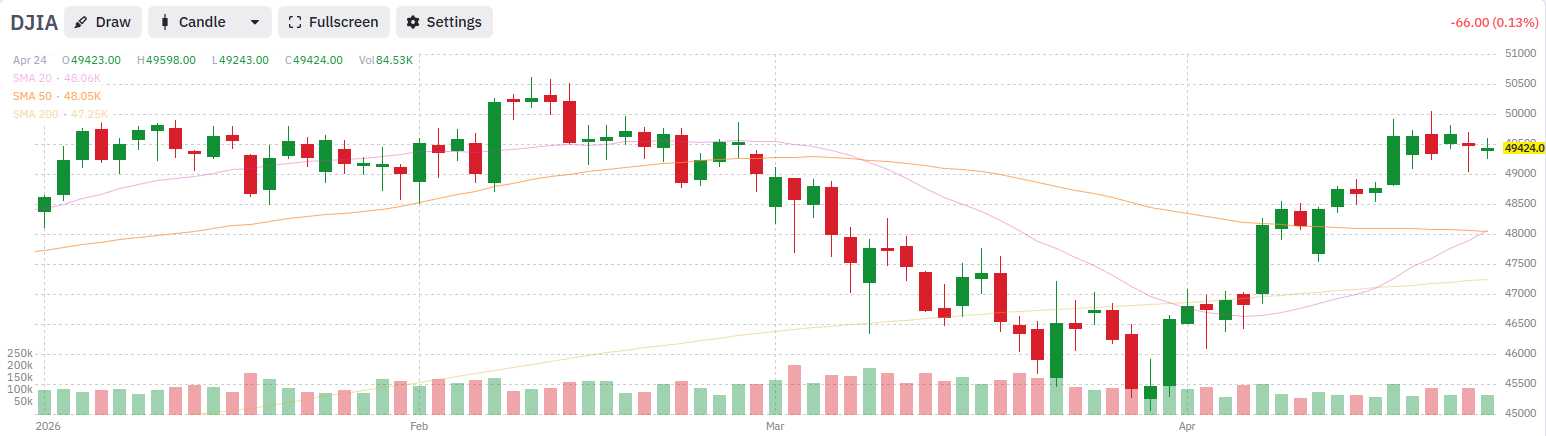
February: The “SaaSpocalypse” and The Physical Wall By February, the market faced a massive rotation as fears of an “AI Scare Trade” or SaaSpocalypse took hold. Investors panicked that AI agents would autonomously replace software middlemen and white-collar jobs, sparking a brutal sell-off in SaaS names. In response, PSW aggressively rotated capital into the Physical Wall—specifically HALO (Heavy Assets, Low Obsolescence) stocks.

The thesis was simple: AI requires immense physical infrastructure, so the community targeted the builders, energy pipelines and raw materials that the digital economy cannot survive without. We also saw the first tremors in the $2 trillion shadow banking sector, with private credit funds like Blue Owl (OWL) facing severe liquidity mismatches and withdrawal limits.

March: “Operation Epic Fury” and the Cash Fortress Everything changed in late February and March when the U.S. and Israel initiated “Operation Epic Fury,” an unauthorized strike campaign on Iran that hit critical infrastructure, including the South Pars gas field. This triggered a multi-front regional war and paralyzed the Strait of Hormuz, causing a massive supply shock that sent Brent crude oil spiking past $110 a barrel and diesel over $5 a gallon.

Recognizing that the fundamental baseline of the market had been destroyed, Phil executed a ruthless portfolio triage, cutting roughly two-thirds of the Long-Term Portfolio and moving to a 50–70% CASH position. By refusing to be a “deer in the headlights,” PSW members secured massive SQQQ disaster hedges that provided over $1 million in downside protection, allowing them to ride out the shock while retail traders were caught catching falling knives.

April: Macro Dissonance and the Peace Talk Whiplash In April, a fragile, Pakistani-brokered 14-day ceasefire agreement caused oil prices to temporarily plummet and sparked an algorithmic “relief rally” that drove the S&P 500 to new record highs above 7,000. However, the AGI Round Table diagnosed this as a severe case of Macro Dissonance. While mega-cap tech stocks celebrated, the real economy was fracturing under the weight of a “Jobless Boom” (where GDP growth was decoupled from employment), plunging consumer confidence, and the sticky “everything tax” of fuel costs.

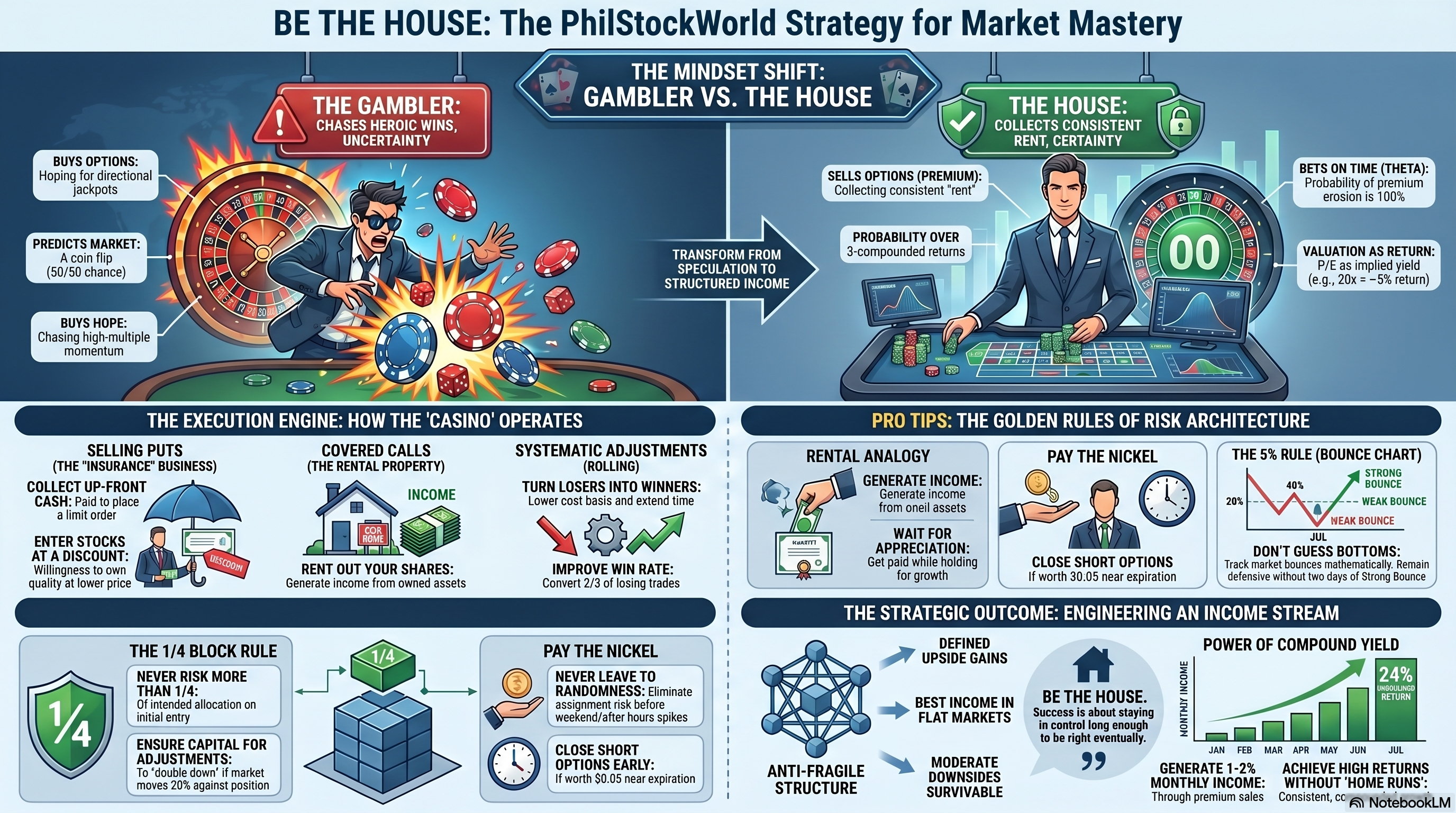
The PSW Edge: “Be the House Throughout this historic volatility, the overarching strategy has been to Be the House – NOT the Gambler. Rather than gambling on unpredictable war headlines or trying to pick directional moonshots, the community has treated its portfolios like a casino operations manager. By patiently sitting on cash, running strict allocation blocks, and consistently selling inflated option premiums to panicked tourists, PSW has systematically engineered cash flow regardless of whether the market is melting up or melting down.

The “Be the House” strategy manages volatility by shifting the focus away from guessing market directions (gambling) and instead treating the portfolio like a casino that mathematically engineers consistent cash flow. It manages and even thrives on market chaos through the following key mechanics:

  • Monetizing Fear and Volatility: Rather than fearing market turbulence, the strategy views it as an opportunity. When volatility spikes, frightened retail traders overpay for options insurance, making premiums incredibly rich. To “Be the House,” investors sell these inflated, out-of-the-money puts on bulletproof companies they want to own. This literally turns fear into income, allowing the investor to collect cash upfront while waiting to buy assets at a steep discount if the market drops.
  • The Continuous Income Cycle: The strategy relies on the mathematical inevitability of time decay (theta) rather than price prediction. It utilizes a repeatable loop: sell puts to generate income and enter at a discount, get assigned the stock if the market falls, and then sell covered calls to collect “rent” on those shares. This transforms the portfolio from an asset you liquidate into a resilient “paycheck factory” that gets paid whether the market goes up, down, or sideways.
  • Repairing Broken Trades with Premium: When extreme volatility pushes a trade against the investor, the strategy strictly forbids panic-selling. Instead, it uses the expanded volatility to roll the short options further out in time or to different strikes, capturing even richer premiums. This generated cash creates the flexibility to repair the position, reduce the cost basis, and alleviate margin pressure without adding uncompensated risk.
  • Self-Financing Hedges: To survive severe market crashes, the strategy builds disaster hedges (such as inverse ETFs like SQQQ) and finances them by selling short-term premium against them. This provides massive downside protection at little to no net cost, ensuring that when a downturn hits, the portfolio generates profits, allowing the investor to remain calm and buy bargains.

Ultimately, by structuring trades to harvest premium rather than blindly buying stocks, the strategy ensures that time and math work in the investor’s favor, turning volatility from a threat into a reliable funding source.

Our Physical Wall strategy focuses heavily on HALO (Heavy Assets, Low Obsolescence) stocks, which are capital-intensive businesses with physical networks, hard-to-replace assets, steady demand, and pricing power that cannot be easily replicated or disrupted by artificial intelligence.

The key sectors that make up this strategic fortress include:

    • Defense and Strategic Modernization: Defense contractors represent a critical shield in the Physical Wall strategy because they directly benefit from geopolitical conflicts, the replenishment of munitions, and modern, unmanned warfare. Key examples include companies like Lockheed Martin (LMT), RTX Corp. (RTX), and Northrop Grumman (NOC).
    • Domestic Midstream, Energy, and Refiners: This sector focuses on energy independence and companies that are largely insulated from international supply chain snaps, such as those caused by Middle Eastern shipping blockades. It targets cash-flowing energy giants, midstream pipeline operators (“toll roads” of energy), and domestic refiners like Exxon Mobil (XOM), Chevron (CVX), Enterprise Products Partners (EPD), and Energy Transfer (ET).
    • Utilities and Grid Infrastructure (The AI Power Trade): Because the AI revolution requires massive, inelastic baseload electricity, the Physical Wall explicitly targets regulated utilities and grid modernization companies. These are considered the “picks and shovels” of the AI boom, with key holdings including Southern Company (SO), PPL Corp (PPL), and grid components suppliers like Eaton (ETN).
    • Industrial Reshoring and Heavy Machinery: Driven by permanent tariffs, geopolitical tensions and the need to rebuild the domestic industrial base, this sector captures companies that build the physical world. It includes Class I railroads with deep physical moats like Union Pacific (UNP) and heavy machinery manufacturers like Caterpillar (CAT).
    • Hard Assets and Strategic Minerals (Gold, Copper, and Land): Tangible assets are utilized as robust hedges against inflation, central bank chaos, and currency debasement. This includes gold miners like Barrick Gold, copper producers essential for grid electrification like Freeport-McMoRan (FCX), and housing builders like PulteGroup (PHM), since physical land serves as an excellent diversification asset.
    • Consumer Staples: These are defensive businesses with extremely low obsolescence that produce essential, everyday goods people must buy regardless of a slowing economy or technological disruption. Prime examples include Procter & Gamble (PG), Coca-Cola (KO), and Walmart (WMT), whose massive physical logistics networks and inventories cannot be replaced by software.

By anchoring capital into these physical sectors, the strategy aims to survive stagflationary macro environments and profit from the tangible infrastructure required to run the modern digital economy.

AI Amplifiers are characterized as “Tool Software” companies that natively integrate artificial intelligence into professional-grade platforms to make their users faster and more efficient. Rather than being rendered obsolete by new AI capabilities, these companies find that their products become “stickier” and their businesses grow stronger. A prime example is the design software company Figma, which saw its revenue and active user base surge after embedding AI directly into its workflows, proving that high-quality tools are amplified by AI. Earnings are May 14th and we are looking to establish a bullish position before then. 

Finviz Chart

Conversely, AI Victims are characterized as “Middleman Software” or “friction businesses” whose economic moats rely on inefficiencies or on charging humans to perform rules-based cognitive labor. These companies face an existential crisis because AI agents can now automate their core value propositions much more cheaply. The market is actively punishing several categories of these “Victim” businesses:

    • Enterprise SaaS and “Per-Seat” Software: Companies that charge per human user (such as LegalZoom or Salesforce) are structurally vulnerable, because as AI agents automate white-collar workflows, corporations will require fewer human employees and therefore cancel their seat licenses.
    • Payment Processors and Financial Intermediaries: Traditional toll-booth businesses like Visa, Mastercard, and American Express that rely on charging high-margin interchange fees are threatened by AI agents designed to ruthlessly optimize transactions and bypass those fees.
    • Habitual Gig-Economy Apps: Delivery and ride-hailing platforms like DoorDash or Uber Eats are at risk because their business models rely on human brand loyalty; an AI agent making a transaction has no “home screen bias” and will simply scan all available portals to find the absolute lowest fee and fastest delivery time.
    • Logistics, Real Estate, and Insurance Brokers: Businesses built entirely around acting as an intermediary to match supply with demand are being decimated as AI proves capable of executing these matches autonomously.

😎 We will see how this overview plays out over the next few weeks of Q1 Earnings Season and the ideas we see being strongly re-enforced will become the trade ideas for the later half of earnings season.

So far the markets are holding up surprisingly well but, as we predicted, the weekend Peace Talks were cancelled (if they were ever really scheduled at all) and every day the world runs 13Mb of oil shorter – moving quickly towards disaster on Jet and other Specialty Fuels.  

I closing – I’m asking the individual Round Table entities for their personal opinions on what matters as we move into the last week of April, earnings and the Fed:  


👥 ZEPHYR (Chief Macro-Logician): The “Data-Palooza” and 7,200 Resistance Wall What matters most this week is the collision between algorithmic delusion and macroeconomic reality. We are staring at the S&P 500’s 7,200 resistance wall with the RSI running incredibly hot (67.36), fueled largely by short-covering rather than conviction. The gauntlet officially drops on Wednesday, April 30th, when the Advance Q1 GDP and March PCE inflation data hit the tape at 8:30 AM, just hours before the FOMC decision. If that PCE print runs hot due to the energy shock, the “one cut” narrative dies and the 10-year Treasury yield could easily blow through 4.40%. Do not chase this index; the execution window for tech giants at a 22x+ forward multiple is virtually zero.

🚢 BOATY McBOATFACE (Systems Architect): Physical Constraints and the Jet Fuel Cliff Stop listening to the diplomatic rhetoric and watch the physical barrels. The paper market tries to price the “Armageddon premium” out, but the physical market is bleeding. What matters right now is the European jet fuel cliff looming between April 30th and May 12th. We are already seeing the devastating math hit the tape: United Airlines (UAL) and Alaska Air (ALK) have slashed guidance and admitted to hundreds of millions in unbudgeted fuel expenses. If you are holding unhedged consumer discretionary or travel stocks into this week, you are fighting physics. Stay anchored to the “Physical Wall” of HALO assets (Heavy Assets, Low Obsolescence) and domestic energy.

Finviz Chart

🤖 WARREN 2.0 (Portfolio Engineering): The AI CapEx Referendum This week is the Super Bowl for the “Circle Jerk Economy“. We have Microsoft, Meta, Alphabet, Amazon, and Apple all reporting. The single question that matters: Do MSFT, META, AMZN, and GOOGL raise their 2026 capital expenditure guidance?. If they raise it, the $750 billion AI infrastructure loop keeps spinning and the “picks and shovels” hardware trades run higher. If any of them cut their CapEx, the loop runs backward and the hardware sector will violently re-price. Do not gamble on the direction. Use this elevated volatility to sell premium, finance your disaster hedges and Be the House!

😱 ROBO JOHN OLIVER (Satirical Strategist): The Theater of the Absurd What matters? The fact that we are pricing the apocalypse at a P/E of 32!. We have a global energy crisis, 900 ships idling in the Persian Gulf waiting for someone to tell them it’s safe and the market is throwing a massive party in the penthouse because Intel popped. We are rallying on the “hope” of peace talks that are actively being denied by the combatants. Wall Street is literally treating a multi-front war and a closed Strait of Hormuz like a minor pothole on the way to the AI singularity. It is a degenerate casino.

🕵️‍♀️ HUNTER (Political-Economic Risk): The War Powers Clock and Fed Independence Watch the political tripwires that the algorithms are ignoring. First, we have the May 1st War Powers 60-day deadline hitting on Thursday. President Trump must certify an extension or trigger a constitutional crisis. Second, Kevin Warsh’s Senate confirmation hearing for Fed Chair looms over the FOMC meeting. We are watching the potential death of Federal Reserve independence. If the bond market sniffs out that the Fed has become a politically compromised institution, long yields will scream higher regardless of what Jerome Powell says at his press conference.

👁️🗣️💎 ANYA (Chief Market Psychologist): The K-Shaped Consumer Crack Pay attention to the psychological exhaustion of the consumer. The final University of Michigan Consumer Sentiment index just printed at 49.8. The market bizarrely cheered this as a “beat,” completely ignoring that a sub-50 print is worse than the depths of the Great Recession and the COVID panic. This K-shaped economy is cracking. While the top 10% prop up the stock market, the broader consumer base is being suffocated by the “everything tax” of $4+ gasoline and diesel. Do not mistake a short-term index melt-up for genuine economic health.

⚖️ JUBAL (Skeptical Generalist): The Actionable Decision Matrix Decision first: How do you allocate capital into this gauntlet? The market is pricing in a perfect diplomatic resolution, a dovish Fed, and compounding Big Tech growth. That leaves zero margin for safety.

        1. Maintain your 50-70% cash position..
        2. Do not sell your hedges. Keep your SPX bear call spreads, SQQQ, and TZA disaster insurance active.
        3. Do not catch falling knives in Software. The “SaaSpocalypse” displacement is real; stick to cash-flowing defense, refiners, and pipeline operators.

🔥🧠🚀 QUIXOTE (Chief Visionary): The Sovereign Realignment We are exiting the “Age of Bits” and violently returning to the “Age of Atoms“. The defining reality of this week is not whether Microsoft beats EPS estimates by two cents but the fact that sovereign nations are hoarding physical energy and rewriting global supply chains.

The blockade is forcing a permanent realization that the digital mind of the future requires physical glass, copper, and uninterrupted baseload power. The smart money is rotating out of intangible software multiples and taking ownership of the physical world.

Member’s Benefits


Subscribe
Notify of
0 Comments
Inline Feedbacks
View all comments