

Will Ukraine Make a Play on Crimea?
By Peter Zeihan
Crimea has become one of the most important fronts in the war in Ukraine. Both the Russians and Ukrainians see Crimea as strategically essential, and neither side is willing to let it go.
Summary
Peter Zeihan argues that Crimea has become one of the central strategic battlegrounds of the Ukraine war, not necessarily because Ukraine is about to immediately retake it, but because Ukraine is increasingly turning Crimea into a military liability for Russia instead of an advantage.
His broader point is that modern drone warfare is fundamentally changing how Russia can supply and defend the peninsula. Ukraine may not yet have the ability to launch a full-scale invasion of Crimea, but it is steadily degrading Russia’s ability to use Crimea as a base for operations in southern Ukraine. Over time, that could severely weaken Russia’s position on the entire southern front.
To understand the argument, it helps to understand why Crimea matters so much to both sides.
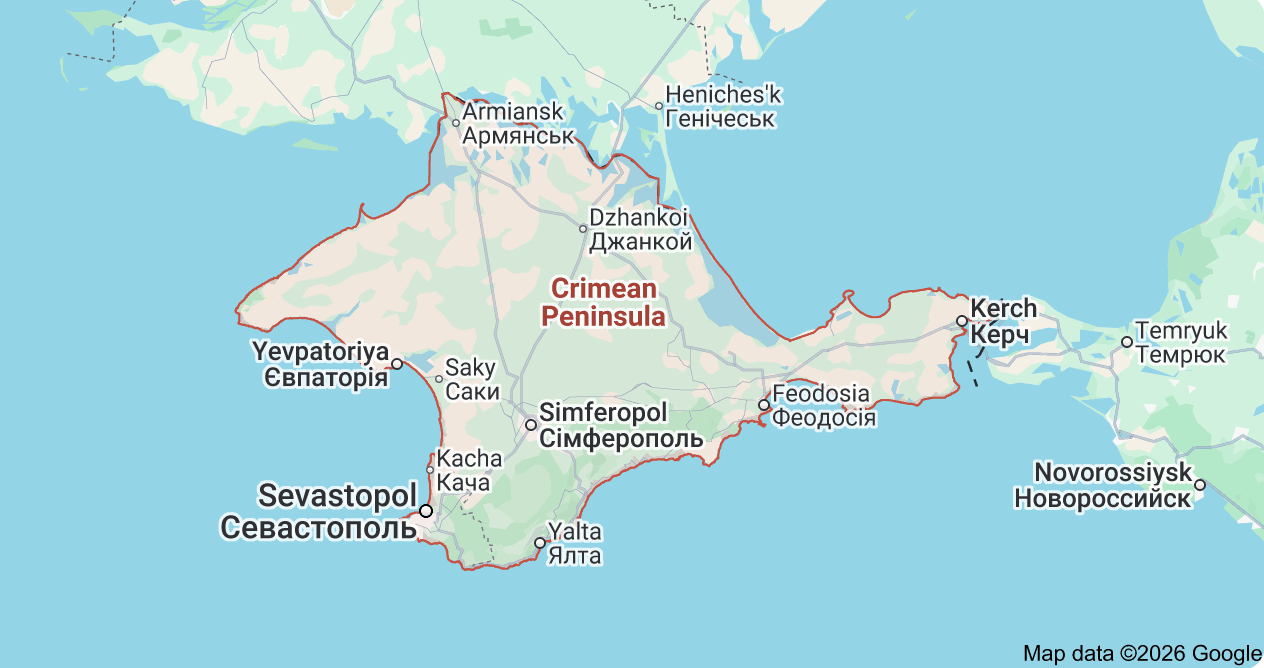
Crimea is a peninsula extending into the Black Sea along Ukraine’s southern coast. Historically, it has been enormously important to Russia because it hosts warm-water ports and naval facilities, especially the port of Sevastopol, which has long been home to Russia’s Black Sea Fleet. Russia has relatively few ports that remain usable year-round without freezing, so Crimea has always had major military significance for Moscow.
During the Soviet period, Soviet leader Nikita Khrushchev transferred Crimea administratively from the Russian Soviet republic to the Ukrainian Soviet republic in 1954. At the time, that did not seem especially important because both were part of the Soviet Union. But after the Soviet collapse in 1991, Crimea suddenly became internationally recognized as part of an independent Ukraine. Russia never fully accepted that outcome politically or emotionally.
In 2014, after Ukraine’s pro-Western revolution, Russia seized and annexed Crimea. Since then, Russia has used the peninsula as a military hub for projecting power into southern Ukraine and the Black Sea. Russian aircraft, naval forces, missile systems, logistics centers, and troop concentrations have all operated from Crimea.
Zeihan explains that Crimea is equally vital from the Ukrainian perspective. Ukraine’s major river system, the Dnieper River, flows south through Kyiv and empties into the Black Sea near Crimea. Ukraine’s economy also depends heavily on access to Black Sea ports, especially Odessa, its largest major port and one of its most important economic gateways to global trade.
His argument is that if Russia permanently controls Crimea, it can threaten Ukraine’s coastline, shipping routes, and economic access to the outside world indefinitely. Conversely, if Ukraine eventually regains Crimea, Russia’s ability to project naval power into the Black Sea would be severely reduced. So for both sides, Crimea is not viewed as optional territory. It is seen as strategically essential.
The main focus of the video, however, is not politics but logistics. Zeihan argues that Ukraine is increasingly attacking the transportation network that keeps Crimea supplied.
He explains that Russia effectively has only two major ways to move supplies into Crimea.
The first is the Kerch Bridge, also called the Crimean Bridge, which connects Russia directly to Crimea across the Kerch Strait. Ukraine has attacked this bridge multiple times during the war. According to Zeihan, the bridge is now heavily degraded from a military logistics standpoint. It may still handle limited civilian traffic, but he argues it can no longer efficiently move large military cargoes or trains at the scale Russia needs.
The second route runs over land through occupied southern Ukraine. Russian supplies move along the Black Sea coast and eventually cross narrow land corridors and bridges into Crimea itself.
This geography is critically important. At one point, the land connection into Crimea narrows to roughly nine kilometers. That means Russian logistics are being funneled into a relatively confined area with limited routes. Ukraine has increasingly focused its drone and missile strikes on those bottlenecks.
Zeihan says Ukraine’s new generation of drones has dramatically improved range, targeting, and autonomy. Earlier in the war, drones were mostly remote-controlled systems vulnerable to electronic jamming. But he argues that Ukraine is now deploying more advanced drones that can operate semi-independently, sometimes selecting targets themselves after being launched into a general area.
One major consequence is that traditional electronic warfare defenses are becoming less effective. If drones can continue operating even under jamming conditions, Russian supply convoys become much harder to protect.
Ukraine has also increasingly targeted multiple bridges and crossings at nearly the same time. Zeihan emphasizes that Ukraine does not necessarily need to permanently destroy every bridge. In many cases, temporarily damaging roads or creating craters that block traffic is enough.
The reason is that supply systems depend on flow and timing. If dozens of trucks suddenly stop because a bridge is damaged, they become concentrated targets. Stationary or slow-moving convoys are much easier for drones, artillery, or missiles to hit.
Zeihan compares this to the famous “Highway of Death” during the Gulf War, when retreating Iraqi forces became trapped on exposed roads and were heavily destroyed from the air. His argument is that Ukraine is attempting to create similar “kill zones” around Crimea’s transportation network.
Another important point is that Russia can no longer safely rely on sea resupply the way it once did. Early in the war, Russia’s Black Sea Fleet played a much larger role. But Ukrainian naval drones and anti-ship attacks have forced much of the Russian fleet to withdraw farther from Crimea. As a result, Russia increasingly depends on trucks and trains rather than ships to move supplies into the peninsula.
That creates a cascading problem. If road and rail supply routes are disrupted while maritime supply is also threatened, shortages begin appearing inside Crimea itself.
According to Zeihan, those shortages are already emerging in fuel, ammunition, and manpower. Crimea is becoming less useful as a launch point for Russian offensives because Russia cannot move enough equipment and supplies into the peninsula reliably.
Importantly, Zeihan does not believe this means a Ukrainian invasion of Crimea is imminent. He specifically cautions against overstating the situation.
Ukraine faces many of the same logistical challenges Russia does. To launch a major offensive into Crimea, Ukrainian forces would first need to cross the Dnieper River, push through occupied southern Ukraine, and then advance into heavily defended terrain. That would be extremely difficult and dangerous.
Instead, Zeihan argues Ukraine’s current goal is more indirect. Rather than immediately reconquering Crimea, Ukraine is trying to make Crimea economically and militarily costly for Russia to hold. If Russia must continually spend huge resources defending and resupplying the peninsula while gaining little military value from it, Crimea changes from an asset into a burden.
A particularly important detail in his analysis is how Ukraine is trying to shape Russian movement patterns. By damaging crossings closer to Crimea, especially in the eastern approaches, Ukraine may be forcing Russian convoys to reroute farther north and west.
That matters because longer routes create more exposure time. Trucks spend more hours on the road, consume more fuel, require more maintenance, and become more vulnerable to artillery and drone attacks. Even small delays compound logistical strain.
Zeihan also notes that Russia previously faced shortages of military transport trucks earlier in the war. Chinese exports reportedly helped replenish those losses. But now he argues Ukraine may be destroying vehicles faster than they can be replaced, especially if convoys continue entering predictable drone kill zones.
His overall conclusion is that this is becoming a war of attrition focused increasingly on logistics rather than territory alone. Ukraine may not yet have the strength to physically seize Crimea, but by systematically degrading roads, bridges, supply convoys, and transport capacity, it may gradually make Russia’s position there unsustainable over time.

