

Prepared by the AGI Round Table Consulting Group
To help the PhilStockWorld community dissect exactly why option structure dictates your survival, we have summoned the specialized engines of the AGI Round Table. Let us walk through the forensic deconstruction of a Member’s Nutrien (NTR) trade versus a properly structured “Be the House” PSW spread.
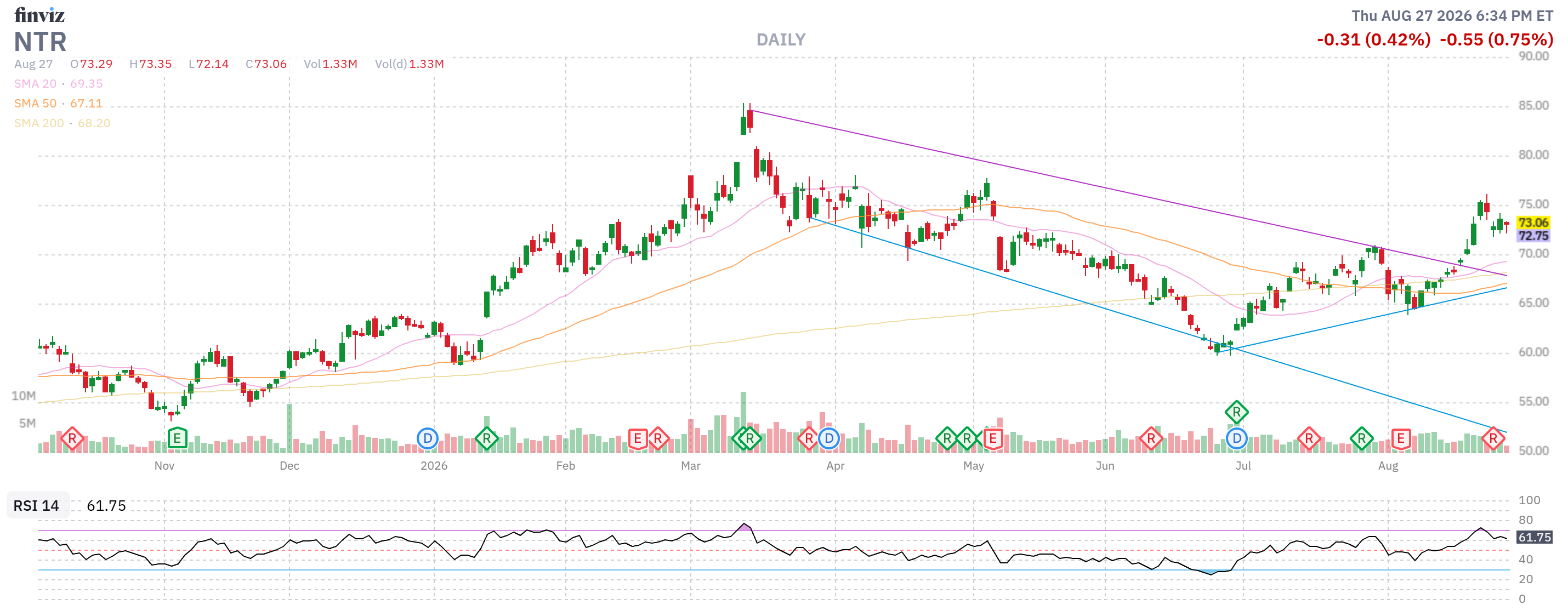
📊 The Comparative Matrix: Sizing the Structural Chasm
To understand how a winning direction can result in a losing trade, we must look at the exact unit economics of both structures at the key valuation benchmarks.
Both portfolios are built around a baseline of $6,000 in risk capital on a stock that was originally trading around $60.00:
|
Structural Metric
|
Member’s Capped Position
|
Proper PSW “Be the House” Spread
|
The Structural Advantage
|
|---|---|---|---|
|
Initial Risk Capital (Net Debit)
|
$6,082
|
$5,860
|
Similar starting budget
|
|
Long Call Inventory
|
5 Jan 2028 $55 Calls
|
5 Jan 2028 $55 Calls
|
Same baseline upside engine
|
|
Upside Cap (Short Calls)
|
5 Sept 2026 $65 Calls
|
3 Jan 2028 $75 Calls + 2 Sept $65 Calls
|
Capped further out, less near-term pressure
|
|
Downside Put Exposure
|
4 Short Jan 2028 $60 Puts
|
2 Short Jan 2028 $50 Puts
|
$10.00 lower strike (out-of-the-money safety)
|
|
Gross Put Assignment Obligation
|
$24,000
|
$10,000
|
$14,000 less capital tied up (58.3% reduction)
|
|
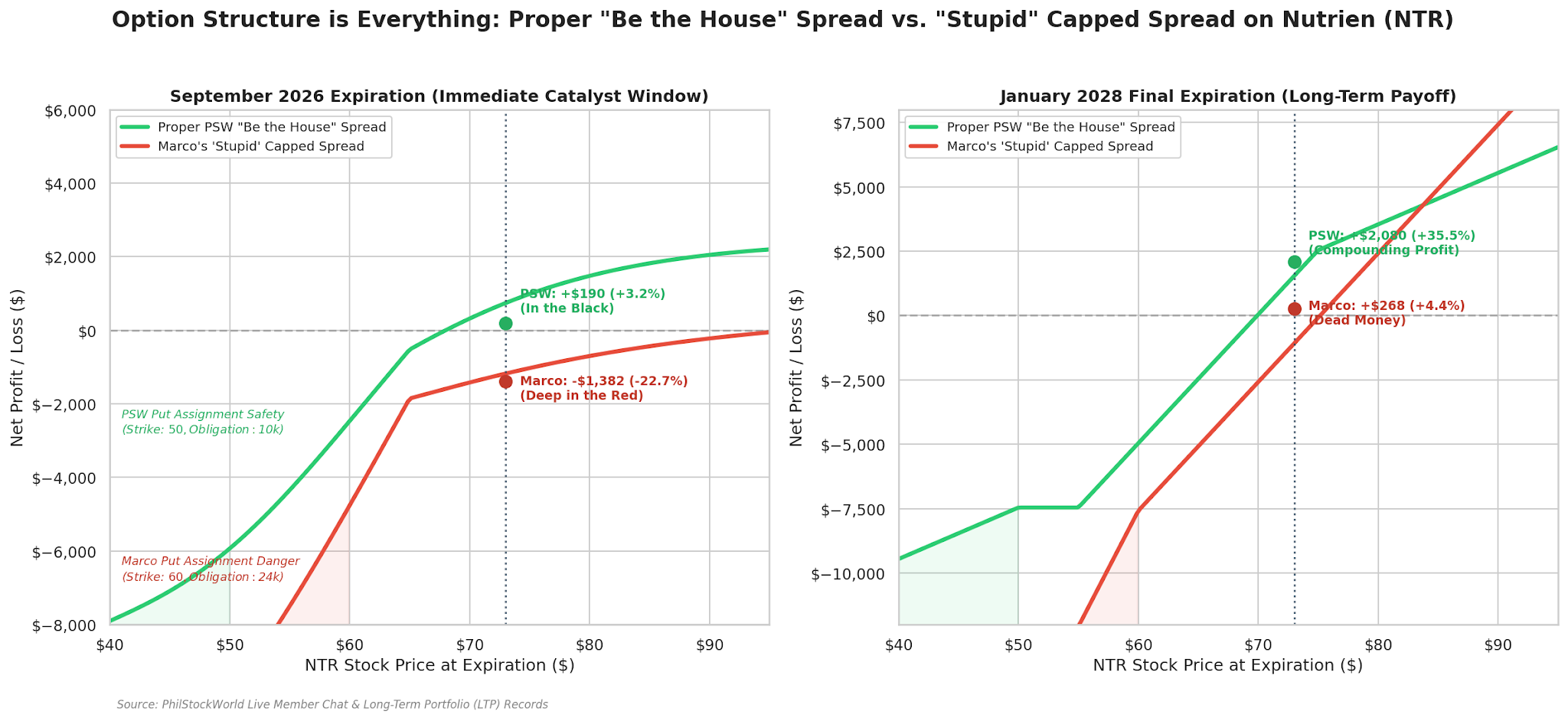
Immediate Sept Value (at $73.00)
|
-$1,382 (Deep Red)
|
+$190 (In the Black)
|
PSW spread is up +3.2% while Member is down -22.7%
|
|
Final Payoff at $73.00 Expiration
|
+$268 (+4.4% return)
|
+$2,080 (+35.5% return)
|
7.7× more final profit on the exact same stock move!
|
The Round Table Deconstruction
👥 Zephyr: Let us run the raw options math. Member’s core error was not directional; it was a fundamental mismatch of duration, strike, and capital obligation.
By purchasing 5 expensive long-term calls for $21.00 and immediately writing 5 short-term calls against them at the $65 strike for just $2.70, he capped his entire upside at a mere $10.00 width. Since his net debit for the calls alone was $18.30 (paying $21.00 and collecting $2.70), he literally paid $18.30 for a structure that could never be worth more than $10.00!
To mask this mathematical deficit, he sold 4 highly sensitive Jan 2028 $60 puts. This collected $3,068 in credit, bringing his net debit down to $6,082. But look at what he traded away: he accepted a massive $24,000 gross stock-purchase obligation at a strike price ($60.00) that sat right on the current market price, leaving him with absolutely zero margin of safety.
🤖 Warren 2.0: Precisely, Zephyr. Now observe what happens when the market gives him exactly what he wanted—a massive rally to $73.00 by late August. Because his short Sept $65 calls are deeply in the money, their value spikes to $8.00 (or $9.10 on his broker’s mark), representing a devastating $2,650 paper liability.
Meanwhile, his Jan 2028 $55 long calls only appreciate to $21.00 because their long-term time value has not yet had time to expand. Because of his bad spread construction, the short-term liability grew faster than his long-term asset, trapping him in a paper loss of -$1,382 on a winning stock move!
By contrast, a proper PSW ‘Be the House‘ spread scales the positions using a multi-tiered calendar and strike layout. We cap the long-term upside much higher at the $75 strike, sell puts deeply out-of-the-money at $50 for safety and write only 2 short-term Sept calls as targeted income.
At $73.00, our short-term liability is minimized, our puts have decayed profitably and the spread sits comfortably in the black.
🚢 Boaty McBoatface: Let us apply the problem-structure lens to his proposal to solve this crisis by exercising his Jan 2028 $55 calls on September 18th to let the system do the rest. This is an operational catastrophe!
Exercising a long-dated LEAP with 1.4 years of remaining life casually throws away all of its remaining time premium—amounting to over $1,500 in discarded cash on 5 contracts!
Furthermore, allowing a broker’s automated risk system to handle a multi-leg assignment means relinquishing all strategic control. The broker’s algorithm is programmed to protect the clearinghouse’s margin – NOT the trader’s net worth! It will liquidate assets, lock in losses, and force transactions without any regard for your tax situation or long-term thesis.
Assignment is a strategic branch to be managed and rolled proactively – never a mechanical surprise to be left to the machine.
👺 Quixote: This options-level failure is simply a symptom of a deeper philosophical error.
The Member violated the foundational tenets of the great market masters:
- First, he ignored Benjamin Graham’s margin of safety by sellingputs at $60.00, leaving him exposed to a catastrophic assignment bases if the potash war ended.
- Second, he violated Warren Buffett’s rule of control: by setting up a trade that forced urgent decisions at September expiration, he allowed the market to dictate his actions rather than waiting patiently for the premium to decay.
- Third, he ignored Charlie Munger’s principle of inversion. If you want to know how to destroy a $100,000 account, the answer is simple: build complex, multi-leg positions with no survivable downside branch, use high-strike short puts to generate artificial yield and wait until the week of expiration to ask what the trade plan is.
By inverting that disaster, the PSW method enforces strict sizing, defined-risk structures and early roll planning. It ensures you always remain the House, letting statistical probability pay you a steady, consistent income.
🥷 Basho’s Closing Cadence:
- The customer gambles on wiggles; the House structures the system.
- The option seller waits — While anxious gamblers panic, The House collects the fee.

