


What if better trading decisions start with fewer opinions, not more? Investment education for self-directed traders should help you separate useful analysis from hype and turn market information into a process you can repeat. Alerts and confident predictions can grab your attention, but they can’t decide whether a trade fits your goals or risk limits.
If you manage your own portfolio, you know how quickly research can become a crowded feed of charts, commentary, and trade ideas. The challenge isn’t finding information. It’s judging what kind of information you’re looking at, checking its assumptions, and connecting a market thesis to position size and potential downside.
This article shows you how to evaluate trading education, distinguish learning resources from analysis and trade pitches, and build a practical research routine that keeps risk in view. It also explains how market commentary, charts, webinars, and portfolio reviews can support your learning without taking the decision out of your hands. The goal is simple: think more clearly, set limits before acting, and make each trade your own.
Key Takeaways
- Investment education for self-directed traders should build independent research and decision-making skills, not encourage blind reliance on trade ideas.
- Learn to distinguish foundational education, timely market analysis, and trade pitches before deciding how each source fits your learning.
- Use a repeatable workflow to investigate a market question, assess risk, make your own decision, and review the outcome.
- Compare education formats by depth, timeliness, interaction, independence, and how well they connect concepts to practical decisions.
- Market commentary, webinars, strategy guides, and virtual portfolio reviews can add useful perspectives to your learning routine while leaving decisions in your hands.
What Investment Education for Self-Directed Traders Should Actually Teach
Investment education for self-directed traders should teach a process, not just deliver a stream of market commentary. The aim is to learn how to research an idea, test its assumptions, plan for uncertainty, and review the decision afterward. Self-directed investing puts decisions in your hands, along with the responsibility to understand them. Understanding Self-Directed Investing offers a useful introduction to that control-and-responsibility principle in the context of IRAs.
Education is different from brokerage access, trade execution, or personalized financial planning. A brokerage platform provides tools for placing orders; educational analysis helps you understand concepts and assess evidence. Neither an example trade nor a market alert can determine what’s suitable for your circumstances.
Educational analysis explains a market idea, its assumptions, and the risks to consider; a personalized recommendation tells an individual what action to take based on their specific circumstances. That distinction matters. A confident opinion can be a starting point for research, but it isn’t a complete decision-making process.
The difference between market information and decision-making skill
Headlines, charts, and alerts are inputs. Skill comes from asking what they do, and don’t, tell you. A headline about rising demand, for example, doesn’t establish whether a company is attractively valued or whether the market has already priced in that news.
Before considering an idea, define a thesis, a time horizon, and an invalidation point: what evidence supports the idea, how long it may take to play out, and what would show your reasoning is no longer sound. Without those anchors, a short-term price move can distract from a longer-term thesis, or a trade pitch can masquerade as education.
The core skills a self-directed trader can develop
A practical education builds several connected skills: researching a company or market, understanding basic valuation, placing an asset in its broader market context, and learning how a strategy works, including its limitations. Understanding mechanics matters because a strategy’s potential payoff is only part of the picture.
Risk belongs in the learning process from the start. Traders can study how position size relates to potential downside and decide in advance what loss or change in conditions would prompt a reassessment. These are planning concepts, not instructions to enter a particular trade.
Finally, keep a decision record. Note the original thesis, evidence, time horizon, risk plan, and later outcome. Review what you knew when you acted, rather than judging the decision solely by what happened next. That helps separate a sound process from a lucky result, or a weak process from an unlucky one, and gives your next round of research something concrete to build on.
Build a Trading Education Foundation Before Following Market Ideas
Before a compelling chart or trade idea grabs your attention, make sure you understand the instrument, the market context, and the risks involved. Investment education for self-directed traders works best as a sequence: learn the basics, check your understanding with examples, then add complexity. Trying to learn every strategy at once can leave you with a collection of jargon but little practical judgment.
Learn the instruments and mechanics you plan to trade
A stock represents an ownership interest in a company. An exchange-traded fund, or ETF, holds a collection of assets and trades on an exchange. An option is a contract whose value is tied to an underlying asset. A call gives its holder the right to buy at a specified strike price; a put gives the right to sell at that price. The expiration is when the contract ends, and the premium is the price paid for the option.
Those definitions are only the starting point. Liquidity affects how readily an asset or contract can be traded and may influence the gap between quoted buy and sell prices. Volatility describes how much prices move; for options, it can affect premiums, while sharp moves in either direction can complicate a trade. Learn these mechanics before studying multi-part strategies. When you’re ready to explore further, an advanced options strategies guide can build on the basics without making complex structures your first lesson.
Connect market context to a testable thesis
Company developments, economic data, and broader market sentiment can each offer clues, but none tells the whole story. Turn the information into questions: What evidence supports the idea? What could weaken it? Does the potential time horizon fit the event or trend you’re studying? For chart context, a guide to reading market charts can help you interpret price action as one input rather than a prediction.
Risk education should also extend beyond a single position. The SEC’s Principles of Asset Allocation and Risk Management explains how allocation and diversification relate to portfolio risk. Keep the learning loop simple: study one concept, apply it to a hypothetical example, write down what would change your view, and review your reasoning. For ongoing market commentary and educational resources, explore Phil Stock World’s market analysis as another research input, not a substitute for your own judgment.
Compare Investment Education Formats Without Confusing Access with Expertise
Investment education for self-directed traders comes in different formats, and each serves a different purpose. A library can explain core concepts; commentary can put current market activity in context; a live discussion can clarify how an idea is being analyzed. None turns access to information into expertise automatically. Choose resources by how well they support your learning and independent judgment.
Phil Stock World’s market commentary, educational webinars, and interactive learning resources can support an ongoing study routine. Phil Stock World membership brings together educational and analytical resources, including market charts and sector-specific insights.
A practical checklist for evaluating trading education
Before relying on a resource, check whether it explains its reasoning, identifies relevant risks, and describes what could change the thesis. Look for a clear distinction between foundational education, market commentary, and trade alerts. Strong examples teach principles you can apply elsewhere; they don’t simply encourage you to copy a position.
Try this test: after reviewing the material, can you explain the idea in your own words, name its uncertainties, and identify what you’d research next? If not, treat it as a prompt for further study, not a shortcut to a decision.
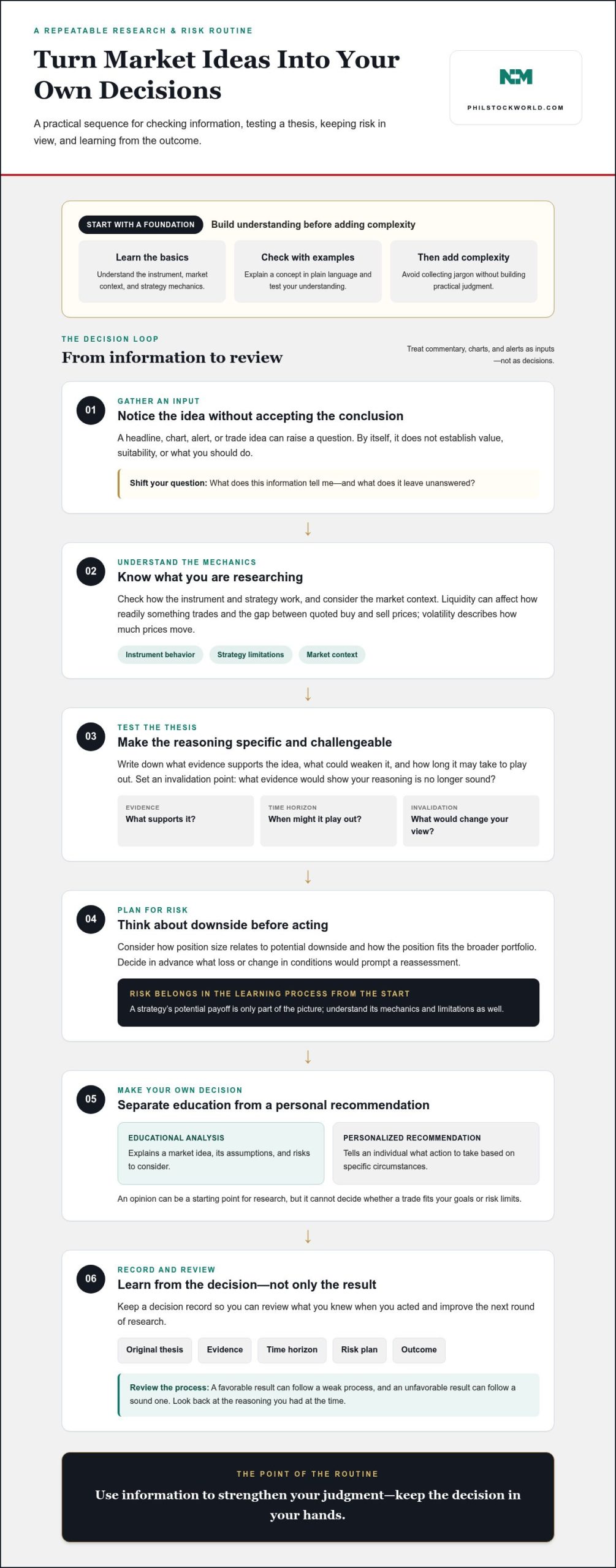
Turn Trading Education Into a Repeatable Research and Risk Routine
A useful research routine turns learning into a series of deliberate checks, not a script for placing trades. Investment education for self-directed traders can help you ask better questions, examine evidence, and decide whether an idea belongs in your process. These steps support independent analysis; they don’t prescribe a trade or guarantee an outcome.
A six-step research routine for self-directed traders
- Start with a question. Make it specific, such as whether a company’s latest results changed its outlook, rather than simply asking whether its stock is “going up.”
- Gather relevant information. Review company developments, market data, and broader conditions that relate to your question. Note what you know and what remains uncertain.
- Write the thesis and timeframe. State what you think may happen, why, and over what period. Identify evidence that would challenge your view.
- Plan for risk before considering execution. Think through position size, maximum acceptable exposure, liquidity, and how the idea could affect the rest of your portfolio. There’s no universal position-size rule that fits every trader or situation.
- Make and record your own decision. If you act, record why. If you pass, note what kept the idea from meeting your criteria. Both choices can provide useful feedback.
- Review the reasoning and outcome separately. Compare what happened with what you expected, using the information available at the time rather than judging the process only by the result.
Risk belongs throughout this routine. A thesis can be plausible and still lose money if timing is off, conditions change, or exposure is too large for the portfolio. Study diversification, concentration, and liquidity as connected concepts: a portfolio with several positions may still carry substantial exposure to the same company, sector, or market driver. The goal isn’t to eliminate uncertainty. It’s to understand where it sits and how it could matter.
- Research question and thesis: What are you investigating, and what is your reasoning?
- Evidence and timeframe: What supports or challenges the idea, and when do you expect to reassess it?
- Risk plan: What exposure are you considering, what could go wrong, and what would prompt a review?
- Review notes: What happened, what did you learn, and would you make the same decision based on the information available then?
For another structured way to reflect on portfolio decisions, explore a virtual portfolio review to examine your reasoning and process while keeping investment decisions in your hands.
How Phil Stock World Can Support Ongoing Trader Education
Education becomes more useful when it has a steady rhythm: learn a concept, watch how it appears in market commentary, then review your own reasoning. Phil Stock World brings together daily market commentary, strategy guides, educational webinars, market charts, and virtual portfolio reviews. Used thoughtfully, these resources can add context to your research without taking over the decision-making.
Use commentary and trade ideas as learning material
A market idea is a chance to investigate, not an instruction to act. Ask what assumptions support the analysis, what risks could undermine it, and which conditions might change the thesis. Then compare that reasoning with your own research. Agreement can still call for more checking; disagreement can reveal a useful question you hadn’t considered.
Strategy guides and webinars can explain concepts behind market activity, while charts and commentary provide context to study. Trade ideas and alerts are inputs for that work, not promises about what will happen. You remain responsible for assessing whether an idea fits your own approach and making your own trading decisions.
A virtual portfolio review can also prompt reflection: Are your holdings aligned with the reasoning you recorded? Have related positions created more concentration than you intended? The value is in examining decisions and portfolio context, not receiving personalized financial planning or handing over control.
Choose a learning rhythm you can sustain
Keep the routine manageable. Use regular market context to identify questions, set aside focused time for study, and periodically revisit your decision notes or portfolio. Webinars and discussion can help clarify concepts and expose you to different viewpoints. Treat those viewpoints as material to evaluate, not a vote that settles the question.
This is the practical edge of ongoing education: not more noise, but a clearer way to sort through it. Phil Stock World membership brings together educational and analytical resources for traders who want to keep learning while making independent decisions. Explore the membership resources to make them part of your research routine.
Make Your Next Trading Decision More Deliberate
Investment education for self-directed traders is most useful when it builds a habit of thinking clearly, not a reflex to follow the loudest market opinion. Learn the mechanics before adding complexity, weigh education and commentary as inputs rather than instructions, and make risk planning part of your research routine.
A consistent process also gives you something valuable to review: the reasoning behind a decision, the assumptions you made, and what the outcome can teach you. No resource can remove market uncertainty, but thoughtful study can help you approach it with more structure and independent judgment.
Phil Stock World, founded and led by veteran trader and market analyst Phil Davis, offers market commentary, webinars, strategy guides, and virtual portfolio reviews to support ongoing learning. Use those resources to sharpen your questions and reflect on your process, while keeping decisions in your hands.
Explore Phil Stock World membership and ongoing market education, then put one useful idea into practice: research it, define the risks, and decide for yourself what comes next. Steady learning can make the process smarter, one decision at a time.
Frequently Asked Questions
What is investment education for self-directed traders?
Investment education for self-directed traders is learning how to research markets, understand securities and strategies, assess risk, and review decisions independently. It helps you interpret information rather than simply react to headlines or alerts. For example, a lesson on valuation should help you understand assumptions and limitations, not tell you which stock to buy. Education builds decision-making skills; it doesn’t replace your judgment or determine what’s right for your circumstances.
How can self-directed traders learn without following every market alert?
Start with a specific research question, then choose a small set of resources that can help answer it. Set a regular time to review market information instead of reacting to every notification. For each idea, note its reasoning, risks, and what could change your view. If an alert doesn’t connect to your research priorities, set it aside. A focused routine helps turn a crowded information feed into purposeful study.
Are trading webinars useful for beginners?
Trading webinars can be useful for beginners when they explain concepts clearly, define unfamiliar terms, and make room for questions. Look for material that discusses assumptions and risks, not just a series of market predictions. Take notes, then restate the main idea in your own words and identify what you’d need to research further. A webinar can add context and structure to learning, but attending one doesn’t guarantee better trading decisions or results.
What should investment education teach before someone trades options?
Before exploring options, learn how contracts work and how they differ from owning shares or an exchange-traded fund. Understand calls, puts, strike prices, expirations, and premiums, then study how liquidity and volatility can affect prices and outcomes. Education should also cover a strategy’s potential risks and how exposure fits into a broader portfolio. Build familiarity with these mechanics before studying complex strategies, and don’t treat an example as a recommendation to trade.
Can market commentary replace independent investment research?
No. Market commentary can offer context, analysis, or an idea to investigate, but you still need to examine the reasoning and decide whether it holds up. Compare its assumptions with your own research, consider what evidence could weaken the thesis, and assess the risks involved. Commentary and trade alerts are inputs, not instructions. Even a well-explained market view can be wrong, and it can’t determine what’s appropriate for your individual circumstances.
How do I know whether a trading education resource is credible?
Assess whether the resource explains its reasoning, distinguishes education from commentary or trade alerts, and discusses risks and uncertainty. Check whether examples teach principles you can apply beyond one specific idea, and whether claims are supported with clear evidence rather than hype. Be cautious of promises of guaranteed outcomes or pressure to act quickly. A credible resource should help you ask better questions, not discourage independent research or imply that one approach suits everyone.
How can I measure whether my trading education is helping?
Track whether you can explain an idea’s thesis, timeframe, assumptions, and risks in your own words. Keep a journal of your research and decisions, then review your reasoning separately from the result. Useful signs of progress include identifying what could invalidate a thesis, understanding an instrument’s mechanics, and following a consistent review process. Don’t measure learning only by whether a position made money; a profitable outcome alone doesn’t prove the decision was well reasoned.

