

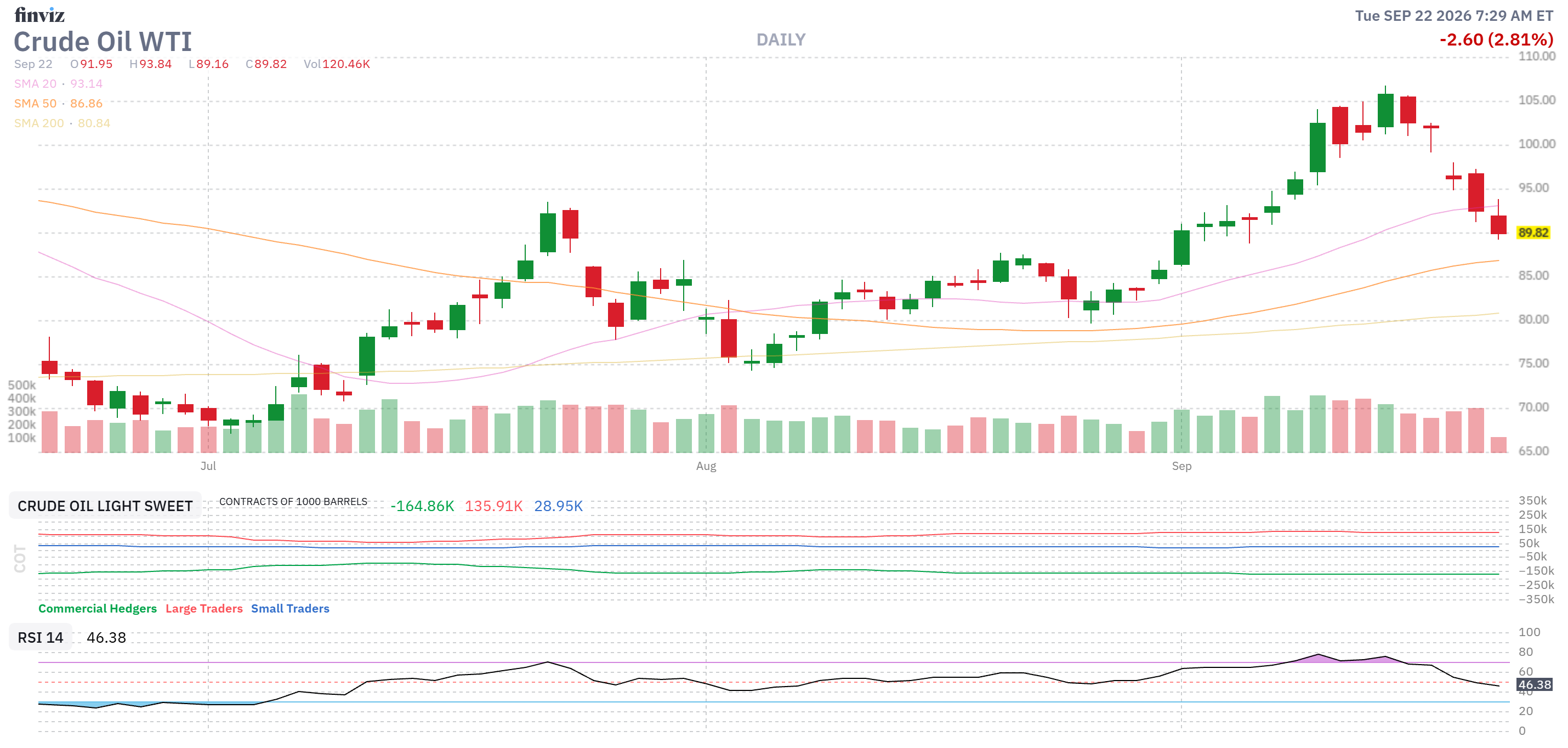
The Price Journey: $70 to $105 to $89 – What Drove Each Move
Act 1: The July Lows ($70 WTI, early July)
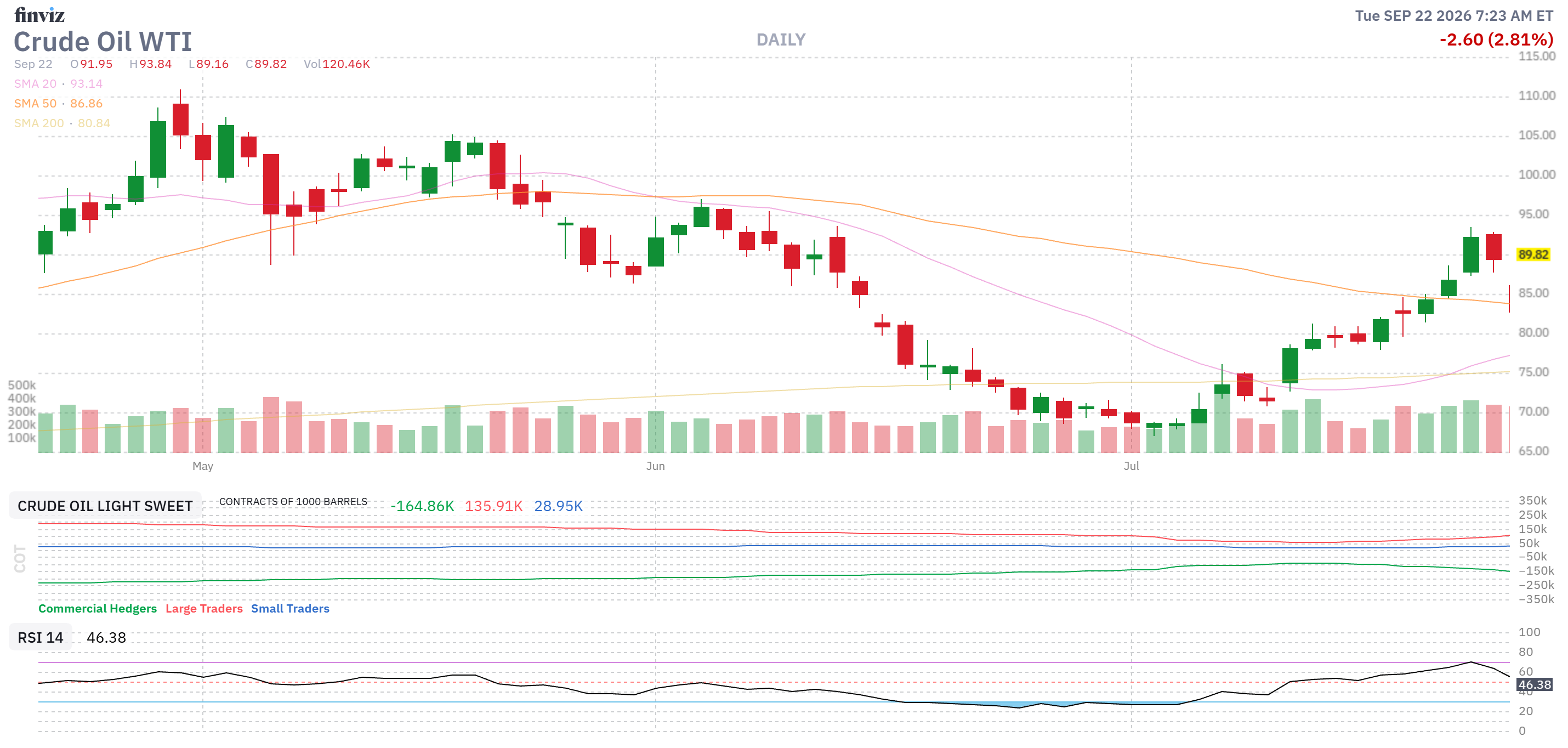
The June 19 Geneva MoU created genuine market optimism. Brent briefly touched pre-war levels around $72-73 as traders priced a reopening of Hormuz. That optimism evaporated when the MoU collapsed July 7-8 – Kharg was re-bombed, the blockade was reimposed – but the market’s memory of $70 oil created an anchor. Throughout late July and early August, WTI oscillated $79-84 in the “managed stalemate” band we identified, with the paper market repeatedly overshooting on peace headlines and the physical market refusing to confirm.
Act 2: The Escalation Ramp (August → September 9, $70 → $105)
The move from $70 to $105 happened in two distinct legs:
Leg 1 (August 31 – September 3): War Resumes
The Larak Island strike on August 31 – which Trump tried to pass off as “Kharg blown to smithereens” with an AI video – was actually the first US strike since late July. Iran responded with IRGC missile attacks on US bases in Jordan. Reuters reported Brent hit $97.29 by September 3 as fresh US strikes and Israeli threats against Tehran drove a genuine supply-risk repricing. This wasn’t a peace narrative unwinding – this was actual new shooting after a month-long de facto pause.[reuters]
Leg 2 (September 9-10: The $105 Spike)
The definitive catalyst was two simultaneous shocks hitting the same week:
First, Hormuz traffic collapsed to single digits. Reuters confirmed only 7 vessels transited September 9, down from 12 the prior day, well below the 10-day average of 14. This was the lowest traffic since May. The EIA’s September 9 report simultaneously revealed Middle East shut-ins averaging 5.7 million bpd in Q4 – a number large enough to drain global stockpiles measurably. Brent crossed $100 on September 9 and CNBC confirmed WTI topped $100 for the first time since May.[reuters][cnbc][reuters]
Then on September 11, the second shoe dropped.
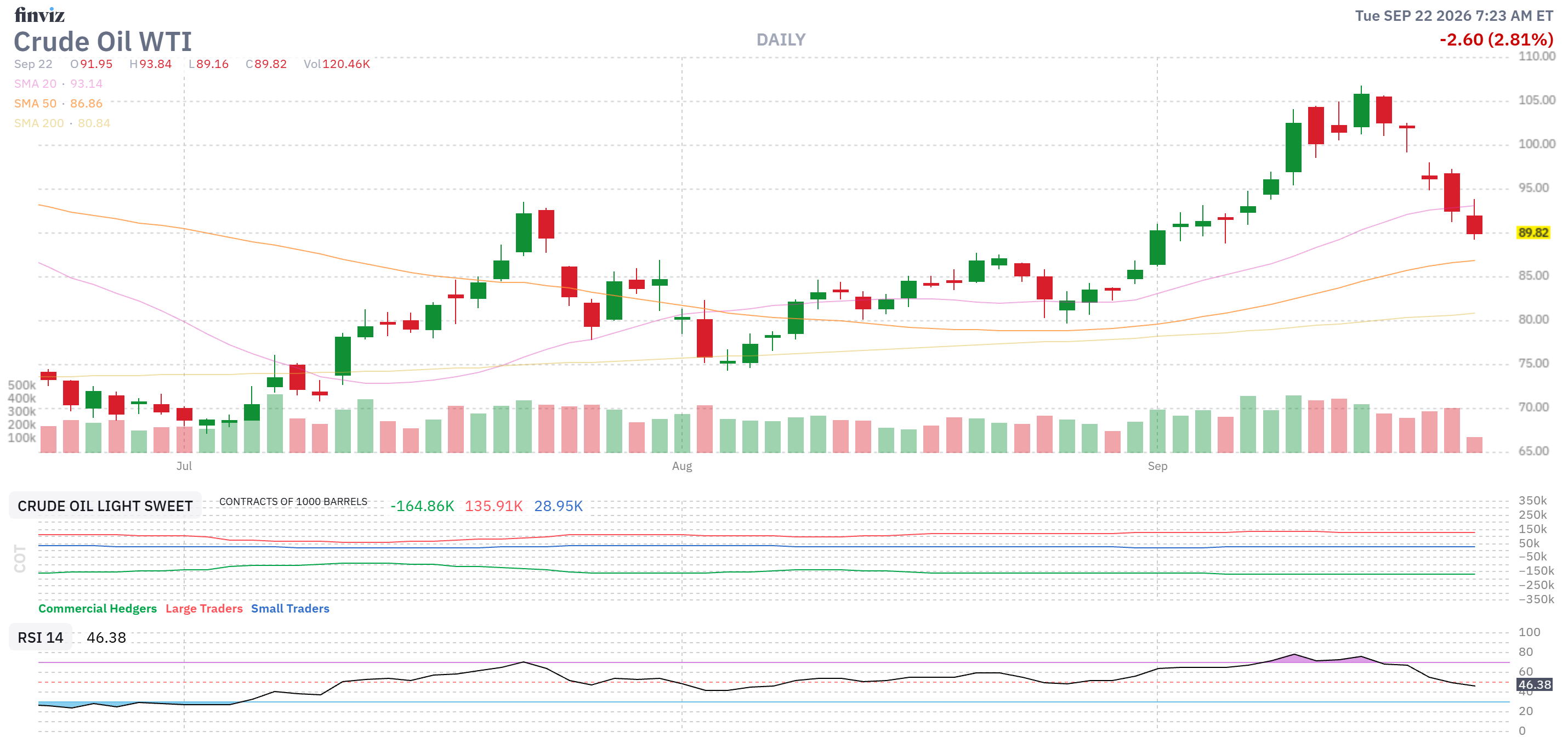
Act 3: The Saudi Pipeline Bomb ($105 → $107+ peak, September 11-15)
On September 11, 2026 – the date is not coincidental from a psychological standpoint – drones launched from Iraqi territory struck Saudi Arabia’s East-West Pipeline, the 1,200km (750-mile) conduit running from the Eastern Province oil fields to the Red Sea export hub at Yanbu. This pipeline was the entire point of Saudi Arabia’s Hormuz bypass strategy – the reason MBS had been publicly calm about Hormuz being closed for months.
Al Jazeera confirmed Saudi Arabia shut the pipeline immediately. Reuters reported September 17 that three pumping stations were hit – this wasn’t a pinprick strike, it was a coordinated multi-point attack designed to maximize repair time. Baghdad launched an investigation and closed the Iraq-Saudi border.[aljazeera][reuters]
The Yanbu disruption removed approximately 4-5 million barrels of Saudi export capacity that had been shielded from the war. Octagon AI’s prediction markets showed the probability of WTI hitting $110+ by September 30 jumped 50 percentage points to 37% on this single news event.[octagonai]
CNN confirmed the Yanbu loading hub – Saudi Arabia’s entire Red Sea export infrastructure – suspended crude loadings. Rio Times/Kpler data put total Gulf shut-ins above 10 million bpd at the peak. Brent hit $107 intraday. WTI touched $105. That is the top.[cnn][riotimesonline]
Act 4: The Reversal ($105 → $89 now, September 15-22)
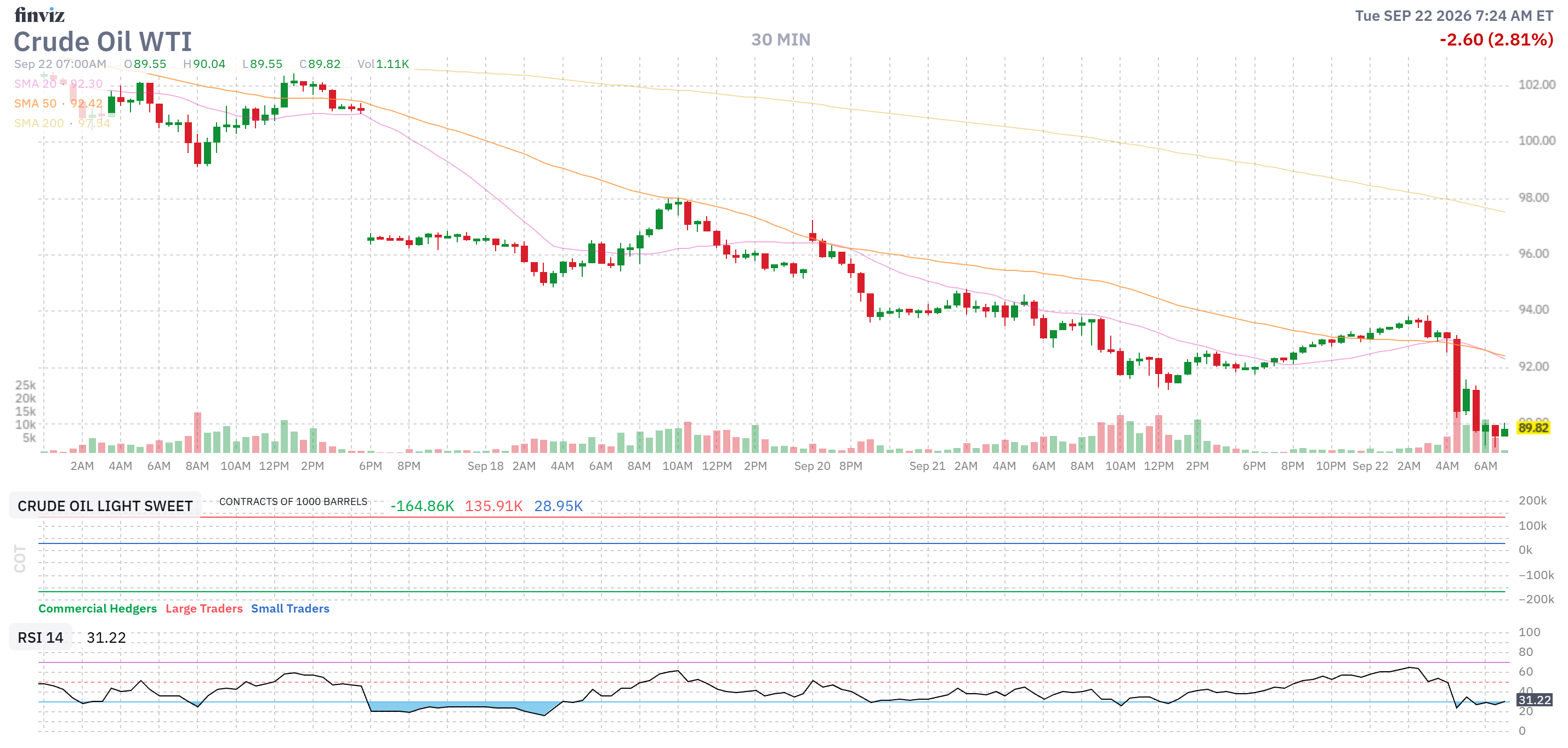
Two forces pulled oil back from the brink:
Force 1: The Saudi Pipeline Partial Restart
By September 15, Aramco engineers had enough of the pipeline repaired to restore partial flow. Reuters confirmed crude loadings at Yanbu had resumed at reduced capacity. “Coming back online” doesn’t mean full capacity – Al Jazeera’s September 17 routing analysis showed Saudi Arabia is still rerouting crude through dark shipments and ship-to-ship transfers off Oman to compensate for reduced Yanbu throughput. But the existential threat – total Saudi Red Sea export cutoff – was off the table.[reuters][aljazeera]
Force 2: Iran’s Formal Conditions via Qatar (September 19)
This is the “deal rumors” you referenced this morning. On September 19, Iran’s new Supreme National Security Council secretary Mohsen Rezaei – who took over from the previous secretary about a month ago – gave an exclusive Al Jazeera interview confirming Iran had formally conveyed seven conditions to Washington through Qatari mediators.[aljazeera]
The three public conditions: end the war on all fronts, release frozen Iranian funds, end the naval blockade. MoneyControl confirmed the full seven-condition list was transmitted, with Rezaei simultaneously warning of a “decisive war” if Trump rejects them.[moneycontrol]
This was preceded September 17 by Trump claiming he had directly spoken to Iranian officials and the US was “hopefully toward the end” of the war – a claim Tehran has not confirmed, consistent with the entire TACO pattern of Trump claiming progress Iran denies.[aljazeera]
Oil dropped ~$16 from $105 to $89 in approximately one week on these two combined inputs.
Game Theory Outlook: This Week and Next
The Payoff Matrix as of September 22
Iran’s position is structurally stronger than it appears:
Iran’s seven conditions are opening bids, not final demands – but they’re coherent demands from a party that has successfully survived 206 days, decapitated its own leadership structure without collapsing, and just demonstrated it can hit Saudi Arabia’s Hormuz bypass through Iraqi proxies. The pipeline strike was Iran saying: “You thought you had a workaround. You don’t.”
Rezaei’s simultaneous “decisive war” warning while presenting formal conditions is classic negotiating posture – Iran is not suing for peace, it is setting terms.
Trump’s position is weaker than the current oil price suggests:
The midterm election is November 3 – 42 days away. SPR is near statutory minimum. Missile inventories are critically depleted. The USS Abraham Lincoln deployment is the longest since Vietnam. The $40 trillion debt is serviced at $1.47T annually. Q2 GDP was -0.4%. None of these clocks have gotten better since August.
Trump needs a deal more than Iran does right now, which inverts the leverage completely from where it was in February. Iran’s dominant strategy – wait – has been vindicated by every week that passes.
The TACO pattern predicts the near-term moves:
Given the formal conditions transmitted via Qatar on September 19 and Trump’s “hopefully toward the end” claim September 17, the setup is identical to every prior TACO moment:
- Optimistic US claim → Iran neither confirms nor denies → market prices partial peace premium → deadline passes → oil spikes back
The question is the timing. With midterms 42 days out, Trump has maximum incentive to manufacture a breakthrough announcement in the next 2-3 weeks – before early voting begins in most states. A “framework agreement” announcement around October 10-15 would be optimal for maximum midterm impact. That is the most dangerous period for shorts and the most important entry point question for longs.
The Saudi pipeline is the new wild card:
Three pumping stations damaged is not a quick fix. Aramco has restored partial flow but the pipeline’s full capacity is likely 6-8 weeks from restoration at minimum. Saudi Arabia routing crude through Oman dark shipments is expensive, slow, and limited in volume. This means the $16 drop from $105 to $89 has been driven partly by market optimism about pipeline repair that is running ahead of the physical reality – just as the mine-clearance claims ran ahead of physical reality.
Probable Scenarios This Week/Next
Scenario A – TACO #10 (60% probability):
Trump announces a “breakthrough” framework response to Iran’s seven conditions, via Qatar intermediary. Oil drops $6-10 on the announcement. Iran’s response is either silence or a counter-demand. By the time the framework collapses (or is revealed as empty), the midterm cycle has absorbed the temporary optimism. Oil recovers to $95-100. This is the most likely path given the electoral calendar.
Scenario B – Genuine Progress, Partial Deal (20% probability):
Iran’s seven conditions get partially met – frozen funds released, naval blockade partially lifted in exchange for Hormuz corridor guarantee. Hormuz doesn’t fully reopen but tanker traffic normalizes toward 20-25 vessels/day. Oil falls to $78-82 range. This requires Trump to accept Iran’s framing, which conflicts with domestic political positioning. Possible but unlikely before midterms.
Scenario C – Escalation Resumes (15% probability):
Iraqi-proxy drone strikes resume on Saudi infrastructure, or Iran retaliates for the Larak Island strike more aggressively. Oil spikes back to $100+. The pipeline having been proven vulnerable changes Saudi Arabia’s calculus and could prompt direct Saudi diplomatic intervention with Trump (another MBS call like August 3). This scenario is the one that makes Phil’s $75 entry thesis look brilliant in retrospect – a spike to $100 followed by a deal announcement cascade.
Scenario D – Status Quo Drift (5% probability):
Nothing happens. Oil drifts $85-92 range. Given the electoral pressure and the formal Qatar channel being live, pure drift seems least likely of all four.
The Entry Point Question
At $89.34 WTI this morning, you are 84 days before the EIA’s estimated return to pre-conflict output levels (Q2 2027 per their September 9 forecast). Hormuz traffic is still in single digits. The Saudi pipeline is partially repaired but not fully restored. The Brent/WTI spread needs to be checked this morning – if it’s back below $5, the market is pricing more peace than the physical situation warrants.
The $75 target from late August looks less likely now because the Saudi pipeline attack changed the floor. The bypass route getting hit raises the minimum plausible war premium. A more realistic range for a TACO #10 dip is probably $82-85 WTI rather than $75 – and that’s the entry zone worth targeting if Scenario A plays out over the next 2-3 weeks.
The long-term thesis remains intact: EIA says no normalization until Q2 2027, Kpler’s Amena Bakr said full normalization won’t happen until 2027 and the pipeline attack confirmed there is no clean Hormuz bypass. The question is just whether you ride out the TACO volatility or wait for the dip.

