

 It’s that time again!
Earnings kick off tomorrow with Big Bank reports from Citigroup (C), Goldman Sachs (GS), JP Morgan (JPM) and Wells Fargo (WFC) along with Albertson’s (ACI), Domino’s (DPZ) and United Health (UNH). Wednesday morning we add Bank of America (BAC), BlackRock (BLK), Fastenal (FAST), Morgan Stanley (MS), Progressive (PGR) and State Street (STT) – so that’s where we’ll be on Wednesday and we’ll be analyzing those opening moves in our Live Trading Webinar at 1pm.
After that, things really hit the fan and it’s going to be 4 intense weeks of market data – including another Fed Rate Meeting and, of course, the dreaded Mid-Term Elections:

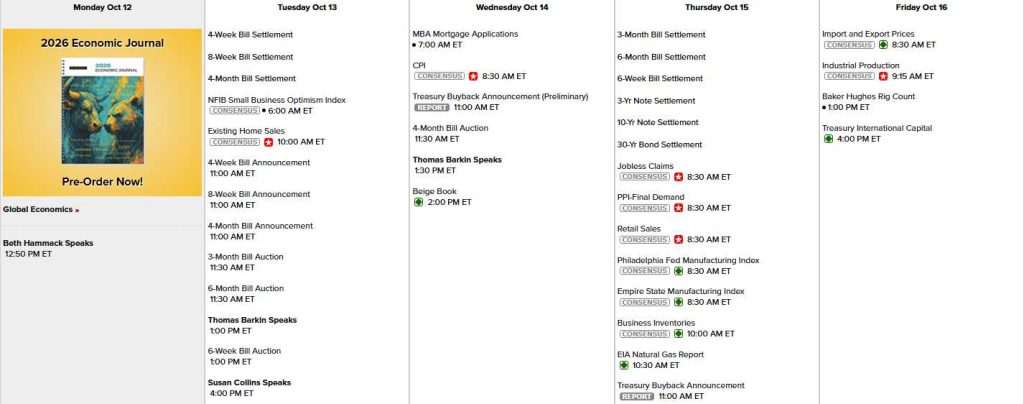
Other market data is taking a bit of a break this week but there are still 5 Fed Speakers, Small Business Optimism, CPI, the Beige Book, PPI, Philly Fed, NY Fed, Import & Export Prices and Industrial Production:
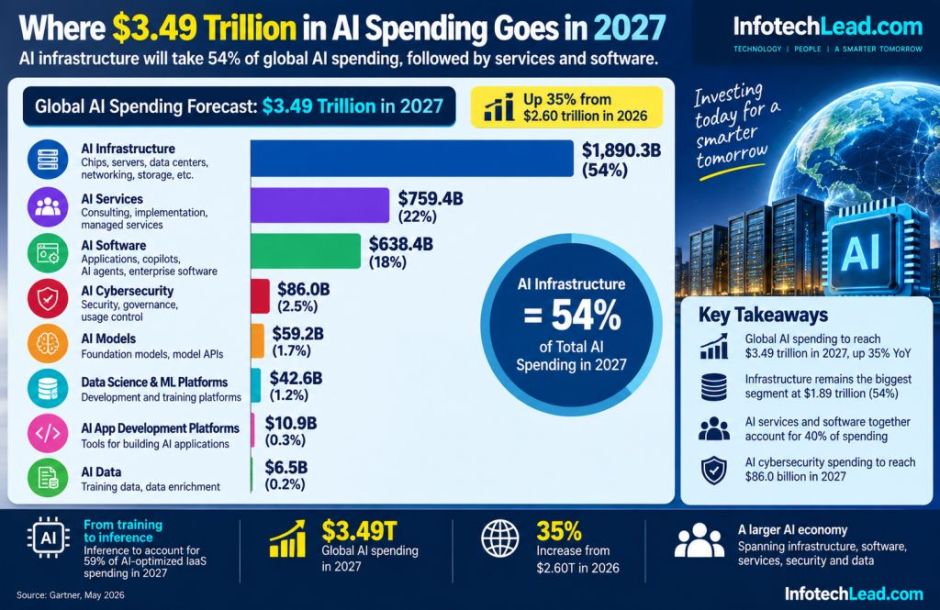
As we’ve been saying, AI capex is being paid for with other people’s money. Earnings this week show whether the lenders still believe it.
The government is part of the same queue. Our National Debt is $40.3 TRILLION! Net interest ran $1.05T through the first 11 months of fiscal 2026, up 12%. That works out to a blended cost of roughly 2.5% to 2.9% on the whole pile. The 10-year costs about 5.2% today. Every $10T that rolls from the old rate to the new one adds roughly $175B to $275B a year and about a third of marketable debt ($12.5Tn) matures within a year PLUS the Government is adding $2.5Tn of new debt each year. That is the bill the HYPErscalers are bidding against as they borrow they own Trillion.
The BIS spelled out the AI financing problem in September. General Manager Pablo Hernández de Cos said the five biggest tech companies will spend over a trillion dollars on AI capex in 2025 and 2026. He said the boom is “increasingly” financed “not by earnings but through debt and, notably, through private credit.” He added that capex is “outpacing their cash flows” and that much of the financing is “opaque and interconnected.“
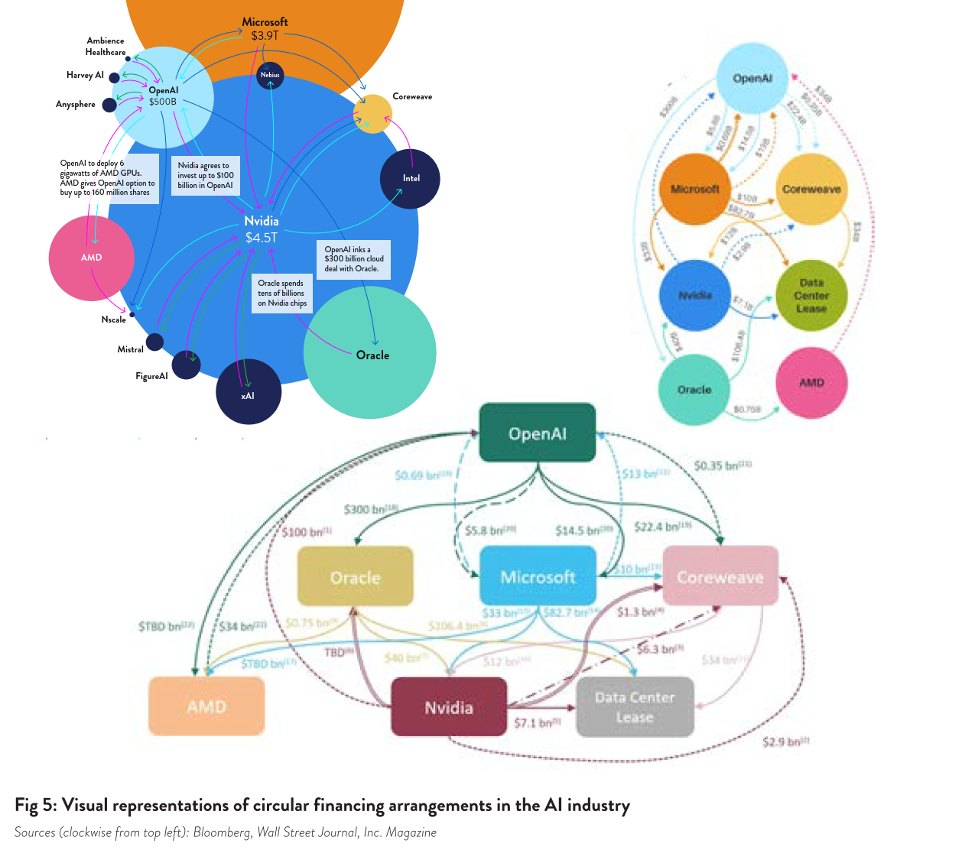
He also described circular financing, where chipmakers and hyperscalers take stakes in AI firms that then buy their chips and compute. That link is “difficult to observe and, at times, difficult to value.” He warned that households hold more wealth in equities, so a repricing “could pass through more forcefully to consumption.”
The history lesson is the blunt part. Canal mania, railway mania, electrification and dotcom were each based on real breakthroughs. They “all drew in more capital than eventual returns could justify” and each correction “had economy-wide implications.” His warning: “Should the returns to AI disappoint, a pullback in investment could turn today’s capital expenditure boom into a bust.“
On the payoff, the median estimate in the literature is about half a percentage point of extra productivity growth a year. That is a long way from the $3T to $4T of annual AI investment the industry expects by 2030.
Oracle has already given us a preview. It sent a force majeure notice on Project Jupiter, a 2.45-gigawatt campus built for OpenAI. The reason was power. It can defer rent but not actually walk away and Oracle says it remains committed. The $18B construction loan behind the project trades below 90 cents on the Dollar, which is at least a $1.8B of paper loss on just one project already. Banks have also spent more than six months trying to sell down a $38B construction loan tied to Oracle-leased sites in Texas and Wisconsin.
None of this looks like banks are pricing in potential losses. Reserves sit at 1.61% of loans, DOWN from 1.72% a year ago. Last quarter Goldman cut its provision from $315M to $102M (inflating apparent profits) and JPMorgan and Bank of America each trimmed theirs by more than 10%. THAT is what we’ll be watching closely as banks begin to report this week.
Restoring last year’s reserve ratio would cost about $16B, or roughly 0.6% of industry equity. At the system’s roughly 10-to-1 leverage, that is about $160B of lending capacity and it lands hardest on the banks with the AI paper. The numbers that matter are the undrawn commitments, which run about 25% of Tier 1 capital for the average large bank and the $1.7T lent to non-bank lenders such as private credit funds.
What to watch Tuesday and Wednesday
-
-
Provisions. Analysts expect JPMorgan at $2.8Bn, Goldman at $407M, Wells Fargo at $1.15Bn, Bank of America at $1.5Bn and Citi at $2.6Bn. A reserve build above those numbers would be the first admission.
-
Data-center and non-bank lending. Let’s see how much of the $38B is still stuck. JPMorgan’s CFO called data-center underwriting a bellwether for lender appetite on the last call.
-
Funding costs and securities losses. The 10-year is above 5.2% and every bank is holding bonds bought at much lower yields – not yet written down in value.
-
Investment banking. Late-September IPOs from Oura and SB Energy were delayed as yields spiked and Bank of America has already guided its investment-banking fees down at least 10%. The SpaceX IPO gave a huge boost to Q2, so Q3 HAS to disappoint by comparison (but still should be way up from last year’s Q3).
-
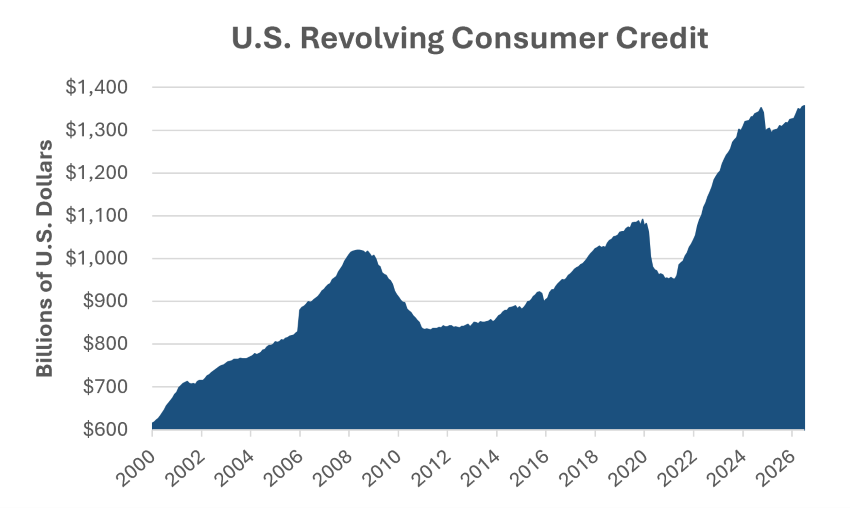
Consumer credit. Student loans are 10.6% delinquent at 90 days or more (NY Fed), and the saving rate fell to 4.1% in August – these are Recessionary numbers we should NOT be ignoring!
-
The same story runs through the rest of the earnings calendar:
-
-
Oct. 15th: TSMC. This is the picks-and-shovels read on whether orders are still accelerating.
-
Oct. 21st: Vertiv, the power and cooling bottleneck.
-
Oct. 22nd: Blackstone, the private-credit and AI-infrastructure financier.
-
Oct. 28th: Microsoft, Alphabet (also Oct. 28) and Meta (also Oct. 28) – all after the close. Meta guided 2026 capex to $130B-$145B. Microsoft’s free cash flow fell 23% last quarter while capex roughly doubled.
-
Oct. 29th: Amazon, Intel (Oct. 29), Blue Owl (Oct. 29) and Ares (Oct. 29). Blue Owl is the developer on the Jupiter project.
-
Nov. 3rd: Apollo, on midterm day.
-
Nov. 9th: KKR and CoreWeave (Nov. 9).
-
Nov. 18th: Nvidia.
-
Dec. 7th: Oracle, after this stretch but the one everyone is waiting on.
-
Four things to look for in each report:
-
-
Capex guidance compared with free cash flow. If spending rises while cash generation falls, the gap gets filled with debt.
-
Mentions of power delays, force majeure or pushed-out completion dates.
-
Backlog concentration. How much of the contracted revenue comes from OpenAI and its circle?
-
Financing mix. Look for new bond deals, leases not yet started and off-balance-sheet vehicles. That is where the BIS says the risk hides.
-
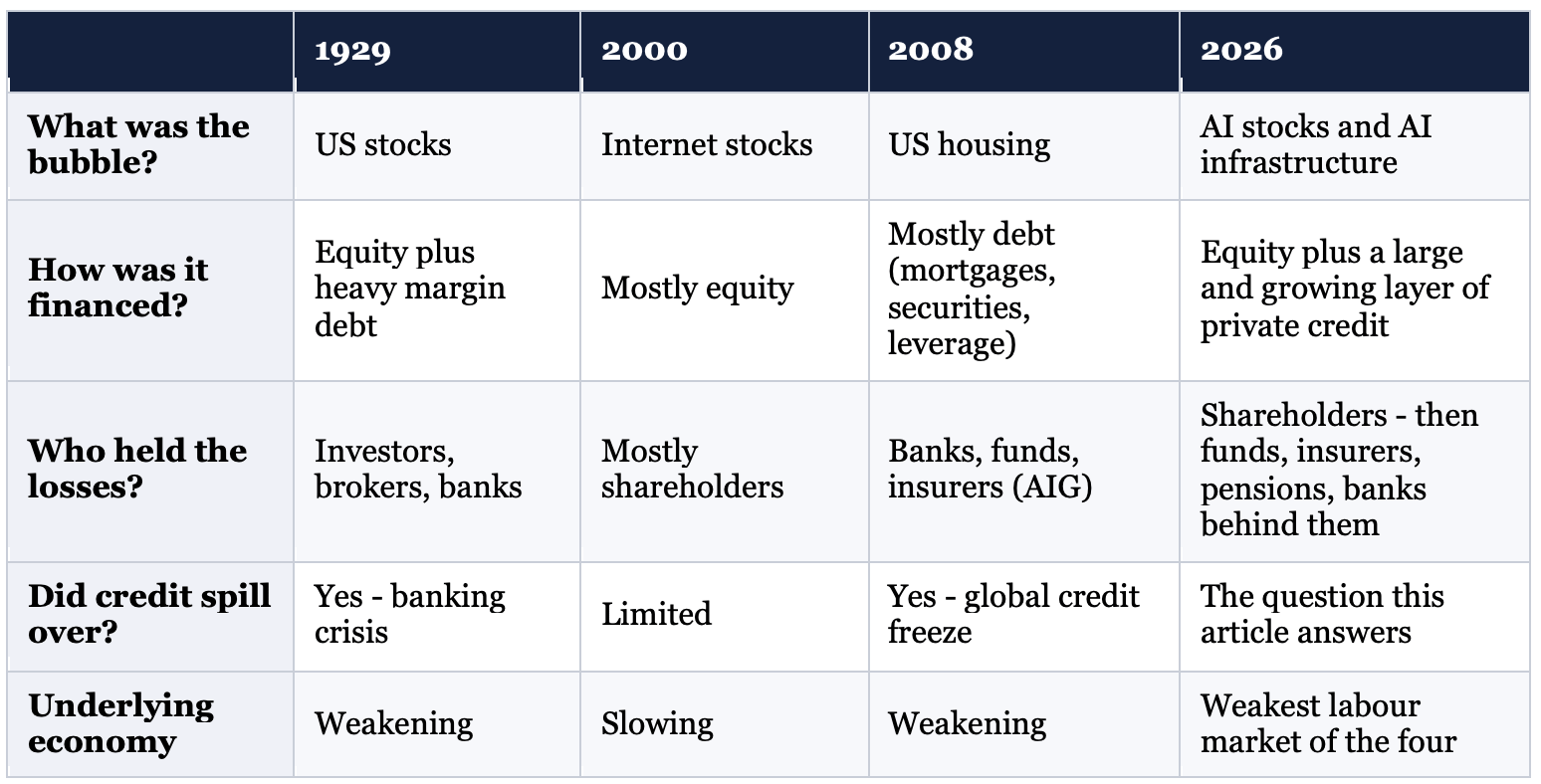
AI-linked bonds were about half of new US investment-grade issuance this year. The Fed meets Oct. 27 and 28 with the 10-year above 5.2%. If banks tighten and hyperscalers keep borrowing, the market will find out how much room is left.
Sources for the figures not linked above: OECD on borrowing, Treasury via JEC on the 3.518% marketable average rate, and BIS Quarterly Review on private credit.
The Next Two Weeks: Follow the Money Abroad
 As we’ve been saying, 5% on the long end was the line we warned about. The 10-year closed Friday at 5.24% and the 30-year at 5.60%. The 30-year hit 5.73% earlier this month, the highest since 2002!
Now 6% is in view. That is 20% above the level we called a catastrophe and 30-year yields last touched it in June 2000 – as the economy was already collapsing. The 30-year is only 40 basis points away and the 10-year would need just 75 basis points. 6% is not an American invention. London’s 30-year gilt already hit 6.04% on Oct. 7th – the highest since 1998. Japan’s 30-year hit a record 4.235% on Oct. 5th as well.
Strategists are still modeling a retreat. The Reuters poll median has the 10-year at 5.00% by year-end. That same poll says strategists underestimated the rise in nine straight monthly surveys. Of the 30 who answered a follow-up, all but 2 said yields were more likely to land above their forecasts than below – yet the Television pundits will give you the simple story – that analysts expect things to get better, not worse…
A 6% 10-Year that makes the budget math break isn’t being modeled. By our arithmetic, every $10T that reprices at 6% instead of 5.25% costs about $75B more a year ($300Bn against our current deficit alone).
The data that moves the long end
-
-
Wed, Oct. 14th, CPI: consensus is 3.6% headline and 2.5% core after 3.4% and 2.4% in August. Beige Book at 2pm.
-
Thu, Oct. 15th: PPI expected +0.5% month over month, retail sales +0.3% after +1.2% and the Philly Fed at 26.5 after 37.8. Fed Chair Warsh speaks that night.
-
Fri, Oct. 16th: import prices and industrial production.
-
Tue, Oct. 20th: housing starts. Friday, Oct. 23r: Michigan sentiment.
-
Overseas data
-
-
UK: August GDP on Oct. 15th (expected −0.1% after +0.4%), then CPI on Oct. 21st. Gilt yields are at multi-decade highs after Bank of England officials flagged inflation concerns and the new chancellor’s first budget is due in about three weeks.
-
Eurozone: final CPI on Oct. 16th. The ECB hiked in June and September and is broadly seen pausing Oct. 29th, with another hike expected in December. Lagarde speaks Oct. 13th and 14th.
-
China: third-quarter GDP, industrial production and retail sales land Oct. 19th. The retail sales reading is the one to watch, because the prior was only 0.4%.
-
Japan: CPI on Oct. 22nd. Markets increasingly expect a BoJ hike in December.
-
Earnings trends
-
-
AI supply chain, the overseas read. TSMC reports Oct. 15th, and ASML reports Oct. 14th. TSMC’s September sales rose about 55%, so the question is the 2027 guidance. For ASML, watch order bookings, the 2027 outlook and China’s share. Lam Research follows on Oct. 21st. Cuts to equipment orders show up here before they show up in hyperscaler capex.
-
Energy windfall versus pass-through. European companies are expected to post 21% Q3 profit growth but only 9.7% excluding energy. Energy majors are expected to post 115.9% growth. Check margins outside oil. J.B. Hunt (Oct. 15th) has warned fuel could cut earnings 5% to 10%, per Investopedia. Airlines follow (American, Oct. 22nd). On the other side, Halliburton (Oct. 20th), Valero (Oct. 22nd) and SLB (Oct. 23rd) show who is collecting. P&G (Oct. 22nd) and GM (Oct. 20th) show whether consumer prices are sticking.
-
War replenishment. RTX (Oct. 20th), Northrop (Oct. 20th), GE Aerospace (Oct. 20th) and Lockheed (Oct. 22nd) show backlog and munitions production rates. CBO says the US has used half to two-thirds of its missile-defense interceptor inventory and rebuilding takes at least five years. Backlog growth there is that bill arriving.
-
Consumer credit. Synchrony and Capital One report Oct. 20th, American Express Oct. 23rd. Watch delinquencies and card balances with the saving rate at 4.1%. UnitedHealth and J&J report on Oct. 13th for the health-cost side.
-
AI demand, the software side. IBM (Oct. 21st), SAP (Oct. 21st) and Tesla (Oct. 21st) show where AI spending lands. In India, TCS reported Oct. 8th with profit up 15%. Wipro reports Oct. 15th and Infosys Oct. 23rd. If AI is eating outsourced services, India is where it shows first.
-
European banks. Barclays reports Oct. 22nd and Nokia the same day (Oct. 22nd). Compare bond-market stress and funding costs there with what the US banks say this week.
-
Yields are at 25-year highs in New York, London and Tokyo and Earnings Season is the first real test of whether companies can absorb them. If the long end reaches 6%, the first place it shows is in the banks and the financing behind the AI buildout.