


What if the best trade idea isn’t the one with the boldest forecast, but the one that explains what would prove it wrong? Market headlines can grab your attention without helping you decide what to do. A polished setup can also leave out its assumptions, risks, or exit conditions. Expert market commentary and trade setups are most useful when they offer context and a conditional plan, not a promise about what happens next.
Looking beyond the headline means separating analysis from confident-sounding promotion, especially when options add layers of risk and AI-generated commentary makes market opinions easier to produce. To assess an idea, identify its reasoning, trigger, timeframe, and invalidation point, then consider the risks before deciding whether to act, wait, or pass. Ongoing market commentary, charts, and discussion can help put an idea in context, so your next move starts with a plan rather than a prediction.
Key Takeaways
- Use market commentary to understand the conditions behind an idea, not as a forecast to follow blindly.
- Break each setup into its thesis, trigger, timeframe, and the risks or conditions that could invalidate it.
- Compare Expert market commentary and trade setups with headlines by looking for evidence, clear conditions, and honest discussion of uncertainty.
- Follow a repeatable review process, then record your reasoning so you can reassess when market conditions change.
- Use ongoing commentary, charts, sector insights, and educational resources to add context to individual trade ideas.
What Expert Market Commentary and Trade Setups Actually Tell You
Market commentary interprets the forces moving prices, such as economic developments, company news, investor sentiment, and market reactions. It connects those factors into a view of current conditions. A trade setup takes the next step by framing a possible opportunity as a conditional idea, with a thesis, an instrument, a timeframe, and decision points. The distinction matters: commentary helps explain the setting, while a setup gives you a way to test an idea within it.
Neither removes uncertainty. A market can react differently than expected, and sound analysis can still be wrong. Analysis explains a possible path; it isn’t an instruction to trade or a promise that the path will unfold. Think of it as a map showing possible routes, not a guarantee of where the road leads.
How commentary provides context for a trading idea
Commentary can bring economic events, sentiment, and price behavior into one frame. For example, a hypothetical analysis might note that a company reported stronger sales, its shares rose, and investors are awaiting an interest-rate decision. Those are observations. The claim that the stock could keep climbing if rates support growth is an interpretation, while an expectation about the rate decision is forward-looking. Keep those layers separate. A narrative can focus your attention, but it isn’t proof that a particular move must follow.
To judge what the commentary actually supports, sort its claims into three groups: observable details, interpretation, and expectations about what has not happened yet. A useful Trading Strategy can draw on fundamental or technical analysis, but the reasoning still needs clear decision points, not just a compelling story.
What makes a trade setup conditional
A setup should make its terms visible: what the idea is based on, which instrument it concerns, the timeframe it applies to, and what price action or event would support it. It should also identify what would weaken or invalidate the premise. Without those conditions, “the stock looks bullish” is a broad opinion, not a plan you can evaluate. The timeframe matters, too: a short-term price pattern and a longer-term company thesis can point in different directions.
- Thesis: What market behavior or information supports the idea?
- Instrument: What asset or options position is being discussed?
- Timeframe: When should the idea play out, or be reassessed?
- Decision points: What would support, weaken, or invalidate the premise?
These details help you assess an idea, not outsource the decision. Consider whether the instrument and timeframe fit your circumstances, understand how the position could lose value, and decide what level of potential loss you can tolerate. Options can behave differently from the underlying shares, so a directional view alone doesn’t explain the full risk. A useful outcome is a clearer decision, including the decision to wait or pass.
How to Break a Trade Setup into Thesis, Trigger, and Risk
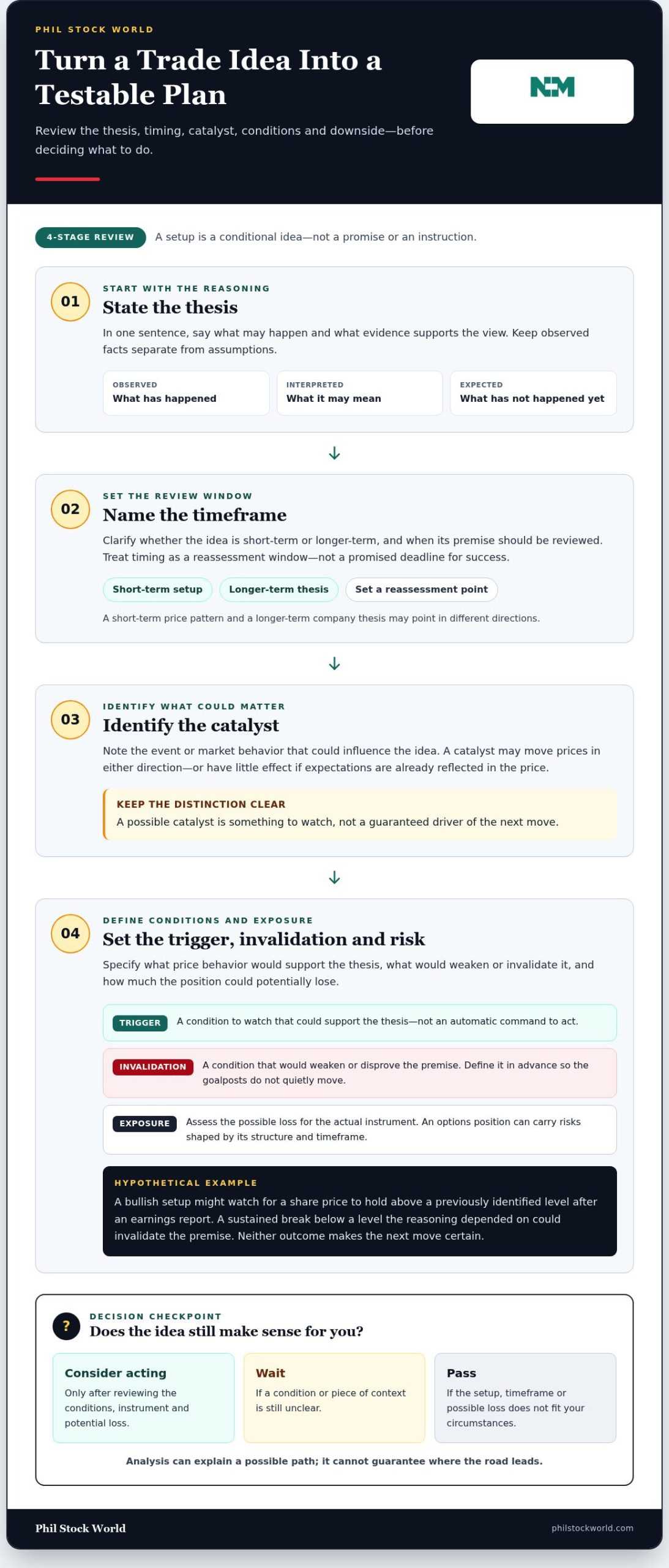
A setup is easier to evaluate when you take it apart before considering action. Start with the reasoning, then identify the timeframe and possible catalyst. Next, define what price behavior would support the idea, what would weaken it, and what loss the position could expose you to. This sequence turns a market view into questions you can test, rather than a call you have to accept or reject based on confidence alone.
A setup without conditions that could prove it wrong isn’t a plan; it’s a prediction wearing a trading jacket. Expert market commentary and trade setups are most useful when their assumptions are visible. For another perspective on how market commentary connects trends to investment implications, see Charles Schwab Market Commentary.
Check the thesis, timeframe, and possible catalyst
State the core thesis in one sentence: what do you think may happen, and what evidence supports that view? Separate the evidence from a catalyst that could influence the market, such as an upcoming company announcement or economic release. A catalyst can move prices in either direction, or have little effect if expectations are already reflected in the price. Define the timeframe as a window for reassessment, not a promised deadline for success.
- State the thesis. Summarize the reason behind the idea and distinguish observed facts from assumptions.
- Name the timeframe. Clarify whether the setup is short-term or longer-term, and when its premise should be reviewed.
- Identify the catalyst. Note what event or market behavior could matter, without treating it as a guaranteed driver.
- Set the conditions and assess exposure. Define what you’d watch, what would invalidate the idea, and how much you could potentially lose.
Map the trigger, invalidation point, and risk
A trigger is a condition to watch, not an automatic command to act. In a hypothetical bullish setup, a trader might watch for a share price to hold above a previously identified level after an earnings report. That behavior could support the thesis, but it wouldn’t make the next move certain. An invalidation condition might be a sustained break below a level that the original reasoning depended on. Specify the condition in advance so a changing story doesn’t quietly move the goalposts.
Consider downside exposure for the actual instrument, not just whether the underlying idea sounds compelling. An options position can have risks shaped by its structure and timeframe, so a directional thesis alone doesn’t describe the possible loss. Position size is a personal risk decision, not a universal percentage or formula. Consider your circumstances and tolerance for loss, and don’t treat a setup as suitable simply because its trigger appears.
For a broader view alongside your own review, ongoing market commentary and trade ideas can help place individual setups in context. Use that context to examine assumptions, not to skip your own assessment of risk.
How to Compare Expert Setups with Headlines and Hot Takes
A headline is built to catch your eye. A useful setup should also stand up to questions. The difference isn’t whether the writer sounds confident; it’s whether you can trace the reasoning, understand the conditions, and see what could go wrong. Use this comparison to distinguish a testable idea from a dramatic claim.
| What to check | Reasoned setup | Headline or hot take |
|---|---|---|
| Evidence | Connects its view to observable company, economic, or price information. | Leans on a bold claim or a striking chart without explaining the basis. |
| Timeframe | States when the idea applies and when it should be reassessed. | Uses “now” or “soon” without defining the window. |
| Conditions | Describes what would support the thesis and what could weaken it. | Suggests the outcome is inevitable, whatever the market does. |
| Risk discussion | Addresses downside exposure and relevant assumptions. | Spotlights possible gains while leaving potential losses in the shadows. |
| Uncertainty | Acknowledges alternatives and what remains unknown. | Frames one interpretation as the only possible outcome. |
Signals of analysis that readers can interrogate
Look for a rationale you can examine, not just repeat. If a commentator argues that a company’s shares may strengthen, can you identify the reported information or market behavior behind the view? Do they explain their assumptions, how long the idea might remain relevant, and what evidence could challenge it? Thoughtful analysis makes room for counterarguments. That doesn’t make it weak; it makes the reasoning easier to test.
Specificity helps only when it comes with context. A price target can look precise while resting on unstated assumptions about earnings, valuation, or market conditions. Ask what would have to be true for that target to make sense, and what downside scenario the analysis considers. A number without its reasoning is decoration, not a decision framework.
Red flags in unsupported trade calls
Pause when a call creates urgency without explaining the thesis, names a target without discussing risk, or gives no way to tell when its premise has failed. Selective success stories deserve scrutiny, too: a winning example doesn’t show how often similar calls struggled or what losses were possible. A popular post, confident delivery, or dramatic chart may earn attention, but none proves the argument.
A testable market thesis names what could support it and what could defeat it; certainty pretends the second possibility doesn’t exist. Expert market commentary and trade setups should help you ask sharper questions, not pressure you to follow a call. If key conditions or downside considerations are missing, treat that gap as a reason to investigate further, wait, or pass.
A Practical Workflow for Reviewing Setups Before You Decide
A repeatable review gives you room to think before market noise sets the pace. Instead of reacting to a persuasive call, use the same checks each time: understand the thesis, test its assumptions, define the risk, then decide whether to act, wait, or pass. Expert market commentary and trade setups can inform that process, but your notes should show why the idea does or doesn’t fit your circumstances.
- Restate the thesis. In plain language, write down what the idea expects and what information or market behavior supports it.
- Check the assumptions. Identify what needs to remain true, what could change, and whether the timeframe still makes sense.
- Define the risk. Consider possible loss, the instrument’s complexity, and how the position might interact with your existing exposure.
- Choose your response. Decide whether to act, wait for clearer conditions, observe without taking a position, or pass.
Adapt the review to your experience and portfolio
Before considering a setup, ask whether you understand the instrument and its risks well enough to evaluate it. If an options strategy’s possible outcomes or timeframe aren’t clear, don’t let a confident explanation rush your decision. Consider your existing positions and overall exposure, too. A new idea doesn’t sit in isolation just because it appears in separate commentary. Passing on something unclear or unsuitable is a sound decision, not a missed test.
Options risk deserves particular attention because a position’s behavior may not mirror the underlying shares. For a deeper discussion of potential risks and protective considerations, explore risk management for options.
Keep a record and learn from the process
Save the original thesis, assumptions, timeframe, decision conditions, and your reason for acting, waiting, or passing. Later, review what changed and what information was available at the time. This helps separate a disciplined decision from a lucky outcome, or a weak process from a sound one that happened to work. Don’t rewrite your original rationale after seeing what the market did.
A watchlist can help you follow a setup without opening a position. Record the price or event that would support the idea, then note whether that condition appeared and whether the thesis still held. Paper trading can also help you practise tracking a hypothetical position and its assumptions, but it doesn’t guarantee how a live trade would behave. Focus on the quality of your process, not on treating hypothetical results as proof.
If you’re exploring more complex approaches, study the structure and risks separately; advanced option trading strategies require careful understanding before you evaluate a particular setup. To put individual ideas alongside broader market context, explore Phil Stock World’s market commentary and trading ideas.
How Phil Stock World Connects Market Commentary with Trade Ideas
A trade idea makes more sense when you can see the market conversation around it. Phil Stock World brings daily stock and options commentary together with trading ideas, helping readers consider how an individual company or setup fits into broader market conditions. That context can prompt useful questions: Is a sector trend supporting the idea or moving against it? Has new information changed the original thesis? Commentary is a resource for analysis, not a command to copy a trade.
Use commentary as a framework for independent judgment
Expert market commentary and trade setups work best as connected but distinct pieces: commentary explains the surrounding conditions, while a trade idea gives you something specific to examine. Phil Stock World’s daily stock market commentary offers a wider lens, while market charts and sector insights provide other ways to explore price behavior and industry context. The value comes from testing the reasoning and assumptions yourself, not treating an expert’s view as a certain outcome.
Educational webinars and strategy guides can help you build familiarity with market concepts and approaches. Use them to sharpen your questions and understand how an idea is framed. They don’t remove market uncertainty or guarantee that a strategy will suit your circumstances.
Choose a learning path that fits your needs
Different resources serve different purposes. Market charts can help you examine price behavior, while sector insights place individual companies within a broader industry picture. Educational content supports learning, and member discussion forums or trading-room access offer a setting to explore ideas with others. Phil Stock World membership tiers range from daily commentary to real-time interactive trading sessions.
A virtual portfolio review offers a way to examine portfolio strategy and consider how holdings relate to the ideas under discussion. Treat it as an opportunity to explore your thinking, not a promise of investment results. Choose resources according to what you want to understand: market context, a particular setup, options concepts, or how portfolio holdings relate to a thesis.
Phil Stock World membership brings together market commentary, trade alerts, educational resources, and community discussion, with different tiers offering different levels of access. Explore the membership options and choose the resources that support the way you want to study markets. The aim isn’t to borrow someone else’s conviction. It’s to build a more informed process for deciding what deserves your attention.
Make Your Next Market Decision More Deliberate
The next useful step isn’t finding a louder prediction. It’s building a habit of asking better questions: What would change my view? What am I still assuming? Am I comfortable with the downside if the idea fails? Those questions turn Expert market commentary and trade setups into a starting point for your own research, rather than a shortcut around judgment.
Keep learning, record your reasoning, and give yourself permission to wait when the picture isn’t clear. A disciplined decision can be an action, a pause, or a pass. The aim is not to eliminate uncertainty, but to meet it with a process you understand.
Ready to add context to your market research? Explore Phil Stock World membership for daily market commentary, trade ideas, charts, and educational resources. Choose the level of access that fits how you want to learn, and build your knowledge one thoughtful decision at a time.
Frequently Asked Questions
Can expert market commentary predict what stocks will do next?
No. Expert market commentary can interpret available information and outline possible scenarios, but it can’t remove uncertainty or guarantee a price move. For example, a company may report strong results yet see its shares fall if investors expected even more. Separate reported facts from forecasts, then ask what new information could undermine the view. Treat commentary as one input to your judgment, not an instruction or promise.
What should a trade setup include?
A useful setup should explain its reasoning, the instrument it concerns, its timeframe, and the conditions that would support or weaken the idea. It should also make the potential downside understandable. For example, if a setup depends on a company meeting a particular expectation, consider what happens to the thesis if the results disappoint. These details help you assess the idea, but they can’t determine whether it fits your circumstances.
Are expert trade setups suitable for beginner investors?
Not automatically. A setup involving options, leverage, or a short timeframe may be difficult to evaluate without experience in how the instrument behaves and how losses can arise. Beginners can use a trade idea as a study exercise: look up unfamiliar terms, write down the assumptions, or track the scenario without opening a position. Build understanding at a pace that suits your knowledge, and don’t mistake exposure to an idea for readiness to trade it.
How can I tell market analysis from a promotional trade call?
Look for reasoning you can examine, not just persuasive delivery. A useful analysis explains what information supports its view, identifies assumptions, and acknowledges what could challenge the idea. Be cautious if a post relies on urgency, confident claims, or selected winning examples while glossing over losses and uncertainty. Those signs don’t prove the call is wrong, but they make it harder to assess. Confidence and popularity aren’t evidence by themselves.
Should I act on a trade setup as soon as I receive it?
No. A setup doesn’t create a deadline to act. News may have changed, the price may have moved, or the conditions behind the idea may no longer apply before you see it. Check whether the original reasoning still fits the current situation and whether you understand the potential exposure. If you need more time, wait. Researching further or passing are sensible choices when the idea no longer makes sense to you.
What is the difference between a market catalyst and a trade trigger?
A catalyst is a possible influence on a stock or the wider market, such as an earnings announcement or economic release. A trigger is a defined condition in a setup that signals the idea may warrant closer consideration. For instance, an earnings report is a catalyst; a specified price response afterward could be a trigger. Neither guarantees direction or success, so evaluate each in light of the setup’s assumptions.