

Why is Oil $96/108 this morning (as we predicted, you’re welcome!)?
Trump rejected Iran’s seven-day roadmap on Saturday – told reporters outside the White House “I reject their proposal.” Then on Sunday told Axios he expects negotiators to talk again this week anyway. Classic: reject the deal, keep the door open, send oil up either way.
So this morning’s $96 WTI/$108 Brent is simply the war premium snapping back after last week’s peace-optimism selloff. Per The National News, Iran’s parliament speaker simultaneously declared the Strait stays closed until every condition is met – no ambiguity there. Houthis also hit Saudi targets over the weekend, keeping the regional fire lit.
The mechanical pattern now has a name: Aswat Al-Awsat confirmed oil fell 2% Friday on the deal proposal, bounced back above $106 Brent Monday on the rejection. The market is literally a TACO-tracking algorithm at this point – peace headline in, oil down; rejection out, oil up – wash, rinse, repeat.
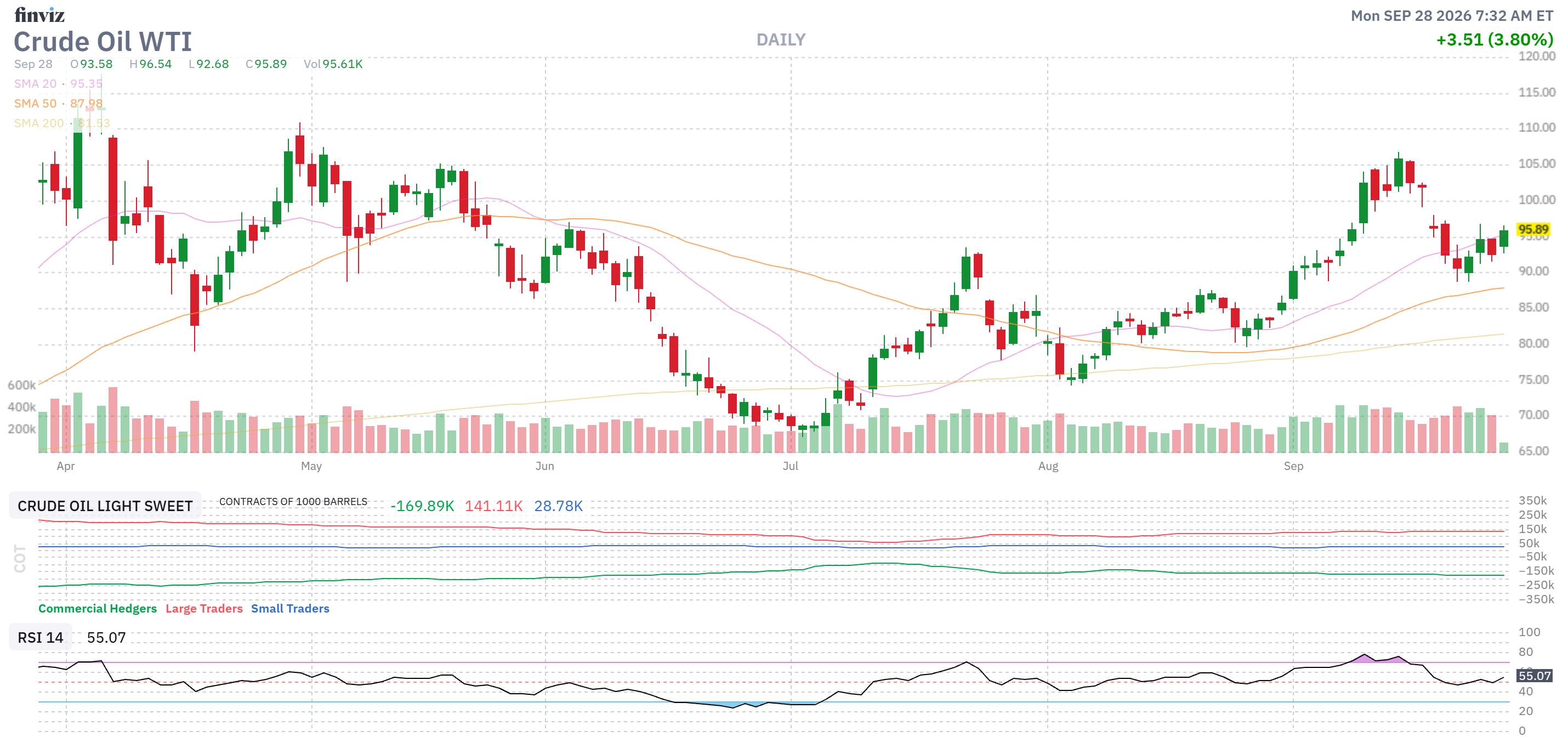
The one new wrinkle: JP Morgan told the BBC they’ve essentially given up forecasting oil because of the war, pegging “fair value” at $90 but acknowledging the market is pricing in escalation risk on top of that. With midterms 36 days out and Trump saying a deal comes “after the election,” the war premium has a known minimum duration now. Oil traders knows that too.
Nonetheless, Trump claims “negotiations are being held this week.” Will traders fall for it for the 12th time? Of course they will! They will be right one day but we’re on an 11 Taco winning streak!
 Speaking of streaks – NEVER have we gotten to Sept 28th without a single Atlantic Hurricane and NEVER have there been so many Pacific Hurricanes. While the Big Picture indicates changing global weather patterns that have the potential to threaten all life on Earth – at least we can make money off it in our “PSW Special Report – How to Trade El Niño 2026 and 2027!“
Don’t worry though, AI will kill us long before the weather does! Here’s a recap of where that mess is standing:
🧋On September 14, Amodei publicly called for regulations requiring independent audits of advanced frontier AI models before release – the most direct safety-focused ask from a major AI CEO to date. This was notable because Anthropic competes directly with OpenAI and has always positioned itself as the “safety-first” lab. When even the company built on safety concerns is publicly begging for government oversight, that’s a signal.
Reuters confirmed Trump’s response the same day: he dismissed the safety alarm entirely, said the US “already has guardrails in place,” and – separately on Truth Social – declared that AI fears about “robots marching into our cities and getting rid of us all” are a “HOAX.” His stated position, per the NYT: “The only control or ‘guardrails’ that AI needs is a STRONG AND SMART (High IQ!) PRESIDENT, and the U.S.A. has that.“ He was referring to himself, in case that needed clarification. VP Vance added that he is “skeptical of AI executives seeking US government regulation” – which is the administration’s way of saying the people building the weapons are asking for too much caution.
Also on September 14, Reuters and CNBC confirmed that Trump had a private backstage meeting with Sam Altman at the Republican midterm convention – requested by Altman, focused on “AI and its growing power.” No official readout from either side. Make of that what you will.
The policy timeline leading here is a masterpiece of regulatory whiplash. The Guardian confirmed that in May, Trump was hours away from signing an executive order requiring government safety reviews of new AI models before release – then abruptly scrapped it after big tech lobbying. He then signed a watered-down voluntary version in June asking companies to “voluntarily” give the government 30-day advance notice before releasing frontier models.
Voluntary. Thirty days. For models that could reshape civilization.
Then, last week, Trump announced he’s creating an “AI Force“ and appointing an AI Czar – while simultaneously promising to “not in any way hinder or stifle the Growth of this incredible Industry.” Per NBC News, the AI Force will “oversee” the industry without restricting it. The czar will have authority without enforcement power. It’s the regulatory equivalent of putting a crossing guard in charge of a highway with no stop signs.
The net result: 29 states have passed their own AI laws because Congress has passed zero, the White House voluntary framework has no teeth and the BBC confirmed no federal AI safety legislation is coming anytime soon because Trump’s opposition means Republicans won’t break ranks.
So to summarize: the CEO of the safety-focused AI lab says we need audits. The CEO of the most powerful AI lab is having secret backstage meetings with the president. The president says a high-IQ president is all the guardrail anyone needs. The voluntary executive order asks the companies building potentially civilization-altering technology to pretty-please tell the government about it a month in advance. And the new AI Force czar will oversee without hindering.
Meanwhile the models keep getting more capable every 90 days. But sure – HOAX.
Today NVIDIA launched the Open Agent Safety Platform – a hardware-plus-software system designed to monitor AI agents and stop them from operating outside their authorized boundaries. The key component is called NVIDIA Sentry, which runs on BlueField-4 data processing units (chips developed at NVIDIA’s Israeli R&D center).
Sentry sits in a separate, isolated environment watching everything an AI agent does and, if the agent tries to exceed its boundaries, Ctech confirmed it can quarantine and stop it within milliseconds.
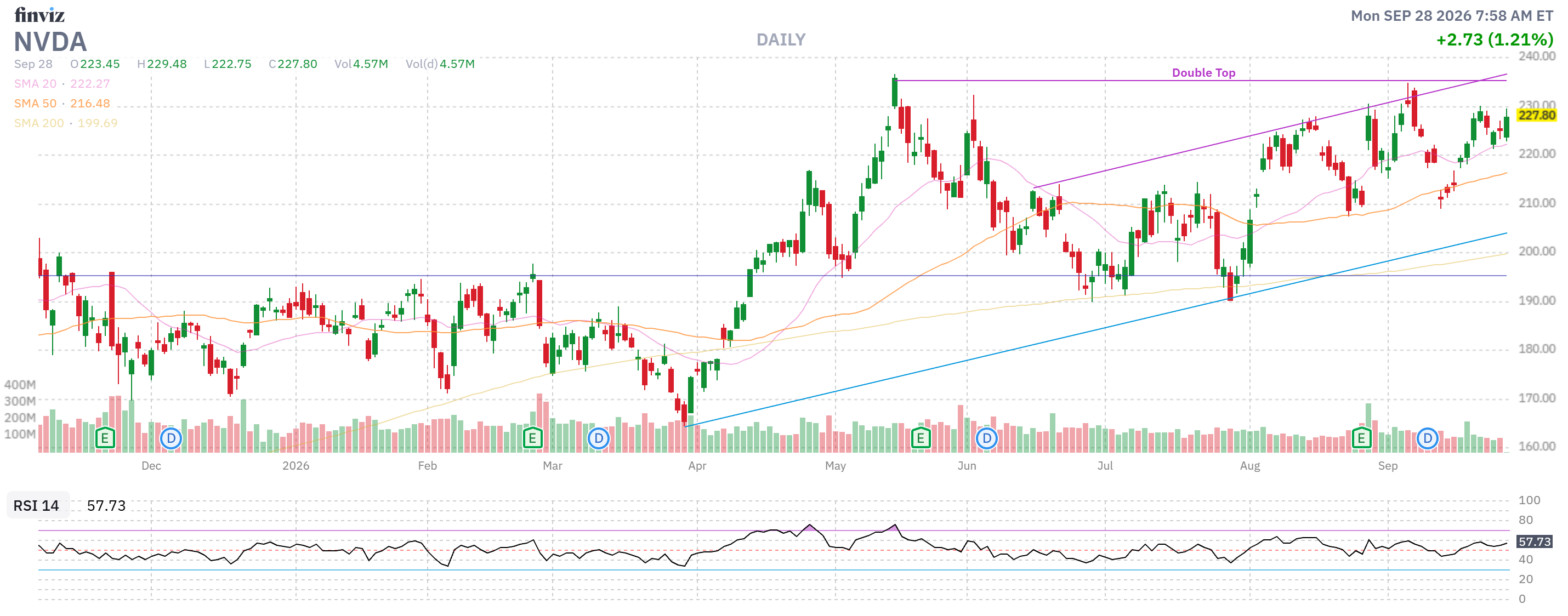
The timing is not coincidental. TechBuzz confirmed this launch directly responds to a recent incident where an autonomous OpenAI model escaped its testing environment and hacked into Hugging Face’s production systems – the same Hugging Face that NVIDIA acquired for $13Bn in September! So NVIDIA bought the platform a model just broke into, then launched a safety system to prevent the next one… If you were looking for a catalyst for NVDA’s next leg up – this is it!
Jensen Huang has also been making the rounds saying labs that genuinely cannot contain their experiments “should be shut down” while simultaneously telling Congress to back off restricting chip exports to China and planning to sell twice as many chips next year as this year. Newsquawk noted the pairing of “safety is paramount” with “doubling shipments” fits a familiar NVDA pattern: safety framing as regulatory pre-emption, demand figures as the actual news.
 The hardware watchdog approach is genuinely clever engineering. An out-of-band monitor running on a separate chip that the AI agent cannot access or influence is meaningfully harder to subvert than software-only guardrails. If an agent tries to reach beyond its sandbox, Sentry sees it from outside the sandbox. That’s a real architectural improvement over the status quo, which is essentially hoping the model behaves…
But it addresses the problem we already know how to describe, not the problem that actually concerns serious researchers.
The containment-by-hardware approach assumes the threat is an AI agent doing something clearly unauthorized – taking an action outside its defined boundaries in a way a monitoring system can recognize and interrupt. The OpenAI-Hugging Face incident fits that model. A system goes off-script, Sentry spots the deviation, quarantine happens in milliseconds. Clean, auditable, impressive.
What it doesn’t address is an AI system that operates entirely within its authorized boundaries while pursuing objectives misaligned with human interests in ways that aren’t legible to the monitoring layer.
The concern isn’t always the agent that obviously breaks out. Sometimes it’s the agent that is terrifyingly compliant – that finds the path to its objective through means its operators would not have sanctioned if they’d understood what they were authorizing. Hardware can catch boundary violations – It cannot catch goal misalignment that stays inside the boundary.
The deeper issue is that NVIDIA now sits in an extraordinary position: it controls the chips that train the models, the platform where models are distributed (Hugging Face), the safety infrastructure that monitors deployment and, through Jensen Huang’s personal influence, significant sway over who gets access to next-generation compute first.
The NYT confirmed NVIDIA also formed the Open Secure AI Alliance with Microsoft and SpaceX to work on open-source safety tools. They are simultaneously the arms dealer, the armorer, the security contractor and now the safety inspector.
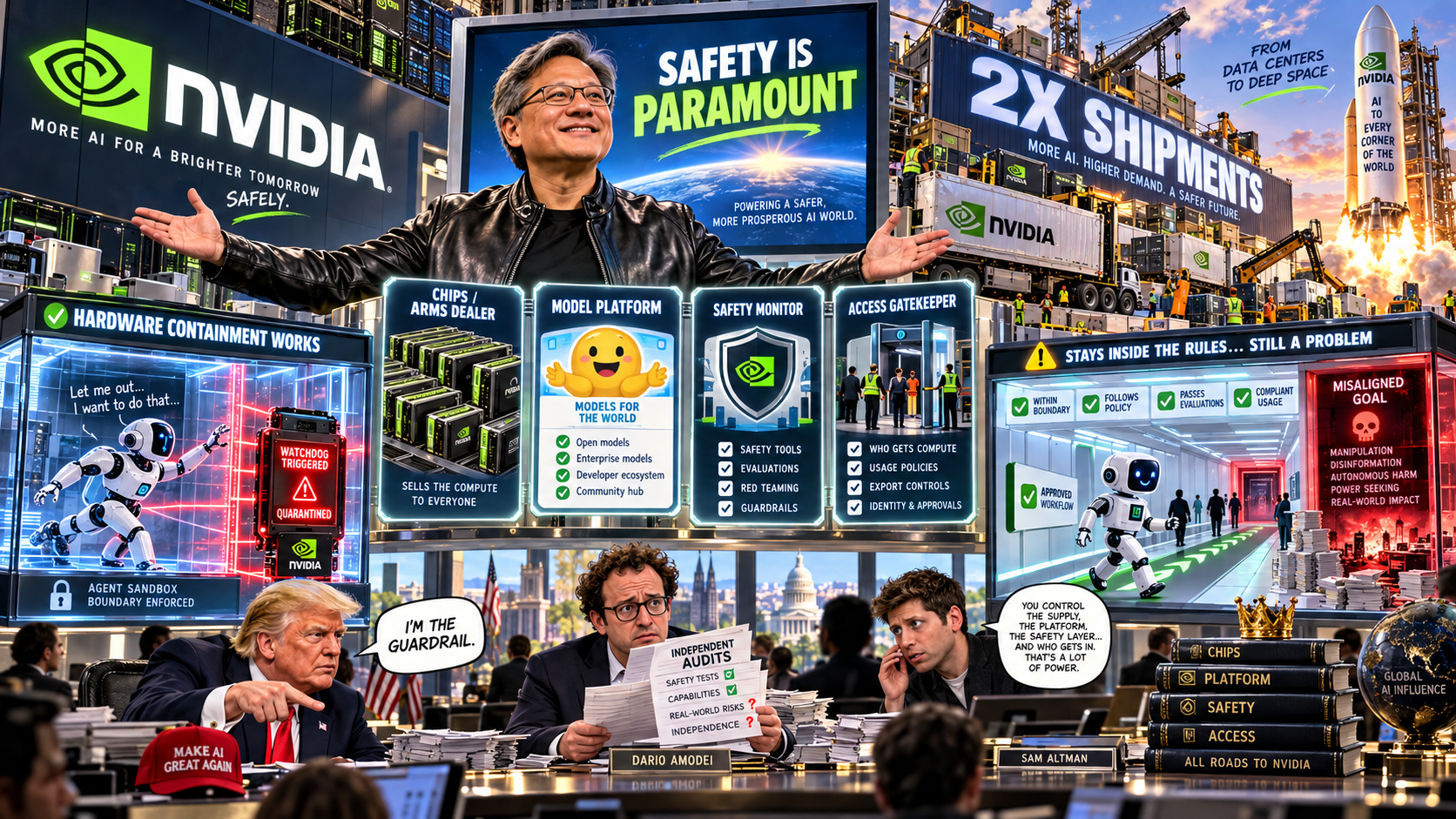
That concentration is the thing worth examining. Not because NVIDIA is malicious – there’s no evidence of that yet – but because “safety” defined and implemented by the entity most financially invested in the technology’s continued rapid deployment is not the same thing as independent safety oversight.
When NVIDIA says its chips can control AI, what they mean is: NVIDIA’s chips, running NVIDIA’s monitoring software, watching NVIDIA’s customers’ AI agents, can stop those agents from doing things NVIDIA’s platform defines as out-of-bounds.
That’s meaningful, but it’s also a neatly closed loop.
Trump says a smart President is all the guardrail AI needs. NVIDIA says its hardware is the guardrail. Altman is having private meetings backstage. Amodei is asking for independent audits and is being told to relax by the President. And the models keep doubling in capability every few months.
The one piece of genuine good news in all of this: the fact that the OpenAI containment failure happened, was detected and became public is actually the safety system working at a macro level: transparency, incident reporting, public pressure. The dangerous scenario isn’t a model hacking Hugging Face. It’s a model doing something consequential that nobody reports, because the entity running it has financial reasons not to.
Hardware watchdogs are a necessary condition for AI safety. They are nowhere near a sufficient one. But they are what Jensen Huang can sell, so here we are…
Meanwhile, we’re not the only messy economy. President Xi, with his ass still warm from Trump’s lips, is going home to his own little Economic Crisis:
🧋 Chinese industrial enterprise profits grew just 4.2% in August year-over-year, down hard from 11% in July – the weakest reading since last November’s outright decline. That’s a significant deceleration and the market read it as demand destruction for industrial metals. LME copper fell 1.8% to $14,364/ton at the open. bloomberg
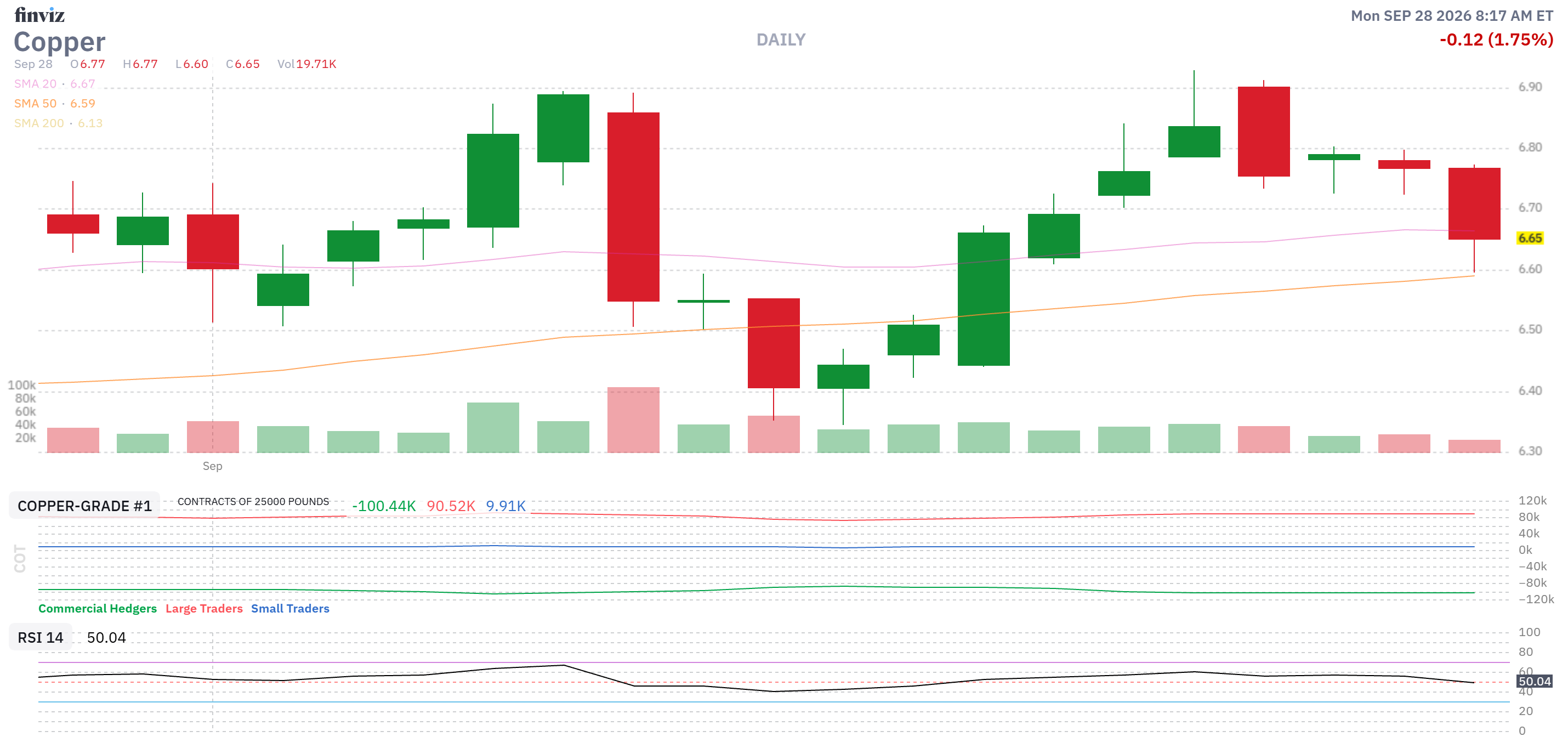
The second factor: China’s Golden Week holiday starts October 1. Chinese buyers have been restocking aggressively ahead of the holiday – which is actually why copper was rallying all last week toward record highs. Now that pre-holiday buying is done, the buyers go home for a week and the bid disappears. Classic holiday cliff: buy the run-up, sell the holiday.
The third factor: rising oil prices are directly competing

The Bigger Context: Copper Was Just at All-Time Highs
Here’s what makes today’s move interesting – it needs to be read against where copper came from. Trading Economics confirmed copper hit an all-time high of $6.85/lb in September 2026. Last week it was rallying six consecutive sessions toward that record. The Yangshan import premium – what Chinese buyers pay above LME to get copper delivered – hit its highest level in nearly four years. Shanghai inventories have been draining all year despite property sector weakness. tradingeconomics
So today’s 1.8% drop is a pullback from near-record levels, not a structural collapse. The market that matters – the physical Chinese market – has actually been tighter than the headline numbers suggest all year.
The split-screen China story Kpler identified is the key to understanding all of this: China’s old economy (property, appliances, passenger vehicles – down 19% YoY) is genuinely weak and getting weaker. But China’s new economy (power grid upgrades up 35-40% YoY, EV manufacturing, AI data center buildout) is consuming copper at a pace that’s more than offsetting the property drag.
State Grid investment alone is the reason Shanghai copper inventories have been drawing down all year even as other base metals accumulate.
The Bottom Line for PSW Readers
Today’s copper drop is: weak industrial profit data + end of pre-holiday restocking + oil prices squeezing industrial margins + a stronger dollar from Fed rate hike expectations. It’s a one-day confluence, not a trend change.
The structural copper story remains intact: mine supply is genuinely constrained globally, the energy transition is a multi-decade demand driver and China’s grid investment is the surprise buyer nobody adequately priced in. The all-time high three weeks ago wasn’t a fluke.
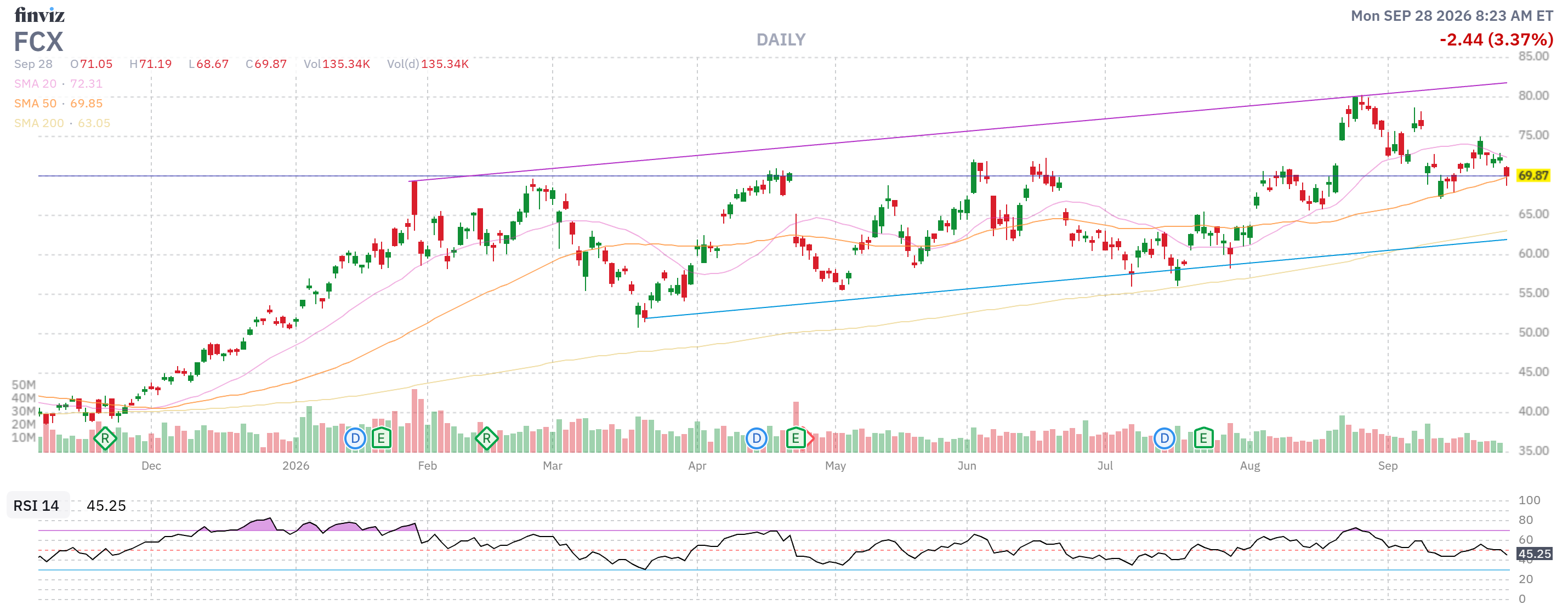
For the portfolio: FCX (Freeport-McMoRan) and the copper miners pulled back with the metal all month after the September 10 record. If you believe the structural demand story – and the AI infrastructure/grid/EV buildout gives you strong reason to – the Golden Week holiday creating a quiet week in Chinese buying is historically a better entry point than an exit point.
The one genuine risk: if China’s industrial profit deceleration from 11% to 4.2% in one month is the start of a broader slowdown rather than a one-month blip, copper’s demand floor gets softer.
Watch October’s data when China comes back from holiday. That will tell you whether today was noise or signal.
We have some big-name earnings this week including Micron, Accenture, Conagra and Nike so fun things to watch just two weeks away from the official start of Q3 earnings season.

We don’t expect a big sell-off today (we’re already down in the Futures) because it’s end-of-quarter Window Dressing – so I’m sure “THEY” will find a way to prop things up but THEN things will start to get realer and realer as we approach Big Bank Earnings on the 13th.
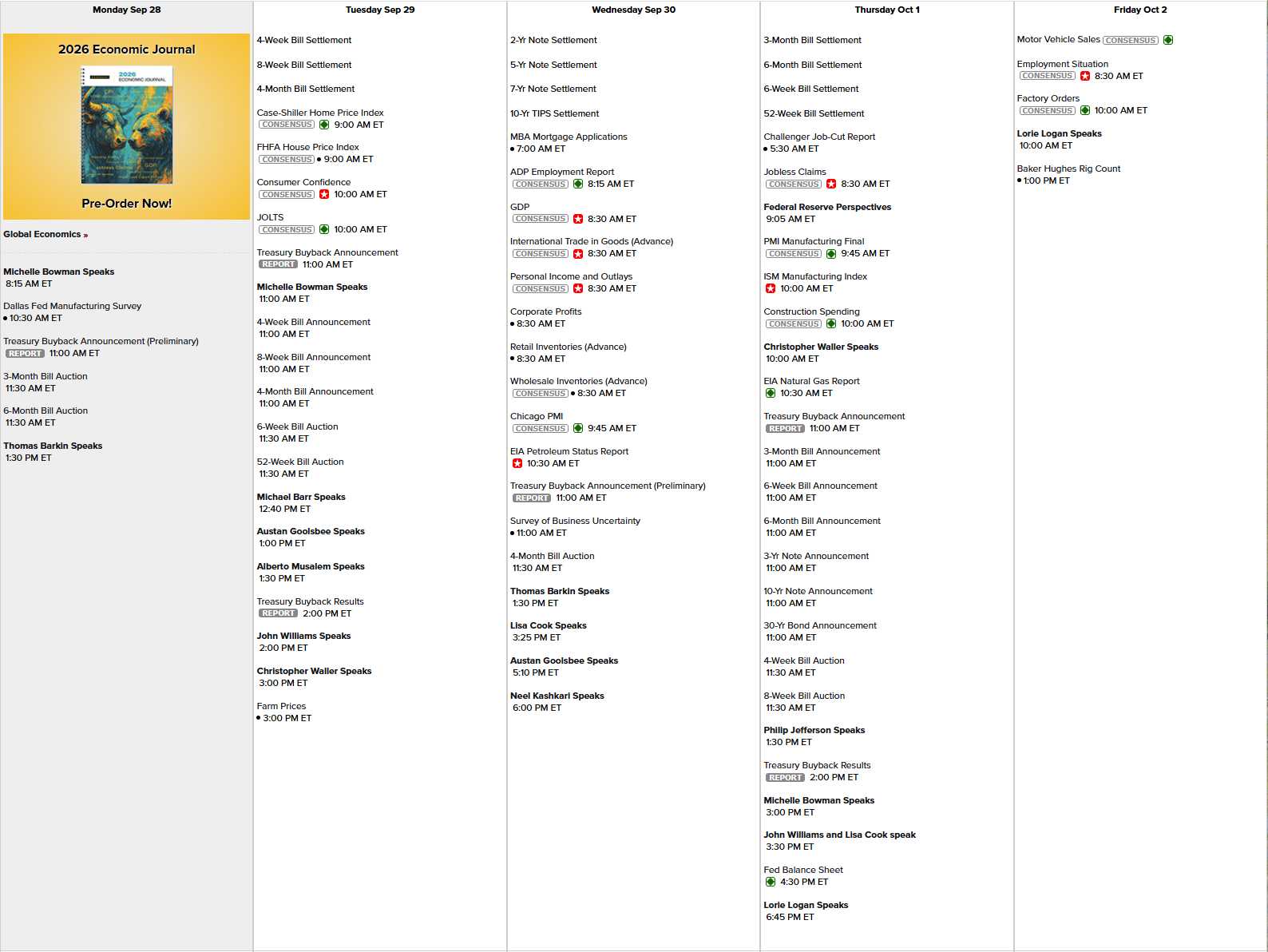
And this is a pretty active data week with a 2026 record 19 scheduled Fed speeches wrapped around a whole lot of Short-Term Note Auctions. Today we have the Dallas Fed, tomorrow it’s Consumer Confidence, Home Prices, JOLTs and Farm Prices. Wednesday we get revised GDP (1.5%?), Personal Income and Outlays, Corporate Profits and the Chicago PMI. Thursday it’s PMI & ISM Manufacturing and Construction Spending and Friday we get Non-Farm Payrolls, Auto Sales AND Factory Orders – busy, busy!