


What if the best trade idea isn’t the one with the boldest forecast, but the one whose thesis, risks, and exit conditions you can explain? With market opinions arriving from every direction, curated trading opportunities can help narrow the field. But a ticker and a confident call aren’t a strategy. The useful question is whether the research gives you enough context to judge the setup for yourself.
Look beyond the headline: What could move the trade? What would weaken the thesis? Does the risk fit your goals, time horizon, and tolerance for losses? In this guide, you’ll find a repeatable framework for evaluating trade ideas, distinguishing context-rich analysis from bare ticker suggestions, and maintaining a manageable watchlist without handing over your independent judgment. We’ll also look at how ongoing market commentary and discussion can support that process, and what to consider when deciding whether a research membership belongs in your routine. Ideas are prompts for analysis, not promises of returns.
Key Takeaways
- Curated trading opportunities are research prompts, not automatic instructions to trade. Learn what separates useful context from a ticker tip or signal.
- Use a five-step checklist to examine context, thesis, catalyst, downside, and whether an idea suits your approach.
- Compare curated research with news feeds, social tips, and automated signals to understand the trade-offs in transparency and reader involvement.
- Build a review routine that records your assumptions and time horizon, then identifies what would make you reassess.
- See how Phil Stock World’s commentary, research, and discussion can support your independent evaluation of market ideas.
What Are Curated Trading Opportunities, and What Are They Not?
Curation means selecting and explaining market ideas so readers can assess their relevance. It does not mean predicting which trades will succeed. Curated trading opportunities should give you a reason to pay attention to a security or market development, along with enough context to investigate the idea. They are research prompts, not automatic instructions to buy or sell.
That distinction matters in a crowded information stream. A curated idea is more than a ticker beside a confident headline, but it’s also different from an algorithmic signal that produces an entry or exit alert. A directory of trading tools or educational resources may help you find materials, but it doesn’t necessarily assess a timely market setup. Editorial research connects an idea to a thesis and relevant market conditions while leaving the decision-making with you.
How a researched opportunity differs from a stock tip
A researched opportunity gives you something to examine. It may explain the underlying thesis, identify market context that could support or challenge it, and outline decision points to monitor. For example, a note about a company approaching an earnings announcement could explain why the event matters, including relevant expectations or industry conditions, and what new information might weaken the case. The purpose isn’t to declare a winner. It’s to make the reasoning visible.
A ticker alone tells you little. Without an explanation, you can’t tell whether the idea is based on company fundamentals, a broader market trend, a technical setup, or simply someone’s opinion. You also have no clear starting point for testing the claim or deciding what would change your mind. Background on Understanding Market Trends can help clarify how traders think about broader price movements, but no single trend settles whether a particular trade fits your circumstances.
Good research supports independent assessment; it doesn’t replace it. You still need to consider your objectives, time horizon, existing positions, and tolerance for risk. An idea that makes sense in a discussion may not suit your approach.
What curation can, and cannot, do for an investor
Selection can help focus your attention. Instead of treating every headline, chart, and social post as equally urgent, start with a smaller set of questions: What is the thesis? What information matters next? What evidence would undermine the idea? This structure can make research time more purposeful and help distinguish a reasoned argument from noise.
But a shorter list isn’t a safer list by definition. Markets remain uncertain, prices can move sharply, and a well-supported thesis can still be wrong. Research access does not predict future performance or remove the possibility of losses. Think of curation as a map of questions worth investigating, not a forecast or a shortcut around judgment. Its value lies in giving you context to scrutinize, then letting you decide whether the idea belongs in your process.
How to Evaluate a Curated Trading Opportunity Before Acting
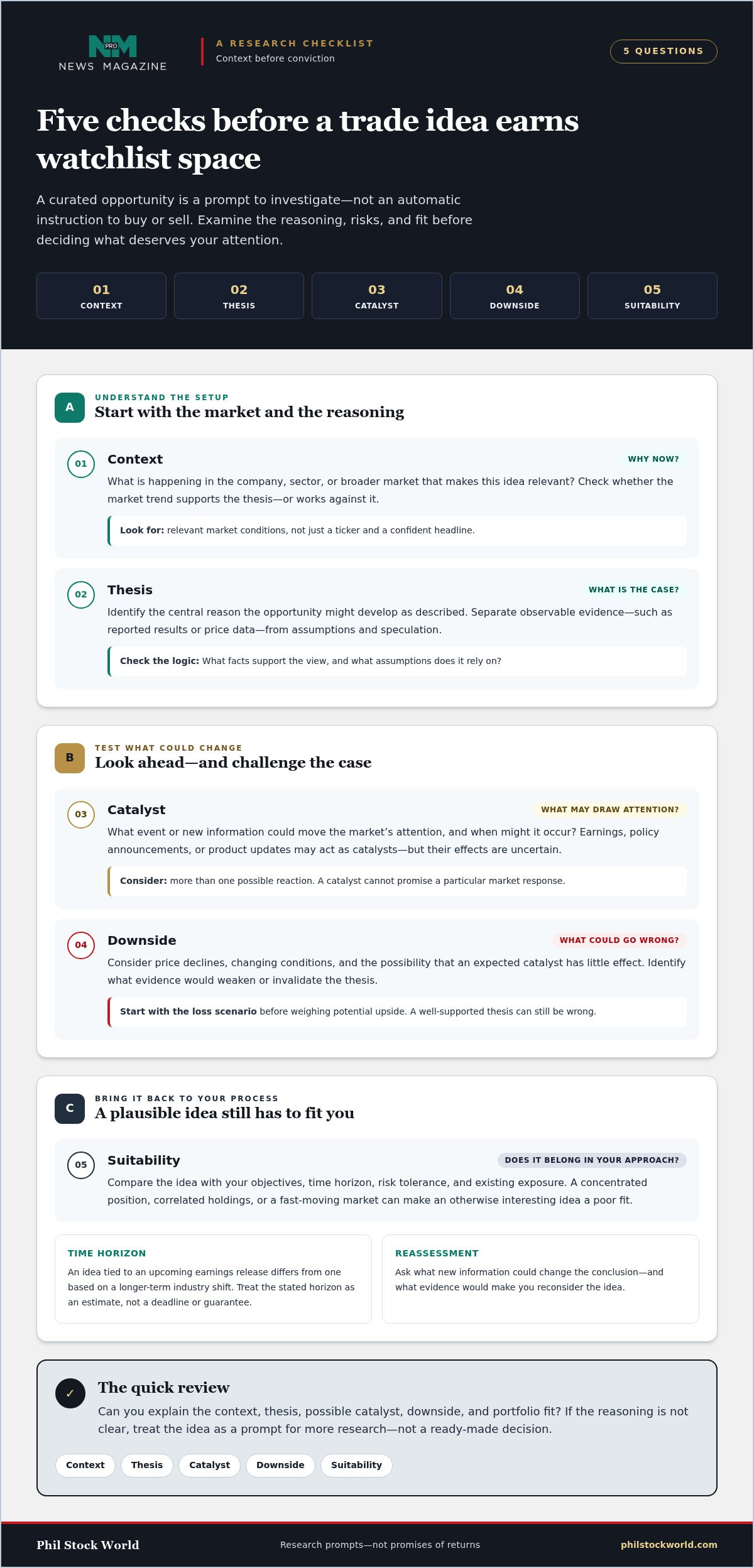
A strong idea should withstand a few pointed questions before it earns space on your watchlist. Check the market backdrop, the logic behind the thesis, what might change the picture, how much you could lose, and whether the idea fits your approach. A catalyst can draw attention to a setup, but it can’t promise a particular market reaction.
In short: assess context, thesis, catalyst, downside, and suitability before deciding whether an idea deserves further consideration.
- Context: What’s happening in the company, sector, or broader market that makes this idea relevant now? Consider whether the market trend supports the thesis or works against it.
- Thesis: What’s the central reason the opportunity might develop as described? Separate observable evidence, such as reported results or price data, from assumptions and speculation.
- Catalyst: What event or new information could move the market’s attention, and when might it occur? Earnings, policy announcements, or product updates may act as catalysts, but their effects are uncertain. Consider more than one possible reaction.
- Downside: What could go wrong, and what evidence would weaken or invalidate the thesis? Consider price declines, changing conditions, and the possibility that the expected catalyst has little effect before weighing potential upside.
- Suitability: Does the idea fit your objectives, time horizon, risk tolerance, and existing exposure? A plausible thesis still may not belong in your portfolio.
Read the thesis, time horizon, and evidence together
A thesis needs a timeframe. An idea tied to an upcoming earnings release differs from one based on a longer-term shift in an industry, so check whether the analysis explains when its reasoning may play out. Treat that horizon as an estimate, not a deadline or guarantee. Then ask what facts support the view, which assumptions it relies on, and what new information could change the conclusion.
For example, a hypothetical company may look attractive because demand appears to be improving. Does the analysis point to evidence for that shift, or assume recent momentum will continue? That distinction helps you test the argument rather than simply inherit its confidence.
Examine downside and portfolio fit
Start with the loss scenario. A concentrated position, correlated holdings, or a fast-moving market can make an otherwise interesting idea a poor fit. This isn’t about applying a universal position size. It’s about understanding how the risk could interact with the rest of your portfolio and your ability to tolerate a setback. Options have their own mechanics and risks, so readers exploring them can build separate knowledge through advanced option trading strategies.
Use the checklist as a pause button, not a trading signal. Phil Stock World’s ongoing market commentary and analysis can provide context to examine. The decision to act remains yours.
Curated Ideas, News Feeds, and Trading Signals: What Should You Compare?
Different sources serve different workflows. A broad news feed can help you monitor events, social posts can surface ideas quickly, automated signals can apply defined rules, and editorial research can connect a selected idea to its market context. The useful comparison isn’t simply which format sends the most alerts. Consider how much reasoning you can see, how often information changes, and what judgment the format expects from you.
An idea’s usefulness depends on transparent reasoning and clear risk context, not on how quickly or frequently it arrives. Use the comparison below to match a source to the questions you need answered.
| Format | Context | Transparency | Update cadence | Educational value | Your role |
|---|---|---|---|---|---|
| Curated research | Selected ideas with relevant market or company background | Reasoning may be explained; assess what evidence supports it | Varies by publication and market developments | Can show how a thesis is formed and reviewed | Evaluate fit, risk, and whether conditions have changed |
| Unfiltered news feed | Wide coverage of headlines and events | Reports events, but may not explain their trade implications | Often frequent as stories develop | Can build awareness of events and themes | Decide which stories matter and verify their relevance |
| Social-media tips | May focus on a single ticker, trend, or personal view | Assumptions and evidence can be hard to assess | Depends on the poster | Varies; a short tip may offer little explanation | Check claims, timing, incentives, and downside independently |
| Automated signals | Generated from programmed rules or indicators | Depends on how clearly the rules and limitations are described | May produce alerts when specified conditions occur | Can illustrate rule-based approaches, but may explain little about broader context | Understand the signal’s limits and decide how, or whether, to use it |
Research-led curation versus an endless stream of market headlines
A feed prioritizes breadth: it can expose you to developing stories across companies and markets. The trade-off is that headlines don’t necessarily answer the next question: why might this matter to a particular thesis? Research-led curation narrows the field and adds interpretation, but no selection process captures every relevant development. With either format, verify important claims and account for conditions that may have shifted since publication.
Editorial ideas versus automated signals and social-media tips
Editorial analysis uses human judgment to frame evidence and explain a point of view. An automated signal applies programmed conditions, which may make its trigger more systematic, but doesn’t automatically reveal why the setup matters or when its assumptions may fail. A social tip can be a useful prompt, yet leave out timing, evidence, or a downside scenario. None of these formats is inherently superior for every reader or task.
More alerts don’t necessarily produce better decisions. A busy feed can create pressure to react, while a signal can appear precise without answering whether it suits your objectives. Curated trading opportunities can organize your research queue, but your process still needs to distinguish a fresh alert from a genuinely useful reason to investigate. Compare a source’s context, transparency, cadence, and educational value with the work you’re prepared to do yourself.
Build a Repeatable Routine for Reviewing Trading Opportunities
A consistent review habit turns market ideas into something you can examine over time, rather than a string of headlines you may forget by tomorrow. Keep research and execution separate: an article or commentary can prompt questions, but it shouldn’t become an automatic order. First write down what you think the idea is saying, what evidence supports it, and what could change your view.
For curated trading opportunities, a short written record can also reduce hindsight bias. You’ll have a snapshot of what you knew and assumed at the time, making it easier to assess your reasoning later, whether or not the market moved in your favor.
Create a simple opportunity review note
Keep the format light enough to use consistently. A note doesn’t need to predict every market turn. It needs to preserve the logic behind your assessment and give you a clear place to revisit it.
- Date and source: Record when you reviewed the idea and where it came from.
- Thesis and evidence: Summarize the central argument and the information that supports it.
- Assumptions and uncertainties: Identify what the analysis takes for granted and what remains unknown.
- Time horizon: Note the period the idea appears to address, treating it as an estimate rather than a deadline.
- Reasons to reassess: Write down developments that could strengthen, weaken, or invalidate your view. These depend on the idea, so avoid forcing a universal price level or trigger onto every situation.
Keep each entry concise. A few clear sentences are often more useful than a sprawling diary that’s hard to maintain. When new information arrives, add a dated update instead of rewriting the original note. That preserves the trail of your thinking.
Review decisions without hindsight bias
Revisit notes on a schedule that suits your process, and compare your original reasoning with what happened afterward. Did the evidence change? Did an assumption prove shaky? Did you overlook a risk, or did an unexpected event alter the picture? The goal is to learn from the decision, not to grade it only by the final price movement.
A sound process can still lead to an unlucky short-term outcome, just as a weak rationale can get a lucky result. Separate those two. Look for patterns in the questions you ask, the assumptions you make, and the information you tend to miss. Use those observations to refine your next review, not as a promise of improved returns.
Readers who want a structured look at portfolio decisions can explore Phil Stock World’s virtual portfolio review as a related way to examine strategy. To put your review routine into practice alongside ongoing market research and discussion, explore Phil Stock World membership.
How Phil Stock World Helps Readers Explore Curated Trading Opportunities
Once you have a way to question a trade idea, the next step is finding research that gives you something meaningful to examine. Phil Stock World provides daily stock and options commentary, trading ideas, and market analysis to help readers follow developments and consider how they relate to a thesis. The aim is context and education, not a promise that an idea will work.
Membership access varies by tier, with options ranging from daily commentary to real-time interactive sessions. Members can also access research and discussion, with specific access depending on the tier. The right fit depends on how much market material you can realistically review and whether you value a more interactive way to discuss ideas. Review the membership options to see how the different levels of access fit your routine.
From market commentary to an informed independent decision
Commentary can help frame what’s moving markets, why a company or sector is drawing attention, and which questions may deserve a closer look. Discussion adds another dimension: it gives readers a way to consider different interpretations of the same market conditions rather than treating a single viewpoint as the final word. Used thoughtfully, these resources can support your research routine and help you keep a thesis connected to a changing market backdrop.
That’s the role of curated trading opportunities in a sound process: they can point toward ideas worth investigating, but you remain responsible for deciding what, if anything, to do. General commentary and research aren’t individualized investment advice, and no research format can remove uncertainty or guarantee a result. Keep applying your own criteria for risk, time horizon, and portfolio fit.
Phil Stock World also offers educational webinars and virtual portfolio reviews. These resources can help readers explore market concepts and review their strategy. They complement the research process but don’t make decisions on your behalf or provide personalized financial planning.
Choose the level of research and participation that fits your routine
Before joining, think about your actual habits. Do you want a regular stream of commentary to follow, or would you use research, community discussion, and interactive sessions? A membership is most useful when its level of access fits the time you have to read, reflect, and revisit ideas. A large volume of material isn’t automatically an advantage if it crowds out careful review.
Compare the membership options with your preferred pace of research and participation, then decide whether that structure supports your independent process. Visit Phil Stock World to explore the research and educational resources available and review membership options. The goal is not to outsource judgment. It’s to make your own evaluation better informed.
Make Your Next Market Review More Intentional
Your next step doesn’t have to be placing a trade. Choose one idea you’re considering and use it to sharpen your research routine: write down what you believe, what could change your view, and when you’ll revisit the evidence. That habit can help turn a flood of market commentary into a more deliberate practice while keeping every decision your own.
For readers who want continuing perspective, Phil Stock World offers daily market commentary, educational resources, and member discussion. Founded and led by trader and market analyst Phil Davis, it’s a place to explore market ideas and develop your understanding, not a promise of trading results.
See whether the research and level of participation fit the way you like to follow markets. Explore Phil Stock World membership and take the next step at your own pace. With a clear process and curiosity intact, you can approach new opportunities with greater focus.
Frequently Asked Questions
What are curated trading opportunities?
They’re market ideas selected for further attention and presented with information that helps readers understand why they may matter. For example, a company’s upcoming earnings could be highlighted alongside the business development or market theme behind the interest. That differs from a directory of investing resources, which organizes materials but may not discuss a current setup. Treat the idea as a starting point for your own research, not a ready-made decision.
Are curated trading opportunities a guarantee of profit?
No. Curated trading opportunities can lose value, even when the underlying analysis is thoughtful and the expected event occurs. A company might report strong results, for instance, but its share price could still fall if investors expected more or broader market conditions turn negative. Consider what could go wrong before acting, and never assume that a confident tone, detailed research, or past success makes a future result certain.
How can I tell if a trading opportunity is worth researching?
Look for a clear reason the idea is relevant and enough detail to check its key claims. If a note refers to a company announcement, find the original announcement and see whether it supports the interpretation. Then ask what information you still need, such as the company’s recent results or the event timeline. If you can’t explain why the idea matters in your own words, it may need more research before it earns your attention.
Are curated trading ideas the same as trade alerts?
Not necessarily. An alert often signals that a condition has occurred or that an analyst has flagged a development; it may be brief and time-sensitive. A curated idea may provide more explanation, but formats vary. Before treating any alert as meaningful, check what prompted it, when the information was issued, and whether the conditions still apply. A notification is a cue to review, not an instruction to place an order.
Can beginners use curated trading opportunities?
Yes, beginners can use them as learning material, provided they pause to understand unfamiliar terms and risks. If an idea mentions options, for example, learn how the contract works before considering its implications. Start by summarizing the rationale in plain language and noting what you don’t yet understand. Educational resources can build familiarity, but reading an idea doesn’t by itself establish that a trade is suitable for you.
How often should I review a curated trading idea?
Review it when meaningful new information arrives and in line with the idea’s stated time horizon, rather than following a fixed schedule for every setup. A company announcement, revised outlook, or major change in market conditions may make an earlier assessment stale. For a longer-term thesis, constant checking can add noise; for a time-sensitive event, waiting too long may leave you working from outdated assumptions. Keep the source date visible in your notes.
Do curated trading opportunities replace financial advice?
No. General market commentary and trading research are educational resources, not guidance tailored to your complete financial circumstances. They don’t account for every personal factor, such as income needs, tax situation, or other obligations. Use research to inform questions and build market understanding, but don’t treat it as a personal recommendation. If you need advice based on your individual circumstances, seek guidance from a qualified financial professional.