


What makes a trading strategy workshop useful isn’t the boldness of its market calls, but whether it teaches you to make decisions when a setup gets complicated. A polished pitch can promise confidence while skipping the hard parts: what to analyze, when to enter, how to manage a trade, and what to do when the thesis no longer holds. Trading strategy workshops should teach a repeatable process, not promise easy wins.
It can be difficult to separate practical instruction from generic commentary. The right fit depends on your experience, the markets or strategies you want to study, and whether you learn best through live discussion, focused webinars, or resources you can revisit. This guide explains how to assess a workshop’s curriculum, look for meaningful practice and feedback, and evaluate its coverage of position sizing, risk, and trade management. You’ll have a clearer framework for comparing formats and deciding whether an educational opportunity can help you think more independently.
Key Takeaways
- Trading strategy workshops are most useful when they explain the reasoning behind a method, not just the signals it produces.
- Assess a workshop’s curriculum by checking its learning objectives, examples, practice, and coverage of risk.
- Compare workshops, webinars, trading rooms, and self-paced resources by how you learn best and how much interaction you need.
- Evaluate claims with a practical checklist, and remember that education can’t remove market uncertainty or guarantee profits.
- Ongoing commentary, strategy guides, webinars, and portfolio reviews can help you revisit your assumptions as market conditions change.
What should a trading strategy workshop help you learn?
A trading strategy workshop should teach you how to think through a trade, not hand you a confident-sounding call and leave you to guess what happens next. It offers structured instruction in a method: identifying a potential setup, assessing market context, planning an entry, defining risk, and reviewing the decision afterward. The aim is a process you can examine and practice, not a shortcut to a particular result.
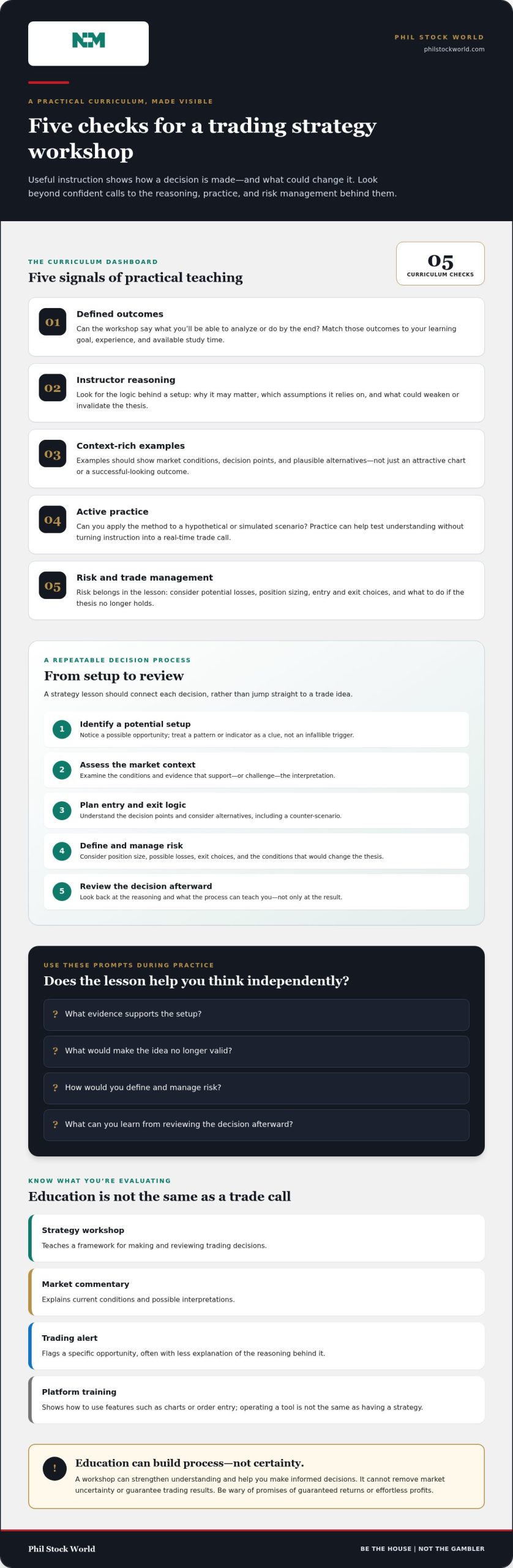
A strategy workshop teaches a framework for making and reviewing trading decisions; a trade recommendation tells you what someone else thinks you should buy or sell. Keep that distinction in mind. Market commentary explains current conditions and possible interpretations. A trading alert flags a specific opportunity, often with less explanation of the reasoning behind it. Platform training shows you how to use features such as charts or order entry, but knowing how to operate a tool isn’t the same as having a strategy.
Good instruction connects the pieces. A chart pattern or indicator can be one clue, not an infallible trigger. A useful session explores why a setup might matter, what could invalidate the thesis, and how risk fits into the decision. For a grounding in the range of types of trading strategies, consider how approaches differ in their time horizons, methods, and assumptions. The workshop should make its chosen approach understandable, rather than present it as a universal answer.
Which learning goals make a workshop useful?
Start with a question you want to answer. Are you trying to recognize a setup, plan entries and exits, understand a strategy’s logic, or improve how you review decisions? Trading strategy workshops are easier to assess when their stated outcomes match your goal, experience, and available study time. Learning a method means understanding how to apply and question it. It isn’t the same as being told to place a specific trade.
Who benefits from structured trading education?
Beginners can use structured lessons to organize what they’re learning, but a workshop shouldn’t be mistaken for a replacement for foundational market knowledge. Experienced investors may prefer a focused session that challenges familiar habits or sharpens how they build and review a thesis. Match the examples and vocabulary to your interests: stock analysis and options strategies involve different concepts, mechanics, and risks.
Before signing up for an educational format, check whether you’ll work through decisions, not just listen to conclusions. A useful workshop might ask you to consider:
- What evidence supports the setup?
- What would make the idea no longer valid?
- How would you define and manage risk?
- What can you learn from reviewing the decision afterward?
Education can strengthen your process and understanding. It can’t remove uncertainty from markets or guarantee trading results. The distinction is between learning to make your own informed decisions and relying on someone else’s confidence.
How to judge a trading strategy workshop’s curriculum and teaching
A polished presentation can make almost any strategy sound convincing. The real test is whether the instructor shows how they reached a conclusion, what could prove it wrong, and how risk shapes the decision. Trading strategy workshops should make that reasoning visible, not just showcase attractive charts or successful-looking examples.
A useful curriculum sets clear learning objectives and connects them to explanation, examples, practice, and review. Look for:
- Defined outcomes: What will you be able to analyze or do by the end?
- Instructor reasoning: Does the teacher explain why a setup matters and what assumptions it relies on?
- Context-rich examples: Do examples show market conditions, decision points, and plausible alternatives?
- Active practice: Can you apply the method to hypothetical or simulated scenarios?
- Risk and trade management: Are potential losses, position sizing, and exit considerations part of the lesson?
A complete strategy lesson connects market context, a testable thesis, entry and exit logic, risk controls, and a review of what could change the decision. Use that as a standard when comparing a detailed curriculum with a list of trade ideas. Charts and market analysis can provide evidence, but they don’t make the decision for you. A moving average, for example, may help illustrate a trend. The instructor should still explain why the signal matters in context and what would weaken that interpretation.
Does the curriculum explain the reasoning behind trades?
Look for a step-by-step walkthrough: what the instructor observes, how those observations support a thesis, and which conditions would change it. A useful example considers both a potential entry and a counter-scenario, such as a price move that undermines the original idea. If the lesson jumps straight to a trade without explaining its logic, it’s hard to learn how to evaluate the next one independently.
Are practice and risk part of the instruction?
Look for exercises that ask you to consider position size, possible losses, and exit choices before deciding whether an example fits the method. Practice doesn’t need to involve live trading; hypothetical cases can help you test your understanding without confusing instruction with a real-time call. Be wary of promises of guaranteed returns or effortless profits. The SEC’s Investor.gov for financial education offers educational information and tools, including resources for checking investment professionals when relevant.
As a follow-up, compare what you learn in a workshop with ongoing market commentary and strategy analysis. Revisiting an idea as conditions shift can help you assess whether its assumptions still hold, rather than treating one example as a permanent rule.
Trading workshops, webinars, and live rooms: which format fits?
The best learning format depends on what you need to do next. Want a guided sequence that builds one idea from the ground up? A workshop may fit. Need a focused overview or a place to ask a timely question? A webinar may be a better match. Trading strategy workshops are one part of the education toolkit, so compare how each format supports your learning habits instead of assuming one is always best.
| Format | Interaction | Structure | Replay or reference value | Learning pace |
|---|---|---|---|---|
| Workshop | Often includes discussion or exercises | Sequenced around a focused skill or topic | Depends on whether materials are available afterward | Guided, with room to work through examples |
| Webinar | May include questions and discussion | Usually centers on a presentation or topic | A recording or slides can support later review | Set by the session schedule |
| Trading room | Live discussion can invite questions | Follows ongoing market activity | May be less convenient as a reference unless sessions are recorded | Fast-moving and tied to current conditions |
| Self-paced guide | Typically limited or absent | Organized for independent study | Easy to revisit and use as a reference | Reader-controlled |
| Market commentary | Varies by format | Interprets current developments | Written analysis can be revisited | Read at your own pace, often alongside market events |
When is a workshop more useful than a webinar?
A workshop suits learners who want to stay with one subject long enough to examine its moving parts, apply a method, and connect the steps. A webinar can work well for a shorter topic overview, a presentation, or discussion of current market conditions. Live access may let you ask questions; recorded materials, when available, make explanations easier to revisit. Neither format guarantees better decisions. Its value depends on how well the content meets your goal and how actively you engage with it.
When can ongoing commentary or interactive sessions help?
Recurring analysis can show how a strategy concept meets changing market conditions. For example, revisiting a market thesis across sessions can help you notice which assumptions remain useful and which deserve another look. Phil Stock World offers daily commentary, educational webinars, strategy guides, and virtual portfolio reviews, giving learners complementary ways to study analysis and revisit ideas.
Interactive education can support discussion and learning, but it’s distinct from individualized portfolio management. A session that explains how an analyst interprets a market question is not the same as someone managing assets or making personal decisions on your behalf. For a broader perspective on financial learning, the National Endowment for Financial Education offers educational resources. You can also explore trading webinars for investors as a related topic.
How to evaluate workshop claims, risk coverage, and personal fit
A persuasive workshop page can make a strategy sound tidy. Markets rarely are. Before committing your time, look past polished language and assess what the learning experience actually covers. Trading strategy workshops should help you build a more deliberate process, not suggest that uncertainty can be switched off.
- Define your goal. Decide what you want to understand or practice, such as evaluating a stock setup or learning how an options strategy works.
- Inspect the curriculum. Match the stated learning outcomes to the actual topics, examples, and activities.
- Assess the risk coverage. Look for discussion of potential losses, position sizing, exit decisions, and what could invalidate a trade thesis.
- Compare the format. Consider whether the pace, interaction, and time commitment fit the way you learn.
- Review the claims. Look for transparent explanations of the method and its assumptions, not promises about results.
Here’s the key point: no workshop can remove market uncertainty or ensure profits. Risk education matters as much as entry signals. If a course focuses heavily on when to enter but leaves downside scenarios and trade management in the shadows, the picture is incomplete. A sound lesson should discuss what might go wrong, not only what looks good in hindsight.
What are credible workshop claims, and what deserves skepticism?
Trust substance over swagger. A clear explanation of a strategy’s logic, assumptions, and possible losses gives you something to assess. Guaranteed outcomes, pressure to act immediately, or exceptional success stories without meaningful context deserve caution. Also distinguish education from individualized financial advice or trade execution: an example used to explain a concept isn’t automatically a recommendation for your portfolio.
How can you assess fit before committing?
Check that the learning goals suit your experience and interests. A beginner may need clear definitions and a steady introduction; an experienced investor may want a focused examination of a specific decision process. Make sure the examples address stocks, options, or the mix you want to study, since the instruments use different mechanics and vocabulary. Be realistic about the time involved, too: a fast-paced live session and a guide you can revisit ask different things of you.
Set your own measure of success before the session begins. It might be explaining a strategy’s assumptions, identifying a risk you previously overlooked, or using a consistent review process. These are learning outcomes you can evaluate without treating short-term trading results as a report card. For ongoing market analysis and educational resources to support continued study, explore Phil Stock World’s market education.
Continue learning with Phil Stock World’s market education
A focused workshop can introduce a framework; continued study helps you see how it holds up as market conditions shift. Phil Stock World brings together daily stock and options commentary, educational webinars, strategy guides, market charts, and virtual portfolio reviews. These resources offer different ways to revisit an idea, follow its assumptions, and sharpen your research routine.
How can market commentary extend a workshop lesson?
Take a concept from a workshop, such as forming a market thesis, and compare it with current analysis. What evidence supports the view? What has changed? Which assumptions still look reasonable, and which might need another look? Commentary can provide context for those questions without turning an educational framework into a command to make a specific trade.
Charts and sector insights can add another layer. They can help you observe price behavior, compare activity across industries, or consider how a broader market move relates to an individual stock. A chart isn’t an answer key. Use market information as evidence, then decide what it does and doesn’t support. To build that skill, consult a guide to reading market charts as you practice interpreting chart details alongside a broader thesis.
What can ongoing education add after a focused session?
Webinars let you return to a subject through a focused presentation or discussion, while strategy guides offer material to revisit at your own pace. Together, they can help you turn a workshop takeaway into a repeatable research habit: state the question, gather relevant information, form a thesis, consider risk, and review what changes over time. Trading strategy workshops can provide a starting point, while ongoing analysis gives you opportunities to test your understanding against fresh market context.
A virtual portfolio review offers another educational lens. It can help you examine portfolio decisions, consider how your reasoning fits together, and identify questions worth researching further. For a deeper look at this format, explore a virtual portfolio review guide. This kind of review supports learning and analysis; it isn’t direct asset management or a substitute for making your own decisions.
Phil Stock World’s Premium Membership provides different levels of commentary, research, and interactive trading sessions, supporting learning beyond a single session. Its educational resources inform independent research; the company does not provide brokerage services or manage assets on your behalf.
Continue building your process with Phil Stock World’s market analysis, webinars, strategy guides, and portfolio review resources. Choose the format that helps you ask better questions, examine your assumptions, and make more informed decisions.
Make your next learning step count
Let your next move be guided by a question you want to answer, not pressure to find a perfect strategy. A useful learning goal might be explaining your reasoning more clearly, spotting which assumptions need testing, or reviewing a decision with greater discipline. Trading strategy workshops can open that door, but the lasting value comes from continuing to learn and apply what you’ve studied.
Phil Stock World, founded and led by veteran trader and market analyst Phil Davis, offers ways to continue that work through webinars, virtual portfolio reviews, and strategy guides. Membership tiers provide different levels of analysis and interactive access, so you can explore an ongoing learning format that suits your interests.
Explore Phil Stock World membership and educational resources, then choose one idea to study and one question to carry into your next market review. Progress starts with curiosity and a process you can keep refining.
Frequently Asked Questions
Can a trading strategy workshop guarantee profitable trades?
No. A workshop can explain analytical tools and decision-making methods, but it can’t control market movements or remove the possibility of loss. Results depend on factors such as changing conditions, execution, and how a trader applies what they learn. Treat promises of certain profits as a warning sign. A more realistic measure of value is whether you leave better able to examine an idea and identify what could go wrong.
Do I need trading experience before joining a workshop?
Not always, but some basic market familiarity can make lessons easier to follow. If terms such as shares, order types, and market prices are new to you, learn those foundations first or look for instruction that starts at an introductory level. More experienced investors may benefit from sessions focused on a particular method. Compare the stated prerequisites with your current knowledge so the pace feels useful, not overwhelming.
How should I prepare for a trading strategy workshop?
Write down what you want to understand and bring a few specific questions. For instance, ask how an instructor distinguishes a valid setup from a similar-looking one that lacks supporting evidence. Review any suggested introductory materials, and have a notebook ready to capture unfamiliar terms and follow-up questions. Avoid sharing account passwords or sensitive financial information in a learning session. Arriving with a clear objective helps you focus on the material.
Are online trading workshops as useful as in-person classes?
Either format can be useful; the teaching design matters more than the room or screen. An online session may work well if it includes clear visuals, a way to ask questions, and materials you can revisit. In-person classes can make discussion feel more immediate, but they still need strong instruction and relevant examples. Consider your schedule, comfort with online tools, and preference for live discussion. A format that keeps you engaged is more likely to support learning.
Can I use a workshop to learn options strategies?
Yes, if the workshop is designed to teach options rather than assume you already know them. Look for coverage of calls and puts, strike prices, expiration, premiums, and how a strategy’s payoff may change under different market conditions. For example, check whether an explanation covers both the intended outcome and the risks if the underlying stock moves differently than expected. Options have distinct mechanics, so make sure the lesson matches your experience and learning goals.
How can I tell whether I learned something useful from a workshop?
Try explaining the method in your own words without relying on the instructor’s slides. Then apply it to a new hypothetical example: What evidence would you examine, what assumptions are you making, and what could change your view? If you can answer those questions more clearly than before, that’s a meaningful learning outcome. You can also keep a short learning log of questions, concepts to review, and decisions you’d analyze differently next time.
Do trading workshops replace a broker or financial adviser?
No. A workshop is educational, not a brokerage service for executing trades or personalized financial planning tailored to your full circumstances. Phil Stock World offers market commentary, research, educational resources, and virtual portfolio reviews, but it doesn’t provide brokerage services or direct asset management. Keep those roles distinct: education can help you understand decisions, while trading access and advice suited to your circumstances are separate needs.

