


A strong investment idea can still be a poor fit for a portfolio. An expert review of investment holdings looks beyond individual picks to assess the investor’s expertise, fund and non-fund positions, asset allocation, investment ideas, and stock valuations together. The aim is to understand how each holding shapes the portfolio’s overall direction, risk, and balance.
It’s natural to ask whether a stock looks promising. But a promising stock isn’t automatically the right holding, especially if it overlaps with other investments or its valuation changes the case for owning it. This review explains what to evaluate, how fund holdings differ from direct investments, and why allocation and valuation matter alongside the idea itself.
You’ll come away with a clearer framework for judging the whole portfolio, not just its most exciting positions.
Key Takeaways
- Assess expertise by how it informs decisions, while remembering that experience alone can’t remove investment risk.
- Compare fund-related and independently selected holdings to spot overlap, concentration, and differences in how positions contribute to the portfolio.
- Evaluate asset allocation as a whole: the mix of investments shapes exposure and can matter as much as any individual holding.
- Test each investment idea against its valuation and portfolio role, rather than treating an appealing company as an automatic buy.
Financial expertise and investment outcomes
Expertise matters when it connects research to a portfolio’s purpose, rather than treating market knowledge as an end in itself. A sound review considers performance, risk, taxes, and the investor’s financial goals together.
Investment Research and Financial Planning
Investment research examines securities and markets, while financial planning connects that analysis to an investor’s goals and time horizon. In a U.S. taxable account, tax review considers the account type, realized gains or losses, fund distributions, and whether a proposed change could create a taxable event. These factors can affect the net result, so consider potential tax consequences before changing a holding.
Portfolio Performance and Risk Evaluation
Portfolio performance and risk evaluation compares returns with a relevant benchmark and the portfolio’s purpose, then examines concentration, volatility, liquidity, and declines. AllianceBernstein measured portfolio risk by examining losses in the worst 1% of rolling three-month periods. For ERISA plan investments, fiduciaries must assess risk-adjusted expected returns net of anticipated fees and expenses over an appropriate time horizon, according to the U.S. Department of Labor.
Steps in a Professional Portfolio Review
A professional portfolio review starts with an inventory of holdings, account types, goals, and the investor’s time horizon. The reviewer then examines performance, risk, allocation, fees, and potential tax effects, looking for overlaps or positions that don’t fit their stated purpose. The discussion should explain the findings and trade-offs, giving the investor a clear basis for deciding what to revisit.
Advisor Credentials, Fiduciary Status, and Fees
Verify an advisor’s credentials through the issuing organization’s records and confirm what each designation represents. Ask the advisor to explain in writing whether they’re acting as a fiduciary for the work and what that means for recommendations. Request a clear fee breakdown, including advisory charges, transaction costs, underlying fund expenses, and potential conflicts, to understand the full cost and how the advisor is compensated.
Mutual-fund-related and non-fund-related holdings
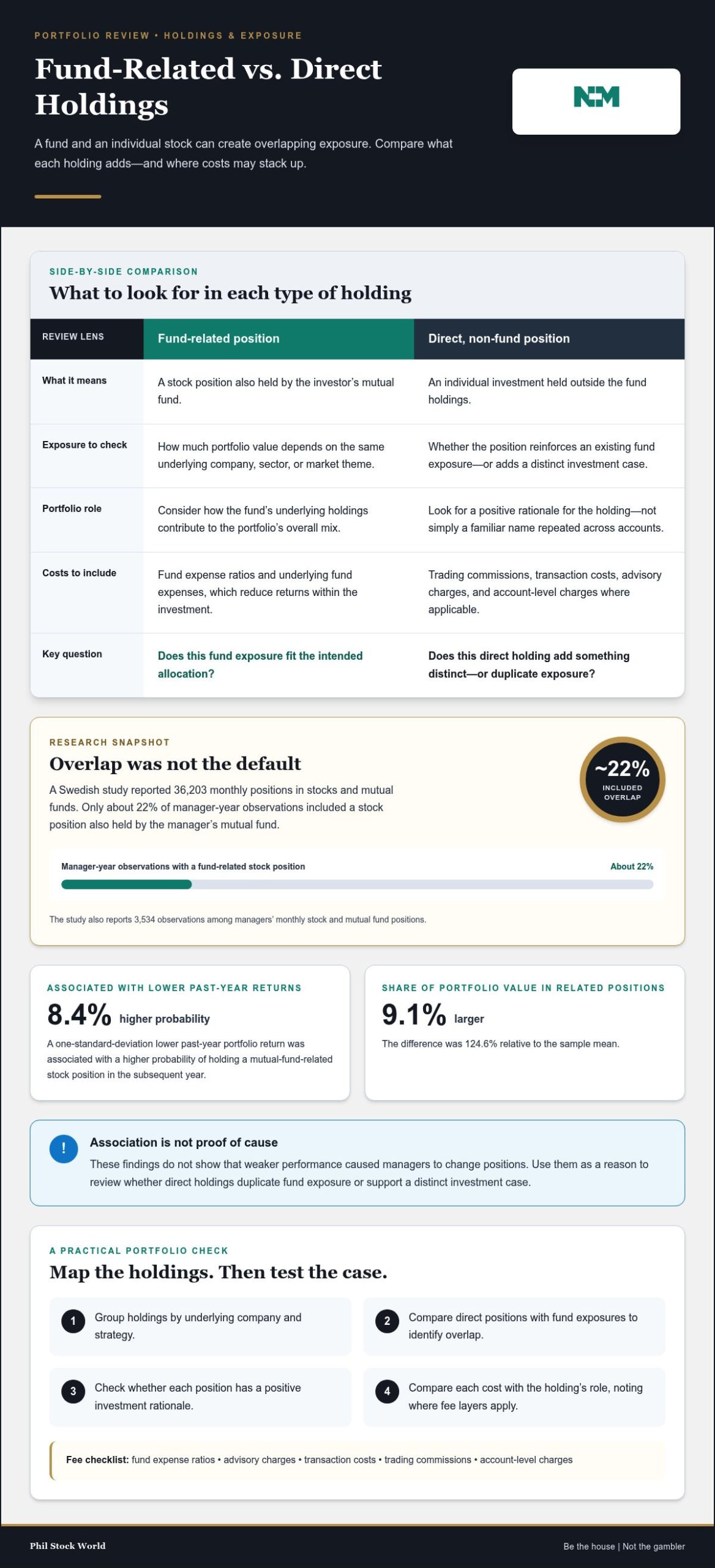
A portfolio may own a fund while also holding individual stocks that the fund owns. That creates overlapping exposure; non-fund positions are direct investments outside the fund holdings. Reviewing both helps reveal whether holdings that appear separate actually depend on the same companies, sectors, or market themes.
A Swedish study reported 36,203 monthly positions in stocks and mutual funds. Only about 22% of manager-year observations included a position also held by the manager’s mutual fund. That finding shows why “fund-related” shouldn’t be assumed to describe every direct holding. Map each stock against fund holdings, then consider how much portfolio value depends on overlapping exposures.
The study also found that a one-standard-deviation lower past-year portfolio return was associated with an 8.4% higher probability of holding a mutual-fund-related stock position in the subsequent year. The share of portfolio value in related positions was 9.1% larger; that difference was 124.6% relative to the sample mean. These are associations, not proof that weaker performance caused managers to change positions. The practical point: review whether a direct position reinforces a fund exposure or adds a genuinely distinct investment case.
Include fees in the comparison. Review fund expense ratios, advisory charges, transaction costs, trading commissions, and account-level charges. Fund expenses reduce returns within the investment, while trading or advisory costs may appear separately. Compare each cost with the holding’s role, and note where multiple layers of fees apply.
For a concrete review, group holdings by underlying company and strategy, then compare direct positions with fund exposures. Look for a positive investment rationale for each holding, not simply a familiar name repeated across accounts. A Virtual Portfolio Review can help readers examine those portfolio relationships and identify questions for further analysis.
The study reports 3534 observations among the managers’ monthly stock and mutual fund positions. This count can be considered alongside the reported overlap when reviewing whether direct holdings complement or duplicate fund exposure.
Asset allocation
Asset allocation divides a portfolio across investment types, sectors, and regions. Even a mix of broad funds can be heavily tilted toward one industry.
Benchmark Comparisons
An appropriate benchmark is a reference index that matches a portfolio’s asset mix, market, and investment approach. Compare returns over the same period, while accounting for fees and differences in risk. A broad U.S. stock index won’t fairly measure a portfolio that holds bonds, international shares, and cash. Use a blended benchmark or relevant benchmarks for each part, and treat the results as context rather than a verdict on performance.
Concentrated Positions and Overlapping Funds
A concentrated position puts a large share of the portfolio’s outcome in one company, sector, or market theme. If an investor owns a technology stock directly and also holds a fund with that stock among its largest holdings, the combined exposure may be greater than it first appears. Review underlying holdings across funds and direct investments to spot where apparent diversification doesn’t provide independent sources of return, and where a decline in one area could affect several positions at once.
Portfolio Review and Rebalancing
A portfolio review checks whether current holdings still fit the intended allocation; rebalancing adjusts positions that have drifted from it. Set a regular review cadence, such as an annual check, and revisit sooner after a major change in goals, time horizon, or financial circumstances. Rebalance based on the target mix and the reason for the drift, not simply because markets moved. This keeps decisions tied to a plan rather than short-term noise.
For example, if stock gains leave a portfolio more equity-heavy than intended, compare its current mix with the target before making changes. Consider transaction costs, potential tax effects, and whether new contributions could restore balance. An independent benchmark and a clear target allocation give each review a consistent reference point.
Investment ideas and stock valuations
A compelling stock idea is only a starting point. An expert review of investment holdings tests the business case, the price investors are paying, and the position’s role in the portfolio. Separate the company’s prospects from the stock’s valuation: a strong business can still be overpriced, while a challenged company may already reflect substantial pessimism. The key question is whether the evidence supports both the investment thesis and its current market price.
Start with the thesis. Identify what could drive revenue, earnings, or cash flow, then consider what might weaken those drivers. Compare the company’s valuation with its own financial performance and relevant peers, using measures suited to its business model. A price-to-earnings comparison, for example, can mislead when earnings are unusually high, low, or negative. Pair valuation measures with balance-sheet strength, cash generation, and the assumptions behind expected growth.
Next, test the idea against the portfolio. Even an attractive stock may add little if existing funds already hold similar companies or depend on the same market theme. Consider position size, potential downside, and whether the thesis differs meaningfully from current holdings. For insurers, peer analysis can compare investment portfolio information alongside financial, underwriting, and operational aspects. Use peer comparisons to inform a tailored investment strategy, not as a template for copying a competitor.
Finally, write down what would change your view. A useful review names the thesis, valuation evidence, main risks, and facts that would weaken the case. That record makes later decisions less dependent on market excitement or a sharp price move. An expert review of investment holdings can help frame what deserves another look when company results, assumptions, or valuation change. Judge the business, price, and portfolio role together, then use market charts and analysis to support a closer review of investment ideas.
For insurers, comparison is an input to judgment. Peer analysis should inform a tailored investment strategy, not be used to copy a competitor’s approach. The practical test is whether any lesson from peers fits the insurer’s own investment aims and portfolio, rather than importing another organization’s choices wholesale.
Phil Stock World: Premium Membership
Phil Stock World offers Premium Membership for readers seeking ongoing market commentary and investment ideas to inform their own research. If you’re weighing holdings, a Virtual Portfolio Review can help you examine how positions fit together. Educational Webinars offer opportunities to build knowledge, while Market Charts and Analysis help you follow market activity.
These resources are useful when you want context for evaluating a thesis, comparing holdings, or sharpening your understanding of market moves. They support learning and analysis; investment decisions remain yours.
Explore Phil Stock World’s offerings or visit the Phil Stock World website to learn more.
Make Your Next Investment Decision Deliberate
The value of a review lies in the decisions that follow. Before acting, write down what you want a holding to accomplish and what new information would change your view. This discipline can help distinguish a reasoned adjustment from a reaction to headlines or a restless market day.
An expert review of investment holdings can also give you a clearer set of questions for ongoing research: What has changed in the investment case? Does the position still fit your priorities? Which assumptions deserve another look? Keep those questions in mind as new information arrives, and revisit your reasoning when circumstances shift.
For continued market context and educational resources, explore Phil Stock World’s investment resources. Your next move can be thoughtful, measured, and grounded in a process you understand.
Frequently Asked Questions
Looking for investment advice?
For market education and trading ideas, Phil Stock World offers commentary and educational resources, including Premium Membership and webinars. These can help you study market developments and sharpen your own questions. They are not personalized financial planning, direct asset management, or brokerage services. Use them for context and learning, and consider decisions about your own circumstances separately from general market discussion.
What does an expert investment holdings review include?
A review should also consider when you may need access to your money and whether your accounts fit upcoming plans. For example, if you expect to use savings for a home purchase, the reviewer can assess whether the portfolio’s liquidity and potential sale timing fit that goal. The discussion should leave you with clear questions about your assumptions, priorities, and any trade-offs involved.
How do asset allocation and diversification affect portfolio risk and returns?
Asset allocation determines how much of a portfolio is exposed to different investment categories, while diversification spreads exposure across holdings. For example, several funds that all emphasize the same sector may provide less variety than their names suggest. A broader mix can reduce dependence on one company or theme, but returns still reflect the performance and market exposures of the investments held.