


The premium from a covered call is real, but a dependable income stream is not automatic. Options trading for consistent income often starts with owning shares and selling a call against them. You collect the option premium, but if assigned, you may have to sell your shares at the strike price, limiting gains above that level. The stock can still fall, too.
That trade-off matters more than the premium. If you’re considering income from shares you already own, compare the potential cash flow with the risk of giving up upside or holding a declining stock.
This guide explains how covered calls work, how they differ from cash-secured puts, and what affects the outcome of each strategy. It also explains how education and paper trading can help you practise evaluating option prices, assignment scenarios, and expiration risk before committing real capital.
Key Takeaways
- Compare what happens if you’re assigned: a cash-secured put can require you to buy shares, while a covered call can require you to sell shares you own.
- Assess the stock’s direction, time to expiration, and volatility before choosing a strategy; market conditions can change how an options position performs.
- Use paper trading to practise tracking premiums, breakeven points, and assignment scenarios before committing real capital.
- Build your understanding through education and market analysis, then use a virtual portfolio review to examine how a strategy fits your current positions.
What’s the difference between a cash-secured put and a covered call?
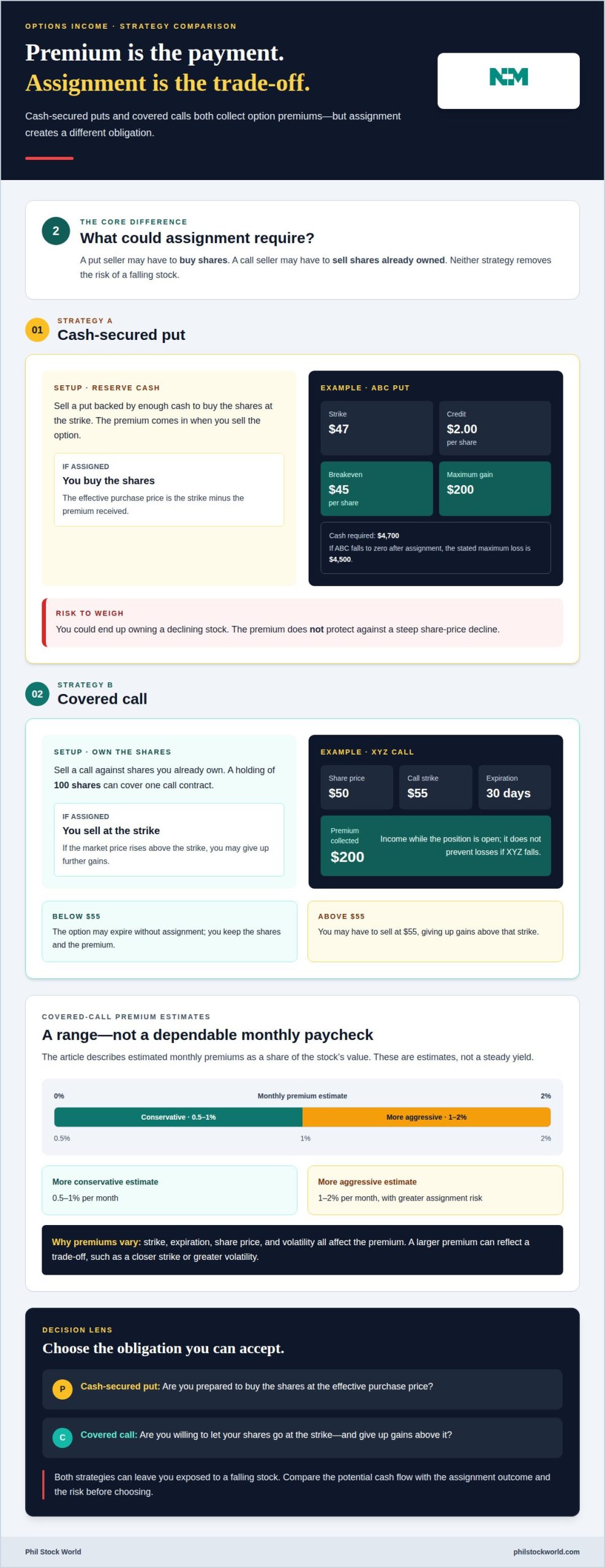
Cash-secured puts, covered calls, and credit spreads are commonly used to collect option premiums. The key difference is the obligation if you’re assigned: a put may require you to buy shares, while a call may require you to sell them.
Cash-Secured Put Basics
A cash-secured put is a short put backed by enough cash to buy the shares at the strike price. Selling the put brings in a premium, but assignment means purchasing the stock. This may suit an investor willing to own the shares at the effective purchase price, calculated as the strike minus the premium received. The premium does not protect against a steep share-price decline.
Collateral for Cash-Secured Puts
Collateral is the cash reserved to meet the put seller’s obligation if assigned. For example, setting aside $5,000 can cover a 100-share purchase at a $45 strike, which requires $4,500. If the stock trades at $50 and the put sale brings in $150, the premium lowers the effective cost if shares are assigned. The reserve makes the purchase obligation visible before the trade begins.
Compare that with a covered call: the seller already owns the shares and may have to sell them at the call’s strike. A 100-share holding can cover one call contract. In a separate example, selling an ABC put at a $47 strike for a $2.00 credit creates a $45-per-share breakeven and a $200 maximum gain. The position requires $4,700 in cash; if ABC falls to zero after assignment, its maximum loss is $4,500.
Neither strategy is risk-free. A put seller may end up owning a falling stock, while a call seller may miss gains above the strike if assigned. The better fit depends on whether you’re prepared to buy shares or willing to let shares you own go.
Tax treatment also matters. The Internal Revenue Service says gains and losses from a commodity or option dealer’s ordinary-course trading in section 1256 contracts and related property are included in net earnings from self-employment.
How does a covered call generate income?
A covered call earns a premium by selling a call against shares you already own. In return, you take on an obligation: if assigned, you may have to sell those shares at the strike price.
Premium Income from Covered Calls
The premium is the payment received for granting the call buyer the right to buy shares at the strike. For example, with XYZ trading at $50, selling a $55 call with a 30-day expiration collects $200. The premium provides income while the position remains open, but it doesn’t prevent losses if XYZ falls. The return depends on the premium relative to the shares’ value and how the stock moves.
Potential Stock Assignment
Assignment means delivering the covered shares at the strike price, even if the market price has risen higher. If XYZ climbs above $55, the call seller may have to sell at $55 and give up further gains. If XYZ stays below $55, the option may expire without assignment, and the seller keeps the shares and premium. Either outcome matters: choose a strike you’d accept as a sale price.
A separate illustration from the U.S. Department of Labor describes pledging to sell shares at $46 for a stated $450 premium. The premium is not a fixed paycheck. Its size reflects factors such as the strike, expiration, share price, and volatility, so returns vary across stocks and trades.
As a broad estimate, covered-call premiums may range from 0.5% to 2% of the stock’s value monthly. Conservative approaches are estimated at 0.5-1% per month; more aggressive approaches at 1-2%, with greater assignment risk. These are estimates, not a steady monthly yield. A large premium can reflect a trade-off, such as a closer strike or greater volatility.
To study how changing strikes affect premiums and assignment scenarios, Premium Membership offers exclusive trading ideas and market analysis.
What is an options trading strategy?
An options strategy combines contracts to match a market view, such as expecting a range-bound market or increased volatility. The underlying price, time to expiration, and volatility all affect the result.
Choosing Strategies by Objective and Outlook
Choose a strategy by comparing its potential payoff with your objective and market outlook. A collar pairs an out-of-the-money protective put with an out-of-the-money covered call, balancing protection against capped upside. A long straddle buys a call and put at the same strike and expiration, aiming to benefit from a substantial move in either direction. Each structure responds differently to price direction and volatility.
Market Conditions and Strategy Performance
Market conditions can help a strategy or expose its weak spot. Range-bound traders may consider calendars, diagonals, butterflies, or iron condors, while a sharp move can challenge positions built around limited price movement. Options outcomes also shift as time passes and volatility changes. Historical comparison is context, not a dependable-income promise: the collar strategy index performed similarly to the S&P 500 over the prior three years.
In the United States, options tax treatment depends on the contract and trading activity. The Internal Revenue Service includes gains and losses from a commodity or option dealer’s ordinary-course trading in section 1256 contracts and related property in net earnings from self-employment. Broker approval requirements and transaction charges also vary by firm and account.
Options Income Factors
Implied volatility affects the premiums buyers and sellers negotiate. Higher expected movement can increase premiums, but may also signal greater risk. Time to expiration affects time value, which reaches zero at expiration. Strike selection changes both the premium and assignment exposure: a closer strike may bring in more premium but can increase the likelihood of assignment. Consider these factors together, not in isolation.
Income Strategies for Small Accounts
Small-account strategies are positions whose collateral or maximum risk fits the available capital. A defined-risk vertical spread combines bought and sold options of the same type and expiration, with different strikes. For example, an ABC call spread selling the $55 call and buying the $60 call collected a $1.25 net credit, with a $375 maximum loss. Options can produce income, but no structure guarantees consistency; position sizing and losses still matter.
Paper trading and options education
Paper trading lets you practise an options position with simulated money before risking capital. Test a clear thesis over several months, record your entry, and track the position through expiration. For a covered call, note the shares owned, call strike, premium, and possible assignment. This gives options trading for consistent income a practical foundation: a decision record to review, not just a premium to celebrate.
Track more than whether a trade ends in profit. Record why you chose the contract, how the stock moved, and whether the result matched your expectations. For example, a simulated call might gain value from its premium while the underlying shares lose value. Reviewing both sides shows whether the position’s overall result matched your objective. That perspective matters because options trading for consistent income depends on the performance of the full position.
Practise the mechanics, too. Buying a call gives the buyer the right to purchase the underlying security at the strike price before expiration. Record how that right changes as the share price moves and time passes. At expiration, an option’s time value is zero, so distinguish time value from any intrinsic value in your paper-trading log.
Simulation has limits: it cannot recreate every pressure of a live position or guarantee a similar result with real money. It can still help you practise decisions such as holding, closing, or managing assignment risk before putting capital at risk. Keep notes on each simulated trade, then compare your plan with the actual price path and expiration outcome.
Pair that practice with structured education. An options webinar can clarify contract mechanics, premiums, and how changing market conditions affect a position. Phil Stock World’s Educational Webinars offer a place to deepen that understanding. Study a setup, paper trade it for several months, then review your decisions before considering live trades.
Phil Stock World
Phil Stock World connects options concepts with market context through Educational Webinars, Market Charts and Analysis, Premium Membership, and Virtual Portfolio Review. Use these resources to deepen your understanding of a strategy, follow market conditions, or review how options positions interact with a portfolio.
Use education and analysis to sharpen your own decisions, not as a substitute for understanding assignment risk, possible losses, or the limits of premium income. If you’re ready to explore further or have a question about the available resources, contact Phil Stock World.
Build a Process You Can Refine
Make your next move a repeatable decision process, not a chase for a monthly target. Before entering a trade, write down your market view, why you chose the position, and what would change your mind. Afterward, compare the result with your original thesis. This record can show whether your choices reflect a considered method or a reaction to the latest market swing.
A disciplined approach to options trading for consistent income means assessing decisions across changing conditions, not measuring success by a single premium. Keep learning, revise your criteria as you gain experience, and allow for periods when no trade fits your plan. Consistency comes from a sustainable process, not from expecting the same outcome from every position.
If you’d like to continue developing your approach with market education and portfolio perspectives, start a conversation with Phil Stock World. Take the next step at your own pace, with curiosity and a clear-eyed view of risk.
Frequently Asked Questions
So how do you prepare?
Before trading, write down your market view, the maximum loss you can accept, and what would trigger an exit. Then choose a strategy whose obligations fit that plan. In a simulated trade, track the option price and underlying share price together, not just the premium. Review the result after expiration to see whether your assumptions matched the outcome.
What are the four fundamental types of options trades?
The four basic options positions are buying a call, selling a call, buying a put, and selling a put. A call buyer has the right to buy shares at the strike; a put buyer has the right to sell them. Sellers take on the corresponding obligation if assigned. Combining these positions creates strategies with different risk and payoff profiles.
How do covered calls generate income, and what are the risks?
A covered call earns a premium by selling a call against stock you own. If you hold shares and sell a call, you keep the premium, but the shares may be called away at the strike. If the stock falls, the premium only offsets part of the loss on the shares. Consider whether you’d be willing to sell at that strike.
How do cash-secured puts work for income?
A cash-secured put seller collects a premium and reserves enough cash to buy shares at the strike if assigned. For a 100-share contract, calculate the full purchase obligation before entering, then account for the premium when assessing the effective cost. The key question is whether you’d still want the shares if their market price dropped below the strike.
How much capital is typically needed for options income strategies?
There is no single capital amount that suits every options strategy. A cash-secured put requires enough cash to buy the shares at the strike, while a covered call requires ownership of the shares used to cover the contract. A spread’s risk depends on its strike width and credit. Start with the obligation and potential loss, then decide whether the position fits your available capital.
What are the risks of selling options, including assignment and large losses?
Selling an option creates an obligation that may be triggered by assignment. A put seller may have to buy shares that have fallen sharply; a covered-call seller may have to sell shares after a rally. Premiums do not erase these risks. Before opening a position, consider the share-price scenarios that could create a loss, and understand how assignment would change your holdings.