


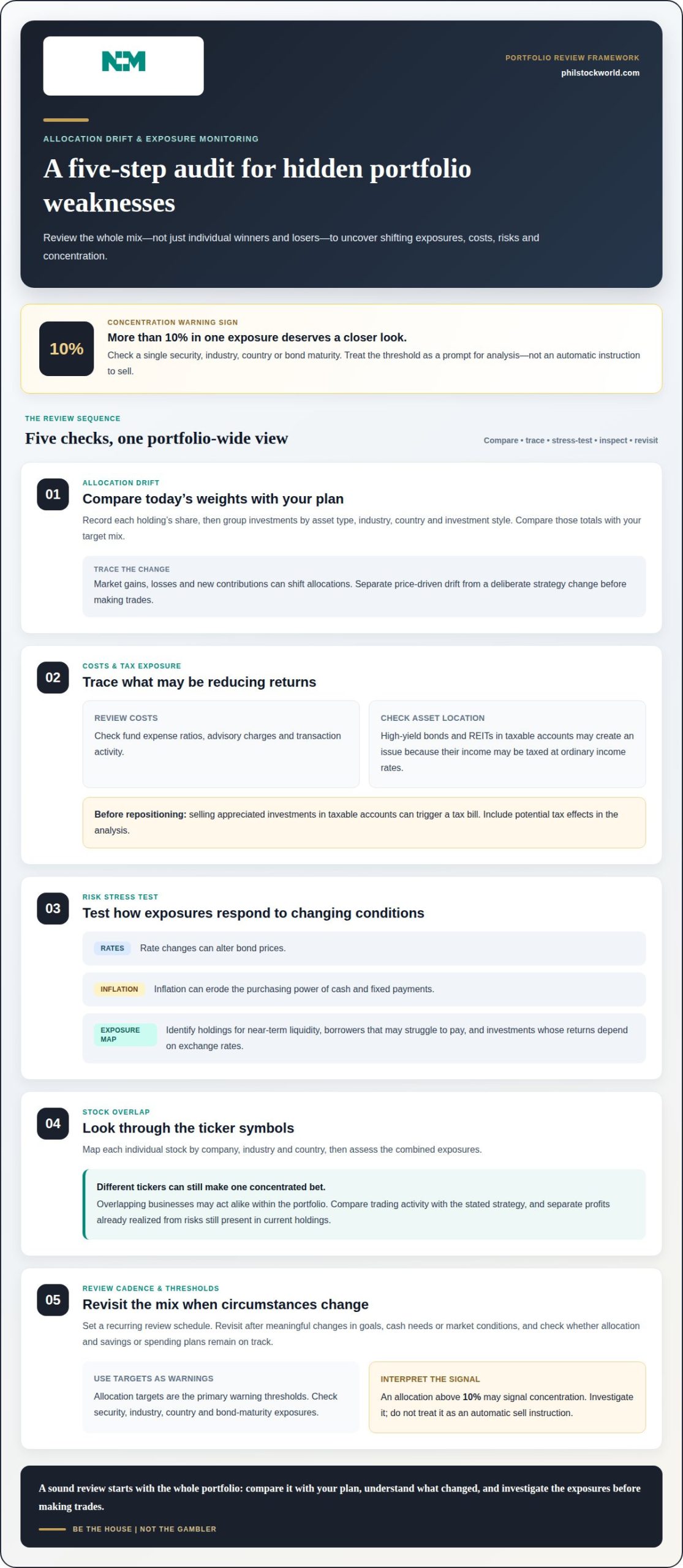
A portfolio can look diversified holding by holding and still carry the same risks in several places. Identifying portfolio weaknesses means reviewing the whole mix for allocation drift, risk that no longer fits your goals, benchmark underperformance, and hidden concentration. An allocation above 10% to a single security, industry, country, or bond maturity can be a warning sign, not an automatic sell signal.
It’s easy to focus on individual winners and losers, but the bigger picture can reveal exposure quietly building across a portfolio. This guide explains how to identify five common weaknesses: allocation drift, mismatched risk, poor benchmark comparisons, overlapping holdings, and concentration. You’ll learn what to review and how to distinguish a meaningful concern from a market move that needs more context.
Key Takeaways
- Review the portfolio as a whole to uncover overlapping holdings and exposure shifts that individual investment checks can miss.
- Match the portfolio’s risk and liquidity to when you’ll need the money, rather than relying on a broad risk label.
- Compare each major investment segment with a benchmark that reflects what it actually holds.
- Look for outsized exposure across securities, industries, countries, and bond maturities before deciding whether changes are needed.
Allocation drift and exposure monitoring
Review the portfolio as a whole. Individual holdings may look sound while their combined exposures shift. Compare the current mix with your intended allocation, then investigate what changed before making trades.
- Compare current weights with your plan. Record each holding’s share of the portfolio, then group investments by asset type, industry, country, and investment style. Compare those totals with your target mix. Market gains, losses, and new contributions can push allocations off course, so distinguish price-driven drift from a deliberate change in strategy.
- Trace fees and tax exposure. Review fund expense ratios, advisory charges, and transaction activity to see what may be reducing returns. High-income assets, such as high-yield bonds and REITs, in taxable accounts can create an asset-location issue because their income may be taxed at ordinary income rates. Selling appreciated investments in taxable accounts can trigger a tax bill, so include potential tax effects in your analysis before repositioning.
- Stress-test the exposures. Consider how interest rates and inflation could affect the portfolio’s mix: rate changes can alter bond prices, while inflation can erode the purchasing power of cash and fixed payments. Assess liquidity by identifying holdings that can support near-term needs, credit risk by examining exposure to borrowers that may struggle to pay, and currency risk by checking investments whose returns depend on exchange rates.
-
Inspect Individual Stock Holdings
Map each stock by company, industry, and country, then assess the combined exposures. In a portfolio of individual stocks, several overlapping businesses can make different tickers act like one concentrated bet. Compare trading activity with the portfolio’s stated strategy: frequent or erratic changes can make it harder to tell whether decisions reflect analysis or short-term reactions. Also distinguish profits already realized from the risks still present in current holdings.
-
Set Review Frequency and Warning Thresholds
Set a recurring review schedule and revisit the portfolio after meaningful changes in goals, cash needs, or market conditions. Periodic reviews help assess allocation and whether savings or spending plans remain on track. Use allocation targets as your primary warning thresholds; an allocation above 10% to one security, industry, country, or bond maturity may signal concentration. Treat it as a prompt for analysis, not an automatic instruction to sell.
Assessing risk tolerance and investment horizon
Your capacity for risk depends on when you’ll need the money, how much loss you can absorb, and how you respond under pressure. Test the portfolio against those realities, not just a risk label.
- Match each goal to its time horizon. List the purpose and expected timing of each financial goal. For a goal one to three years away, prioritize preservation and liquidity over growth. Low-risk assets can help protect capital needed for a specific expense. Longer horizons may allow more exposure to equities, but only if their potential declines won’t derail the goal.
- Stress-test a downturn before it arrives. Model how a broad stock-market decline, falling bond prices, or reduced income could affect your portfolio and spending plans. Check whether near-term withdrawals would force you to sell investments after losses. For retirees, a runway of safer assets can help fund spending during a stock bear market, reducing pressure to sell equities at depressed prices.
- Audit emotional decision-making. Compare recent trades with your written investment plan. Fear can push investors to sell after declines; greed can encourage buying after a sharp run-up. Both reactions can lead to buying high and selling low. Automating investments can reduce emotional decisions, while a clear plan gives you a reference point when headlines get loud.
- Use a SWOT analysis on your process. Identify internal weaknesses, such as unclear goals or decisions driven by market noise, alongside strengths that support consistent investing. Then develop a response for each weakness, such as setting rules for contributions or withdrawals. The advantage is practical: decisions follow a repeatable process rather than the mood of the market.
- Revisit risk when life changes. A job change, retirement, or a new spending need can alter your capacity for loss even if your holdings stay the same. A portfolio risk review can help connect those changing priorities with the investments and withdrawal plans you’re evaluating.
Comparing portfolio performance with benchmarks
Compare each major asset segment with a benchmark suited to its holdings and strategy. Consider returns alongside volatility and downside risk, so a higher return isn’t automatically mistaken for a better risk-adjusted result.
-
Select Suitable Benchmarks
Match each segment to a relevant market yardstick, not one headline index for the entire portfolio. Compare large-cap stocks with the S&P 500, international bonds with the Bloomberg Barclays Global Aggregate Bond Index, and real estate with the S&P US REIT. If large-cap stocks represent 30% of your portfolio, compare that allocation with the S&P 500, not your full portfolio’s return. For a first pass, examine the three largest portfolio segments and choose a benchmark for each.
-
Evaluate Risk-Adjusted Returns
Compare performance over the same period, then weigh returns against the risk taken to achieve them. A portfolio that trails its benchmark with similar volatility may point to a strategy weakness; lower returns paired with much smaller losses tell a different story. Review drawdowns, fluctuations, and recovery patterns as well as total returns. Keep the comparison like for like: a bond-heavy portfolio and a stock index carry different risks.
- Build a custom benchmark when needed. Combine relevant benchmarks in proportions that mirror your target allocation. For example, a portfolio holding large-cap stocks, international bonds, and real estate needs a blended reference reflecting those asset weights, rather than an all-stock index. Use the same measurement period and rebalance the comparison when your intended mix changes. A custom benchmark helps distinguish a portfolio’s strengths from returns driven simply by its asset allocation.
- Compare individual-security portfolios fairly. If you select stocks or bonds yourself, compare long-run results with an inexpensive index mutual fund focused on the same market segment. Match the category and evaluation period; otherwise, different exposures can distort the comparison. Use the result to identify whether security selection adds value relative to that focused alternative, rather than treating one short-term gap as a verdict.
Concentration in a single security, industry, country, or bond maturity
- Measure each exposure across the full portfolio. Group holdings by company, industry, country, and bond maturity, including positions held through funds. An allocation above 10% to any one of these areas can flag a potential weakness. Treat the threshold as a prompt to examine how a downturn could affect your overall position, not as an automatic instruction to sell.
- Look through every fund to its underlying holdings. Multiple ETFs can own the same companies, creating more exposure than their separate names suggest. In one portfolio example, five ETFs held the same seven underlying companies. Compare fund holdings and combine repeated positions to see whether diversification is real or mostly cosmetic.
- Check whether a popular index adds hidden concentration. At the time described, Apple, Amazon.com, and Microsoft together represented about 17% of the S&P 500. A portfolio that owns several funds tracking similar large-cap markets may therefore carry substantial exposure to the same major companies. Review sector and company weights together; a broad fund label alone doesn’t reveal the full risk.
- Assess concentration against your investment framework. Ask whether a large position reflects a deliberate strategy, a price run-up, or overlapping fund ownership. Then consider the threats that could affect that exposure, such as industry-specific pressure or risks concentrated in one country. A high-income holding can still create concentration if its income and market value depend on the same sector. Weigh the position’s role against the portfolio’s other assets before deciding whether to adjust it.
- Turn the exposure map into a review. If overlapping funds or outsized positions make the portfolio difficult to assess, a Virtual Portfolio Review can help examine how those risks fit together. Request a Virtual Portfolio Review to discuss the portfolio’s concentration and exposure.
Phil Stock World: Virtual Portfolio Review
Phil Stock World’s Virtual Portfolio Review can help you assess how your holdings, exposures, and investment approach fit together. Consider it when your review raises questions about overlapping positions, allocation, or benchmark performance and you need a clearer overall view. The goal is to make portfolio risks easier to understand, not to make decisions for you.
For ongoing context, Market Charts and Analysis and Educational Webinars offer ways to explore market movements and investment concepts. Premium Membership includes access to exclusive content, including top trades and sector-specific insights. Use these resources to build on your own review and sharpen the questions you bring to your next portfolio decision.
Contact Phil Stock World to discuss a Virtual Portfolio Review.
Make Your Next Portfolio Decision More Deliberate
Identifying portfolio weaknesses matters most when it improves your next decision. Before acting, write down what you want a change to achieve, what evidence supports it, and what might make you reconsider. This brief record can help distinguish a considered adjustment from a reaction to market noise.
Keep reviewing your approach as your goals and circumstances evolve. A portfolio isn’t a set-and-forget machine; its role should continue to fit the life you’re building. Make room to learn, revisit your reasoning, and adjust thoughtfully when the facts or your priorities change.
If you’d like another perspective on the portfolio decisions ahead, start a conversation with Phil Stock World. A clearer process begins with asking better questions, and you can take that step at your own pace.
Frequently Asked Questions
Are You Making These 5 Common Portfolio Mistakes?
Your portfolio may have weaknesses if it no longer matches its intended mix, carries more risk than you’re comfortable with, lags an appropriate benchmark, or concentrates exposure in similar holdings. Frequent trading without a clear rationale is another warning sign. Start by recording the evidence behind each concern and deciding whether it affects your goals, rather than treating every market dip as a flaw.
What are common signs of weaknesses in an investment portfolio?
Warning signs include returns that don’t support your stated objective, holdings that move together in stressful markets, and investments whose purpose you can’t explain. Different funds don’t necessarily diversify risk if they rely on similar companies. Also check whether the portfolio fits your planned withdrawals, particularly if you may need cash when many assets are facing sharp price swings.
How do I measure portfolio diversification and concentration risk?
Measure diversification by grouping exposures and assessing how much each group contributes to overall risk, not by simply counting holdings. A portfolio with dozens of investments can still depend heavily on a few economic drivers. Consider how each group might respond to the same event, such as a slowdown affecting several industries, to judge whether the mix offers meaningful variety.
What is asset allocation drift, and how do I rebalance a portfolio?
Asset allocation drift occurs when changing portfolio weights leave your mix out of line with its intended targets. Rebalancing brings the mix back in line with your investment plan. One approach is to direct new contributions toward underweight assets before selling. If you’re considering a sale, account type matters: selling in a taxable account can trigger taxes, while trades inside a tax-sheltered account have no tax consequences as long as the assets remain there.
How do I evaluate sector, geographic, and individual-stock exposure?
Start by classifying each holding by sector, country exposure, and underlying company, including holdings inside funds. Distinguish where a company is listed from where it operates, since those can differ. For each stock, consider how its performance could affect the wider portfolio alongside similar companies. This can reveal whether holdings that appear different share a common source of risk.