



A quiet volatility backdrop doesn’t make a calendar spread simple. A long calendar spread sells a near-term option and buys a later-dated option, usually at the same strike, for a net debit. Understanding calendar spread mechanics for low volatility environments means tracking the trade-off: time decay may help as the short option loses value, while a volatility drop may hurt the longer-dated option more.
That tension is what makes calendar spreads appealing and easy to misread. A range-bound market can suit a calendar, but the harder question is whether the premiums, volatility term structure, and time remaining give the spread room to work. This guide explains how theta and vega interact, why a low-volatility entry can still carry sharp risks, and what a backtest can reveal about the strategy. We’ll start with the basic structure, then connect the Greeks to pricing and explain why historical results need careful interpretation before they inform a trading decision.
Key Takeaways
- See how a calendar spread pairs options with different expiration dates and why the strike and timing shape its potential payoff.
- Assess how faster decay in the short-dated option can interact with the longer-dated option’s greater sensitivity to implied volatility.
- Use volatility term structure to understand why a spread’s entry price and exposure can change even when overall market volatility looks subdued.
- Learn what backtesting can reveal about past performance, while accounting for the assumptions and market conditions that influence the results.
Vega and implied volatility
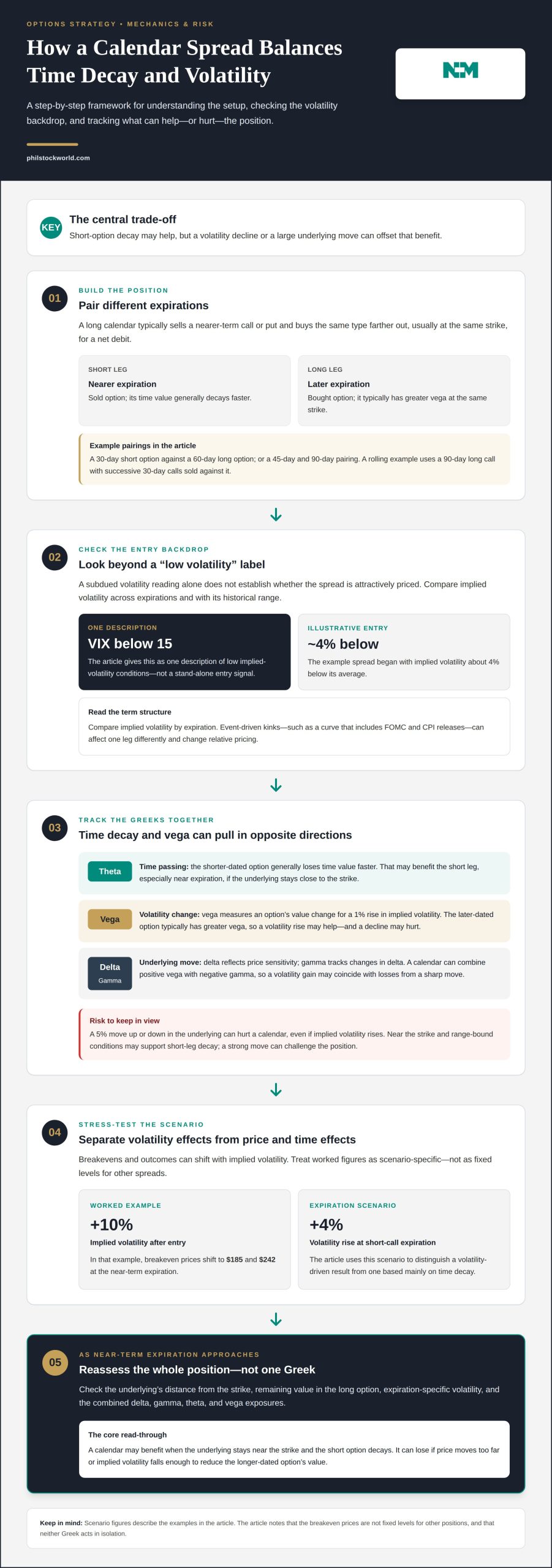
Near the short option’s expiration, a long calendar may profit if the underlying stays near the strike and the short option decays. It can lose if the underlying moves too far or implied volatility falls enough to reduce the longer-dated option’s value.
Vega and Implied Volatility Sensitivity
Vega measures how much an option’s value changes for a 1% rise in implied volatility. In a calendar, the longer-dated option typically has greater vega than the shorter-dated option at the same strike, so rising volatility can lift the position’s value. That sensitivity cuts both ways: a volatility decline can weigh more heavily on the option being bought.
Consider a worked example where implied volatility rises 10% after entry: the spread’s breakeven prices shift to $185 and $242 at the near-term expiration. Those figures illustrate how volatility can reshape the payoff range; they aren’t fixed levels for other positions.
Low Volatility and Term Structure
A low implied-volatility environment means options are priced with relatively subdued expected movement; the VIX below 15 is one description of such conditions. Term structure compares implied volatility across expirations, and its shape can make the long and short legs respond differently. A low reading alone doesn’t tell you whether the entry offers favorable pricing.
One approach is to compare current implied volatility with its historical range. The example spread began with implied volatility about 4% below its average, illustrating why traders may consider an entry when volatility sits toward the low end.
Price movement still matters. A 5% move up or down in the underlying can hurt a calendar, even if implied volatility rises. Event-driven kinks can also distort the term structure: a forward implied-volatility graph for options expiring 12/16 includes FOMC and CPI releases. An event concentrated in one expiration may alter that leg’s implied volatility, changing the spread’s relative pricing. Read the expiration-specific curve alongside the stock’s distance from the strike, not the overall volatility reading alone.
Short-term theta decay and long-term vega exposure
A calendar’s time and volatility exposures can pull in different directions. Decay in the short option may help, while market movement and changing implied volatility can offset that benefit.
Theta Decay Across Expirations
Theta estimates how an option’s value changes as time passes. The shorter-dated option generally loses time value faster, which can benefit a calendar’s short leg, especially near expiration, if the underlying stays close to the strike.
Rolling can extend the approach: against a 90-day long call, a trader may sell successive 30-day calls. Each new short option introduces fresh exposure, so the underlying’s level and the remaining long option’s value still matter.
Long-Term Vega Exposure
Vega measures how an option’s value responds to changes in implied volatility. The later-expiring option typically has greater vega than a shorter-dated option at the same strike, so a volatility increase may benefit a long calendar. A decline may work against it, potentially outweighing gains from decay in the short leg.
The balance can change as the short option approaches expiration. For example, an analysis of a long calendar considers a 4% volatility rise at the short call’s expiration. That scenario helps distinguish a volatility-driven result from one based mainly on time decay; neither Greek acts in isolation.
Delta, Gamma, Theta, and Vega
Delta reflects price sensitivity, gamma tracks changes in delta, theta captures time decay, and vega measures volatility sensitivity. Together, they describe a position’s changing risk profile. A calendar can combine positive vega with negative gamma, so a volatility gain may coincide with losses from a sharp move in the underlying.
That mix matters when assessing directional risk. A near-strike, range-bound market may support decay in the short leg, while a strong move can challenge the position even if implied volatility rises. Track all four exposures as the shorter-dated option nears expiration; no single Greek tells the whole story.
Use market charts and analysis to follow how volatility and price movement evolve around an options position.
What is a Calendar Spread?
A calendar spread pairs options on the same underlying, usually at the same strike, but with different expiration dates. This structure determines the trade’s debit and how the position responds as the near-term contract expires.
Unlike a diagonal spread, a calendar generally keeps the strike the same while varying the expiration dates. A vertical spread uses different strikes with the same expiration, while a long option is a single contract rather than a two-leg position.
In the United States, account approval and trading conditions depend on the brokerage. Fees vary by broker and contract, and tax treatment depends on the options and transactions involved. Keep the trade’s records and holding details in mind.
Spread Structure and Expiration Selection
A typical long calendar involves selling a nearer-term call or put and buying the same type of option farther out, often at a 1:1 ratio. The short option may expire in 30 days while the long option expires in 60 days. A 45-day and 90-day pairing offers another middle-ground structure.
Strike choice shapes the position’s directional exposure. An at-the-money strike creates a more neutral setup if the underlying stays nearby, but a move away can change the payoff. The near-term option may expire worthless while the bought option remains open. Expiration spacing determines how much time value remains in that long leg.
Debit, Maximum Loss, and Breakeven Points
The debit is the price paid for the longer-dated option minus the premium received from selling the shorter-dated option.
For a long calendar, the debit paid is the maximum risk. Breakeven points depend on the underlying’s price and the remaining long option’s value when the short leg expires, so they aren’t fixed by a simple calculation. They generally fall within one strike of the spread’s strike price, but volatility and time remaining affect the exact range.
How do implied volatility and volatility term structure affect calendar spread pricing?
Calendar pricing reflects implied volatility in both legs, not just the market’s overall volatility level. The term structure shows how implied volatility changes across expirations, so options at the same strike can reflect different volatility assumptions. Calendar spread mechanics for low volatility environments therefore depend on the relationship between maturities, not simply on a quiet reading of broad-market volatility.
A long calendar may have a more favorable entry when near-term options are expensive relative to farther-dated options. Selling the short option brings in more premium, while the longer-dated option preserves exposure beyond the near expiration. Compare implied volatility across expirations, since the gap can narrow or reverse as conditions shift.
One example shows implied volatility at approximately 36% for the sold option and 34% for the purchased option. That two-point gap affects the starting prices, but it doesn’t decide the result alone. Changes in the underlying, time remaining, and expiration-specific volatility also influence the spread’s value and potential breakevens. This is another reason calendar spread mechanics for low volatility environments call for comparing both legs rather than relying on one volatility figure.
Event pricing can bend the term structure. Around the Ethereum Merge, September 23 and September 30 calls traded at a significant volatility premium to September 9 calls. Yet the volatility difference between September 23 or 30 and October 7 or 14 was much smaller. An event concentrated in one expiration can reshape relative option values without lifting every maturity equally.
Compare options at the same strike across expirations, then identify whether an event premium is concentrated in the short or long leg. Volatility skew also matters: calls and puts at different strikes may have different implied volatility. A calendar’s pricing depends on these details, not simply on whether volatility appears low.
Use volatility charts to compare expirations and put the spread’s pricing in market context.
Phil Stock World
Phil Stock World helps readers connect calendar-spread mechanics with changing market conditions through education, analysis, and portfolio-focused discussion. When you’re weighing whether theta, implied volatility, or a shifting term structure is driving a position, Market Charts and Analysis and Educational Webinars can add context. Premium Membership and Virtual Portfolio Review offer further ways to engage with trading ideas and review how options strategies behave in a portfolio.
These resources support your own understanding; they don’t replace your judgment or execute trades for you. If you want to explore the educational and analytical resources relevant to options strategies, contact Phil Stock World.
Put the Next Trade Through Its Paces
Before committing capital, turn your market view into a clear, testable thesis. Define what would make the calendar attractive, what price action would challenge that view, and how you’ll assess the position as conditions change. A backtest can show whether the idea held up across different market regimes, but its assumptions matter: option pricing, volatility inputs, and trade management can all shape the result.
That discipline is central to applying calendar spread mechanics for low volatility environments. Rather than treating a quiet volatility reading as a signal on its own, use it as one input in a broader decision about timing, exposure, and risk. Keep your thesis specific, review what the data supports, and adapt as the market evolves.
For further discussion and market education, Contact Phil Stock World. A thoughtful process can help you approach your next options decision with greater clarity.
Frequently Asked Questions
What is a calendar spread in options, and how does it work?
A calendar spread combines two options on the same underlying with the same strike but different expiration dates. For example, a trader might sell a nearer-dated put and buy a later-dated put. The short contract’s value can change faster as expiration approaches, while the longer-dated contract remains open. The outcome depends on the underlying price and the value of both options.
How do calendar spreads perform in low-volatility environments?
A calendar can benefit when the underlying stays close to the strike and the short option loses time value, but low volatility alone doesn’t ensure a gain. A volatility decline can reduce the longer-dated option’s value, while a sharp price move can put the position under pressure. Consider the volatility of each expiration and the underlying’s distance from the strike, not just a broad market volatility measure.
What strike, expiration dates, and option type are typically used for a calendar spread?
Traders often use matching at-the-money call or put strikes, selling the nearer expiration and buying the farther one. A typical pairing uses a short option with 30 to 45 days to expiration and a long option with 60 to 90 days. Calls and puts can both form calendars. The choice depends on the intended exposure and whether the underlying is expected to stay near the selected strike.
How does theta decay affect a calendar spread over time?
Theta affects both legs, but not equally: the nearer-dated option often loses time value faster, which can help a long calendar if the underlying stays near the strike. As the short option approaches expiration, for example, its remaining time value may shrink quickly. A move away from the strike or a change in implied volatility can offset that effect, so time decay isn’t the only driver of results.
How should traders choose calendar spread strikes and expiration intervals in low volatility?
Start with the market view: a neutral thesis points toward a strike near the underlying, while a directional view may call for a different setup. Compare implied volatility across expirations and consider whether an event affects one option’s maturity more than another. A 60-day versus 120-day pairing is suggested for very flat, low-volatility markets, but wider spacing also leaves more time for conditions to change.
What are the main risks of calendar spreads, including volatility changes and early assignment?
Key risks include a large move away from the strike, falling implied volatility, and changes in the relative pricing of the two expirations. The short option may be assigned before expiration, so traders should understand the implications. This can create a stock position while the longer-dated option remains open. Understand the assignment implications for the option type and monitor the short leg as expiration approaches.