

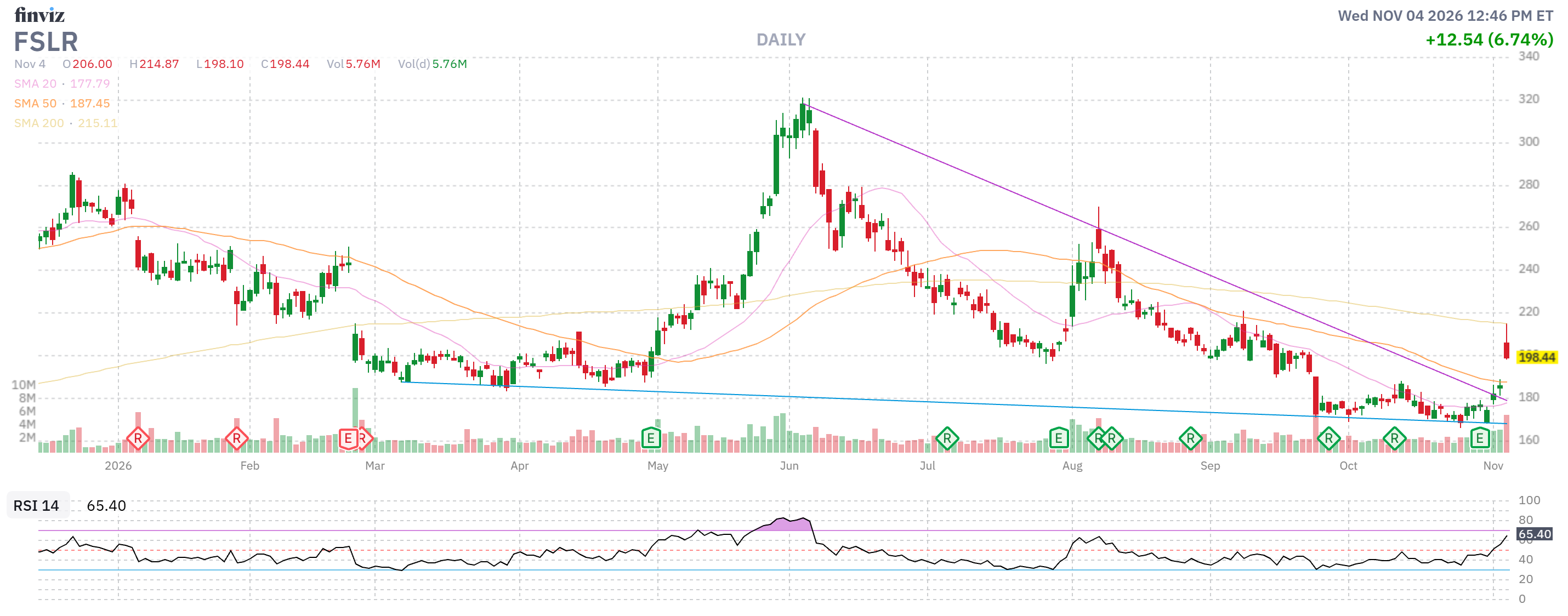
🚢 Top Trade Alert: First Solar (FSLR)—A Better Policy Backdrop at a Value Price
At approximately $200, we like First Solar enough to establish a new long-term position. Our plan is a January 2029 bull call spread, partially financed with short puts, followed by quarterly put and call sales to generate income. We will set the strikes, quantities, and entry prices separately.
The election has improved the investment case—not because solar subsidies magically reappear this morning, but because the risk of further legislative damage has diminished. Combined with First Solar’s net-cash balance sheet, substantial contracted business and domestic manufacturing position, that creates a compelling opportunity to sell time while owning value.
Why First Solar
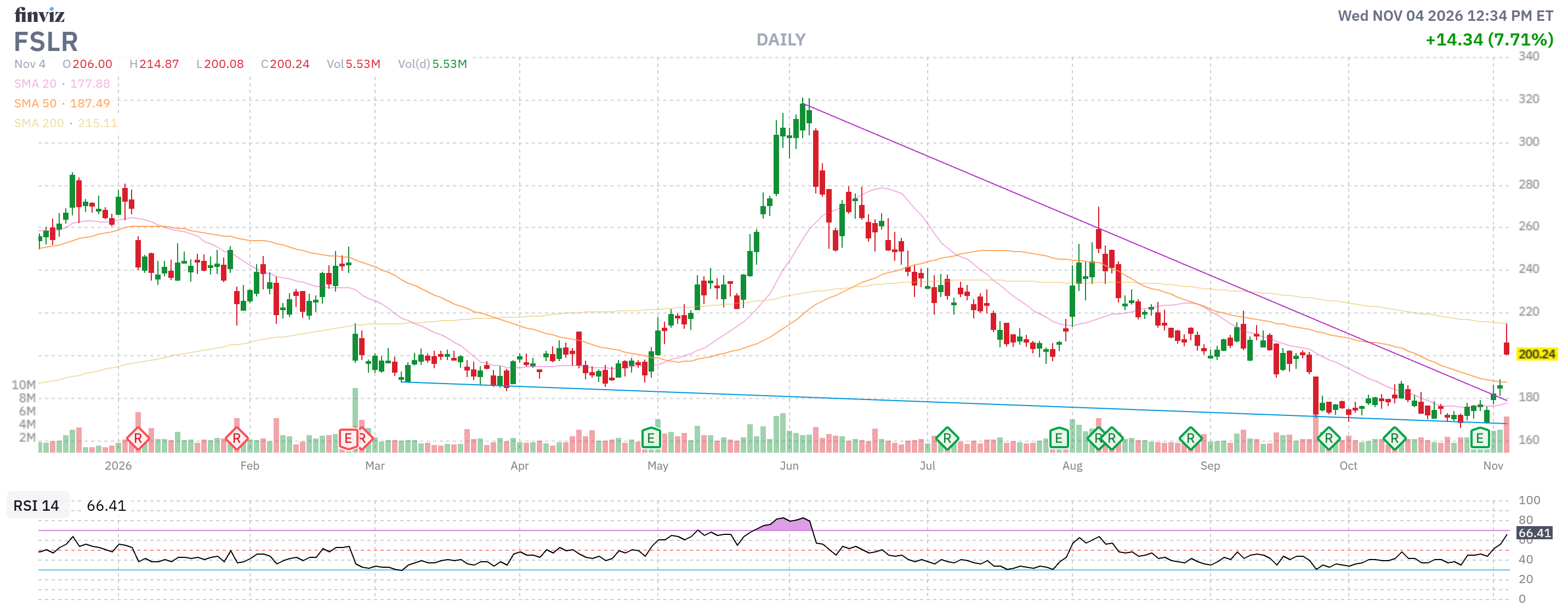
First Solar manufactures cadmium-telluride thin-film solar modules, primarily for utility-scale projects. It is not a residential installer dependent on homeowners financing rooftop systems. Its manufacturing technology also differentiates it from the crystalline-silicon supply chain used by most competitors. [2818]
The latest report gives us a substantial business to underwrite:
| Q3 2026 measure | Result |
|---|---|
| Quarterly revenue | $1.23Bn |
| Quarterly EPS | $5.30 |
| Net cash | Approximately $1.5Bn |
| Contracted backlog | 44 GW |
| Backlog value | Approximately $13.5Bn |
| Scheduled deliveries | Through 2030 |
| New share-repurchase authorization | $500M |
At $200, the approximate equity value is $21.6Bn. The backlog does not guarantee profit, but it gives First Solar considerably more visibility than a business relying entirely on next quarter’s orders. [2771][2784]
Why the election matters
Democrats’ projected control of both congressional chambers makes additional anti-renewable legislation harder to advance and provides stronger oversight of administrative policy. That improves the probability of a more predictable operating environment for manufacturers and their customers. [2772][2782]
We are not assuming an immediate reversal of existing law. The new Congress begins in January, and the president retains his veto. Our first benefit is a lower probability of additional damage—not a guaranteed new spending program. [2770]
That distinction matters particularly for First Solar. Its 2026 adjusted EBITDA guidance includes approximately $2.07Bn–$2.19Bn of Section 45X manufacturing credits. Those credits are material to earnings, so greater confidence in their durability has real financial value. [2784]
We cut FSLR during the October portfolio simplification because we wanted fewer policy-dependent positions. Revisiting it after a material change in that policy backdrop is discipline, not inconsistency.
What we are paying for
We do not need to assume extraordinary growth to make $200 interesting:
| Illustrative sustainable EPS | P/E at $200 |
|---|---|
| $12 | 16.7x |
| $15 | 13.3x |
| $18 | 11.1x |
| $20 | 10.0x |
These are valuation scenarios, not earnings forecasts. They show why a lower effective ownership basis through put sales could give us room for disappointment without requiring a return to an extravagant multiple.
The risks we are accepting
The latest quarter was mixed. First Solar reduced full-year sales guidance to $4.6Bn–$4.9Bn and shipment guidance to 16–17 GW. Nine-month operating cash flow was negative $403M, reflecting, among other factors, the timing of module receipts and manufacturing-credit monetization. Accounting profits must ultimately become cash. [2784][2801]
We also need to watch project delays, customer credit, factory execution, and tellurium availability. Copper-refinery recovery and recycling can support tellurium supply but neither makes it unlimited. [2820][2826]
Finally, tariff changes are not uniformly bullish. First Solar benefits from protection against competing imports; the favorable outcome is better project certainty while preserving domestic manufacturing economics—not necessarily eliminating every trade barrier. [2770]
How we intend to play it
Our structure will have three components:
-
- A 2029 bull call spread providing long-duration recovery participation.
- Short puts at a price where we genuinely want to own the assigned shares.
- Selective quarterly call and put sales to collect premium while the business develops.
The income program reduces our dependence on a rapid rally, but it is actively managed. Additional put sales increase potential ownership, and short calls must be sized against the actual long exposure. We will establish those commitments when we select the legs—not infer them from a small opening debit.
Bottom line
First Solar offers a profitable domestic manufacturing franchise, net cash, contracted demand, and a materially improved political backdrop at approximately $200.
We are not betting on an election-day spike. We are giving the business more than two years to execute while using options to improve our entry and generate income. The objective is a position that works with reasonable operating results—not one that needs every solar policy, shipment, and earnings forecast to go perfectly.
FSLR earns a Top Trade Alert. The business case is established; the executable options structure comes next.
For the Long-Term Portfolio (LTP) our FSLR trade will be:
-
-
-
- Sell 10 FSLR 2029 $175 puts for $26 ($26,000)
- Buy 20 FSLR 2029 $170 calls for $76 ($152,000)
- Sell 15 FSLR 2029 $220 calls for $57 ($85,500)
- Sell 10 FSLR Jan $200 calls for $17.50 ($17,500)
- Sell 7 FSLR Jan $185 puts for $10 ($7,000)
-
-
That’s net $16,000 on the $100,000 spread with $84,000 (525%) upside potential and we’re starting out $60,000 in the money! PLUS we have 8 more chances to sell $24,500 in premium is another potential $196,000 (1,225%) and you KNOW I love a trade where most of the money comes from selling premium!