


The wheel’s premium stream comes with a stock-sized commitment. The strategy pairs cash-secured puts with covered calls: sell a put, buy shares if assigned, then sell calls against those shares. A cash-secured put can require you to buy 100 shares at the strike price, so the cash you reserve and your willingness to own the stock matter as much as the premium. This wheel strategy options trading guide for passive income starts with that trade-off, not a promise of easy returns.
If you’re drawn to the wheel because it seems like a simple way to collect option premiums, the appeal is understandable. But premium income doesn’t eliminate the risks of owning shares or reduce the cash commitment: assignment can leave you holding a stock as its price falls. The traditional wheel follows a recurring put-to-shares-to-call cycle, though traders may vary how they manage each step. Understanding that distinction helps you decide whether the traditional wheel fits your approach.
This guide explains how the two option types work, how much cash and capital the strategy can require, and where its risks arise. It also puts the traditional wheel in context so you can judge whether its mechanics suit your goals and comfort with owning shares.
Key Takeaways
- Understand how put assignment moves the strategy from cash to stock ownership, and how covered calls can shape what happens next.
- Estimate the cash commitment by relating a put’s strike price to the shares and contracts it covers before choosing a position size.
- Weigh the opportunity cost of reserved cash against the risks of holding a stock through a price decline.
- Compare the traditional put-to-shares-to-calls cycle with variations in how traders manage positions and decide when the wheel fits their approach.
Selling cash-secured puts and covered calls
The wheel links selling puts to owning shares, then selling covered calls. Each option can bring in a premium, but also creates a commitment tied to the underlying stock.
Covered Calls After Put Assignment
A covered call is a call sold against shares acquired after a put assignment. With one contract covering 100 shares, the trader can sell a call and collect its premium while agreeing to sell those shares at the strike if assigned. The shares then support the next stage of the wheel. That transition matters because the call can bring in another premium, while setting a price at which the portfolio may lose its shares.
Average Cost and Covered Call Assessment
Average cost helps assess a covered call by showing how its strike compares with the trader’s adjusted share basis. If assigned at $110, the shares sell above that adjusted basis. Together, the share-price gain and call premium shape the trade’s result. This calculation helps distinguish premium collected from the total outcome, and clarifies the sale price the trader has accepted.
Stock Losses and Assignment Risks
The main risks are assignment and losses if the underlying stock declines. A put seller may have to buy 100 shares at the strike even when the market price has fallen below it. The premium reduces the effective cost basis, but it doesn’t prevent further losses if the shares keep dropping. A covered call creates a different trade-off: if the stock rises above its strike, assigned shares can be sold before the price recovers further. The wheel therefore suits a mildly bullish outlook, not a guarantee of passive income. Before selling a put, consider whether owning the shares at that strike fits the portfolio.
Capital requirements and account sizing
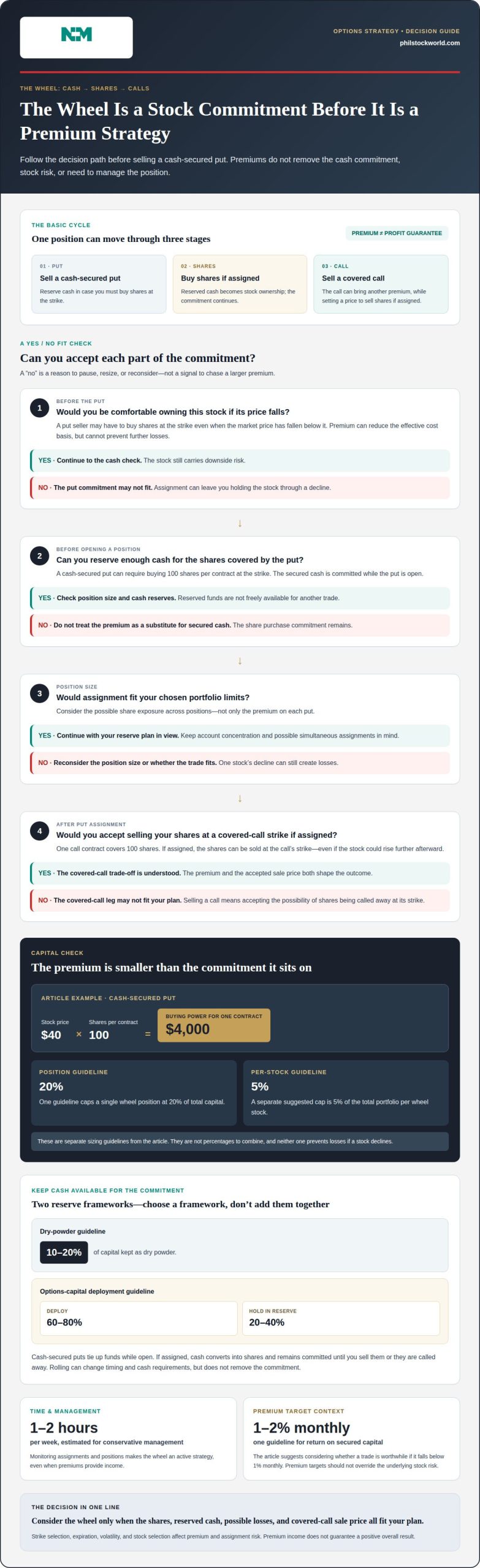
Size a wheel position around the cash it could absorb, not the premium it might collect. A put’s secured capital depends on its strike, shares per contract, and contract count. For a $40 stock, one contract requires $4,000 in buying power to cover 100 shares. That cash is committed while the put is open. A wheel strategy options trading guide for passive income should make this capital commitment clear before discussing potential returns.
One sizing guideline caps a single wheel position at 20% of total capital. That limit can reduce the risk of one stock dominating the account, but it doesn’t prevent losses if the stock declines.
These ranges describe account scale, not guaranteed returns. Strike selection, expiration, volatility, and stock selection all affect premium and assignment risk.
U.S. short-term capital gains can be taxed at ordinary income rates of 22-37% for higher earners. Trading fees depend on the broker’s pricing and contracts traded, and can reduce net premiums.
Can the wheel generate passive income? Premiums may provide income, but monitoring assignments and positions makes the strategy active. Conservative management is estimated at 1-2 hours per week. A wheel strategy options trading guide for passive income should treat returns as variable, with stock gains and losses affecting the outcome.
To consider positions alongside market conditions, explore options market analysis.
Cash commitment and opportunity cost
Cash-secured puts reserve funds that you can’t freely use for another trade. This creates an opportunity cost: while the position is open, those dollars can’t support other stocks or portfolio needs. If you’re assigned, the cash converts into shares, and your commitment continues until you sell them or they’re called away. Receiving a premium doesn’t make the reserved capital available again.
Cash reserves help absorb that constraint. One guideline suggests keeping 10-20% of capital as dry powder; another recommends deploying 60-80% of options capital and holding 20-40% in reserve. These are different sizing frameworks, not percentages to combine. The right balance depends on how much of the portfolio is already committed and whether you want room for new opportunities.
Position limits can prevent one assignment from dominating the account. A suggested cap is 5% of the total portfolio per wheel stock. For example, if several puts might be assigned around the same time, their combined share exposure matters more than each premium viewed alone. The portfolio needs enough uncommitted cash to handle those outcomes without forcing a sale elsewhere.
Cash also has a potential return of its own. When interest rates are low, interest on reserved funds may be negligible, so the cash’s opportunity cost becomes more noticeable. One guideline targets at least 1-2% monthly return on secured capital; it suggests considering whether a trade is worthwhile if it falls below 1% monthly. Premium targets shouldn’t override the risks of the underlying stock.
Rolling a position can change its timing and cash requirements, but it doesn’t remove the commitment. A roll may tie up capital for longer, while assigned shares may need ongoing management through covered calls. Your reserve plan should account for both open cash-secured puts and stock holdings, not just the next premium. That’s the difference between tracking cash and treating it as available.
What are the steps to run the wheel strategy using cash-secured puts and covered calls?
The wheel follows a sequence: choose a stock, sell a cash-secured put, manage possible assignment, then consider covered calls. Each step depends on whether you’re willing to own the shares and have the cash available for the commitment.
- Select the underlying stock. Choose a company you’d be comfortable holding if its price falls after assignment. Stock selection matters because the strategy can leave you owning shares through a decline. Match the position to your portfolio’s risk limits, rather than choosing solely for a tempting premium.
- Sell a cash-secured put. Set a strike where buying the shares would fit your plan, then reserve enough cash for assignment. One suggested approach places put strikes 5-15% out of the money. Option selection also depends on expiration; a commonly suggested window is 30-45 days. A closer-to-the-money option may offer more premium, alongside a greater chance of assignment.
- Respond to the put’s outcome. If the put expires out of the money, you keep the premium and can assess another trade. If assigned, buy the shares at the strike. Don’t treat assignment as a glitch in the process. It’s the handoff from the cash-secured put stage to potential stock ownership.
- Consider a covered call. With shares in hand, select a call strike that reflects the price at which you’d sell them. Selling the call brings in premium, but assignment can transfer your shares at that strike. If the call expires without assignment, you still own the stock and can evaluate another call. If shares are called away, the cycle can return to cash and puts.
Keep track of expiration dates, available cash, share basis, and the reason for each strike. Rolling an option changes its terms and timing, so reassess the trade rather than rolling automatically. For help evaluating a portfolio’s wheel positions, review your options strategy.
Phil Stock World
Once you’ve mapped the wheel’s cash requirements, assignment risks, and call decisions, Phil Stock World can help you explore the strategy further. Use its Market Charts and Analysis to follow market conditions, or explore Educational Webinars to build your understanding of trading strategies. A Virtual Portfolio Review can help you examine how wheel positions fit together in your portfolio, and Premium Membership gives you access to exclusive content.
Explore these educational resources for more context as you evaluate options strategies. They offer ideas and education, not trade management. You remain responsible for deciding which stocks to trade, how much capital to commit, and how to handle assignment.
For more information, contact Phil Stock World.
Make the next move deliberately
Before committing capital to a live wheel, decide what would prompt you to pause, adjust, or exit. A written plan can connect stock selection, your willingness to accept assignment, and the call strike you might consider next. That makes each expiration a decision point rather than an automatic loop. Paper trading can help you practise tracking those decisions without committing real capital.
Use this wheel strategy options trading guide for passive income as a framework, not a target return. The key test is whether the mechanics suit your priorities when the underlying stock falls, stays flat, or rises above a call strike. Refine your plan as you learn how the cash demands and stock exposure feel in practice.
If you’d like to discuss your options strategy and next learning steps, contact Phil Stock World. Keep asking precise questions, and build your approach one considered decision at a time.
Frequently Asked Questions
What Is the Wheel Strategy?
The wheel is a cycle of options trades built around a stock you’re prepared to own. A trader starts by selling a cash-secured put. If assigned, they receive shares and can then sell covered calls against them. If a call assignment sells the shares, they may return to selling puts. Premiums can provide income, but owning shares keeps the strategy exposed to market movements.
What Happens at Expiration?
At expiration, the stock price relative to the option’s strike helps determine whether the option may be exercised. If a put expires out of the money, its seller may keep the premium without receiving shares. Assignment, however, can require buying shares at the strike price. If a covered call is assigned, the shares may be sold at its strike. After expiration, check both the position and the resulting share or cash balance.
What is the options wheel strategy and how does it work?
The wheel is a repeating approach that alternates between options on a stock and ownership of that stock. For example, a trader sells a put on a company they’re willing to hold. If assigned, they can sell calls against their shares. If those shares are called away, they can consider selling another put. The cycle isn’t automatic: each new trade depends on the current position and market outlook.
How much cash or buying power is needed to start the wheel strategy?
For a cash-secured put, estimate the required buying power as strike price multiplied by 100 shares and the number of contracts. The amount needed to start therefore depends on the chosen stock and strike. Also account for other open positions so assignment doesn’t commit more cash than intended.
How are options premiums, returns, and annualized yield calculated for the wheel?
Multiply the quoted premium per share by 100 shares and the number of contracts to calculate gross premium. To estimate a trade’s return, divide the premium by the capital secured for that position. For example, $300 received against $10,000 of secured capital equals a 3% return for that trade period. Annualizing scales a period’s return over a year, but doesn’t mean that return will repeat.
How does the wheel strategy compare with buy-and-hold, covered calls, and dividend investing?
The wheel collects premiums through cash-secured puts and covered calls, but requires cash for possible share ownership. You can lose money if shares fall, or have shares called away at the call strike. While holding assigned shares, you may also receive dividends.